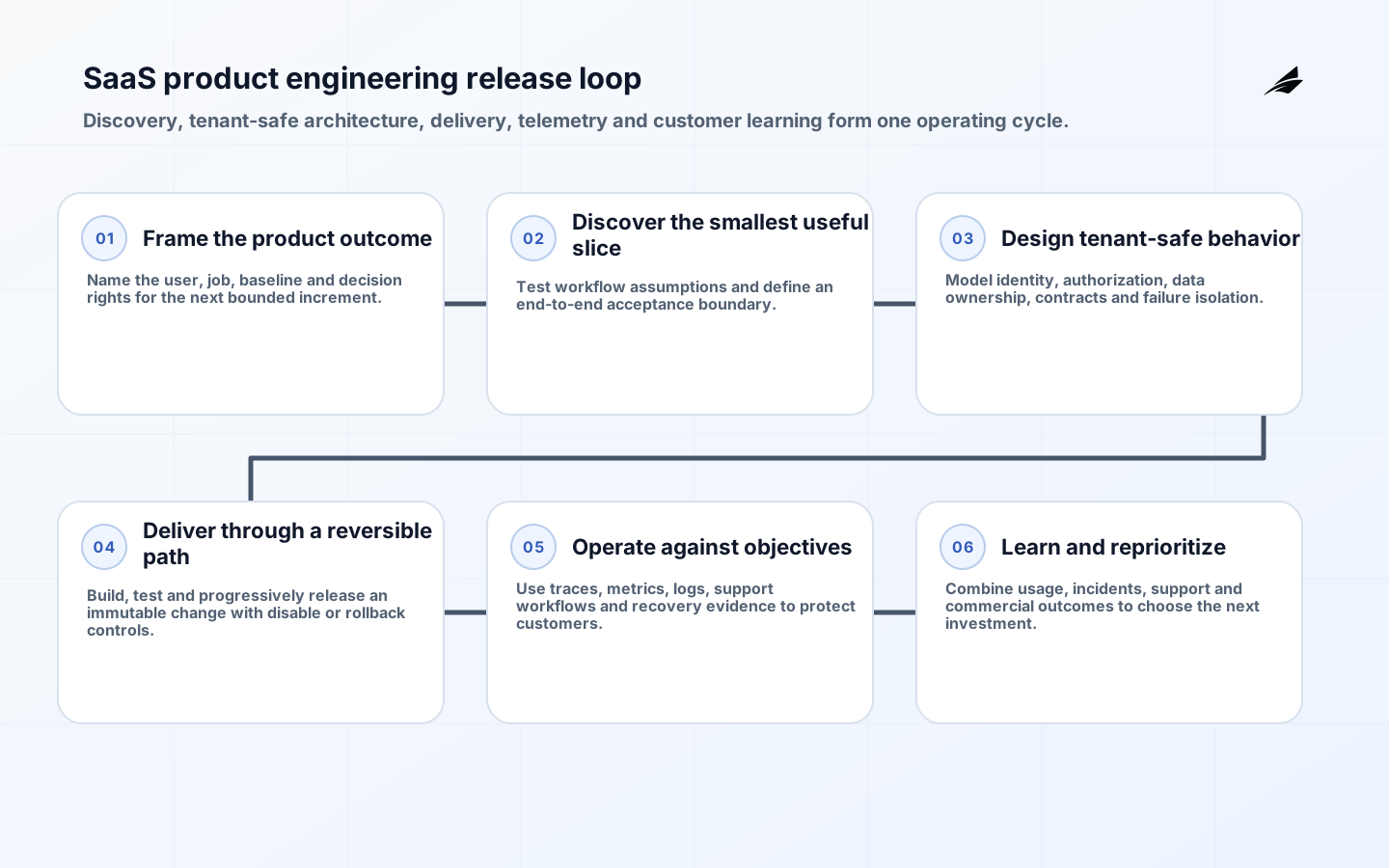
Product engineering services for SaaS companies should create more than features. The engagement must help a product team discover the right problem, design tenant-safe architecture, deliver changes repeatedly, protect customer data, observe production behavior, support users, and improve the system after launch. A backlog closed on time is not enough if releases are fragile or the client cannot operate what was built.
This checklist can be used when selecting a partner, defining a statement of work, or recovering a SaaS product that has outgrown its first implementation. It complements Edilec's product engineering, custom software development, and cloud and DevOps capabilities.
1. Define product outcomes and decision rights
Write the business and user outcomes before staffing a delivery team. Examples include reducing time to first value, improving completion of a core workflow, meeting an enterprise security requirement, or supporting a new pricing model. Attach a baseline and target where possible. Separate outcomes from output such as number of screens or story points.
Name who decides product priority, architecture, security risk, release readiness, and production incident response. A partner can lead execution and advise on tradeoffs, but the client needs an accountable product owner and access to business users. Define how disagreements are resolved and which decisions require written records.
| Decision | Accountable role | Required input | Evidence |
|---|---|---|---|
| Product priority | Product owner | User evidence, strategy, support signals and commercial impact | Prioritized outcome and acceptance measure |
| Architecture | Engineering owner | Quality attributes, constraints and alternatives | Decision record and migration consequence |
| Security risk | Named risk owner | Threat model, test results and data classification | Acceptance, remediation or exception |
| Release | Service owner | Functional, security, reliability and support readiness | Release record and rollback plan |
| Incident response | Incident commander | Telemetry, customer impact and runbook | Timeline, actions and learning review |
2. Turn discovery into a testable product scope
Discovery should examine users, workflow, domain language, current alternatives, constraints, and the smallest end-to-end release that can produce evidence. Prototype uncertain interactions, but do not confuse a clickable interface with a working service. Map data ownership, integrations, security boundaries, billing implications, support, and migration early.
A useful scope contains user scenarios, non-functional requirements, excluded work, assumptions, acceptance criteria, dependency owners, and a release hypothesis. Keep a risk register for unresolved questions. Fixed scope without discovery tends to hide uncertainty in change requests; an entirely open backlog can hide accountability. Use a staged commercial model that exposes learning.
3. Design tenant-safe architecture and data ownership
Decide tenant isolation, identity, authorization, encryption, data residency, retention, backup, and deletion before growth makes them expensive. Every record should have clear ownership and tenant context. Authorization must be enforced on the server for both business functions and objects. Background jobs, exports, analytics, support tools, and caches require the same tenant controls as customer-facing APIs.
| Architecture concern | Readiness question | Minimum evidence |
|---|---|---|
| Tenant isolation | Can one tenant ever query, cache, export or receive another tenant's data? | Negative authorization tests and architecture review |
| Identity and roles | Can customers express real responsibilities without granting broad admin rights? | Role model, recovery flow and access test |
| Data lifecycle | Can records be retained, exported and deleted by policy? | Data inventory, retention jobs and deletion verification |
| Integration contracts | Can retries and provider failures occur without corrupting state? | Versioned schemas, idempotency and failure tests |
| Scalability | Which resource or tenant behavior creates the first limit? | Load model, quotas and capacity evidence |
| Recovery | Can service and data recover within agreed objectives? | Restore test and dependency runbook |
Document significant choices as architecture decision records with alternatives and consequences. Prefer incremental modularity to premature microservices. A well-structured application with clear domain boundaries can be easier to operate than many services with weak ownership. Split components when scaling, release independence, isolation, or team structure creates a demonstrated need.
4. Integrate security into the delivery system
Security work belongs in planning, design, implementation, verification, release, and response. NIST's Secure Software Development Framework provides practices that can be integrated into different development lifecycles. Require protected source control, reviewed changes, dependency management, secrets controls, reproducible builds, artifact provenance, vulnerability handling, and a defined disclosure path.
Use the OWASP Application Security Verification Standard to establish testable application-security requirements appropriate to the product. Threat-model high-value workflows such as account recovery, invitations, exports, billing, API keys, support impersonation, and administrative operations. Automated scans help but do not replace authorization and business-logic testing.
5. Make releases small, repeatable and reversible
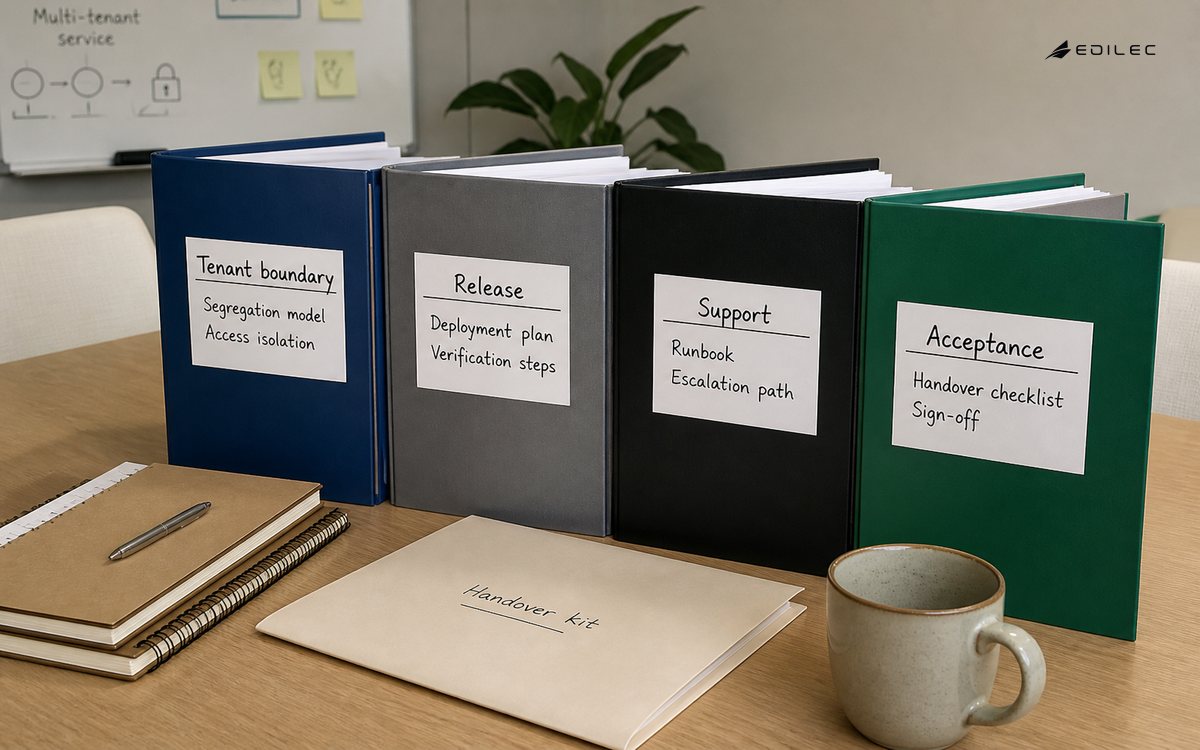
The delivery pipeline should build, test, scan, package, and deploy the same artifact through controlled environments. Infrastructure and configuration changes need version control and review. Separate deployment from release using feature controls where useful, but manage stale flags. Database changes should be backward compatible across rollout and rollback windows.
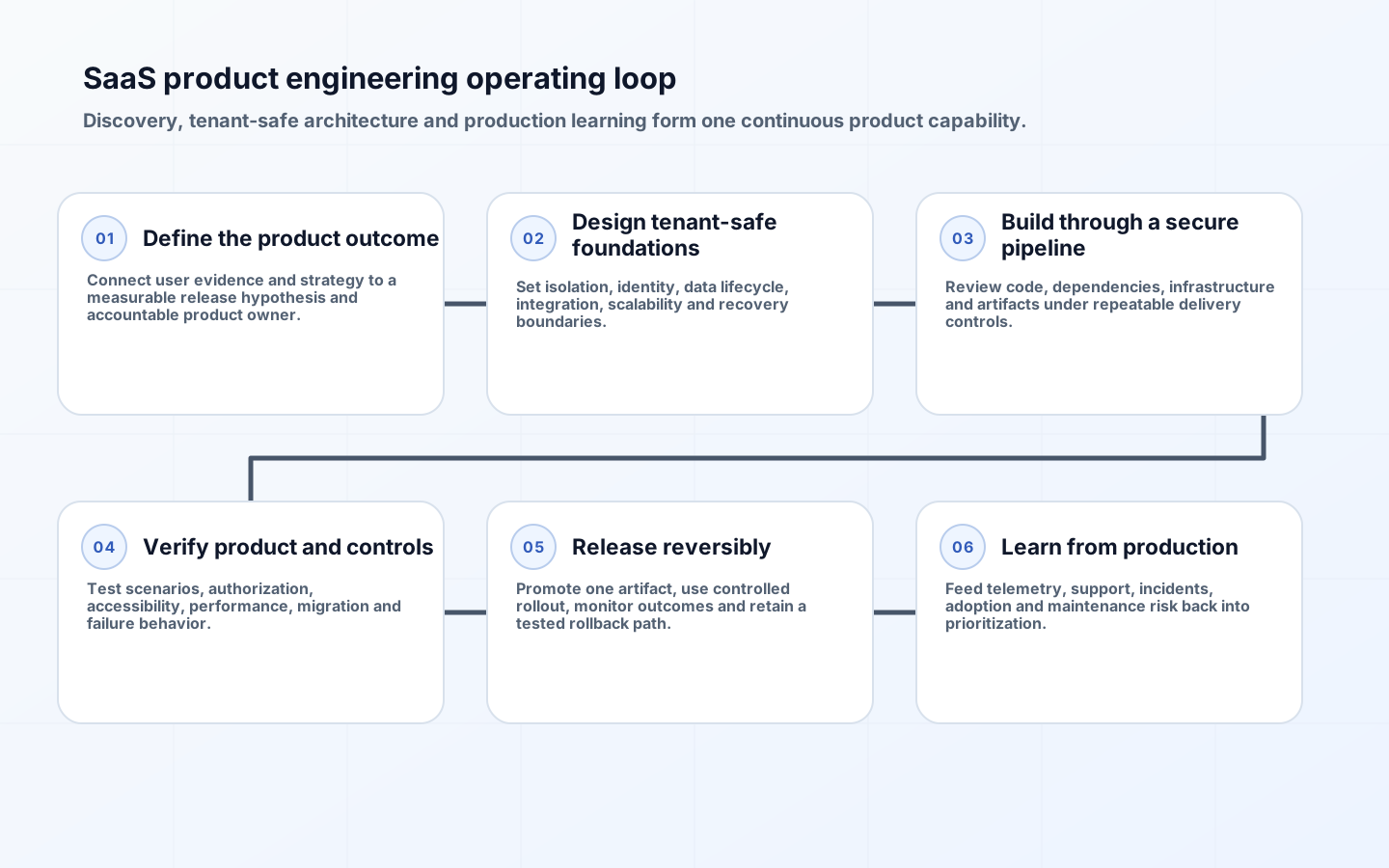
| Release gate | Question | Evidence |
|---|---|---|
| Product | Does the slice meet the defined user outcome? | Scenario acceptance and analytics plan |
| Engineering | Are tests, migrations and dependencies ready? | Pipeline result and peer review |
| Security | Are material threats controlled or explicitly accepted? | Threat model, scan and manual test findings |
| Reliability | Can the service detect and recover from failure? | Load, failure and rollback results |
| Support | Can users and responders understand the change? | Release notes, runbook and support briefing |
6. Build observability and support into the product
Instrument important user and system paths with consistent traces, metrics, logs, and business events. OpenTelemetry provides vendor-neutral observability documentation for generating and exporting telemetry. Avoid logging secrets or sensitive customer content. Include tenant-safe correlation identifiers so responders can trace a request without exposing another customer's data.
Define service-level indicators around outcomes such as successful login, data import completion, billing operation, or report generation. Set alerts on customer impact and exhaustion risk rather than every technical fluctuation. Run restore, failover, and incident exercises. Product engineering is incomplete until a named team can diagnose and recover the service.
7. Verify quality, accessibility and product behavior
Use a test strategy that balances unit, integration, contract, end-to-end, security, accessibility, and exploratory testing. Test tenant and role boundaries as first-class scenarios. Include browser, device, timezone, locale, slow network, and assistive-technology cases relevant to the audience. W3C recommends WCAG 2.2 as the current conformance target for web accessibility.
Production validation should compare expected and actual user outcomes. Feature analytics, support themes, performance, errors, and customer interviews reveal different parts of the truth. Establish a direct loop from production evidence into prioritization rather than treating support and operations as separate from product development.
8. Govern the engineering partnership and handover
The client should retain access to repositories, environments, cloud accounts, domain records, monitoring, design files, and documentation from the beginning. Define intellectual property, open-source obligations, subcontractors, security responsibilities, data processing, incident notification, and exit assistance in the agreement. Avoid a final-week handover of a system the client has never operated.
Review outcomes, delivery risk, quality, security, operating health, and spend on a regular cadence. Demonstrations should use working software and realistic data. Track escaped defects, lead time, recovery, change failure, support load, and adoption alongside roadmap progress. A healthy partner makes constraints visible early.
Implementation checklist and key takeaways
- Named owners exist for product, architecture, security, release and incidents.
- The first release is an end-to-end outcome with measurable acceptance.
- Tenant isolation, identity, data lifecycle and recovery have test evidence.
- Source, build, dependency and deployment controls follow a secure lifecycle.
- Releases are observable, reversible and supported by runbooks.
- Accessibility and authorization are tested beyond automated scans.
- The client controls critical accounts, repositories and production access.
- Operations and customer learning feed the roadmap after every release.
Frequently asked questions
How long should a SaaS MVP take?
A bounded product slice can often reach controlled users in a few months, but the range depends on domain complexity, integrations, security, data migration, and readiness expectations. An MVP should still include identity, support, monitoring, and a recovery path appropriate to its risk.
Dedicated team or project scope: which model is better?
A project scope suits a bounded outcome with understood interfaces. A dedicated cross-functional team suits sustained discovery and product evolution. Hybrid stages are common: fixed discovery and foundation, followed by an outcome-governed team.
What should handover include?
Handover includes working access, architecture decisions, source and build instructions, infrastructure, secrets ownership, data model, operational dashboards, alerts, runbooks, recovery evidence, open risks, dependency inventory, product analytics, and paired operation of releases and incidents.
Commercial governance should connect payment to demonstrable outcomes without encouraging unsafe shortcuts. Milestones can cover discovery evidence, an end-to-end release, verified tenant controls, operational readiness, and a successful handover. Clarify what happens when a dependency owned by the client blocks work. Track changes with their business reason and consequence, not merely billable hours. Reserve capacity for maintenance, dependency updates, incident learning, and architectural work so roadmap pressure does not steadily consume product reliability.
Before signing, speak with references that operate a comparable product. Ask who handled production incidents, how estimates changed after discovery, whether senior engineers stayed involved, how security findings were resolved, and whether the client could release independently. Contract language matters, but demonstrated operating behavior is stronger evidence of the partnership you will receive.
Finally, define a maintenance baseline before the first roadmap commitment. Reserve ownership for framework upgrades, dependency vulnerabilities, database care, observability costs, access reviews, backup tests, performance, and customer-data lifecycle. These are product capabilities, not overhead discovered after launch. A partner should make this work visible, report the accumulated risk, and prioritize it with product outcomes rather than allowing it to accumulate outside the plan.
Conclusion
SaaS product engineering is a continuous operating capability. The right partner connects discovery to tenant-safe architecture, secure delivery, reliable releases, support, and production learning. Use evidence from the checklist to judge readiness; polished demos and velocity reports cannot substitute for a product that the team can safely operate and evolve.