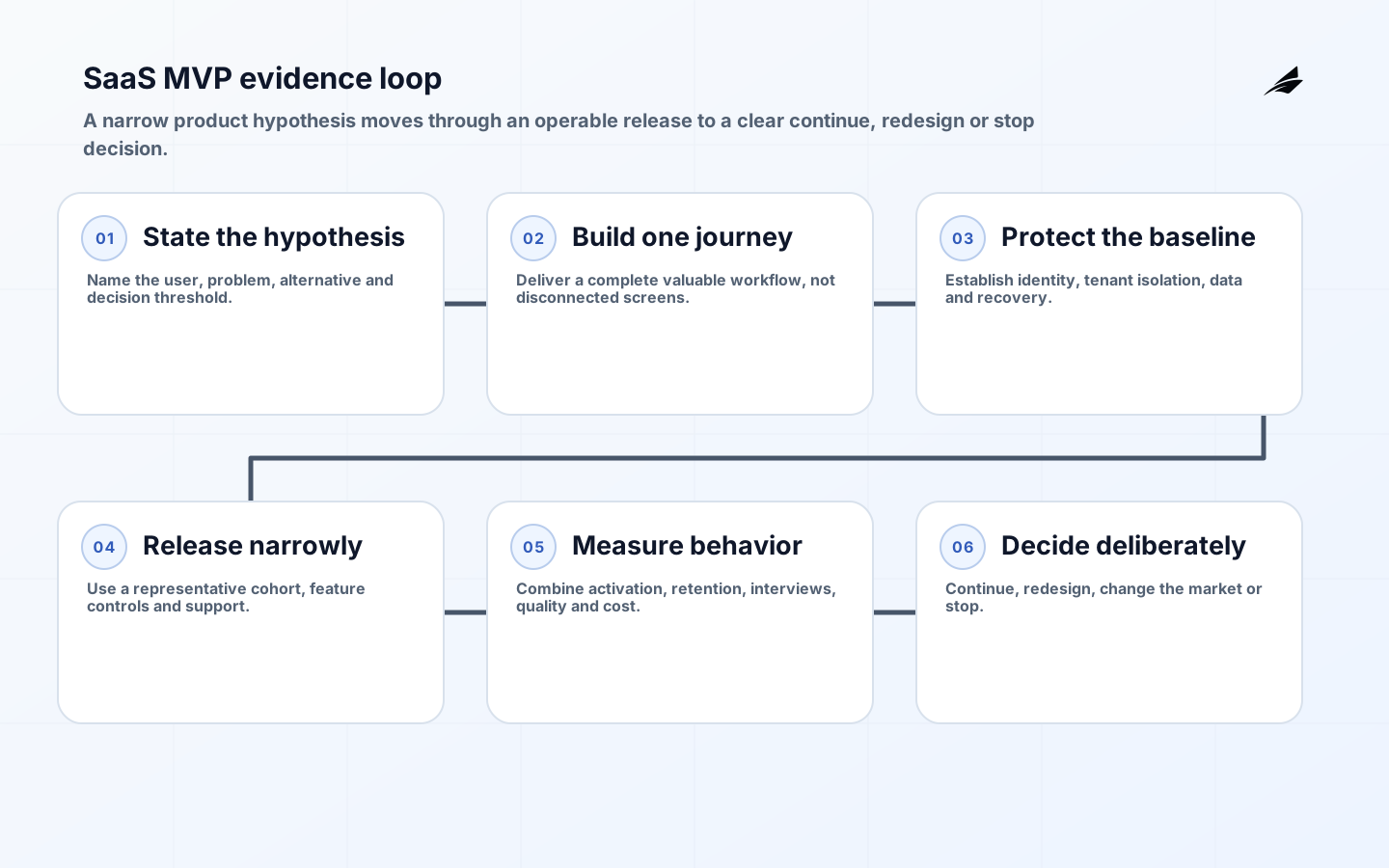
A SaaS minimum viable product is the smallest operable product that can test a consequential business hypothesis with real users. “Minimum” describes the scope of the experiment, not the quality of security, data handling or recovery. “Viable” means the product can complete a useful customer workflow, state its limitations, collect trustworthy evidence and be supported by the team. A thin interface over unfinished manual processes may be a valid experiment when those boundaries are explicit; an unsafe multitenant service is not.
SaaS MVP development should combine small-batch delivery and rapid customer feedback with a deliberate technical foundation. DORA guidance supports reducing batch size and integrating customer feedback into product work. NIST SSDF and OWASP ASVS provide structured security practices and verification requirements. Official billing documentation matters because subscription state, entitlements and payment events become product behavior, not merely finance configuration. The aim is to learn quickly without creating hidden obligations that prevent safe growth.
Define the hypothesis before choosing features
Write the product hypothesis as an actor, problem, proposed behavior and observable outcome. Identify the current alternative and why a customer would change. For example: an operations manager needs to reconcile supplier exceptions without combining spreadsheets and email; the product should allow the manager to review, assign and close an exception from one auditable workflow. Evidence might include successful completion, reduced re-entry, continued use and willingness to adopt the workflow under realistic conditions.
Set non-goals and stop criteria. An MVP for exception management may exclude advanced forecasting, custom report builders and automated supplier decisions. It should not exclude tenant isolation, authorization, backup, event reconciliation or a support path. Decide what result would cause the team to continue, redesign or stop. Without that decision rule, every ambiguous signal becomes an excuse to add features rather than learn.
| Hypothesis element | Question | Useful evidence |
|---|---|---|
| Customer | Who experiences the problem and has authority to adopt? | Named role, context and buying or approval path |
| Workflow | What valuable task must be completed? | Observed end-to-end completion with realistic data |
| Outcome | What change should the product create? | Behavioral and operational evidence compared with the current approach |
| Decision | What will the team do with the result? | Predefined continue, redesign or stop conditions |
Choose the smallest end-to-end product slice
Map the customer journey from discovery and account creation through the core task, value confirmation, support and cancellation. Select one coherent path that crosses the real technical and operational seams. A slice that demonstrates a dashboard without identity, data ingestion or downstream action postpones the hardest evidence. Keep breadth narrow, but implement the chosen workflow through its complete state transitions so users can rely on the result.
Split work into independently releasable changes. Establish a production-like skeleton early: identity, tenant context, core data model, deployment, telemetry, backup and a support contact. Add one workflow step at a time behind controlled release mechanisms. Small batches make failures easier to diagnose and feedback easier to connect to a change. They also reduce the temptation to wait for a large launch before learning whether the proposed behavior is usable.
Establish tenant and data boundaries early
Choose a tenancy model based on isolation needs, operational capability and likely customization. Shared application and data infrastructure can be efficient, but every request, job, cache entry, object and query must preserve tenant context. Separate infrastructure can strengthen isolation for particular needs while increasing provisioning and maintenance work. Document the model and test it; do not rely on developers remembering to add a tenant filter to every new query.
Keep authoritative business state in a controlled data model and define retention, export and deletion behavior. Use migrations that can be tested and rolled back or safely moved forward. Encrypt data in transit and at rest using supported platform capabilities, protect secrets outside source code and restrict production access. Backups are incomplete until a restore is exercised and the restored service is checked for integrity and tenant boundaries.
Build a proportionate security baseline
Use NIST SSDF to make secure development part of the team’s workflow: define security requirements, protect code and build systems, review designs, manage dependencies, test releases and prepare to receive and remediate vulnerability reports. Use OWASP ASVS to select verifiable application controls appropriate to risk. At minimum, design explicit authentication, server-side authorization, session protection, input handling, audit events, secrets management and safe error behavior.
Threat-model the end-to-end workflow. Consider cross-tenant access, account takeover, privilege changes, unsafe file handling, administrative misuse, billing manipulation, data export and abuse of public APIs. Verify that authorization uses the authenticated subject, tenant and resource rather than trusting client-supplied identifiers. Log consequential changes with enough context for investigation while avoiding unnecessary sensitive data. Give security findings owners and release decisions, not an indefinitely growing scanner queue.
Treat billing and entitlements as product state
Define the commercial model in terms the product can enforce: trial, subscription period, plan, included capability, quantity, usage, upgrade, downgrade, cancellation, refund and delinquency behavior. Keep the payment provider’s customer and subscription identifiers mapped to an internal account. Store the product’s interpreted entitlement state rather than querying an external billing API on every request. Reconcile that state from signed events and scheduled checks.
Billing events can arrive late, more than once or out of order. Processing must be idempotent, observable and recoverable. Decide how access changes after payment failure, cancellation or plan transition; an abrupt lockout may be inappropriate for exported data or active work. Test the full lifecycle with provider-supported test environments. Finance, support and engineering should use the same definitions so a customer does not receive conflicting explanations about invoice and access state.
| MVP capability | Minimum operational evidence | Do not expand when |
|---|---|---|
| Core workflow | Representative users complete the intended task | Success requires unrecorded expert intervention |
| Tenant boundary | Automated and manual isolation checks pass | Resource access depends on client-provided tenant identity |
| Billing | Subscription events reconcile to product entitlements | Duplicate or delayed events corrupt access state |
| Operations | Team can observe, support, restore and deploy | Only the original developer can diagnose failure |
Create a customer feedback and release loop
Recruit participants who experience the target problem and can use representative data within approved boundaries. Observe behavior instead of relying only on stated preference. Ask users to complete the workflow, explain decisions and identify missing trust signals. Combine interviews with product events, support conversations and operational evidence. Instrument only events that answer a product question, and document their meaning so later analysis does not confuse page activity with customer value.
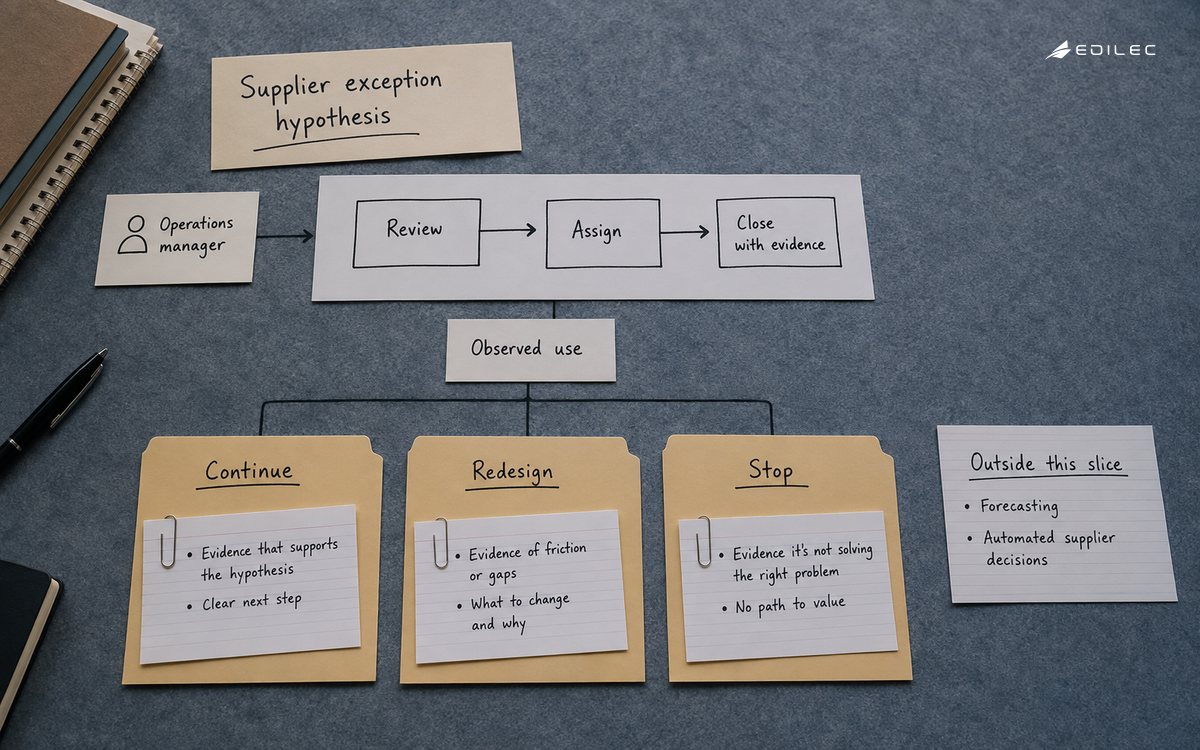
Release to bounded cohorts and retain a safe rollback or disable path. Review feedback at a regular product cadence, grouping evidence by hypothesis rather than by the loudest requester. A request may reveal a missing core need, a usability problem or a customer-specific preference; those lead to different decisions. Close the loop by telling participants what changed, what did not and why. Trustworthy feedback depends on users seeing that their time informs real choices.
Prove that the MVP can be operated
Define service indicators for the core journey: successful sign-in, workflow completion, dependency health, queue delay, billing reconciliation and recovery. Alert on customer consequence rather than every technical fluctuation. Create short runbooks for common failures and name the person responsible for response. Support needs a way to inspect account and entitlement state without receiving unrestricted database access. Administrative actions should be authorized and recorded.
Manage cost using actual product behavior. Allocate infrastructure, third-party API, messaging, observability, storage and support costs to meaningful units where possible. Test demand limits and provider quotas. A product can demonstrate customer value while revealing an unsustainable delivery method; that is useful evidence. Redesign expensive paths before volume magnifies them, and retain spending safeguards that do not silently degrade customer data or reliability.
Use an evidence-led MVP delivery plan
- Write the customer, problem, workflow, outcome and decision hypothesis.
- Map the complete customer journey and choose one end-to-end slice.
- Record non-goals, tenant boundaries, data rules and security requirements.
- Build the production skeleton and release the slice in small increments.
- Implement subscription, entitlement and event-reconciliation behavior.
- Test authorization, isolation, restore, deployment and support scenarios.
- Observe representative customers and combine feedback with product and service evidence.
- Choose whether to continue, redesign or stop before adding adjacent features.
Completion does not mean the product has every capability on its roadmap. It means the selected hypothesis has been tested through a safe, supported product and the team has enough evidence to make the next investment decision. Preserve architecture decisions, known limitations, customer findings, security evidence and operational runbooks so growth does not depend on reconstructing why the MVP behaves as it does.
Key takeaways
- Make the MVP small in hypothesis and scope, not weak in essential controls.
- Build one complete customer workflow through real technical and operational seams.
- Establish tenant isolation, authorization, restore and secure delivery early.
- Model billing events and entitlements as recoverable product state.
- Use small batches and representative customer behavior to guide decisions.
- Scale only after value, operability, security and economics have credible evidence.
Frequently asked questions
Should an MVP use production-quality architecture?
It needs production-appropriate boundaries for the claims being tested: identity, authorization, tenant isolation, data protection, deployment, observation and recovery. It does not need infrastructure designed for hypothetical scale. Prefer simple supported components and record where later evidence may justify change.
When should billing be added to a SaaS MVP?
Add it when willingness to pay, plan behavior or entitlement enforcement is part of the hypothesis. If early users are intentionally free, the team can defer live charging, but it should still model account, plan and access state so billing is not later forced into assumptions that conflict with the product.
How do we know when the MVP is finished?
The MVP is finished when the predefined hypothesis has enough representative evidence for a decision and the experiment’s access, data and support obligations are resolved. The decision may be to scale, refine the workflow, change the market or stop. A permanent beta without a decision is not completion.
Conclusion
Strong SaaS MVP development produces learning through an operable product. It starts with a narrow hypothesis, implements one complete customer journey, protects tenant and account boundaries, treats billing as product state and releases in small batches that customers can meaningfully evaluate.
The lasting asset is not just the first feature set. It is a delivery system that can test product choices without losing control of security, data, reliability or cost. That foundation lets the team scale evidence-backed value and stop weak ideas before they become expensive obligations.