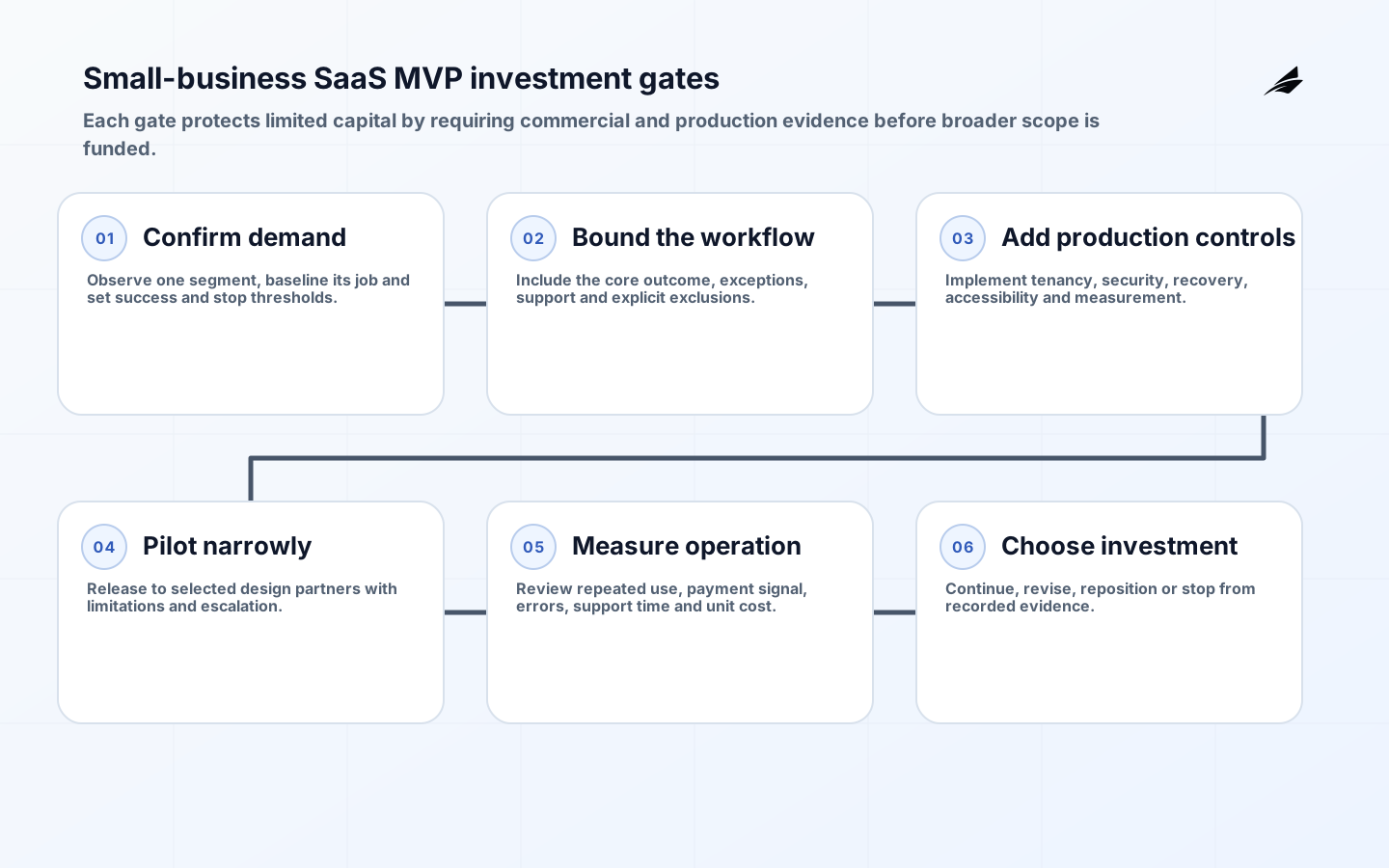
SaaS MVP development for a small business should test whether a defined customer will repeatedly use and pay for a service, while creating a product the business can support. “Minimum” does not mean a clickable shell with no recovery, security or ownership. It means the smallest complete workflow that produces evidence about demand, value, usability and operating cost without committing scarce capital to unproven breadth.
This checklist is for owners replacing a manual service, packaging internal expertise or launching a focused B2B product. Begin with the small-business SaaS MVP practical guide, use this checklist for delivery acceptance, and keep the small-business SaaS FAQ available for commercial and technical decisions.
Confirm customer evidence and an investment rule
Name one customer segment and observe the current job end to end. Collect real documents, delays, workarounds, error stories and the point where money or trust changes hands. Write an outcome that can be tested: an approved clinic manager schedules staff without spreadsheet re-entry, for example. Record the current time, error or cost baseline. Expressions of interest are useful, but behavior such as design-partner commitment or willingness to provide data is stronger.
Before build, define success, guardrail and stop thresholds. Success might combine repeated weekly use with a paid conversion; guardrails might cap support minutes and incorrect records. A stop rule protects a small business from interpreting every weak signal as a request for more features. Set the review date and the person authorized to continue, revise or close the experiment.
| Checklist decision | Evidence to collect | Pass condition | Warning |
|---|---|---|---|
| Problem | Observed workflow and baseline | Pain is frequent and material | Only survey enthusiasm |
| Customer | Narrow segment and buyer | User and payer are identified | Everyone is a target |
| Outcome | One end-to-end job | Completion changes real work | Feature count is success |
| Economics | Price hypothesis and support cost | Plausible contribution margin | Cloud cost alone is modeled |
| Investment | Success, guardrail and stop rules | Decision date and owner exist | No stopping condition |
Define the smallest complete MVP scope
Map onboarding, core work, confirmation, exception, support and exit. Mark which steps may remain manual behind the service, provided they are visible, safe and economically plausible. Put requests that do not change the primary decision in a later list. Include operator tools needed to inspect state and correct bounded errors; direct database editing is not an acceptable support design. Prototype confusing interactions before committing to production code.
Write acceptance scenarios with real examples. Include empty data, duplicate submission, lost connection, expired invitation, denied permission, failed payment and provider outage. Define the authoritative record at each transition. A narrow workflow with explicit failures is smaller in long-term effort than a happy-path demo that forces the owner to repair every exception manually.
Choose simple architecture with real tenant controls
A modular application with a managed database, queue and a few external services is often enough. Avoid microservices unless a measured need justifies distributed operations. Multi-tenancy still requires deliberate design: validate tenant context server-side, scope every data access, test cross-tenant denial and carry context into jobs, files, caches and logs. AWS SaaS Lens treats isolation as a foundational property, not something authentication supplies automatically.
Document dependencies, quotas and failure behavior. Add timeouts, bounded retries and idempotency for payments, invitations and imports. Use infrastructure definitions and separate production access. Back up authoritative data and prove restoration. Managed services reduce maintenance only when someone still owns configuration, updates, cost and recovery. Prefer portable business data and clear exports over speculative provider independence.
| MVP area | Minimum production requirement | Evidence | Later trigger |
|---|---|---|---|
| Identity | Individual accounts and recovery | Sign-in and recovery test | Enterprise federation demand |
| Tenancy | Server-enforced isolation | Negative access tests | Regulated silo requirement |
| Billing | Authoritative plan and payment state | Reconciliation sample | Self-service volume |
| Data | Backup, restore and export | Timed restore result | Residency commitments |
| Operations | Logs, alerts and support history | Failure rehearsal | On-call requirement |
Include security, privacy and accessibility
Classify collected data and remove fields without a business purpose. Use encryption in transit, least privilege, secret management, dependency review and server-side authorization. NIST SSDF helps turn secure development into roles, protected software, well-secured releases and vulnerability response. OWASP ASVS can supply testable application controls. Define patch and incident ownership before launch, even if the team is one owner and a development partner.
Use WCAG 2.2 as the accessibility reference and test the actual workflow with keyboard navigation, visible focus, labels, error identification and status messages. Accessibility also improves clarity for rushed or inexperienced users. Publish understandable privacy and service terms appropriate to the market, and obtain qualified legal advice for applicable obligations. Do not collect sensitive data merely because a form makes it easy.
Build a repeatable release and support path
- Create customer-owned repositories, cloud accounts, domains and essential vendor access.
- Protect the main branch and automate build, test and deployment from versioned configuration.
- Test domain rules, authorization, integrations, migrations and the critical customer path.
- Add product events, tenant-aware logs, service metrics and actionable alerts.
- Rehearse deployment, smoke testing, rollback, restore and a support lookup.
- Release to a named design-partner cohort with limitations and escalation explained.
- Review usage, errors, support effort, cost and qualitative evidence each week.
- Stabilize the workflow before adding another customer segment or capability.
Keep changes small and traceable. DORA's metrics help inspect delivery throughput and instability, but a small team should avoid elaborate reporting. Track change lead time, failed releases and recovery alongside task completion and support burden. The practical objective is a path that can ship a correction confidently during a customer issue, not a dashboard assembled for investor theater.
Plan the full MVP cost
Budget discovery, design, engineering, data migration, integrations, security, testing, cloud setup, analytics, support tools, launch and transition. Add recurring cloud, email, identity, payment, monitoring, backup, domain, support and compliance costs. Model cost per active tenant at low, expected and high usage. Free tiers can help experimentation but should not conceal limits that force urgent migration.
Use staged funding: evidence and prototype, production slice, bounded pilot, stabilization. Release money when the prior stage reduces a named uncertainty. Fixed scope works for a stable, narrow deliverable; a capacity-based team better fits learning when priorities can change. In either model, require demonstrable outcomes, access and a stopping option. The support-team SaaS MVP plan offers a useful domain example.
Launch with measures that guide a decision
Measure the activation event closest to first customer value, repeated use at a cadence matching the job, paid conversion or credible commitment, task completion, errors, support minutes, availability and unit cost. Segment by target customer, not every available property. Review individual failures while volume is small. One severe data or trust incident may matter more than an attractive average completion rate.
Schedule a formal review after enough representative cycles. Compare results with thresholds and decide: continue the same segment, revise the workflow, change positioning or stop. Record evidence and reasoning. Do not let a single enthusiastic customer turn a shared SaaS product into custom consulting unless that is an explicit business-model decision.
Example: a scheduling SaaS MVP
Imagine a small training business replacing phone and spreadsheet scheduling. The first segment is independent instructors, and the target job is publishing available sessions and receiving a confirmed booking without manual re-entry. The MVP needs instructor and customer identities, tenant-scoped availability, timezone-aware slots, duplicate-booking prevention, confirmation, cancellation, operator history and payment status if payment is part of the experiment. A marketplace, marketing automation and complex packages can wait.
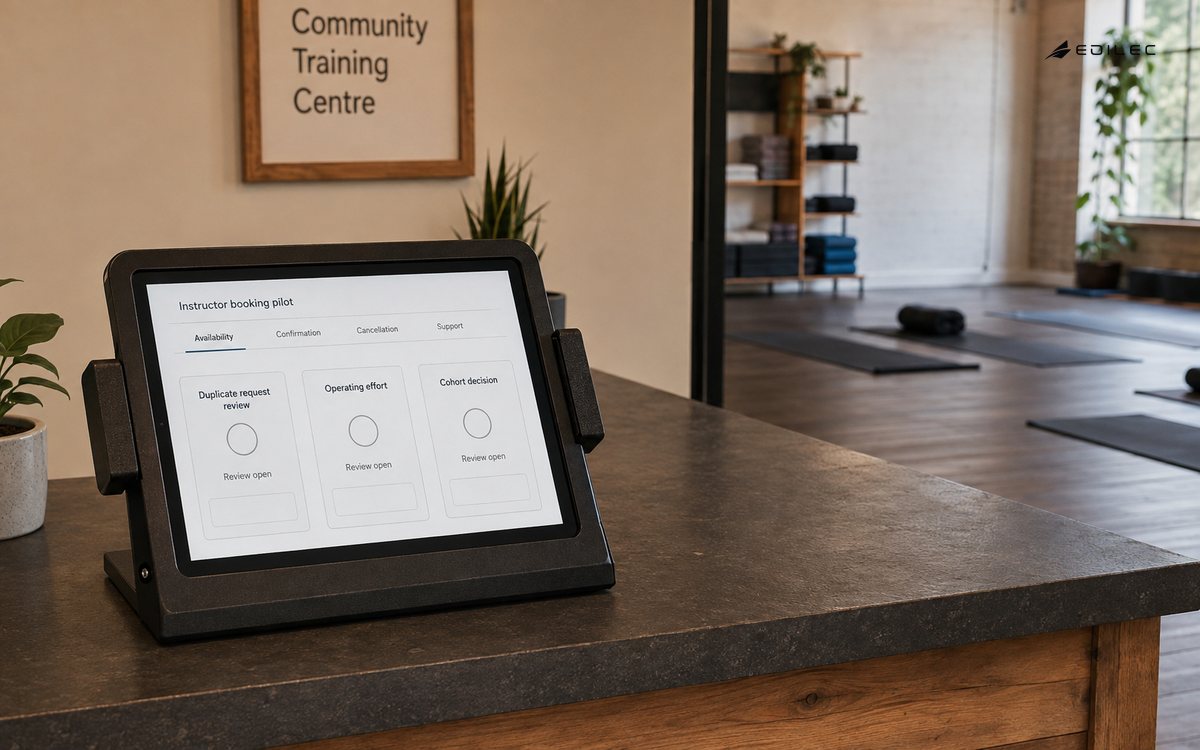
Before launch, test simultaneous bookings, expired links, failed payment callbacks and daylight-saving transitions with representative data. Pilot with a few instructors over several booking cycles. Measure published-to-booked conversion, repeat use, incorrect bookings, support minutes and cost per active instructor. Continue only if behavior and support effort fit the threshold; one-off requests should enter a separate evidence log rather than immediate scope.
Key takeaways
- Define an MVP as the smallest complete learning system.
- Keep the target customer and outcome narrow enough to measure.
- Treat tenant isolation, recovery and support as launch requirements.
- Fund stages that retire specific commercial and technical risks.
- Expand only after repeated behavior and viable operating effort are visible.
Frequently asked questions
Should a small business use no-code for a SaaS MVP?
It can be appropriate when the platform supports required workflow, tenancy, security, accessibility, integration, data export and expected economics. Test limits and ownership before committing. No-code changes the implementation method; it does not remove product or operational responsibilities.
How many features should the MVP include?
Enough to complete and recover one valuable customer job. Count workflow outcomes rather than screens. Defer capabilities that do not affect the current investment decision, while retaining controls needed for data integrity, access, support and measurement.
When should a design partner request become custom work?
Treat it as product scope when it serves the chosen segment and strengthens the shared model. Treat it as custom work when it creates tenant-specific code or operations without broader evidence. Price and govern that exception explicitly so it does not quietly consume the roadmap.
The owner should also plan a clean stop. Export customer records, settle payments, notify users, revoke access and close vendor resources if the test ends. A reversible experiment protects customers and reduces the emotional pressure to continue a product merely because data, accounts and contracts are difficult to unwind. Test the export and closure steps before launch so promises made to early customers are operationally credible.
Conclusion
A small-business SaaS MVP should preserve cash while producing honest evidence. Focus on one complete customer outcome, implement simple architecture with real controls, launch narrowly and measure operating effort as carefully as demand. That creates a sound basis for the next investment, including the possibility that the best decision is to stop.