Enterprise teams use the term MVP in very different ways. The useful definition is a narrow, production-capable product designed to test a consequential assumption with real users. These answers focus on the decisions that keep speed meaningful: what to include, what cannot be deferred, how to protect tenants, and how to convert a pilot into credible evidence.
What does MVP mean in an enterprise SaaS context?
It means minimum scope for valid learning, not minimum engineering quality. The product should support one complete workflow for a defined cohort and include the controls required by its data, users and criticality. Identity, authorization, tenant isolation, audit events, monitoring, recovery and support may all be necessary even when the visible feature set is small.
How should the team choose MVP scope?
Start with an investment question and one user outcome. Map the current workflow, exceptions, records and systems, then choose the smallest vertical slice that can produce evidence. Defer adjacent personas, uncommon configuration, secondary integrations and scale that the pilot will not exercise. Do not defer a control that makes the learning unsafe or invalid.
| Include | Reason | Evidence |
|---|---|---|
| Complete target workflow | Tests actual user value | Observed completion and outcome |
| Essential administrator path | Enterprise use needs governed setup | Provisioning and role test |
| Authoritative integration | Tests system fit | Reconciled records and failure recovery |
| Tenant and security controls | Protects customer boundaries | Threat review and negative tests |
| Operational path | Makes the product supportable | Alerts, runbook, backup and rollback |
| Measurement | Enables the investment decision | Telemetry and interview plan |
Is an MVP the same as a prototype or proof of concept?
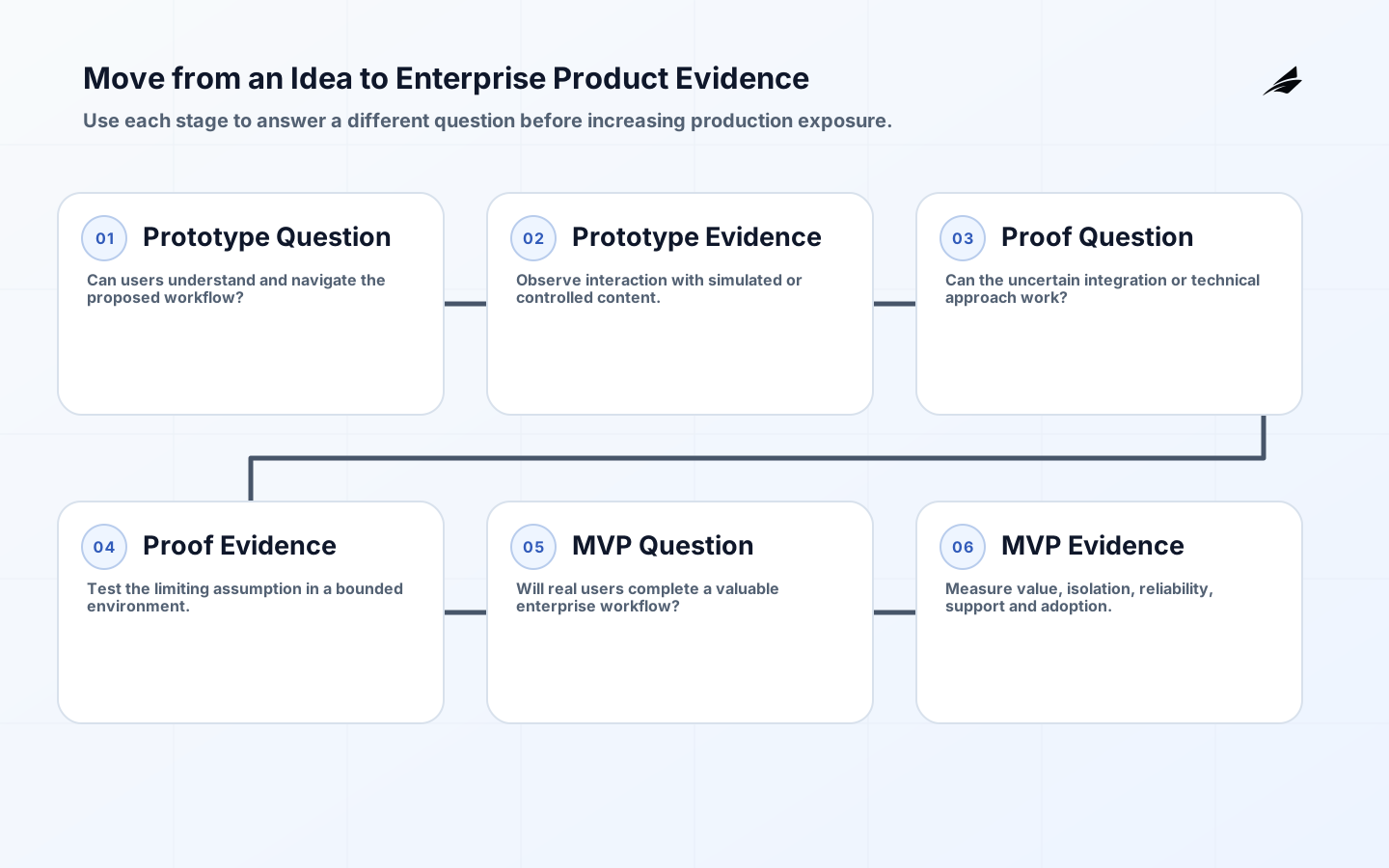
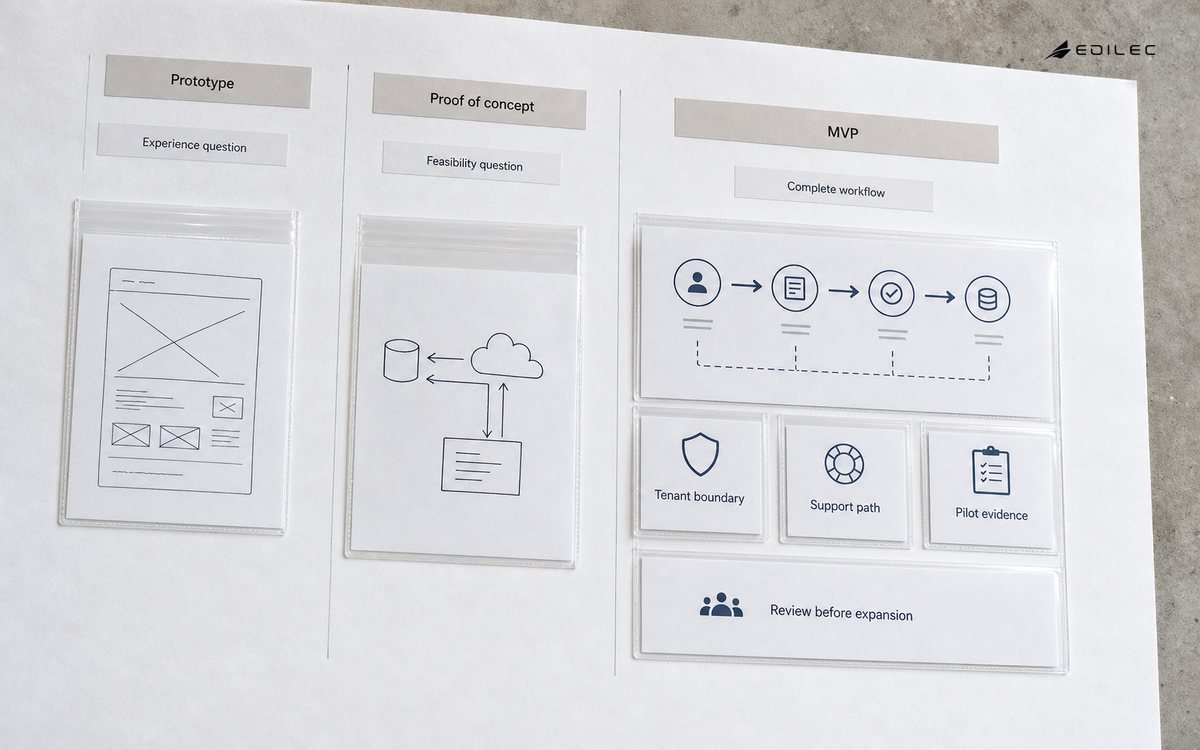
No. A prototype explores experience; a proof of concept tests feasibility; an MVP tests value and operation with real use. Earlier artifacts may precede the MVP and reduce uncertainty. They should not quietly become production because simulated identity, hard-coded tenancy or manual deployment appeared sufficient during a demonstration.
Who needs to participate before development?
At minimum: sponsor, product owner, representative users, technical owner and operational owner. Add security, privacy, legal, compliance, procurement, finance and data owners according to the workflow. Their job is not to expand scope; it is to identify constraints, evidence and decisions while change remains inexpensive.
Does the MVP need multitenancy from day one?
The intended tenant model needs design from day one, even if the first pilot uses one customer organization. Pooled, siloed and bridge approaches trade isolation, cost, scale and manageability differently. A silo can still participate in a SaaS operating model if onboarding, deployment and operations remain unified. What should be avoided is accidental single-customer code with no credible path to consistent upgrades.
Is authentication enough to isolate tenants?
No. Authentication identifies a subject. Isolation ensures that the subject's tenant context constrains every resource access. Test database queries, object storage, caches, queues, background jobs, exports, logs and support tooling. Central enforcement reduces the chance that a missing filter in one feature exposes another tenant's data.
Which security work belongs in an MVP?
Use threat and data classification to choose depth. A typical baseline includes secure identity and sessions, least privilege, tenant enforcement, input handling, secrets management, encryption, security logs, dependency management, protected builds, vulnerability response, backups and tested recovery. NIST SSDF organizes secure development practices, while OWASP ASVS supplies testable web application requirements.
How many integrations should the first release include?
Include the smallest set required to prove the workflow and enterprise fit, often one identity provider and one system of record. For each integration, define ownership, API limits, authentication, mapping, idempotency, retry policy, reconciliation and the operator path for failed records. A connector without failure operations is unfinished scope.
How should customer customization be handled?
Prefer bounded configuration for branding, roles, workflow parameters and notifications. Avoid customer-specific branches or deployments that prevent uniform upgrades unless a deliberate isolation model requires dedicated infrastructure. Record every design-partner request against the target market problem; one customer's process is evidence, not automatically the product model.
| Decision | Lower-complexity option | Escalate when |
|---|---|---|
| Tenant deployment | Pooled resources with enforced context | Regulation, isolation or load requires a silo |
| Workflow variation | Versioned configuration | Rules become a distinct product capability |
| Integration | One canonical contract | A second system tests a real market assumption |
| Analytics | Core events and operational reports | Users need governed self-service analysis |
| Availability | Objective tied to pilot workflow | Business criticality or commitments increase |
| Support | Defined pilot channel and rota | Customer count or coverage window expands |
How should cost and timeline be estimated?
Estimate by work and uncertainty: discovery, workflow design, tenant model, integrations, data migration, security, environments, testing, pilot support and handover. State assumptions and ranges. An early technical proof can narrow one risky dependency. Universal per-feature prices or fixed schedules ignore enterprise review queues and integration readiness, so they create false precision.
How should the enterprise pilot be run?
Choose a bounded, representative cohort and define start, duration, support, data handling, stopping conditions and rollback. Include normal users, an administrator and support personnel. Observe use, exceptions and workarounds. Keep a parallel process where required until recovery and data reconciliation are proven.
- Approve scope, residual risk and release evidence.
- Automate tenant provisioning and verify role assignments.
- Train by role and state known limitations plainly.
- Monitor workflow, tenant, reliability and security signals.
- Interview users without treating feature requests as validated needs.
- Hold an evidence review with expand, revise or stop authority.
Which measures show whether the MVP works?
Use a balanced set: eligible-user activation, target workflow completion, time and error points, exception age, support demand, administrator effort, user feedback, reliability against the agreed objective and security findings. For delivery health, trend lead time, release frequency, failed-change recovery, change failures and rework at team or service level. Avoid using activity counts as proof of customer value.
When is the MVP ready to expand?
Expansion is justified when the evidence answers the original question positively, material risks are controlled, operating ownership is accepted and the next cohort does not require a different product. Resolve or explicitly accept reliability, security and data issues before multiplying exposure. A successful demonstration is not the same as a repeatable tenant lifecycle.
What are the most common failure modes?
Common failures include building a broad horizontal platform before one workflow, allowing a design partner to become a custom project, ignoring procurement and identity lead times, treating login as isolation, launching without operator tools, and measuring delivery instead of adoption. The practical enterprise SaaS MVP guide provides the full planning path, and the implementation checklist turns it into gates.
Should the team build internally or use a development company?
Choose from capability, capacity, domain context, security requirements and long-term ownership. External delivery can add specialist capacity, but the enterprise must retain product decisions and risk accountability. Evaluate suppliers using the enterprise SaaS development company FAQ, including evidence, handover and exit.
How should change management be handled?
Treat adoption as part of product design. Identify whose work, authority or evidence changes, and involve those roles in discovery and pilot review. Communicate the reason for the new workflow, what remains unchanged, where to obtain help and how feedback will be used. Training should follow roles and real tasks rather than presenting every feature. Managers need guidance on interpreting new records and handling legitimate exceptions.
Plan the transition from the old process explicitly. Decide whether work runs in parallel, how in-flight cases migrate, which system is authoritative during the pilot and when the old path closes. A new interface cannot succeed if approvals still happen through private messages and only final status is copied into the product. Monitor bypasses as evidence of missing value, unclear policy, poor usability or insufficient authority.
How much data should move into the MVP?
Move only what the target workflow and decision require, while meeting retention and legal obligations. Profile source quality, define mappings, rehearse migration and reconcile counts and critical fields. Historical data can remain in an accessible archive when the product does not need it for operation, reporting or audit. The team should also prove deletion, correction and export paths for the data it does import.
Set a migration ownership matrix before handling production records. Business owners approve mapping and reconciliation rules; data owners resolve quality exceptions; engineers implement repeatable movement; security and privacy owners review access and handling. Preserve source identifiers and an audit trail where appropriate so an unexpected value can be traced. Decide how failed records are quarantined, corrected and replayed without duplicating completed work.
Should the first release include AI features?
Only when an AI-assisted task is central to the assumption being tested and can be evaluated safely. Define permitted inputs, human review, output handling, failure behavior, monitoring and a non-AI fallback where needed. Do not add generative functionality merely to make the MVP appear current; it introduces additional data, quality, security and operating questions that can distract from the core workflow.
How can procurement support MVP speed?
Engage procurement before the intended pilot date and give it a bounded description of data, users, suppliers and environments. Reuse approved contract and assessment paths where they fit, but do not misclassify a production pilot as a harmless experiment. Identify long-lead identity, security, privacy and legal reviews during discovery. A smaller scope can reduce review complexity when it genuinely reduces access or data, not when required work is merely relabeled as later.
Who operates the MVP after launch?
Name the operational owner before release. Define monitoring, incident response, user support, access changes, data corrections, deployment, backup review and vulnerability handling. The development team may initially cover some duties, but ownership, hours and escalation must be explicit. If the pilot succeeds, transfer routines and knowledge before widening the cohort; otherwise adoption can grow faster than the product's ability to respond.
Key takeaways
- Minimum scope still requires production controls proportionate to real use.
- Design tenant boundaries before a one-customer pilot hardens accidental assumptions.
- Limit integrations and customization while completing their failure paths.
- Estimate uncertainty, review work and operations as well as feature development.
- Expand only from balanced evidence of value, reliability, security and operability.
Conclusion
The enterprise SaaS MVP is a decision instrument built as a real product. Keep the workflow narrow, the boundaries explicit and the pilot reversible. When product evidence and operational evidence agree, leaders can invest in expansion with far more confidence than a feature-complete demonstration can provide.