An enterprise SaaS minimum viable product is the smallest production-capable product that can test a valuable workflow with real organizational constraints. It is not a disposable demo and it is not the first third of a full requirements list. The MVP must let a defined customer group complete meaningful work while protecting tenant data, supporting administrators and producing evidence for an investment decision.
Define the decision the MVP must enable
Begin with the uncertainty that matters: will users adopt a new approval path, can the product integrate with the system of record, can administrators govern access, or can the operating model support several customer organizations? State what evidence would justify expansion, revision or closure. Without that decision, every requested feature sounds essential and the MVP becomes an underfunded full product.
Choose one end-to-end workflow with an accountable user and a visible outcome. A generic example is a controlled request-and-approval service: an employee submits a request, a manager reviews it, the system records the decision, an administrator manages roles, and an operator can investigate failures. This tests identity, tenant context, authorization, auditability, notification and support without claiming a particular commercial result.
| Scope layer | Include in an enterprise MVP | Usually defer |
|---|---|---|
| User value | One complete, frequent or high-friction workflow | Adjacent workflows with different owners |
| Administration | Tenant setup, roles, status and essential configuration | Highly flexible policy builders |
| Integration | One authoritative system and a visible failure path | Long-tail connectors |
| Security | Tenant isolation, least privilege, secrets, logs and recovery | Controls unrelated to the assessed risk |
| Operations | Deployment, monitoring, support and rollback | Premature global scale |
| Evidence | Adoption, completion, errors and qualitative feedback | Vanity engagement totals |
Turn discovery into testable scope
Observe the current workflow and collect representative records, exceptions and approval rules. Separate policy from historical habit. Identify the system of record for each field, the roles that may read or change it, and the event that proves completion. Include procurement, security, privacy, legal and operations early enough to shape the first release rather than block it at launch.
- Write a one-sentence user outcome and a separate investment question.
- Map the happy path, top exceptions, handoffs and manual workarounds.
- Classify data and record residency, retention, deletion and export obligations.
- Name tenant, user, administrator, support and service identities.
- Define acceptance tests for value, security, reliability and operability.
- Create an explicit later list with the condition that would promote each item.
Choose a proportionate SaaS architecture
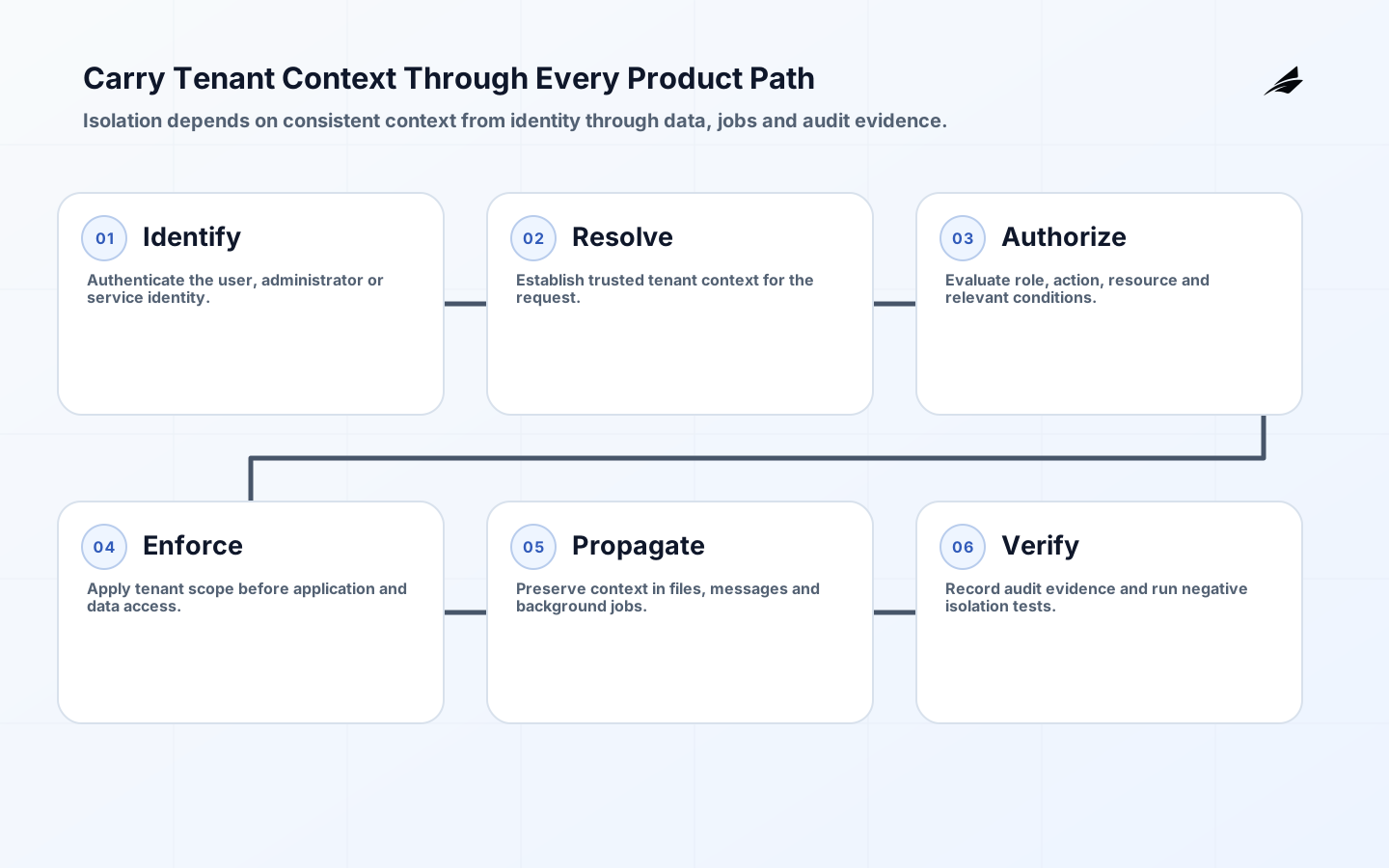
Define tenant boundaries before selecting components. A tenant is usually a customer organization, while users may belong to one or more tenants. Decide how tenant context enters a request, how authorization is enforced, how data is partitioned and how background jobs, exports, caches and logs retain that context. AWS guidance emphasizes that authentication is not the same as isolation; Microsoft likewise recommends continuous testing against cross-tenant access.

Pooling resources can improve efficiency, while siloed resources can simplify some isolation or compliance cases at higher operational cost. Bridge models combine them. The MVP needs a documented reason for its choice and a path for expected growth. Avoid tenant-specific forks. Configuration and policy should vary without creating separate product versions that cannot be upgraded consistently.
Build security and operations into delivery
Use NIST SSDF practices to protect source, dependencies, build credentials and releases, and to plan vulnerability response. Translate relevant OWASP ASVS requirements into acceptance criteria. Threat-model the tenant boundary, administrative actions, file handling, APIs and integrations. Test both permitted and forbidden access, including changed identifiers, background processing and support tools.
Define service-level indicators around user behavior, such as successful request completion or timely processing, then set an initial objective that matches the pilot's importance. Instrument traces and logs with tenant-aware correlation while preventing sensitive data leakage. Backups need restore tests, not only successful job messages. Every alert needs an owner and a response action.
| Risk | MVP control | Release evidence |
|---|---|---|
| Cross-tenant exposure | Central tenant-context enforcement and negative tests | Automated isolation tests and review |
| Privilege misuse | Role matrix, least privilege and audited admin actions | Permission tests and access review |
| Integration failure | Idempotency, retry limits and operator queue | Failure simulation and reconciliation |
| Unsafe release | Protected pipeline, review and rollback | Signed-off deployment rehearsal |
| Data loss | Backups, retention and restore procedure | Successful restore exercise |
| Low adoption | Workflow research, pilot support and feedback | Observed completion and interviews |
Run a controlled enterprise pilot
Select a representative but bounded customer group. Avoid only expert champions; include ordinary users, an administrator and support staff. Agree the pilot period, data handling, support channel, incident route and stopping conditions. Migrate only the minimum data required, reconcile it, and preserve a rollback or parallel process until the exit gate is met.
- Prepare: approve scope, risks, test evidence, support rota and rollback.
- Provision: automate tenant creation, roles, configuration and audit records.
- Onboard: train by role and verify access before business use.
- Observe: review completion, errors, latency, denied access and support themes.
- Decide: compare evidence with explicit expand, revise or stop criteria.
- Transfer: document ownership, known limits, backlog and operating routines.
Measure learning, value and product health
Track the proportion of eligible users who complete the target workflow, time and failure points within that workflow, exception volume, support demand and administrator effort. Combine telemetry with interviews because a completed task can still be confusing or require an off-system workaround. Measure reliability and security outcomes alongside adoption so increased use does not conceal operational strain.
For delivery, use team-level trends such as change lead time, deployment frequency, failed-deployment recovery time, change failure percentage and deployment rework rate, following current DORA definitions. These measures help identify delivery constraints; they are not individual productivity targets. Review them with product outcomes and user feedback.
Common enterprise MVP risks
The main risks are a pilot that cannot become production, enterprise requirements arriving after architecture is fixed, custom promises to one design partner, unclear product ownership, and success criteria that reward launch rather than learning. Control them with a production-readiness baseline, explicit assumptions, one change authority, contract review and decision gates. Keep the SaaS MVP implementation checklist beside the delivery plan and use the enterprise SaaS MVP FAQ to align stakeholders.
Model the economics of the next investment
An MVP should improve the quality of an investment decision, so its economic review needs more than development spend. Separate one-time discovery and delivery cost from recurring infrastructure, third-party services, support, security, compliance and product operations. Include the cost of customer onboarding, configuration and integration work. A product that attracts pilot interest but requires repeated manual intervention may have validated a need while invalidating the current operating model.
Use unit measures only when their definitions are stable enough to guide action. Per-tenant infrastructure consumption, support effort per active organization, onboarding elapsed time and frequency of manual exceptions can reveal where the design will strain. Do not extrapolate a small, assisted pilot as though it were self-service production. Record which work was performed by the delivery team behind the scenes and decide what must be automated, documented or priced before expansion.
The next funding request should connect a demonstrated constraint to a bounded increment. If pilot users complete the workflow but administrators spend excessive time provisioning access, the next investment may be tenant lifecycle automation rather than more end-user features. If an integration dominates failures, harden the contract and reconciliation path before adding another connector. This keeps the roadmap tied to evidence rather than the loudest backlog request.
Review commercial assumptions without inventing certainty the pilot cannot provide. Segment evidence by tenant type, workflow frequency and support model so one unusually engaged design partner does not represent the market. Record willingness to continue, procurement barriers and required assurances as qualitative evidence. Before making commitments, validate billing, tax, contracting and service obligations with the appropriate specialists; the MVP architecture should not silently decide the commercial model.
Expansion should preserve a learning cadence. Add tenants or workflow volume in controlled cohorts, compare operating effort with the previous cohort and revisit isolation and capacity assumptions. A product that works for one assisted tenant may still need automated provisioning, tenant-aware support tooling and more predictable configuration. Treat these as product capabilities with owners and tests, not as permanent services performed off-screen.
Maintain a benefits record that separates observed pilot evidence from forecasts. State the baseline, measurement window, affected cohort and confounding process changes so leadership can understand what the product did and did not demonstrate.
- Separate build, transition and recurring operating costs.
- Measure assisted work that will not scale with tenant count.
- Review consumption, support and onboarding by tenant without exposing customer data.
- Tie the next increment to a proven value or operating constraint.
- Update architecture and commercial assumptions as pilot evidence changes them.
Key takeaways
- Define the investment decision and one complete enterprise workflow.
- Reduce breadth without removing tenant isolation, security, recovery or support essentials.
- Choose pooling, silo or bridge patterns from explicit isolation and operating needs.
- Pilot with representative users, observable failure paths and reversible rollout.
- Judge the MVP through adoption, workflow value, reliability, security and learning together.
Frequently asked questions
How is an MVP different from a prototype?
A prototype tests interaction or technical feasibility and may use simulated data. An enterprise MVP supports real users and therefore needs production controls proportionate to the workflow: identity, isolation, monitoring, recovery, support and change management.
How long should an enterprise MVP take?
There is no responsible universal duration. Integration uncertainty, security review, data migration, tenant model, workflow complexity and availability needs drive the plan. Estimate after discovery, state assumptions and use an early proof to reduce the largest uncertainty.
Must the first release be fully multitenant?
Not always, but the intended tenancy model must be explicit. A siloed pilot can be valid when shared onboarding and operations are planned, while a pooled model must enforce isolation from the start. Avoid accidental single-customer design presented as a scalable product.
What proves the MVP succeeded?
Evidence that the target users complete a valuable workflow, the product can be securely operated, and the organization has learned enough to make the stated investment decision. Shipping on time is useful delivery evidence, not product validation by itself.
Conclusion
A strong enterprise SaaS MVP is intentionally narrow and operationally credible. It turns one workflow into testable product, protects customer boundaries, exposes failures and gives leaders evidence for the next decision. That combination preserves speed without borrowing unacceptable risk from the future.