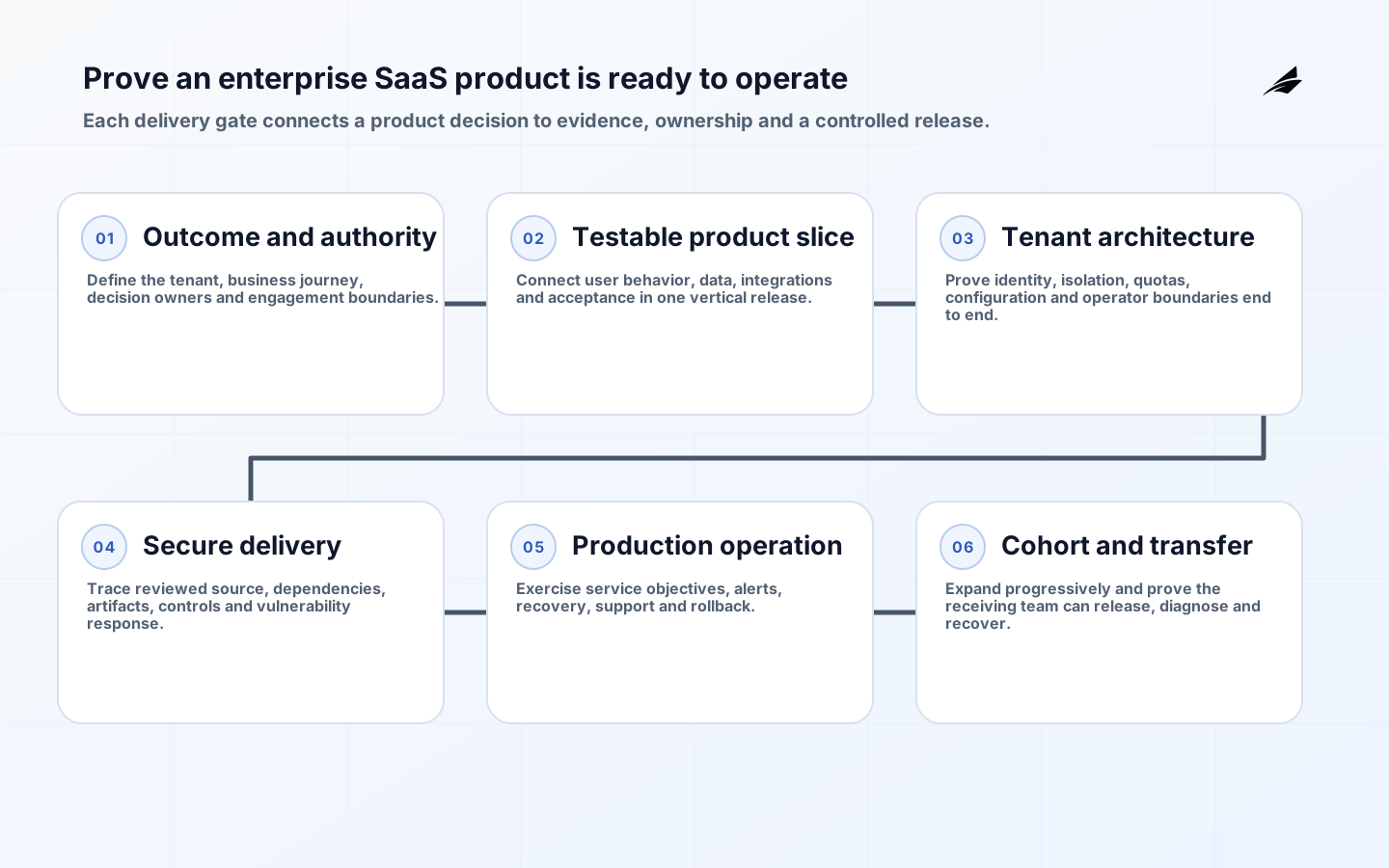
An enterprise SaaS implementation is not complete when the application runs in a demonstration environment. It is complete when a defined tenant cohort can use a supported product, customer data is isolated as designed, operators can diagnose failures, releases are repeatable, and the enterprise can continue delivery without depending on undocumented knowledge. This checklist turns those conditions into reviewable evidence for product owners, architecture, security, operations, procurement and the delivery company.
Use the checklist as a set of gates, not a universal sequence. A lower-risk internal product may combine gates; a regulated or customer-facing product may require formal approvals. Record who accepted each item, the evidence reviewed, exceptions, expiry dates and follow-up owners. The companion scope, cost, risk and delivery guide explains how to estimate the work behind these controls.
1. Confirm outcomes, authority and engagement boundaries
Begin with the business workflow and the tenant, not a feature inventory. Name the decision the product improves, the users involved, the data it handles and the consequence of failure. Define a tenant precisely: it may be a customer organization, business unit, geography or environment. That definition affects identity, data residency, configuration, billing, support and reporting. Microsoft’s multitenant guidance emphasizes that tenant and deployment are different concepts; one tenant may have dedicated resources, while several tenants may share a deployment.
- An accountable product owner can prioritize scope and accept product behavior.
- Business, technical, security and data owners are named, with a decision forum and escalation time.
- The first tenant cohort and excluded cohorts are documented.
- In-scope journeys have measurable outcomes and baseline evidence.
- The statement of work separates deliverables, assumptions, enterprise dependencies and change control.
- Intellectual property, repository access, artifact ownership, data handling, subcontracting, support and exit obligations are explicit.
2. Turn scope into testable product slices
Map complete user journeys across interface, API, data, notifications, administration and support. A vertical slice should create an outcome for a real role and exercise the production path. Include enterprise dependencies such as identity federation, legal review, domain ownership, data access and customer onboarding. These often govern elapsed time even when application coding is straightforward.
| Scope artifact | Minimum content | Acceptance evidence |
|---|---|---|
| Journey map | Actor, trigger, happy path, exceptions, approvals and support path | Observed walkthrough with representative users |
| Product backlog | Outcome, tenant context, dependencies and acceptance examples | Prioritized slices tied to release objective |
| Data inventory | Source, classification, owner, residency, retention and deletion | Owner-approved handling rules |
| Integration register | Contract, authentication, limits, failure behavior and contact | Sandbox proof or validated interface contract |
| Nonfunctional profile | Availability, latency, accessibility, recovery and support needs | Measurable targets and test approach |
Run a short discovery spike for the least-known dependency rather than hiding uncertainty in an estimate. For example, if enterprise single sign-on is required, prove identity mapping, tenant resolution, role assignment and deprovisioning with a nonproduction identity provider. A login screen alone does not prove authorization or isolation.
3. Approve tenancy, isolation and platform architecture
Choose what is pooled and what is isolated for compute, data, queues, caches, encryption keys and observability. AWS’s SaaS Lens treats tenant isolation as an end-to-end concern, while Azure describes isolation as a spectrum with cost, scale, reliability and manageability tradeoffs. Document the rationale per component. Do not assume a dedicated database solves isolation if shared caches, logs, exports or administrative tools can cross tenant boundaries.
- Every request derives tenant context from a trusted identity or routing boundary.
- Authorization checks tenant and resource ownership server-side.
- Queries, background jobs, caches, files, search indexes and exports preserve tenant context.
- Resource quotas and workload controls limit noisy-neighbor effects.
- Tenant-aware telemetry supports diagnosis without exposing sensitive data.
- Provisioning, configuration, suspension, export and deletion are automated or have controlled runbooks.
- Architecture decisions identify limits, migration triggers and rollback paths.
Define a control plane for onboarding, tenant mapping, configuration and fleet operations. Define a data plane for tenant workloads. Even when they share infrastructure, their permissions and failure modes should be explicit. Test isolation with negative cases: altered tenant identifiers, stale sessions, direct object references, background retries and operator actions.
4. Build security, privacy and accessibility into delivery
Use NIST’s SSDF to assign secure development practices across preparation, protected software, secure production and vulnerability response. Translate policy into pipeline evidence: reviewed changes, dependency records, protected build credentials, tested artifacts, vulnerability triage and traceable deployments. Threat-model tenant boundaries, administrative access, exports, webhooks, integrations and support impersonation.
| Control area | Checklist questions | Evidence |
|---|---|---|
| Identity | Are federation, MFA, lifecycle and break-glass paths defined? | Identity tests and access review |
| Application security | Are authorization, validation, secrets and abuse cases tested? | Threat model and security test results |
| Data protection | Are encryption, retention, deletion, backup and restore defined? | Data-flow map and recovery exercise |
| Software supply chain | Can a release be traced to reviewed source and dependencies? | Build provenance, inventory and signed approval |
| Privacy | Are purpose, minimization, user rights and processor duties known? | Privacy review and handling record |
| Accessibility | Can core journeys be completed with keyboard and assistive technology? | WCAG 2.2 evaluation and defect log |
5. Verify engineering and environment readiness
Keep source, infrastructure definitions, migrations, tests and operational configuration under controlled versioning. Environments should be reproducible and meaningfully similar where risk depends on configuration. Separate tenant test data from production data. Define branching, review, artifact promotion and emergency change paths. DORA’s delivery measures are useful at product or service level when interpreted together: speed without recovery and quality is not a sound objective.
- Automated tests cover critical journeys, tenant isolation, contracts and migrations.
- The pipeline fails closed on required checks and records the promoted artifact.
- Infrastructure changes are reviewed, repeatable and drift is visible.
- Feature flags have owners, tenant targeting, audit history and retirement dates.
- Database changes are backward compatible across the planned deployment window.
- Test environments contain representative scale and failure conditions without uncontrolled production copies.
- Developers can reproduce and diagnose a failed build or deployment.
6. Prove production operations before launch
Define service level indicators around what users experience: successful sign-in, completed workflow, fresh data or accepted transaction. Google SRE guidance recommends explicit measurement and validity, so document event sources, exclusions and aggregation windows. Pair objectives with error-budget or exception rules that guide release decisions. Infrastructure uptime alone can remain green while a tenant’s core workflow is broken.
- Dashboards distinguish platform, deployment and tenant-level symptoms.
- Alerts identify an actionable condition, owner, severity and response path.
- Runbooks cover dependency failure, capacity pressure, bad release, compromised credential and data repair.
- Backup restoration and recovery objectives are exercised, not inferred from job success.
- Support can identify tenant, release, correlation identifier and recent configuration safely.
- On-call, incident command, customer communication and post-incident learning are defined.
7. Release in controlled waves and transfer ownership
Start with a cohort that represents the intended operating conditions but limits impact. Define entry criteria, observation period, success thresholds, stop conditions and rollback before exposure. A rollback may route traffic to a previous version, disable a feature or pause onboarding; it must not erase valid transactions. Reconcile data and side effects after any reversal.

| Wave | Entry evidence | Exit or stop decision |
|---|---|---|
| Internal rehearsal | Production-like environment, trained operators, recovery test | Runbook works and critical defects are resolved |
| Design cohort | Approved tenants, support coverage, reversible flags | Journeys and service objectives hold under real use |
| Limited availability | Capacity evidence, security closure, onboarding automation | Support load and reliability remain within agreed bounds |
| General rollout | Operational acceptance, communications and ownership transfer | Expand by cohort; pause on predefined risk signals |
| Handover | Repositories, credentials, records, backlog and training complete | Enterprise owner can deploy, operate and recover independently |
Handover begins during discovery. Pair enterprise engineers with the delivery team, keep decisions in enterprise-accessible systems and rehearse a release led by the receiving team. Verify repository administration, cloud ownership, signing keys, domains, third-party accounts, licenses, documentation and open risks. Remove supplier access that is no longer required and retain only explicitly agreed support access.
Risks the checklist must expose
| Risk | Early signal | Control |
|---|---|---|
| Custom project disguised as product | Tenant-specific forks or unpriced exceptions | Configuration policy and product-owner approval |
| Cross-tenant exposure | Missing tenant context in jobs, logs or exports | Negative isolation tests and scoped operator access |
| Unbounded scope | Backlog grows without release objective change | Outcome-based slices and formal change decisions |
| Late enterprise dependency | Identity, legal or data access blocks a release | Dependency owners and early proofs |
| Fragile handover | Only supplier staff can deploy or diagnose | Paired operation and receiver-led rehearsal |
| Launch without operations | Alerts, support and recovery arrive after users | Production-readiness gate before cohort exposure |
Key takeaways
- Treat every checklist item as a claim that needs named evidence and an owner.
- Define tenant identity and isolation per component before committing to architecture.
- Deliver vertical product slices that include security, data, operations and support.
- Use service objectives, progressive exposure and tested rollback to govern rollout.
- Start knowledge transfer early and prove that the receiving team can operate independently.
Frequently asked questions
When should an enterprise use a SaaS product development company?
Use one when specialist product, architecture or delivery capacity is needed and the enterprise can retain product authority and risk accountability. Evaluate the proposed team, evidence, working model and handover plan. A company name or generic portfolio does not establish fit for a specific product.
Who should own this checklist?
The enterprise product owner should own completion, with architecture, security, data, operations and procurement accepting their domains. The delivery company supplies evidence and identifies uncertainty; it should not self-approve material enterprise risk.
Does an MVP need every control?
It needs controls proportionate to the data, users and exposure it actually has. The depth may vary, but tenant isolation, recoverability, ownership and secure delivery cannot be postponed merely by using an MVP label.
What is good acceptance evidence?
Evidence is repeatable and connected to a requirement: an automated test, observed user task, configuration export, threat-model decision, restore record or receiver-led deployment. Screenshots and status statements are weak when the underlying behavior cannot be reproduced.
Conclusion
A strong enterprise SaaS checklist makes responsibility, uncertainty and operational proof visible. It connects product scope to tenancy, security, service objectives, rollout and exit. When every gate has evidence and the receiving team can run the product, launch becomes a controlled business decision rather than a ceremonial end to development.