Selecting a SaaS product development company is a decision about product ownership, architecture, delivery capacity and long-term operation, not a shortcut to buying a finished outcome. Enterprise teams still own business priorities, data obligations, risk acceptance and supplier governance. The useful question is whether a particular team and engagement model can close a defined capability gap while leaving the enterprise able to govern and operate the product.
This guide shows how to form scope, estimate without invented market prices, compare engagement models, manage delivery risks and release in controlled waves. Use the companion enterprise SaaS implementation checklist to collect acceptance evidence during execution.
Define the product and tenant before asking for a proposal
Write a product brief around a business workflow: who experiences the problem, what decision or task changes, which systems and records are involved, and how the enterprise will know the change is useful. Separate user demand from proposed features. A request for dashboards, notifications and artificial intelligence is not yet a product scope; a request to reduce manual exception handling in a named workflow can be investigated and measured.
Define tenant, user and deployment separately. In business-to-business SaaS, a tenant might be a customer company, division, region or environment. Microsoft’s multitenant guidance notes that isolation is a spectrum and that tenant-to-deployment mapping is an architectural decision. This definition shapes onboarding, identity, configuration, data boundaries, support, analytics and eventual offboarding.
| Scope dimension | Decision to record | Why it changes delivery |
|---|---|---|
| Users and journeys | Roles, frequency, exceptions and accessibility needs | Determines interaction design and acceptance testing |
| Tenancy | Tenant definition, isolation needs and deployment mapping | Changes architecture, operations and cost |
| Data | Classification, residency, retention, migration and deletion | Changes controls, environments and cutover |
| Integrations | Owners, contracts, limits and failure behavior | Creates external dependencies and test needs |
| Reliability | User-centered objectives, recovery and support hours | Changes redundancy, observability and staffing |
| Commercial operation | Plans, entitlements, usage records and support model | Changes control-plane and administrative capability |
Choose an engagement model that preserves accountability
A project model can suit a bounded release with stable acceptance criteria. A capacity-based team can suit evolving discovery when the enterprise provides strong product direction. A build-operate-transfer arrangement can help establish a product team, but transfer must be designed from the beginning. A managed product service changes the ongoing control model and needs explicit service levels, data responsibilities, audit rights and exit arrangements.
- Assess the named team’s relevant architecture, product, security and operational evidence.
- Confirm who makes product, technical, security and release decisions.
- Require enterprise access to repositories, delivery systems, environments and decision records.
- Define how assumptions, changes, subcontractors and conflicts are handled.
- Set knowledge-transfer activities and exit evidence as deliverables.
- Avoid scoring proposals mainly on presentation, headcount or a single fixed date.
Scope vertical slices and production capabilities
Organize the roadmap around complete outcomes. A first slice might allow one tenant administrator to invite users through approved identity, assign roles, complete one workflow and receive support. That slice crosses interface, API, authorization, tenant context, persistence, telemetry and operations. It provides better evidence than building every screen before integration or security begins.
Include product capabilities that demonstrations often omit: tenant provisioning, configuration, audit history, support tools, usage visibility, deletion, accessibility, deployment, observability and recovery. The AWS SaaS Lens emphasizes that SaaS architecture includes shared operational mechanisms even when some tenant infrastructure is siloed. Dedicated infrastructure alone does not create a scalable product operating model.
Build a cost model from work and uncertainty
There is no responsible universal price for enterprise SaaS development. Cost follows the number and complexity of product journeys, tenancy model, unknown integrations, data migration, security assurance, reliability targets, geographic footprint, accessibility, operational tooling and transition duration. Estimate ranges from a discovery-backed backlog, with assumptions and confidence stated. Separate one-time delivery, transition and recurring operation.
| Cost area | Evidence for estimation | Common source of variance |
|---|---|---|
| Discovery and design | Journey maps, prototypes, dependency proofs | Unknown users, rules or enterprise approvals |
| Product engineering | Vertical slices and acceptance examples | Exceptions, configuration and cross-role behavior |
| Platform and tenancy | Architecture decisions and capacity model | Isolation level, regions, quotas and fleet automation |
| Security and assurance | Threat model, control mapping and test plan | Data sensitivity and customer obligations |
| Data and integration | Profiles, contracts, rehearsal plan | Poor data quality and unstable interfaces |
| Operations and transition | Service objectives, support model and handover plan | Parallel running, training and retained legacy cost |
Ask proposals to show team composition by phase, enterprise dependencies, excluded work, contingency treatment and how estimates will be revised after discovery. A fixed price can control spend only when scope and assumptions are sufficiently stable; otherwise it can move uncertainty into change requests, reduced quality or hidden exclusions. A capped discovery followed by evidence-based release estimates is often easier to govern.
Set architecture constraints before detailed design
Decide isolation by resource and risk. Pooled compute and data can improve utilization, while dedicated databases or deployment stamps can increase isolation for selected tenants. Both create tradeoffs in cost, fleet management, capacity and incident impact. Require tenant context through identity, authorization, storage, cache, queue, export, logs and operator tools. Test attempts to cross boundaries rather than reviewing diagrams alone.
Set principles for API contracts, event ownership, data consistency, configuration, secrets, infrastructure definitions and backward-compatible change. Avoid choosing microservices by default. A modular application can be appropriate when one team owns a cohesive domain; distributed services add network failure, consistency and operational work. Architecture should match independent scaling, ownership and change needs.
Treat security and reliability as delivery work
NIST’s SSDF provides a useful structure for preparing the organization, protecting software, producing secured releases and responding to vulnerabilities. Put those practices into the backlog and definition of done. Include threat modeling, reviewed dependencies, build protection, security testing, vulnerability response and deployed-version traceability. Add privacy review around purpose, minimization, retention and user rights.
Define reliability from user journeys. Google SRE guidance recommends service indicators that users care about and explicit objectives with valid measurement. For a SaaS workflow, measure successful tenant sign-in, accepted transaction or fresh report, not merely server uptime. DORA’s delivery measures can reveal release capability and instability when reviewed together over time.
Example: a controlled first enterprise release
Consider an enterprise planning product that consolidates approved source data, lets managers review exceptions and records decisions. Discovery identifies identity federation and source-data ownership as the largest unknowns. The first slice proves tenant mapping, one source contract, role-based review, audit history and operational telemetry for a small approved cohort. It excludes automated recommendations until the underlying decisions and data quality are understood.
The team runs synthetic isolation tests, restores a backup in a nonproduction environment and rehearses rollback. During limited release, support records correlation identifiers and categorizes issues by product, integration and data cause. Expansion depends on agreed journey success, data freshness and support readiness. The example does not assume a duration, price or outcome; those depend on evidence from the actual environment.
Manage the risks that change value or control
| Risk | Consequence | Practical control |
|---|---|---|
| Ambiguous product ownership | Supplier optimizes output while priorities drift | Named product owner and decision cadence |
| Cross-tenant access | Confidentiality breach and loss of trust | End-to-end tenant context and negative tests |
| One-customer customization | Forked product and escalating maintenance | Configuration policy and product governance |
| External dependency delay | Idle team or missed release window | Early proof, owner and fallback decision |
| Operational underdesign | Launch creates incidents and manual support | Service objectives, runbooks and production gate |
| Supplier dependency | Enterprise cannot release or recover alone | Shared systems, pairing and receiver-led rehearsals |
| Permanent dual running | Legacy cost and inconsistency remain | Migration waves and explicit retirement criteria |
A delivery plan with decision gates
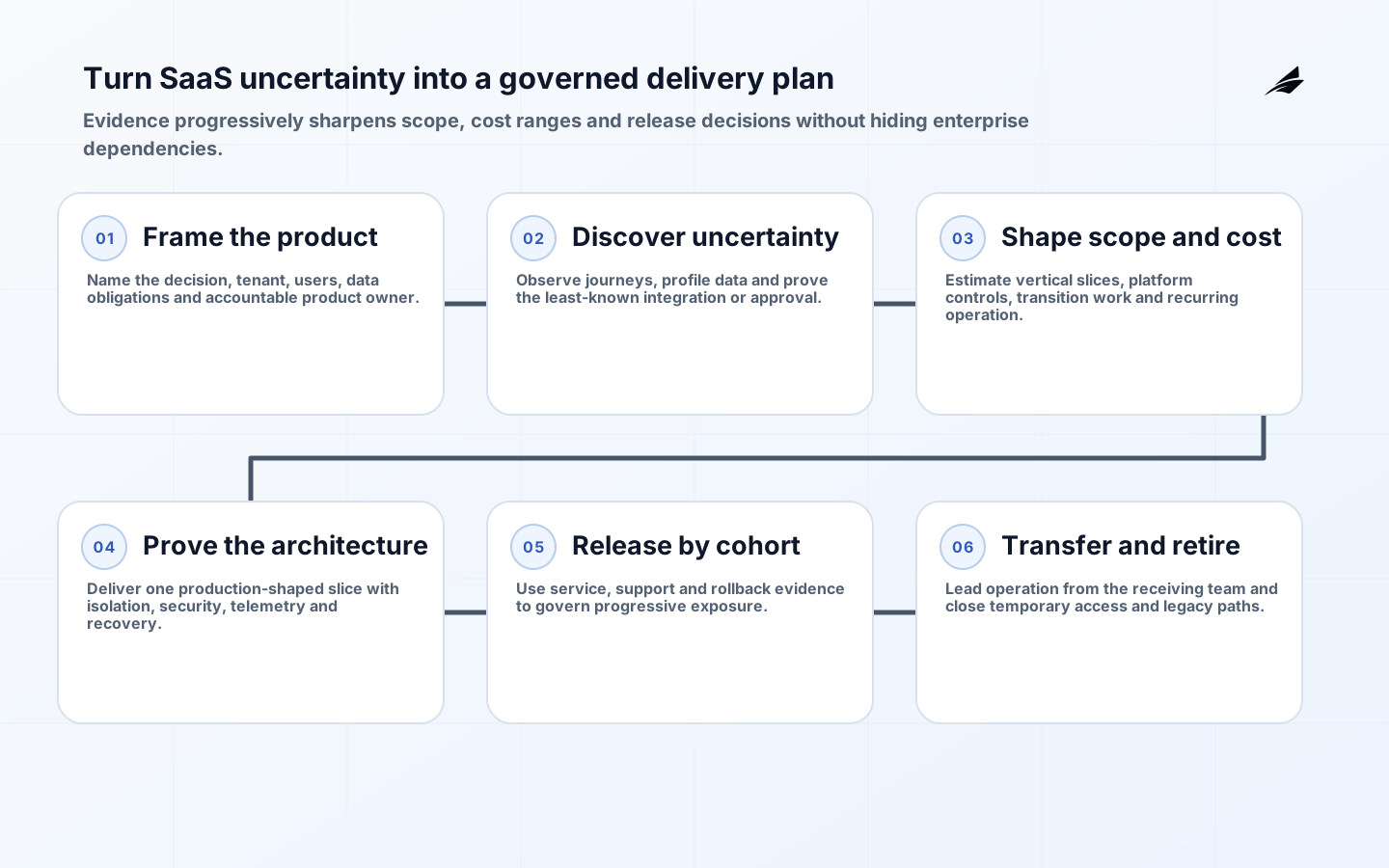
- Frame: agree the business outcome, tenant definition, accountable owners, constraints and investment guardrails.
- Discover: observe users, profile data, map dependencies, prove unknown integrations and model threats.
- Shape: choose tenancy and architecture, prioritize vertical slices, define service objectives and revise estimates.
- Prove: deliver one production-shaped slice with pipeline, observability, isolation tests, recovery and support.
- Release: expose an approved cohort progressively, reconcile state and stop or roll back on predefined signals.
- Expand: add tenants and capabilities only when capacity, support and control evidence remain valid.
- Transfer and optimize: lead releases from the receiving team, remove unnecessary access, retire temporary paths and compare outcomes with the baseline.

Each gate should have a decision owner and evidence. Discovery exits with enough knowledge to fund a slice, not with a large document. A proof exits only when the pattern includes production operations. General release exits only when ownership, support and recovery are sustainable. Keep open risks and assumptions visible rather than converting them into false precision.
Measure product, delivery and operation together
| Perspective | Example measure | Decision supported |
|---|---|---|
| User outcome | Completion, correction or abandonment of the named journey | Whether product behavior is useful |
| Tenant operation | Onboarding lead time and configuration exceptions | Whether the model scales operationally |
| Reliability | Valid user-centered indicator against objective | Whether exposure should continue |
| Delivery | Lead time, deployment frequency, recovery and failed changes | Whether change capability is improving |
| Security | Material findings, remediation age and access exceptions | Whether risk is controlled |
| Economics | Unit consumption and retained legacy operation | Whether architecture and retirement match the plan |
Key takeaways
- Define the product, tenant and business outcome before comparing suppliers.
- Estimate from vertical slices, dependencies and uncertainty rather than generic rates.
- Choose isolation and architecture per component, with operational tradeoffs visible.
- Make security, reliability, support and handover part of scope from the first release.
- Release progressively and fund transfer and retirement as real delivery phases.
Frequently asked questions
What should an enterprise ask a SaaS development company?
Ask who will perform the work, how they define tenant isolation, how estimates handle uncertainty, what evidence passes each gate, where artifacts live, how incidents and vulnerabilities are handled, and how the enterprise will deploy and recover without them. Verify answers against the proposed team and engagement.
Is fixed price appropriate?
It can be appropriate for bounded work with stable interfaces and acceptance criteria. For uncertain product discovery, use a bounded discovery or staged funding model, then revise ranges from evidence. Contract form does not remove uncertainty; it changes where that uncertainty appears.
What is the largest cost driver?
There is no universal largest driver. Unknown business rules, tenant isolation, integrations, migration, assurance, reliability and parallel operation can each dominate. Identify the riskiest assumptions early and test them before scaling the team.
When should handover begin?
During discovery. Enterprise engineers should access repositories, decisions and environments, pair on implementation and lead rehearsals before final transition. Documentation written at the end cannot replace practiced ownership.
Conclusion
A defensible SaaS engagement converts a business workflow into evidence-bearing product slices, makes architecture and cost tradeoffs explicit, and keeps authority with the enterprise. A delivery company is valuable only in the context of a verified team, bounded responsibilities and a plan that leaves the product operable after the engagement changes.