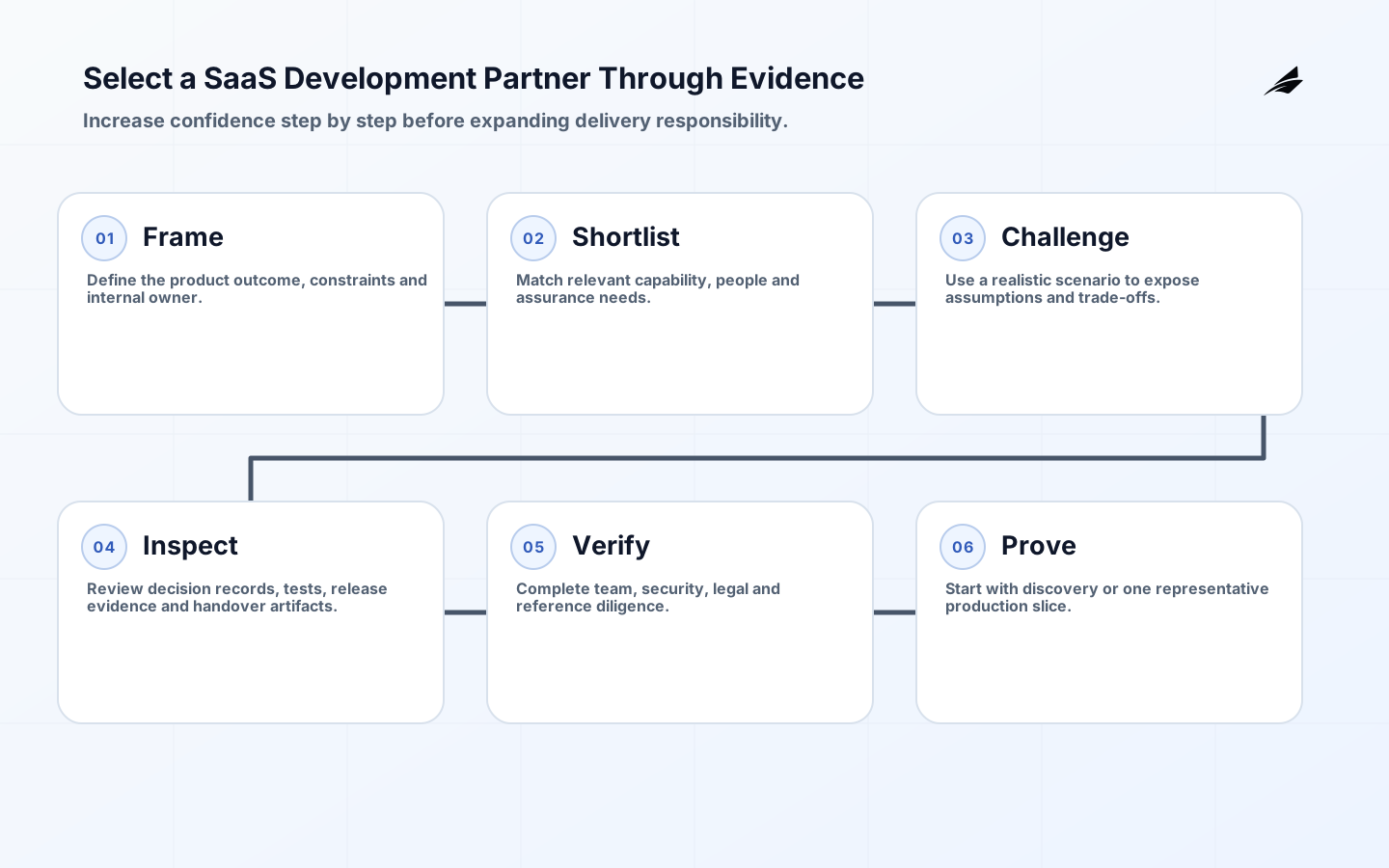
Selecting a SaaS product development company is a decision about product judgment, engineering execution and long-term ownership, not simply access to developers. Enterprise buyers need evidence that a partner can work inside governance constraints, protect customer boundaries, expose delivery risk and leave the product operable by the agreed owner. These questions provide a structured way to compare that evidence.
When should an enterprise use a product development company?
External support can fit when the enterprise has a clear product owner but lacks specialist capacity, needs to accelerate a bounded initiative, or wants independent product and architecture challenge. It is a poor substitute for internal sponsorship, access to users or decision authority. A partner cannot discover the correct product while business owners remain unavailable.
What engagement model works best?
Use a bounded discovery when workflow, architecture or integration uncertainty prevents responsible commitment. Use an outcome-oriented delivery team when scope will evolve through evidence. A fixed scope can suit a stable, well-specified component with controlled dependencies. Staff augmentation can add capacity but leaves prioritization, architecture and integration primarily with the enterprise. Match commercial structure to uncertainty instead of forcing uncertain product work into false precision.
| Model | Good fit | Buyer obligation |
|---|---|---|
| Discovery | Problem, workflow or architecture is unclear | Provide users, records and decision makers |
| Outcome team | Learning will change backlog priorities | Own outcomes and review evidence frequently |
| Fixed deliverable | Interfaces and acceptance are stable | Control changes and dependencies |
| Staff augmentation | Internal leadership and platform are strong | Direct work and integrate contributors |
| Specialist review | Security, data or reliability expertise is needed | Act on findings and own risk decisions |
How should buyers create a shortlist?
Start with the product's domain, data sensitivity, tenant model, integration landscape, target operating model and required assurance. Ask candidates to explain a relevant approach using anonymized artifacts or a scenario, not confidential client detail. Evaluate how they identify uncertainty and trade-offs. A credible answer distinguishes assumptions from facts and does not promise a detailed schedule before seeing dependencies.

- Confirm experience with the required product shape, not only the chosen framework.
- Review who will actually perform product, design, engineering, security and operational work.
- Ask for sample decision records, test strategy, release evidence and handover structure.
- Verify subcontractor use, locations, access paths and accountability.
- Assess communication during disagreement, risk escalation and scope change.
- Check financial, legal and reference evidence through the enterprise's normal diligence process.
What security evidence should a development company provide?
NIST's supply-chain risk guidance encourages buyers to integrate supplier risk into acquisition and oversight. For a development engagement, examine repository access, identity controls, developer endpoints, secret handling, dependency governance, protected builds, artifact provenance, vulnerability disclosure, remediation and incident notification. NIST SSDF provides a common vocabulary; relevant OWASP ASVS requirements can become application acceptance criteria.
Certifications can support diligence but do not answer product-specific questions. Ask who can access production and customer data, how access is approved and reviewed, what logs exist, and how access ends. Contractual security schedules should name evidence, notification, remediation expectations, data return or deletion, subcontractors and audit rights with counsel's review.
How should the buyer evaluate SaaS architecture capability?
Give the candidate a concrete scenario and ask for decisions, not a generic architecture slide. They should define tenant and user, explain pooled, siloed or bridge trade-offs, carry tenant context through APIs and jobs, prevent cross-tenant access, handle noisy neighbors, automate onboarding and observe individual tenant health. AWS and Microsoft both emphasize that there is no single architecture for every SaaS product.
| Area | Evidence to request | Weak signal |
|---|---|---|
| Tenant model | Boundary, context flow and isolation tests | Login presented as complete isolation |
| Data | Ownership, partitioning, lifecycle and recovery | Schema without retention or restore |
| Integration | Contracts, retries, idempotency and reconciliation | Happy-path API diagram only |
| Reliability | User journey indicators, objectives and response | Infrastructure uptime without user context |
| Delivery | Pipeline, environments, tests and rollback | Manual releases dependent on one person |
| Operations | Runbooks, alerts, tenant view and support ownership | Observability postponed until launch |
What should happen during discovery?
The company should observe workflows, review representative records and systems, identify exceptions, map roles and data, frame measurable outcomes, record risks and propose a thin release. Expected outputs include a scope boundary, journey, architecture options, integration assumptions, risk register, release approach and estimate range. Discovery should reduce uncertainty, not produce a large presentation that hides unresolved decisions.
How should delivery governance work?
Keep one enterprise product owner with priority authority and one partner delivery lead. Agree cadence for demonstrations, risk review, architecture decisions, budget forecast and release approval. Maintain a shared backlog, decision log and evidence repository. Escalate blocked dependencies and changed assumptions early. Governance should make decisions faster; layers of status reporting that do not change action are overhead.
- Review working software and operating evidence, not percentage-complete claims.
- Track assumptions, dependencies, decisions and residual risks with owners.
- Connect each major backlog item to a user or operating outcome.
- Approve architecture changes through concise decision records.
- Forecast range, confidence and drivers rather than reporting one immutable date.
- Define who may release, roll back, accept risk and communicate an incident.
How should proposals and cost be compared?
Normalize what each proposal includes: discovery, design, engineering, cloud environments, testing, security work, data migration, licenses, travel, pilot support, documentation, warranty and ongoing operations. Compare assumptions, team composition, capacity and change mechanism. The lowest build price can create a higher total cost if the enterprise must later reconstruct architecture, tests or documentation.
How should partner performance be measured?
Measure product outcomes, delivery health and collaboration. Product measures may include target workflow completion, adoption and support demand. Delivery measures can include trends in change lead time, deployment frequency, failed-change recovery, change failures and rework. Also inspect escaped defects, security findings, forecast accuracy, blocked dependency age and stakeholder decision time. Do not rank individual engineers by output volume.
What should the contract say about ownership and exit?
Counsel should address intellectual property, pre-existing materials, third-party and open-source components, repository ownership, cloud accounts, domains, data, credentials, documentation and rights to continue operation. Define handover throughout the engagement, not only at termination. The enterprise should be able to obtain source, infrastructure definitions, build paths, tests, runbooks, architecture decisions and current risks in usable form.
A practical selection and rollout path
- Frame: define outcome, constraints, internal owner and required assurance.
- Shortlist: compare relevant capability, proposed people and evidence quality.
- Probe: run a scenario workshop and reference or diligence checks.
- Contract: align scope, change, security, ownership, acceptance and exit terms.
- Prove: begin with discovery or one representative production slice.
- Expand: increase responsibility only after delivery and collaboration evidence.
- Transfer: exercise handover and operational ownership before dependency becomes critical.
What supplier risks should enterprises monitor?
Material risks include key-person dependence, undisclosed subcontracting, environment access that exceeds need, customer-specific architecture, weak open-source governance, manual deployment, hidden technical debt, inaccessible repositories and handover deferred until the end. Mitigate them with shared access, evidence reviews, automation, pair working, documented decisions and contractual exit rights. Keep risk accountability inside the enterprise.
How should Edilec be evaluated?
Apply the same diligence described here. Review the specific team, proposed scope, assumptions, security and delivery evidence, ownership terms and handover plan for the contemplated engagement. Do not infer unverified capabilities from this article. Readers considering the category can review the SaaS product development service as one input and then validate fit through direct evidence.
How can the enterprise avoid supplier dependency?
Design continuity into normal delivery. Keep repositories and work tracking accessible to the enterprise, use organization-controlled cloud and domain accounts where agreed, and ensure more than one person understands each critical path. Architecture decisions, environment setup, data models, integration contracts and runbooks should evolve with the product. Documentation created only during departure is likely to omit the reasons and operational knowledge that matter.
Internal participation should match the intended ownership model. An enterprise team that will operate the product needs hands-on involvement in releases, incident exercises, access reviews and restore tests before handover. If the partner will continue operating it, the enterprise still needs enough knowledge and evidence to govern performance, risk and change. Pairing, recorded walkthroughs and shared on-call exercises reveal gaps earlier than document review alone.
Exercise the exit path while the relationship is healthy. Confirm that a clean environment can be provisioned from controlled definitions, a release can be built without an individual's local machine, credentials can be rotated, data can be exported in the agreed format and the receiving team can follow the runbooks. Record dependencies on partner-owned tools and decide whether they transfer, are replaced or remain licensed.
- Maintain continuous enterprise access to agreed code, evidence and environments.
- Spread knowledge across roles and test internal participation in real operations.
- Inventory partner-owned tools, accounts, licenses and pre-existing materials.
- Rehearse build, deployment, restore, credential rotation and data export.
- Define acceptance for transition and close access after transfer is verified.
Key takeaways
- Retain enterprise product ownership and risk accountability.
- Match the engagement and commercial model to uncertainty.
- Evaluate the actual team through artifacts, scenarios and explicit assumptions.
- Put secure development, tenant isolation, operations and exit into acceptance criteria.
- Expand the relationship only from working-product and collaboration evidence.
Frequently asked questions
Is an RFP enough to select a partner?
An RFP can normalize requirements, but written claims should be tested through scenario discussion, artifact review, team interviews and diligence. Product work contains uncertainty that a questionnaire cannot fully reveal.
Should enterprise SaaS development be fixed price?
Fixed price can suit stable deliverables. For discovery-heavy product work, it often shifts uncertainty into contingency, exclusions or change requests. A capped phase with explicit outputs and a re-estimation gate may provide better control.
Should the enterprise own the source repository?
Usually the contract and operating model should give the enterprise continuous access and the agreed ownership rights. Also control cloud accounts, deployment credentials, domains and third-party services; source code alone is not an operable product.
When should handover begin?
At the start. Agree documentation, shared access, internal participation and acceptance evidence, then test the transfer before final release. Continuous handover reduces concentration risk and improves design decisions.
Conclusion
The right SaaS product development company makes uncertainty visible, delivers evidence in small increments and strengthens the enterprise's ability to own the product. Select for judgment and operating discipline as well as technical skill. Clear acceptance, secure delivery, shared artifacts and an exercised exit path protect both the product and the relationship.