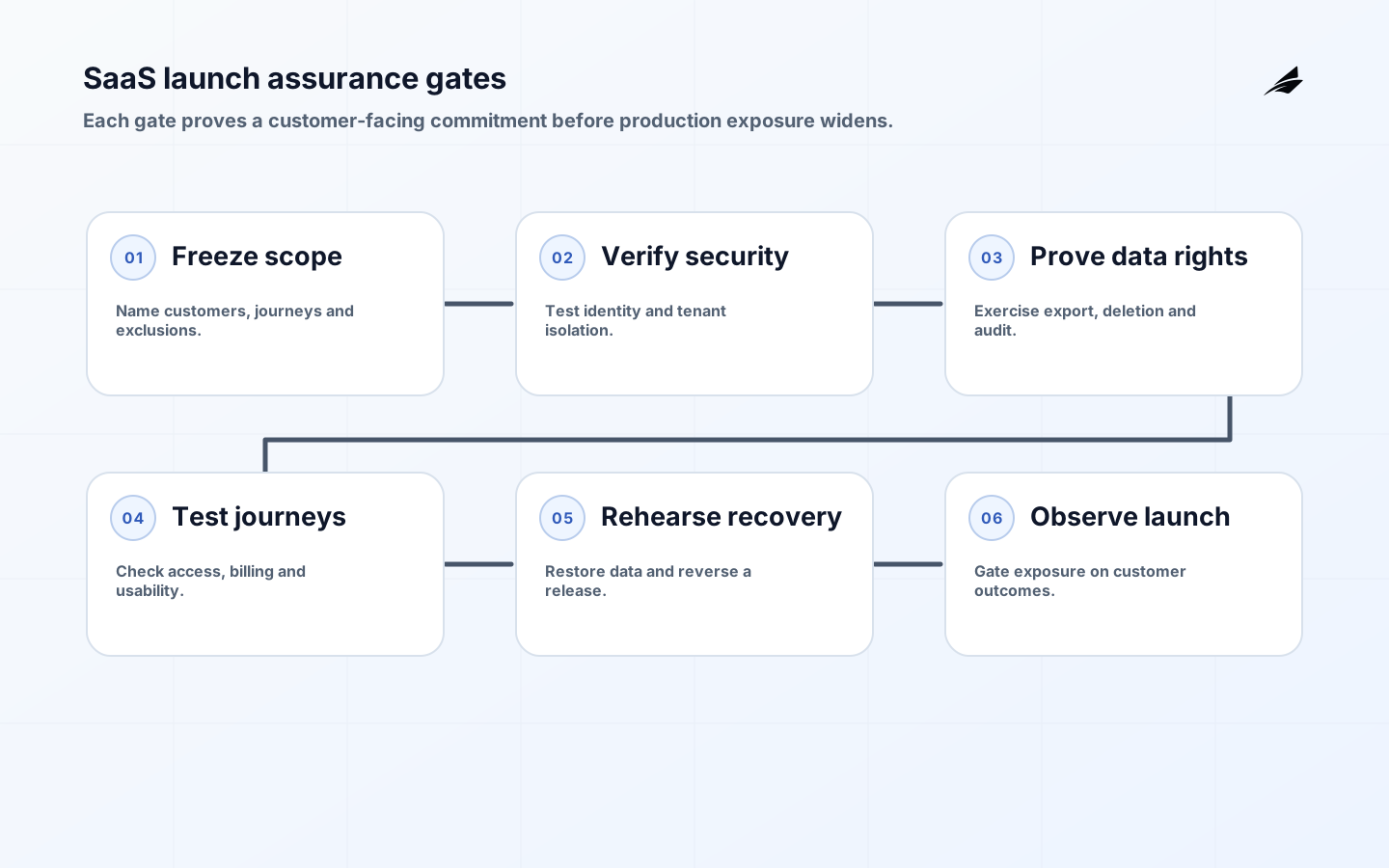
A SaaS launch checklist is a production readiness contract between product, engineering, security, support, finance and operations. It confirms that customers can sign in, complete a critical journey, receive help, trust their data and recover from failure. Launch is not a single deployment. It is the point at which the organization accepts an ongoing service obligation and knows how to observe it.
This guide is intended for IT managers coordinating a real go-live. Pair it with Edilec's SaaS launch planning guide, multi-team launch checklist and application hardening guide. The launch record should link detailed technical evidence rather than repeat it.
Key takeaways
- Define the customer, jurisdiction, data class and supported journey included in the first release.
- Prove tenant, identity, billing and deletion boundaries with tests, not configuration claims.
- Treat accessibility, support, incident response and status communication as release requirements.
- Use progressive exposure, explicit stop conditions and a tested recovery path.
- Keep a launch decision record with owners, exceptions, evidence and the next review date.
1. Freeze the launch boundary
Name eligible customer segments, countries, plans, browsers, devices, integrations, data types, volumes and critical journeys. List excluded cases and how sales and support will handle them. Confirm contractual promises, pricing, trials, cancellation, retention and support hours. A small reliable boundary is easier to widen than a launch that quietly accepts every request while depending on manual exceptions.
Create one launch command record containing release owner, technical owner, support lead, security and privacy reviewers, business validator and decision maker. Link the exact artifact, configuration, schema, infrastructure revision, feature controls and documentation. Record accepted risks with scope, compensating action and expiry. Freeze unrelated high-risk changes during the observation window.
| Launch area | Release question | Evidence | Owner |
|---|---|---|---|
| Customer journey | Can a user reach the promised outcome? | End-to-end test | Product |
| Tenant boundary | Can one tenant access another? | Isolation and authorization tests | Engineering/security |
| Billing | Do plan, tax and cancellation states reconcile? | Sandbox and ledger comparison | Finance/product |
| Support | Can staff diagnose and communicate? | Case simulation | Support |
| Recovery | Can service and data be restored? | Rollback and restore exercise | Operations |
2. Verify security and tenant isolation
Test authentication, session lifecycle, account recovery, administrative access and authorization at object and function level. Verify tenant identity is derived from trusted context and applied in every query, cache, search index, export, job and log. Test invitations, role changes, support impersonation and disabled users. Use separate production identities and least-privilege workload credentials, with protected emergency access.
The OWASP Application Security Verification Standard provides verifiable application security requirements, while NIST's Secure Software Development Framework covers organization, software protection, production and vulnerability response practices. Select requirements proportionate to the service, retain findings and remediation, and confirm critical controls after final production configuration.
3. Confirm data lifecycle and customer control
Document collection purpose, authoritative stores, replicas, indexes, telemetry, backups, regions, retention and deletion. Test export and deletion for one representative tenant, including asynchronous jobs and third-party processors. Verify encryption and key responsibilities, backup access and restore. Ensure test and support environments do not receive production data without explicit controls.
Define audit events for sign-in, administrative action, permission change, export, deletion and consequential business operation. Keep event time, actor, tenant, target, result and correlation while minimizing sensitive content. Confirm customers can obtain promised records and that internal access is reviewed. A privacy notice or contract cannot compensate for an implementation that has no reliable deletion path.
| Failure scenario | Pre-launch exercise | Stop condition | Recovery proof |
|---|---|---|---|
| Bad application release | Canary and rollback | Critical journey regression | Journey and data consistency |
| Database restore | Isolated restore | Recovery objective missed | Record counts and checksums |
| Payment webhook delay | Retry and reorder test | Duplicate or missing entitlement | Ledger reconciliation |
| Identity provider outage | Fallback communication | Users cannot access service | Controlled restoration |
| Tenant data exposure | Authorization test and incident drill | Any cross-tenant access | Containment and notification path |
4. Test usability and accessibility on real journeys
Test registration, authentication, recovery, purchase, critical task, error correction, help and cancellation with keyboard, screen reader, zoom, contrast and mobile layouts. Include loading, empty, timeout and validation states. WCAG 2.2 supplies testable success criteria, but conformance checks should be supplemented by users with disabilities and product-specific tasks. Do not postpone accessible authentication or support until after growth.
Review language, dates, currency, time zone, names, addresses and text expansion for the launch regions. Make destructive and financial actions explicit, reversible where possible and confirmed. Ensure email links, one-time codes and support alternatives work across supported devices. Track accessibility defects with the same ownership and release severity as other product failures.
5. Prove software supply and release controls
Build from reviewed source, pin dependencies, scan secrets and known vulnerabilities, produce immutable artifacts and restrict production deployment. Preserve provenance and verify the artifact promoted is the one tested. The SLSA specification provides a framework for software supply-chain integrity. Apply a realistic level and document residual risk rather than claiming that one build badge guarantees secure software.
Use automated tests, deployment automation, version control and production-like staging. DORA's continuous delivery guidance emphasizes keeping software deployable and releasing in a low-risk manner. Rehearse database changes with mixed versions, third-party limits, rollback and forward repair. Confirm feature controls fail safely and have owners and expiry.
6. Prepare support and production operations
Define service objectives for critical journeys, alerts with actionable runbooks, on-call coverage, severity, escalation and incident communication. Instrument requests, jobs and third-party calls with stable service and tenant-safe correlation. OpenTelemetry can provide portable traces, metrics and logs; the product must still define useful business states such as subscription active, export complete or payment reconciled.
Train support on launch scope, known limitations, identity verification, privacy-sensitive handling, incident escalation, refunds and status communication. Run a case simulation from customer report to engineering diagnosis and resolution. Prepare status-page and customer messages that are accurate without overpromising. Confirm ownership for weekends and holidays in launch regions.
Release progressively and observe
Begin with staff or design partners, then a bounded cohort and broader enrollment. Set observation periods and stop conditions for critical journey success, error budget burn, tenant isolation, billing mismatch, support load and severe accessibility defects. Keep enough capacity and old-version compatibility to recover. Do not let a marketing time override a stop condition without a documented accountable decision.
During the first weeks, review customer outcomes, activation, abandonment, repeat contact, reliability, security signals, costs and unresolved launch exceptions. Segment by plan, region and device. Record every material configuration and vendor change. Schedule a formal post-launch review that closes temporary access, removes seed data, expires risk exceptions and funds recurring operational work.
Validate commercial and customer administration
Run the complete subscription lifecycle using production configuration: quote or checkout, tax handling, payment authorization, entitlement, invoice, plan change, failed payment, renewal, cancellation, refund and account closure. Reconcile the payment provider, billing platform, product entitlement and financial record for each scenario. Verify dates and amounts across currencies and time zones. A successful payment screen is not enough when the wrong plan is activated or a refund never reaches the ledger.
Test administrative journeys with least-privilege roles. Customer administrators should be able to invite, remove and review users; manage approved integrations; obtain invoices and usage records; and request export or deletion according to the product promise. Internal support access should require identity verification, a reason and an audit trail. Confirm that plan downgrades and expired trials remove capabilities without destroying data before the stated retention decision.
Review customer-facing terms, privacy information, status page, support policy and product interface together. Names for plans, limits and service levels should agree. Do not advertise an integration, region or recovery promise that the launch configuration does not support. Prepare renewal and price-change communication even if those events occur later; ownership gaps are easier to correct before the first contract is active.
Give finance and support a shared exception report for duplicate charges, unmatched payments, entitlement drift, tax failures and overdue cancellation. Define who may correct each state and how customer remedy is approved. Exercise one case from report through reconciliation and communication. Commercial operations are part of reliability because customers experience access, billing and support as one service. Set an age threshold and escalation for unresolved money and access cases; an error that remains technically contained can still create customer harm, tax exposure or revenue leakage.
Prepare an evidence pack for the launch decision with links to current tests, accepted risks, recovery results and owner approvals. It should identify the exact release and production configuration, not a staging build or an earlier assessment. Record the decision and observation window. This keeps the go-live meeting focused on unresolved consequence and gives the post-launch review a reliable baseline.
Go-live decision checklist
- Launch scope, exclusions, contracts and owner roster are final.
- Security, tenant isolation, billing and data lifecycle tests pass on production configuration.
- Critical journeys meet accessibility and supported-device requirements.
- Artifact provenance, deployment, schema compatibility and recovery are proven.
- Support, on-call, status communication and incident duties are rehearsed.
- Progressive rollout gates, stop conditions and post-launch review are scheduled.
Frequently asked questions
Must every defect be fixed before launch?
No, but every known defect needs severity, affected scope, owner and decision. Do not launch with failures that compromise the promised journey, security, data rights or usable recovery.
Does a beta label reduce launch obligations?
It can clarify product maturity, but it does not remove duties around security, privacy, accessibility, truthful claims or support. State limitations and eligibility plainly.
Is a penetration test enough for security approval?
No. It is one form of evidence. Secure design, code and dependency controls, authorization tests, configuration review, vulnerability response and operations also matter.
Conclusion
A professional SaaS launch checklist proves that the service can be used, governed, supported and recovered within a declared boundary. Verify tenant and data controls, accessible journeys, secure supply, billing, observability and response. Release gradually and keep the launch decision tied to current evidence. That preparation protects customers and gives the product a stable foundation for growth.