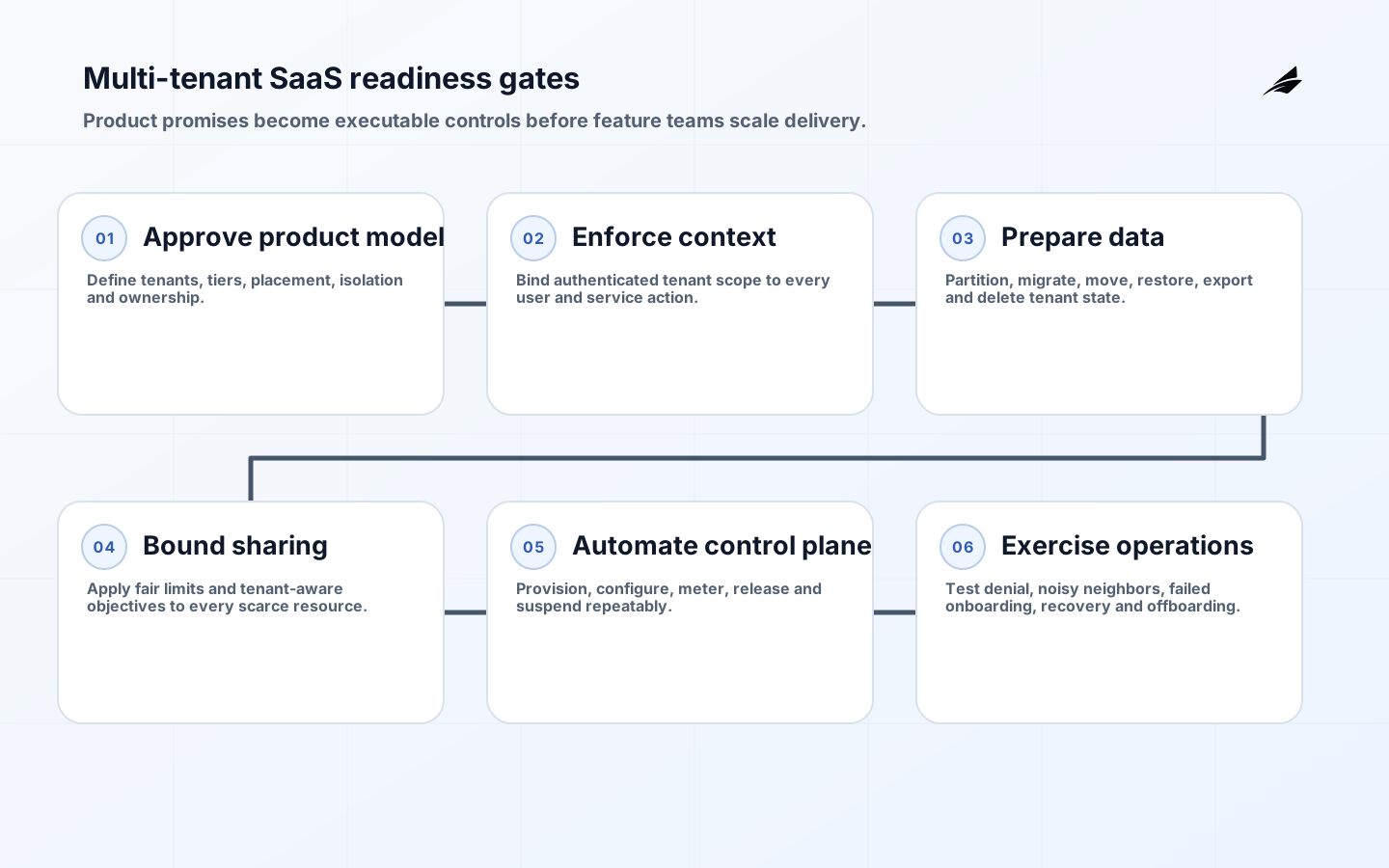
A multi-tenant SaaS architecture implementation plan is ready when the team can demonstrate how tenant context enters the system, where isolation is enforced, how shared limits are controlled and how a tenant is provisioned, billed, moved, restored and removed. Architecture diagrams alone cannot answer those questions. Readiness requires contracts, automated tests, operating ownership and acceptance evidence for every shared or dedicated component.
AWS SaaS guidance treats isolation as foundational and highlights tenant-level reliability concerns. Microsoft’s multitenant architecture guidance describes pooling, dedicated deployments and hybrid stamps as trade-offs rather than maturity levels. This checklist converts those principles into build gates. It complements broader multi-tenant architecture planning by focusing on whether a particular implementation backlog is complete enough to enter delivery.
Confirm the product and tenant model
Approve definitions for customer, tenant, workspace, user, subscription, environment, deployment and entitlement. Model mergers, subsidiaries, multiple regions and test tenants. Define which configuration is product capability and which is unsupported customization. Link commercial tiers to measurable isolation, limits, support and service objectives. If sales can promise a dedicated region or key, the control plane and cost model must be able to provision and operate it repeatedly.
Forecast tenant count, size distribution, growth, peak behavior and data residency. Select isolation separately for identity, compute, database, files, queues, search, cache, analytics and keys. Record why each is pooled, partitioned or siloed and which event would change that decision. Confirm cloud quotas and fleet operations for the highest tenant count, not only application throughput. Dedicated stacks still need unified onboarding, release, telemetry and support to remain a SaaS product.
| Readiness domain | Required artifact | Acceptance question |
|---|---|---|
| Tenant model | Identifiers, relationships and lifecycle states | Can common customer changes occur without data surgery? |
| Isolation | Per-component model and threat assumptions | Where is cross-tenant access prevented and tested? |
| Placement | Region, stamp and capacity mapping | Can a tenant be routed and moved deterministically? |
| Entitlements | Versioned plan and feature policy | Do commercial promises map to enforced behavior? |
| Limits | Quota and fair-use policy | Can one tenant exhaust each shared resource? |
| Ownership | Product, platform, security and support roles | Who responds when a boundary fails? |
Prove identity and authorization boundaries
Document authentication, federation, invitation, membership, role and service-account flows. Derive active tenant context from authenticated authorization, not from a mutable header or path alone. Bind that context to every API, job, message, data query, file key, cache and export. Support impersonation requires explicit user notice where appropriate, time-bound elevation, reason and a record of operator and tenant. Avoid global administrator credentials in routine support tools.
Create negative tests that attempt another tenant’s object identifiers, bulk exports, asynchronous jobs, search results, caches and signed URLs. Verify database policies or query helpers under bypass conditions and migrations. Test stale memberships, disabled tenants and token replay. Authorization is an application concern even when compute or databases are dedicated; shared identity and control-plane services can still cross boundaries. Define incident severity and containment for any isolation failure before launch.
Prepare data, schema and tenant movement
For every store, define tenant partition key, indexes, encryption, retention, backup and restore granularity. Confirm that analytics and support replicas preserve isolation. Plan schema migration across pools, stamps and dedicated databases with version visibility and canary order. Data fixtures should include large and sparse tenants because query plans and indexes respond to distribution. Establish export and deletion workflows across primary, file, search, cache and warehouse systems.
Design tenant movement before it becomes an emergency capacity action. Record current placement, copy or replicate state, reconcile integrity, switch routing and preserve rollback. Handle writes during movement explicitly. Test a region or tier move at production scale and verify integrations, identity, billing and telemetry. A tenant-level restore must not overwrite others, and a stamp-level recovery must preserve the control-plane mapping that sends requests to the restored location.
Set quotas, capacity and tenant-level objectives
List every exhaustible shared resource: request slots, database connections, queue workers, search, reports, storage, outbound API limits and support-heavy operations. Implement per-tenant and tier-aware quotas, fair queues and back-pressure. Separate interactive and batch workloads. Define what callers see when limited and how operators grant temporary exceptions. Test one abusive tenant alongside normal cohorts and verify that service objectives remain within policy.
Measure latency, errors, queue age, freshness and workflow completion by bounded tenant cohort and stamp. Avoid raw tenant identifiers in high-cardinality metrics; use traces or controlled dimensions for diagnosis. Capacity plans need organic growth, launch events, failover headroom and autoscaling delay. Define the placement threshold that opens a new stamp or moves a tenant. Verify that scale-in, retries and dependency throttling do not amplify an overload.
Make onboarding and operation repeatable
The control plane should orchestrate provisioning, placement, entitlements, federation, configuration, billing linkage, suspension and deletion with idempotent steps. Persist state and retry safely after partial failure. No onboarding step should require an undocumented production edit. Version templates and configuration, approve exceptional changes and expose current state to support. Meter usage with durable product events and reconcile it with billing; do not derive operational truth from invoices.
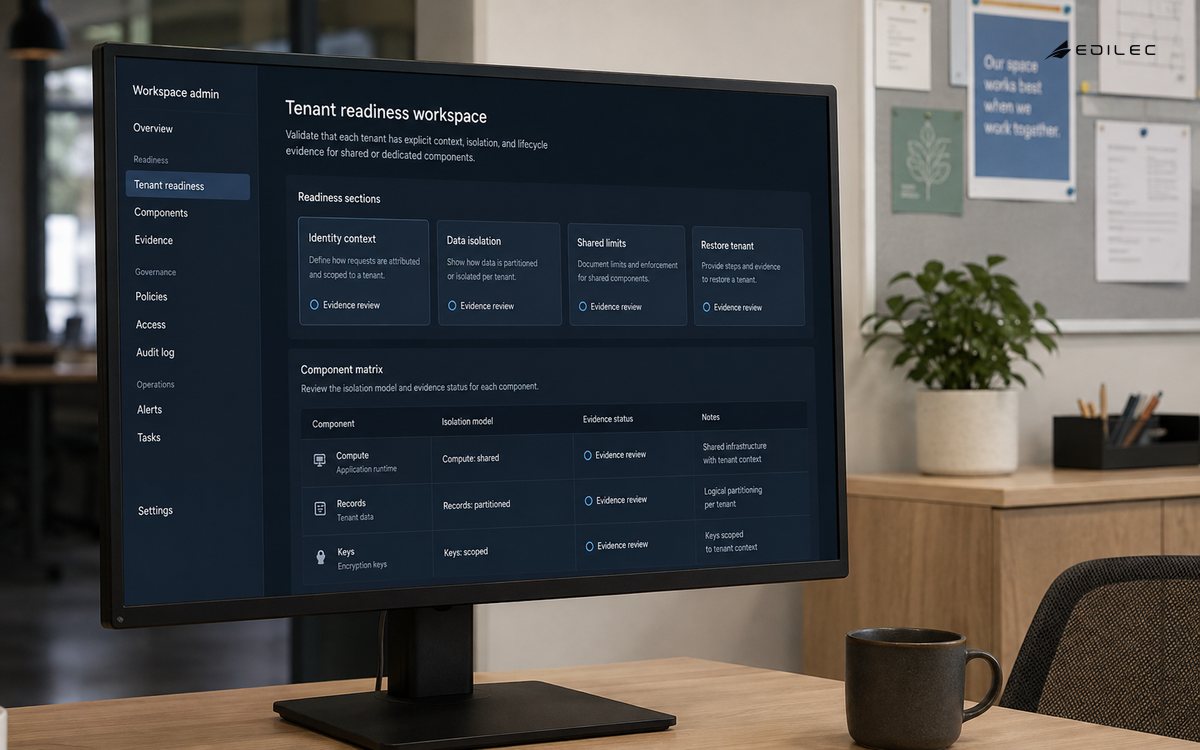
Define release strategy across pooled services and many stamps. Use cohorts, health gates and rollback while preventing long-lived version fragmentation. Support must locate a tenant, see dependencies and perform bounded diagnostics without unrestricted data access. On-call runbooks should cover isolation alarm, noisy neighbor, failed provisioning, stuck migration, metering discrepancy and tenant restore. Practice these events before general availability.
| Implementation gate | Test | Pass evidence |
|---|---|---|
| Cross-tenant denial | Attempt read and write through every execution path | All requests denied with useful audit event |
| Onboarding resilience | Fail and replay each provisioning step | One complete tenant without duplicates |
| Noisy neighbor | Concentrate load from one tenant | Other tenant objectives and fairness remain within policy |
| Tenant movement | Move between stamps or regions and roll back | Routing and state reconcile without loss |
| Recovery | Restore tenant and stamp scenarios | Promised granularity and objectives are met |
| Offboarding | Export, suspend and delete across every store | Retention and deletion evidence is complete |
Convert readiness gaps into the delivery plan
Place foundational work before feature volume: identifiers and context, authorization helpers, provisioning state machine, data partitioning, telemetry and limit enforcement. Build one vertical slice with two tenants and prove denial, load and lifecycle behavior. Add stamp placement and metering, then exercise movement and recovery. Record architecture decisions beside code and tests. Review readiness whenever a new service, store, queue, analytics sink or premium tier enters scope.
- Approve tenant definitions, isolation spectrum, commercial tiers and ownership.
- Implement trusted tenant context and default-deny authorization across all paths.
- Automate placement, provisioning, configuration, schema and entitlement lifecycle.
- Add data partitioning, tenant-level restore, export, deletion and movement.
- Enforce fair-use limits and measure tenant and stamp service objectives.
- Exercise isolation incidents, noisy neighbors, failed onboarding, recovery and offboarding.
Conduct a pre-build readiness review
Run the review against executable examples. Create two tenants with different tiers, regions and identity providers. Walk the same business workflow, then attempt cross-tenant access, exhaust a quota, fail an integration, suspend one tenant and inspect billing events. Ask engineers to identify the control and operator for every transition. Record gaps as backlog dependencies rather than assumptions to solve after feature development. The vertical slice should pass before multiple teams build on the platform.
Review the control plane separately from the tenant data plane. A secure application can still leak through support search, analytics, export or provisioning. Test administrative roles and service identities with the same negative rigor as customer APIs. Confirm that secrets, logs and traces do not expose another tenant. Require support and incident responders to locate affected tenants and contain a stamp without broad fleet access.
Finally, compare the architecture with commercial and legal commitments. Verify data location, retention, service objectives, isolation tiers, export and deletion. Estimate per-tenant and per-stamp cost at expected scale. Product, security, reliability, data, finance and support owners should sign off on the residual risks they actually own. Readiness is achieved when decisions are enforceable and operable, not when every box on a diagram has a technology name.
Key takeaways
- Readiness is testable behavior and ownership, not an architecture diagram.
- Every component needs an explicit pooling or isolation decision and transition trigger.
- Tenant context must survive synchronous, asynchronous, data and support paths.
- Provisioning, movement, recovery and deletion are product capabilities.
- Tenant-level fairness and service objectives are necessary in shared infrastructure.
Frequently asked questions
What should be implemented first in a multi-tenant SaaS product?
Start with tenant identity and context, authorization boundaries, data partitioning and an idempotent provisioning flow. Prove two tenants cannot cross boundaries before adding broad product functionality.
Can dedicated deployments avoid multitenant application design?
They reduce some shared-resource risks, but shared identity, control plane, support, analytics and release systems still need tenant awareness. Unified operations are also necessary to preserve SaaS economics.
How can tenant-level telemetry avoid high cardinality?
Use bounded cohorts and stamps in metrics, carry tenant context in traces and logs with controlled retention, and provide scoped diagnostic queries. Do not place raw tenant or user IDs into every metric label.
Conclusion
A multi-tenant SaaS implementation is ready when customer separation, shared capacity and tenant lifecycle are engineered as observable controls. The checklist should produce denial tests, mixed-load evidence, repeatable control-plane workflows and rehearsed recovery. That foundation lets feature teams move quickly without making every new service invent tenant safety again.