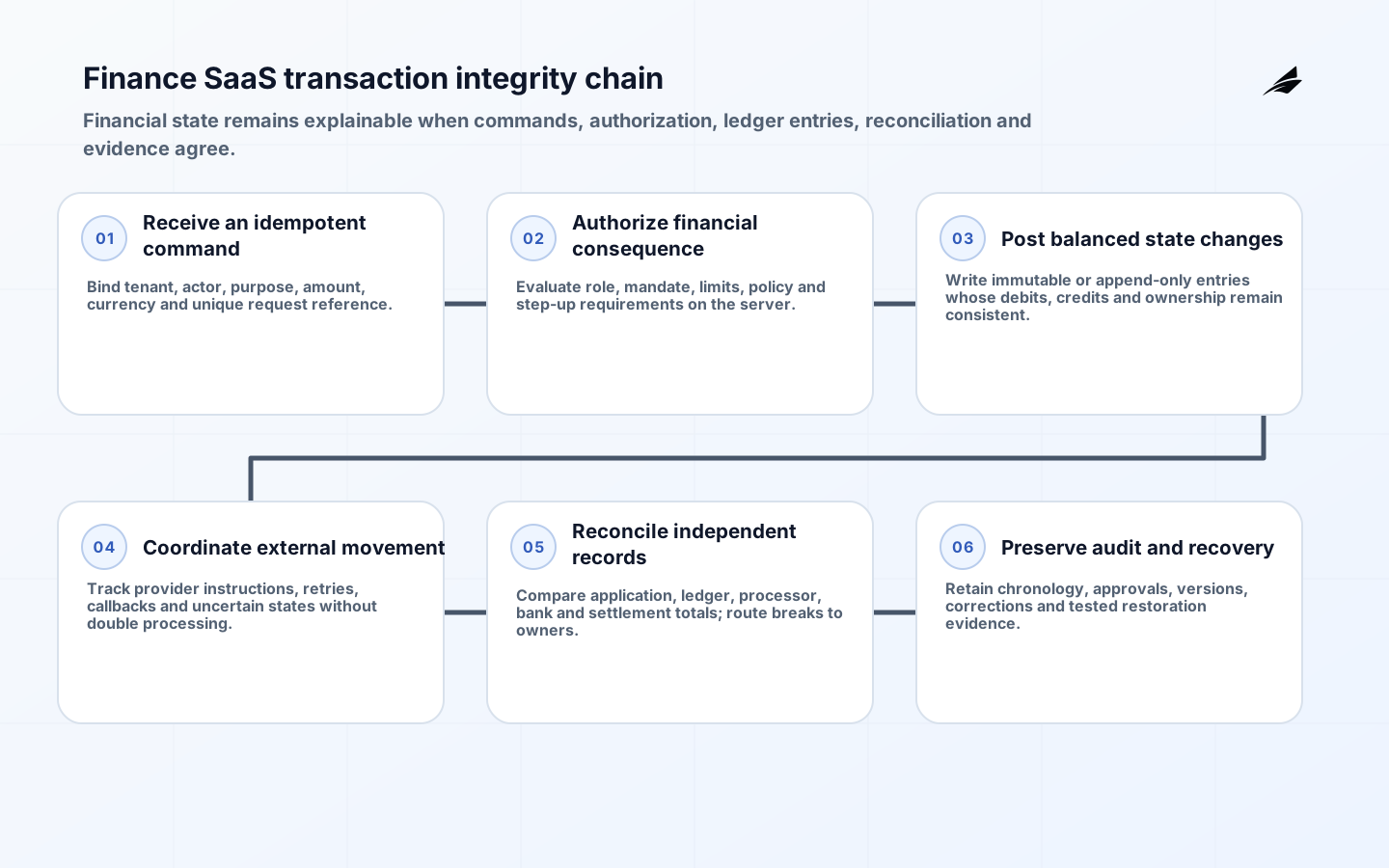
Finance SaaS product development must preserve amounts, ownership, authorization, chronology, and audit evidence under failure and attack. The checklist changes depending on whether the product handles payment-account data, moves funds, maintains a subledger, supports reporting, or only analyzes exported records. Those boundaries must be explicit before architecture and vendor claims are evaluated. A secure login alone does not make a financial workflow trustworthy. The primary planning lens is finance SaaS product development, with decisions expressed in language that product users and operating teams can verify.
Nearby planning resources include SaaS Product Development Company for Finance: Scope, Cost, Risks and Delivery Plan, SaaS Product Development Company for Finance FAQ, SaaS Product Development Company for Startups Implementation Checklist, SaaS Product Development Company for Startups FAQ. Those pages provide companion scope and checklist views; this article develops the technical and operating evidence for the topic here.
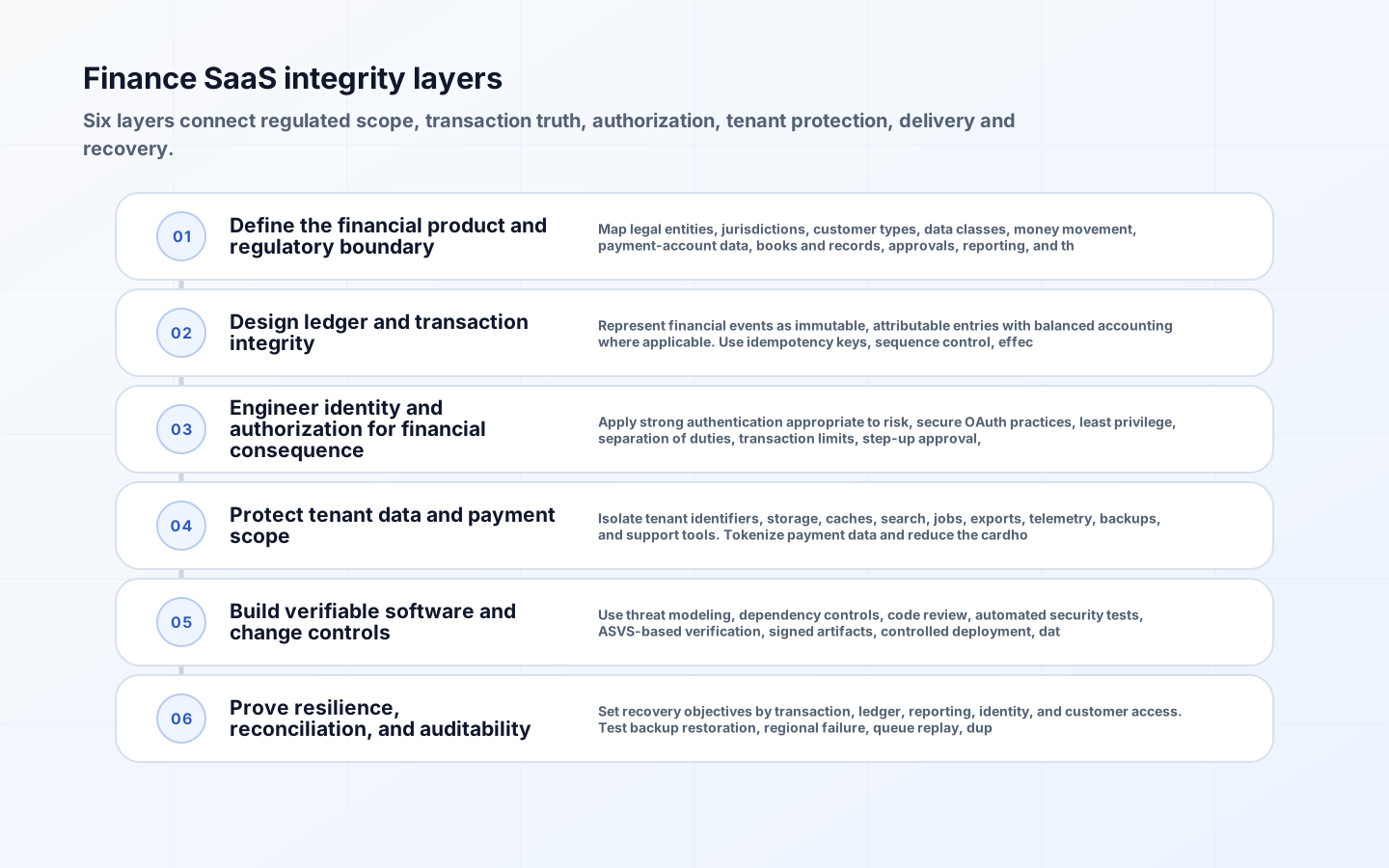
Define the financial product and regulatory boundary
Map legal entities, jurisdictions, customer types, data classes, money movement, payment-account data, books and records, approvals, reporting, and third parties. Obtain qualified legal and compliance analysis for the actual service.
Identify systems of record and the exact point where the SaaS product becomes authoritative. Separate informational projections from booked entries and payment instructions. Ambiguous boundaries can pull unexpected systems into PCI or regulatory scope and leave no owner for financial correctness.
Design ledger and transaction integrity

Represent financial events as immutable, attributable entries with balanced accounting where applicable. Use idempotency keys, sequence control, effective dates, currency precision, reversals, and reconciliation.
Preserve the source event and approval chain. Make corrections through governed adjustments rather than destructive edits, and close periods explicitly. Floating-point errors, duplicate retries, out-of-order events, and silent edits can change balances without obvious application failure.
| Decision area | Required decision | Acceptance evidence |
|---|---|---|
| Define the financial product and regulatory boundary | Map legal entities, jurisdictions, customer types, data classes, money movement, payment-account data, books and records, approvals, reporting, and third parties. Obtain qualified legal and compliance analysis for the actual service. | Identify systems of record and the exact point where the SaaS product becomes authoritative. Separate informational projections from booked entries and payment instructions. |
| Design ledger and transaction integrity | Represent financial events as immutable, attributable entries with balanced accounting where applicable. Use idempotency keys, sequence control, effective dates, currency precision, reversals, and reconciliation. | Preserve the source event and approval chain. Make corrections through governed adjustments rather than destructive edits, and close periods explicitly. |
| Engineer identity and authorization for financial consequence | Apply strong authentication appropriate to risk, secure OAuth practices, least privilege, separation of duties, transaction limits, step-up approval, and controlled administrative access. | Model organization, account, role, resource, and action explicitly. Test join, role change, leave, emergency access, delegated authority, and revocation across tenants. |
Engineer identity and authorization for financial consequence
Apply strong authentication appropriate to risk, secure OAuth practices, least privilege, separation of duties, transaction limits, step-up approval, and controlled administrative access.
Model organization, account, role, resource, and action explicitly. Test join, role change, leave, emergency access, delegated authority, and revocation across tenants. A user who can create and approve the same beneficiary or journal defeats workflow controls even when every action is authenticated.
Protect tenant data and payment scope
Isolate tenant identifiers, storage, caches, search, jobs, exports, telemetry, backups, and support tools. Tokenize payment data and reduce the cardholder-data environment where PCI DSS applies.
Encrypt data in transit and at rest, govern keys and secrets, minimize production copying, and prevent sensitive values from entering logs or lower environments. Cross-tenant leakage often occurs in background jobs, object storage, analytics, and support paths rather than the main user interface.
| Control area | Failure to prevent | Production proof |
|---|---|---|
| Protect tenant data and payment scope | Cross-tenant leakage often occurs in background jobs, object storage, analytics, and support paths rather than the main user interface. | Encrypt data in transit and at rest, govern keys and secrets, minimize production copying, and prevent sensitive values from entering logs or lower environments. |
| Build verifiable software and change controls | An unreviewed migration or feature flag can alter financial behavior as materially as an application release. | Separate production access from delivery authority. Reconcile configuration and infrastructure changes, and define emergency change rules with retrospective review. |
| Prove resilience, reconciliation, and auditability | A service can return to availability while balances, settlement state, or audit sequence remain incomplete or duplicated. | Ensure audit records capture who, what, when, tenant, authorization context, before and after state, correlation, and reason without exposing secrets. |
Build verifiable software and change controls
Use threat modeling, dependency controls, code review, automated security tests, ASVS-based verification, signed artifacts, controlled deployment, database migration checks, and auditable approvals.
Separate production access from delivery authority. Reconcile configuration and infrastructure changes, and define emergency change rules with retrospective review. An unreviewed migration or feature flag can alter financial behavior as materially as an application release.
Prove resilience, reconciliation, and auditability
Set recovery objectives by transaction, ledger, reporting, identity, and customer access. Test backup restoration, regional failure, queue replay, duplicate suppression, and reconciliation against external processors or banks.
Ensure audit records capture who, what, when, tenant, authorization context, before and after state, correlation, and reason without exposing secrets. A service can return to availability while balances, settlement state, or audit sequence remain incomplete or duplicated.
Finance SaaS release evidence
Require an approved scope memo, data and money-flow diagram, ledger invariants, authorization matrix, tenant-isolation results, PCI applicability decision, threat model, ASVS verification, reconciliation tests, recovery exercise, audit samples, and customer support controls. Finance owners accept accounting behavior; security accepts identity and data controls; operations own settlement, reconciliation, alerting, and restoration; compliance approves required evidence and retention.
Run a production-like scenario with duplicate payment notification, delayed processor response, partial database outage, currency precision edge, reversed transaction, expired approver authority, cross-tenant object request, lost signing key access, failed migration, and restored queue. Approval requires exact reconciliation, no unauthorized completion, and an audit trail that explains the final state without manual reconstruction from unrelated logs.
Taken together, the decision for finance SaaS product development must connect define the financial product and regulatory boundary, design ledger and transaction integrity, engineer identity and authorization for financial consequence, protect tenant data and payment scope, build verifiable software and change controls, prove resilience, reconciliation, and auditability. The release review should show which owner accepts each decision, where its source evidence is stored, which threshold blocks production, and how a failed dependency or incorrect result is contained. It should also explain how changes to data, policy, integrations, identities, customer scope, or software versions trigger renewed testing. That linkage matters because controls assessed independently can still conflict in operation: a secure interface may carry stale data, a reliable service may enforce the wrong authority, and a useful workflow may become uneconomic when review or support demand rises. Record these dependencies as maintained product artifacts, not one-time project notes, so later operators can distinguish an approved constraint from an accidental behavior.
The control chain starts with define the financial product and regulatory boundary: Map legal entities, jurisdictions, customer types, data classes, money movement, payment-account data, books and records, approvals, reporting, and third parties. Obtain qualified legal and compliance analysis for the actual service. Evidence must explicitly guard against Ambiguous boundaries can pull unexpected systems into PCI or regulatory scope and leave no owner for financial correctness. Next, design ledger and transaction integrity: Represent financial events as immutable, attributable entries with balanced accounting where applicable. Use idempotency keys, sequence control, effective dates, currency precision, reversals, and reconciliation. Evidence must explicitly guard against Floating-point errors, duplicate retries, out-of-order events, and silent edits can change balances without obvious application failure. Next, engineer identity and authorization for financial consequence: Apply strong authentication appropriate to risk, secure OAuth practices, least privilege, separation of duties, transaction limits, step-up approval, and controlled administrative access. Evidence must explicitly guard against A user who can create and approve the same beneficiary or journal defeats workflow controls even when every action is authenticated. Next, protect tenant data and payment scope: Isolate tenant identifiers, storage, caches, search, jobs, exports, telemetry, backups, and support tools. Tokenize payment data and reduce the cardholder-data environment where PCI DSS applies. Evidence must explicitly guard against Cross-tenant leakage often occurs in background jobs, object storage, analytics, and support paths rather than the main user interface. Next, build verifiable software and change controls: Use threat modeling, dependency controls, code review, automated security tests, ASVS-based verification, signed artifacts, controlled deployment, database migration checks, and auditable approvals. Evidence must explicitly guard against An unreviewed migration or feature flag can alter financial behavior as materially as an application release. Next, prove resilience, reconciliation, and auditability: Set recovery objectives by transaction, ledger, reporting, identity, and customer access. Test backup restoration, regional failure, queue replay, duplicate suppression, and reconciliation against external processors or banks. Evidence must explicitly guard against A service can return to availability while balances, settlement state, or audit sequence remain incomplete or duplicated. Reading these checks as one chain prevents a local pass from hiding an end-to-end failure. The accountable owners should review the chain after any material incident or change and record whether the original assumptions, thresholds, and fallback remain valid.
Implementation takeaways
- Define authority and regulatory scope before architecture.
- Make financial events immutable, idempotent, precise, and reconcilable.
- Enforce separation of duties and consequence-based authorization.
- Test tenant isolation beyond the user-facing request path.
- Verify financial state after recovery, not only service availability.
Frequently asked questions
| Question | Answer |
|---|---|
| Does PCI DSS apply to every finance SaaS product? | No. Applicability depends on whether and how payment-account data is stored, processed, or transmitted; obtain a scoped assessment. |
| Should balances be edited directly? | Prefer governed entries, reversals, and adjustments that preserve chronology and evidence. |
| What is the most important recovery test? | Restore and replay while proving that every financial event appears exactly as intended and reconciles with external systems. |
| How should support access work? | Use strong authentication, explicit customer or break-glass approval, narrow scope, expiry, logging, and regular review. |
Conclusion
A finance SaaS release is credible when the organization can explain every material balance or instruction through source event, authorization, ledger treatment, integration result, and audit evidence. Security controls and accounting integrity are parts of the same product behavior.
The implementation checklist should end with reconciliation under failure. If the platform cannot survive retries, stale authority, partial outages, and recovery without changing financial truth, more features only increase the exposure. Scale follows proven correctness, isolation, and operational ownership.