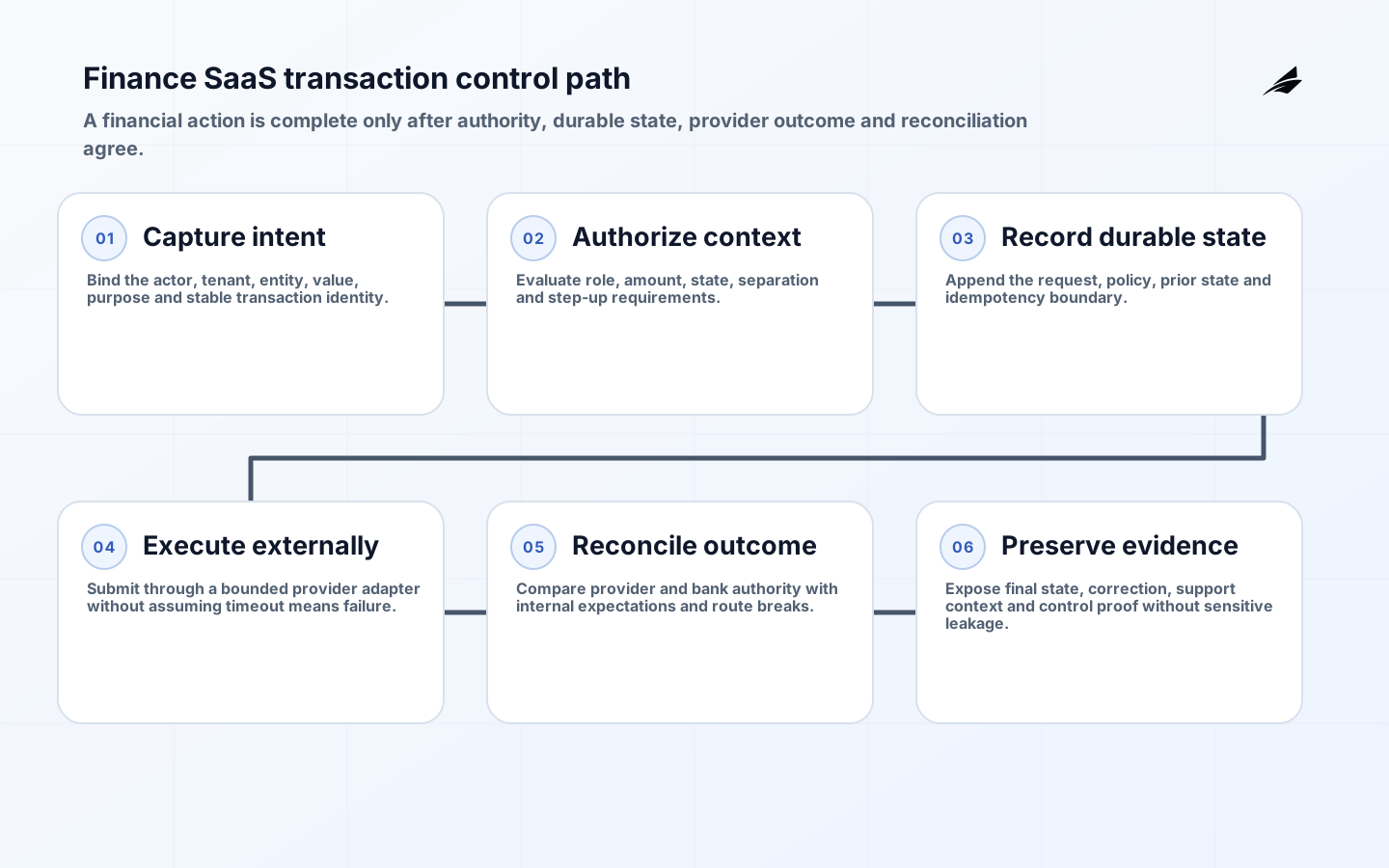
Choosing a SaaS product development company for finance is an architecture, control and operating-model decision as much as a software decision. A finance product may move money, calculate balances, originate credit, reconcile accounts, generate regulatory records or provide data on which customers act. A polished interface cannot compensate for ambiguous transaction state, weak authorization or evidence that disappears during an incident. The product must make every consequential action attributable, bounded, reversible where possible and reconcilable against an authoritative record.
This FAQ helps product, engineering, risk and operations leaders test whether a proposed finance SaaS is ready to build and run. It complements the finance SaaS implementation checklist. Applicable obligations vary by jurisdiction, institution, activity and data. The engineering team should map those obligations with qualified legal, compliance, security and finance owners; it should never represent a generic cloud architecture as automatic regulatory compliance.
What should a finance SaaS product prove first?
Prove one complete financial outcome. For an accounts-payable product, that might be: an authorized invoice is matched, approved under the correct policy, submitted once, confirmed by the payment provider and reconciled to the ledger, while exceptions reach an owner. For lending, it may be an application decision with approved inputs, reason codes, review authority and preserved evidence. Write the journey with actors, values, states, systems, time limits, control points and failure outcomes before splitting it into screens or services.
Define the authoritative record for each fact. The SaaS product may own workflow state while a bank owns settlement status, an ERP owns the posted journal and an identity provider owns workforce authentication. Avoid copying data without a reconciliation rule. For every mutation identify the requester, approver, policy version, idempotency key, previous state, resulting state and external confirmation. This gives engineers a precise contract and gives operations enough evidence to distinguish delay, duplication, rejection and loss.
| Design question | Required decision | Evidence |
|---|---|---|
| Who may act? | Role, amount, entity and context policy | Authorization decision and policy version |
| What is final? | Pending, accepted, settled, reversed and failed states | Provider response plus reconciliation |
| Who owns the fact? | System of record for each field | Lineage and conflict rule |
| What can repeat? | Idempotency and retry boundary | Stable request key and outcome |
| What needs review? | Threshold and reviewer authority | Decision, reason and timestamp |
Does every finance product need a ledger?
Not every product needs to become the accounting ledger, but every money-like workflow needs durable transaction state. If the product holds balances or represents transfers between accounts, a double-entry model is often appropriate because debits and credits preserve an auditable invariant. If it only orchestrates payments, an append-only transaction journal with external identifiers and reconciliation may be enough. Do not call a mutable status column a ledger. Corrections should be represented as new events or reversals so history remains explainable.

Separate the business transaction from transport attempts. A payment can have one business identity and several provider requests due to timeouts. Use idempotency keys, monotonic state transitions and a reconciliation worker that compares internal expectations with provider and bank records. Never interpret a network timeout as a definitive failure. Design suspense and exception queues for uncertain outcomes, with amount, age, owner and permitted actions visible. Reconciliation is not a back-office afterthought; it is how the product proves financial correctness.
Which security controls belong in the product design?
Start with strong identity, explicit tenant and legal-entity boundaries, least privilege, separation of duties and transaction-level authorization. Authentication establishes who is present; authorization determines whether that subject may perform this action for this entity, account, amount and workflow state. Apply step-up verification to consequential actions based on risk. Protect administrative support paths with time-bound access and customer-visible evidence. Test object-level authorization so changing an identifier cannot expose another tenant's invoice, account or report.
Use NIST SSDF to integrate security requirements, protected build environments, component verification, secure design, testing and vulnerability response into delivery. OWASP ASVS 5.0 provides testable application-security requirements. Encrypt sensitive data in transit and at rest, centralize secrets and key lifecycle management, minimize retained data and classify logs. Logs should explain activity without becoming a shadow store of account numbers, credentials or personal data. Threat-model payment redirection, approval takeover, tenant escape, duplicate execution, insider abuse, dependency compromise and report manipulation.
How should compliance shape scope without taking it over?
Create an obligation-to-control map. For each applicable law, rule, contract or standard, identify the business activity, data, control owner, system behavior, evidence, test method and review cadence. PCI DSS v4.0.1 applies to environments that store, process or transmit payment account data or can affect the security of the cardholder-data environment; actual scope depends on the implemented payment flow. Tokenization and hosted payment components may reduce exposure, but only validated architecture and responsibility mapping can establish the result.
Financial institutions and their technology providers should expect scrutiny of development, acquisition, maintenance, governance, third-party connections, security and resilience. The FFIEC's 2024 booklet update emphasizes these connected practices for examination. Build control evidence as a product of normal work: reviewed changes, test results, access decisions, data lineage, reconciliations, restore exercises and incident records. A document assembled just before an audit is usually weaker and more expensive than evidence emitted by the delivery and operational paths.
| Control area | Product behavior | Operational proof |
|---|---|---|
| Tenant isolation | Server-side scope on every request and job | Cross-tenant negative tests |
| Transaction authorization | Context and amount-aware policy | Decision log and reviewer evidence |
| Change integrity | Reviewed immutable build and promotion | Source, artifact and deployment chain |
| Resilience | Idempotency, bounded retries and recovery | Failure exercise and reconciliation |
| Data protection | Minimization, encryption and retention | Inventory, key and deletion evidence |
How should banking, payment and ERP integrations work?
Treat each provider as an asynchronous state machine even if its API looks synchronous. Document authentication, scopes, request signing, idempotency, rate limits, callbacks, sequence rules, maintenance windows, error taxonomy and reconciliation source. Verify webhook signatures and replay resistance, store provider event identifiers, and process events idempotently. Do not rely on webhook arrival alone; poll or reconcile from an authoritative provider endpoint when the consequence warrants it. Version adapters so one provider's terminology does not leak into the core domain model.
Design provider substitution before it is urgent. Keep credentials, routing, mapping and provider-specific behavior behind explicit interfaces. Record what cannot be portable, such as token vaults or account mandates. Test sandbox differences against a controlled production pilot because financial sandboxes often simplify timing and failure. Coordinate load tests and never create real charges unintentionally. For exports, define field meanings, time zones, rounding, currency precision and correction behavior; a technically valid file can still post the wrong accounting result.
What does production readiness look like?
Set service objectives around completed financial outcomes, not HTTP uptime alone. Measure authorization success, transaction age, reconciliation breaks, duplicate prevention, queue age, report freshness and customer-impact minutes. Instrument metrics, traces and logs before launch and propagate transaction and tenant-safe correlation identifiers. Alert on invariant violations and stuck state rather than every transient provider error. Capacity tests should include settlement peaks, batch imports, reporting, retry storms and a slow dependency.
Define recovery at the transaction and data levels. Restore a backup into an isolated environment, verify keys and dependencies, and reconcile restored records with authoritative external statements. Test region or provider failure without duplicating a payment. Write incident authority: who can pause execution, disable a tenant, rotate credentials, approve manual repair and communicate with customers or authorities. Preserve evidence while protecting sensitive data. A rollback of application code cannot undo a transfer already submitted, so use forward correction and compensating transactions where necessary.
How should the product be delivered in controlled stages?
- Map one financial journey, authoritative records, obligations and failure outcomes.
- Prototype the riskiest authorization, provider and reconciliation assumptions.
- Build the transaction journal, tenant boundary and evidence model before broad features.
- Run security, correctness, recovery and finance-operations acceptance tests.
- Pilot with capped values, selected entities and manual reconciliation.
- Expand limits and cohorts only after stable evidence and support readiness.
- Review incidents, breaks, user behavior and control cost before the next scope increment.
Use explicit release gates with product, engineering, security, operations, finance and compliance owners. A first release should have narrow transaction types, value limits, supported currencies and integrations. It should also be operationally complete: monitoring, support, reconciliation, backups, access review and customer communication must exist. Track learning and risk retirement, not only feature velocity. The finance SaaS scope guide can keep cost and sequencing visible.
Key takeaways
- Model complete financial outcomes and uncertain states before screens.
- Keep durable, append-only evidence and reconcile every consequential external action.
- Enforce authorization by tenant, entity, amount and context, not role name alone.
- Map applicable obligations to product behavior and continuously generated evidence.
- Pilot with bounded value and scope, then expand only after recovery and support work.
Frequently asked questions
Can a startup claim its finance SaaS is compliant?
Only in relation to clearly identified requirements, scope, evidence and any required assessment. Avoid a blanket claim. Laws and regulatory permissions vary, and standards such as PCI DSS apply according to actual data flows and responsibilities.
Should payments be built directly into the core product?
Keep the business transaction model in the core domain, but isolate provider protocols in adapters. This preserves consistent authorization and reconciliation while allowing provider changes and reducing vendor-specific leakage.
What is the most important launch metric?
Use a small set: correct completed transactions, unresolved reconciliation breaks, duplicate-prevention failures, customer-impact minutes and critical authorization exceptions. No single metric is sufficient, but correctness and unresolved uncertainty should lead.
Conclusion
A trustworthy finance SaaS makes money movement, authority, system ownership and uncertainty explicit. Its product development team designs reconciliation, evidence, security and recovery with the first journey rather than adding them after growth. That discipline creates a narrower but genuinely operable first release and a sound foundation for new entities, providers and regulated activities.