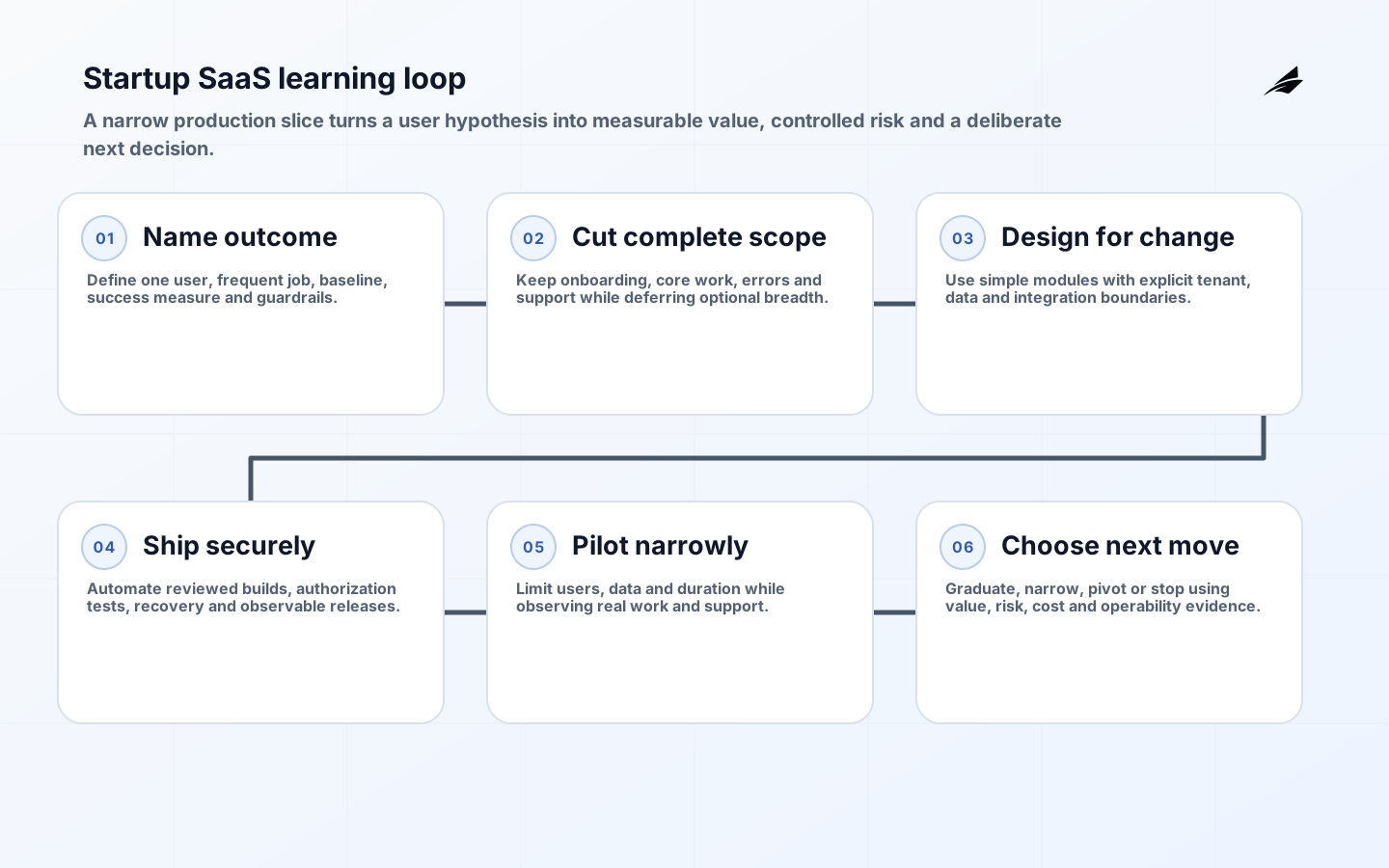
A SaaS product development company for startups should help the founders remove uncertainty, not convert every idea into code. The first implementation must prove that a defined user can complete a valuable job, that the startup can deliver the outcome repeatedly, and that the service can be operated safely with the available team. Scope, architecture and launch are therefore one decision system. A feature that cannot be supported, observed or changed is not truly complete, even when it looks finished in a demonstration.
This checklist moves from evidence to a controlled first release. DORA's current small-batch guidance connects small, independently valuable changes with faster feedback. GOV.UK's service guidance similarly emphasizes user needs, iterative delivery and continued planning. For a startup, those are survival disciplines: cash and attention are limited, so each build slice should retire a specific product, technical, security or operational risk. The companion startup SaaS FAQ addresses common buying and team questions.
1. Define one user, one job and one measurable outcome
Write the first product promise in observable terms: “An operations manager can import a weekly order file, resolve invalid rows and publish an approved schedule in under 20 minutes.” Name the user, trigger, starting material, completed state, frequency and consequence. Interview people who perform the work and inspect real examples. Capture workarounds, exceptions, approvals, handoffs and the current cost of delay. Compliments about an idea are weaker evidence than a user allowing the team to observe a painful workflow or committing to a pilot.
Choose one primary outcome metric and guardrails. The outcome might be time to complete the job, successful first-run completion, resolved cases or retained active teams. Guardrails might cover incorrect records, support burden, customer waiting time and security exceptions. Establish a baseline before launch. Avoid vanity measures such as registrations without activation or page views without task completion. Record the riskiest assumptions: user access, willingness to change behavior, data availability, integration feasibility, buying authority and acceptable price.
2. Cut the MVP to a complete learning path
Map the end-to-end job and select the smallest path that produces the promised outcome for a narrow segment. Include necessary onboarding, error recovery and support; removing them can create a demo rather than a viable product. Defer additional roles, customization, rare integrations and broad analytics unless they are essential to the first decision. Use concierge work deliberately when it helps test demand, but label it and measure its labor. A manual step hidden from the plan becomes an unpriced operational dependency.
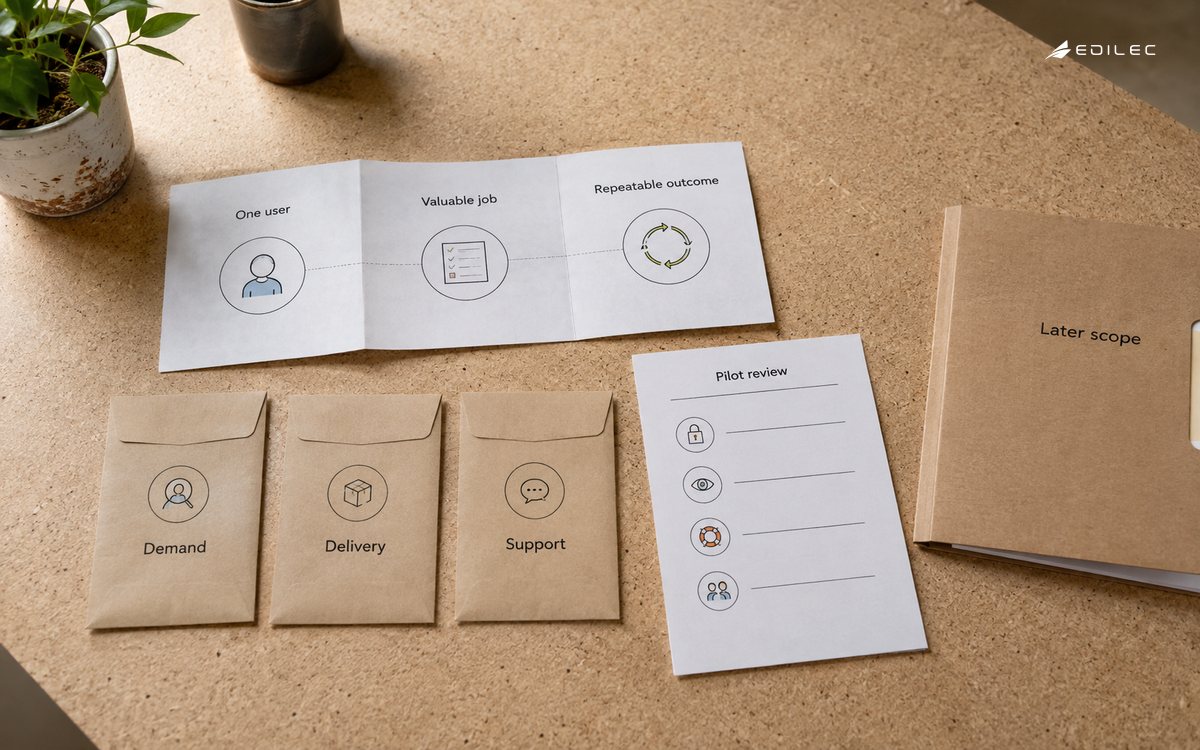
Turn assumptions into slices that can be built and evaluated independently. A vertical slice crosses interface, service, data and operations for one behavior. Define acceptance with an example, expected data state, permission rule, telemetry and failure response. Keep a “not now” list with reasons and review triggers so rejected ideas do not return silently. Time-box prototypes for risky integrations or algorithms, and expect to discard prototype code if it lacks the security, tests and operability required for production.
| MVP question | Include now when | Defer when |
|---|---|---|
| Second user role | The first outcome requires separation or approval | It only improves convenience |
| Integration | Users cannot complete the job without it | A controlled import proves the workflow |
| Customization | A bounded setting unlocks the target segment | Each customer needs bespoke logic |
| Analytics | It proves the core outcome or detects failure | It is general reporting |
| Automation | Manual work prevents a credible pilot | Concierge work can test demand safely |
3. Choose an architecture sized for change
Prefer a modular monolith or a small number of services unless workload or organizational boundaries justify distribution. Define modules around domain behavior and keep interfaces explicit. Use a managed relational database for transactional data when it fits; it provides constraints and transaction semantics that many early products need. Create separate production and nonproduction environments, infrastructure as code, automated backups and a repeatable deployment path. Record a short architecture decision whenever a choice creates meaningful lock-in or operating cost.
Design tenancy explicitly. Identify how every request, query, background job, cache entry, object and export is scoped. Enforce tenant boundaries server-side and test cross-tenant negative cases. Decide whether a user may belong to several tenants and how the active context changes. Add stable identifiers, timestamps and lifecycle states. Keep third-party adapters behind clear contracts and make retries idempotent. Avoid premature platform complexity, but do not postpone the boundaries that prevent data exposure or impossible migrations.
4. Build the minimum secure product
Create a lightweight threat model for account takeover, tenant escape, broken authorization, injection, secret leakage, dependency compromise, abusive automation and data loss. Use a managed identity provider when practical, require multifactor authentication for administrators, apply least privilege and separate support from routine user authority. Centralize secrets, encrypt transport, control production access and preserve attributable administrative activity. Collect only data required for the product promise and define retention and deletion before customers ask.
NIST SSDF provides a compact structure: prepare the organization, protect software, produce well-secured releases and respond to vulnerabilities. Put source review, dependency inventory, secret scanning, automated tests and immutable artifact promotion into the normal delivery path. Use OWASP ASVS 5.0 to turn application risks into testable requirements appropriate to the product. Publish a vulnerability contact and an incident route. Security work should be proportional, but “early stage” does not make cross-tenant access or unrecoverable data acceptable.
| Launch gate | Evidence | Blocker |
|---|---|---|
| User value | Target users complete the core job | Outcome depends on founder intervention |
| Authorization | Role and tenant negative tests pass | Object can cross tenant boundary |
| Data | Backup restore and deletion path tested | Authoritative data cannot be recovered |
| Delivery | Reviewed build deploys and rolls forward safely | Production change is manual and opaque |
| Operations | Alerts, support and ownership are exercised | Critical failure has no responder |
5. Establish a small-batch delivery system
Keep source, configuration and schema changes in version control. Build once, test automatically and promote the same artifact. Add fast unit, integration, authorization and migration tests, then a small number of end-to-end journeys. Use backward-compatible schema changes so deployment is recoverable. Feature flags can separate deployment from user exposure, but each flag needs an owner and removal date. Review changes in small pieces and keep the main branch releasable; large branches delay feedback and hide integration risk.
Define a release checklist that is short because controls are automated: tests pass, migration is safe, telemetry exists, customer impact is understood and recovery is ready. Release to internal users or a pilot tenant first, then expand based on evidence. Google SRE's launch guidance treats launches as a shared operational responsibility rather than a last-minute handoff. Start launch reviews early for high-risk changes and name owners for capacity, dependency, security, support and rollback decisions.
6. Instrument product learning and service health
Define product events from the core journey: onboarding started, input accepted, exception raised, outcome completed and value revisited. Include safe tenant and workflow identifiers without placing secrets or sensitive content in analytics. Pair events with qualitative interviews and support conversations; a funnel shows where users stop, not why. Review activation by target segment and cohort instead of averaging incompatible users. Document each metric's definition so a tracking change does not masquerade as product improvement.
Instrument technical signals before launch. OpenTelemetry describes traces, metrics and logs as complementary signals. Metrics show rates and saturation, traces show the path through services and dependencies, and logs preserve events and error context. Add service objectives for core journey availability and latency, plus data correctness, queue age and background completion. Alerts should lead to a specific action. A dashboard nobody owns and an alert nobody can diagnose are decoration, not an operating capability.
7. Run a bounded pilot and make an explicit decision
- Select users who match the defined segment and agree on the job being tested.
- Import or create realistic data through the intended onboarding path.
- Observe the complete journey, including errors, support and return use.
- Review outcome, guardrail, reliability and support measures each week.
- Fix blockers in small slices and avoid expanding scope to satisfy one outlier.
- Test backup recovery, incident contact and customer communication during the pilot.
- At the decision date, continue, change the hypothesis, narrow the segment or stop.
Set pilot limits for users, data, volume, integrations and duration. Tell participants what is experimental and how support works. Keep an issue register that separates product gaps, defects, security findings and operational debt. Define the graduation criteria before enthusiasm rises: enough target users complete and repeat the outcome; unit economics have a credible path; critical risks are controlled; and the team can support the service. A successful pilot can still justify a pivot if the wrong segment obtained value.
8. Prepare the company, not only the application
Assign product, technical and service owners. Define support hours, severity, escalation, status communication, access requests, data corrections and incident review. Create terms, privacy information and customer commitments with qualified advice appropriate to the markets served. Track cloud, vendor, support and engineering costs per active tenant or completed unit. Review third-party dependency health and renewal risk. The first customer contract should not promise bespoke availability, security or data behavior the product cannot deliver.
Maintain a 90-day roadmap expressed as outcomes and risks, with detailed work only for the near term. Reserve capacity for defects, security and reliability rather than funding features alone. Review adoption, retention, support burden, delivery performance and service health together. Architecture should evolve when observed scale, team topology or compliance needs demand it. Replacing a simple design because a hypothetical future company might need microservices is usually less valuable than improving the current learning loop.
Key takeaways
- Use the first release to test one outcome for one segment.
- Keep scope narrow but include onboarding, errors, support and operations.
- Design tenant authorization, data recovery and delivery discipline from the start.
- Combine product events with traces, metrics, logs and direct user research.
- Graduate a pilot only through predefined value, risk and operability evidence.
Frequently asked questions
How long should a startup SaaS MVP take?
There is no universal duration. A useful first path is usually measured in weeks or a few months, but integration, regulated activity and data migration can extend it. Time-box discovery and risky prototypes, then estimate a narrow production path with explicit assumptions.
Should the startup outsource the whole product?
A delivery partner can supply skills and capacity, but the startup must retain product decisions, customer learning, data responsibility and operational accountability. Name internal owners and require transferable source, infrastructure, documentation and access.
When should the architecture be split into services?
Split when independently scaled workloads, isolation requirements, deployment boundaries or team ownership provide measurable benefit. Keep module contracts clean first. Distribution adds network failure, observability and data-consistency costs that a small team must operate.
Conclusion
Startup SaaS implementation succeeds when a small team can release, observe and support a complete user outcome while learning quickly enough to change direction. Narrow scope creates speed only when the product also has safe tenant boundaries, recoverable data, repeatable delivery and honest pilot evidence. Build that operating core first, and later features will compound learning instead of compounding fragility.