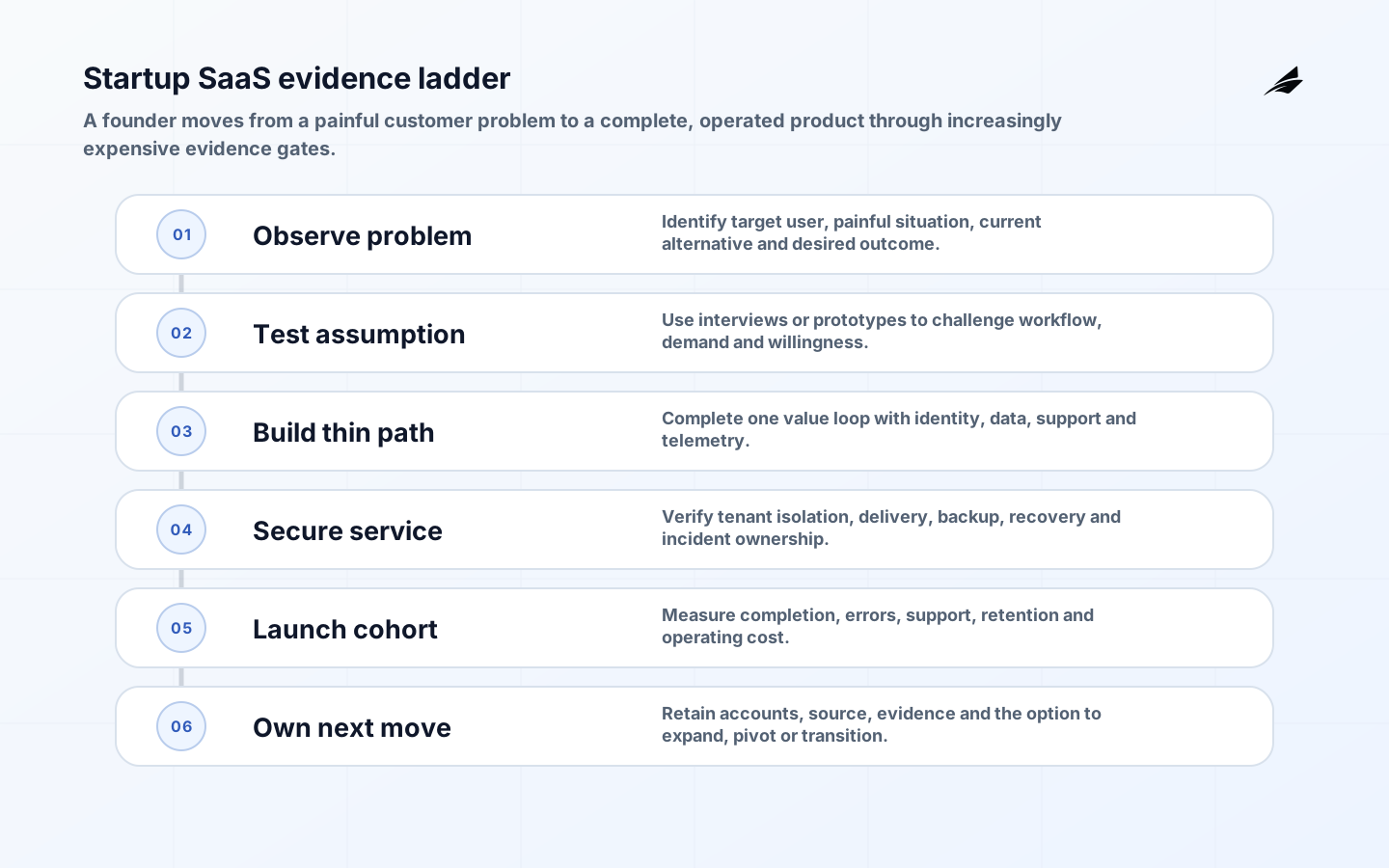
A SaaS product development company for startups should help a founder reduce product and delivery uncertainty, not simply turn a feature list into code. Early-stage products need evidence about users, pricing, workflow and distribution while also creating a service that can protect customer data, collect payment, support tenants and recover from failure. The right partner can provide product discovery, design, engineering, platform, quality and operational capability in one working team. The wrong arrangement can produce an expensive demonstration that nobody can operate or change without the supplier.
This FAQ explains how to define the first outcome, evaluate partners, scope an MVP, choose architecture, control security and cost, release safely and preserve ownership. It assumes the startup retains product direction and business risk. A development company can challenge assumptions and own delivery, but it cannot substitute for founder access to customers, priority decisions or accountability for promises. The selection process should therefore test how the proposed team thinks and works, not only whether its portfolio contains a similar-looking application.
What should be clear before contacting a development company?
Write the target user, painful situation, current alternative and desired outcome in plain language. Bring interview notes, workflow observations, constraints and unknowns rather than a rigid specification. Identify the smallest business loop: how a user arrives, receives value, pays or commits, and returns. Define one leading behavior and one outcome that would change the startup’s decision. For example, successful completion of an onboarding workflow is more useful than registrations, while repeated use by the intended role is more useful than page views.
State non-negotiable constraints such as launch window, regulatory market, data sensitivity, required integration, accessibility target and available operating capacity. Be honest about budget and cash timing. List assumptions requiring discovery: who buys, who uses, what data are available and what part of the process is truly differentiating. A credible partner will propose ways to test those assumptions before implementing the most expensive architecture. Be cautious when every requested feature is accepted without questions about evidence, sequence or operating consequences.
| Selection area | Evidence to request | Warning sign |
|---|---|---|
| Product thinking | A past hypothesis, test and changed decision | Feature estimates without user or outcome questions |
| Engineering | Architecture tradeoff and production failure example | Tool list presented as an architecture |
| Security | Threat model, secure delivery and vulnerability process | Compliance claimed through hosting alone |
| Operations | Telemetry, incident and recovery artifacts | Support begins only after a separate handover |
| Ownership | Customer-controlled repositories, accounts and exit plan | Source or cloud access deferred until final payment |
How should a startup evaluate the proposed team?
Meet the people who will perform the work. Give them a representative scenario and ask how they would discover the workflow, reduce scope, model data, protect tenant boundaries, test the release and observe it in production. Look for explicit tradeoffs and questions. Review a sanitized architecture decision, pull request, test strategy, incident review and runbook. Verify the availability of senior roles and whether they are shared across accounts. References are most useful when they cover setbacks, communication and handover rather than only launch praise.
Choose a commercial model that supports learning. A short paid discovery can produce outcome scope, prototype, risk map, architecture direction and delivery forecast. Fixed price works best when requirements and acceptance are genuinely stable; early product work often is not. Time-and-materials still needs budget, review cadence and outcome gates. Define how scope, assumptions and change are recorded. Avoid using story points or team utilization as the primary evidence of value; working software, validated learning and operating health matter more.
What belongs in a SaaS MVP?
An MVP should complete one end-to-end value path for a narrowly defined user. It usually needs more than the visible feature: authentication, tenant creation, authorization, core records, notifications, support, basic administration, telemetry, backup and a way to correct mistakes. Billing may be manual initially if the learning goal does not require automated plans, but payment and entitlement behavior must still be controlled. Remove decorative dashboards, broad customization and speculative integrations unless they are essential to the first outcome.

Define release acceptance in examples. State who can do what, with which data, and what happens on error or retry. Include empty, loading, partial, unauthorized and failed states. Test the target browser and mobile sizes, keyboard operation and accessibility of the complete journey. WCAG 2.2 provides a current standard for accessible web content; agreeing an appropriate conformance target early avoids treating accessibility as visual cleanup after architecture and components are fixed.
Which architecture is appropriate for an early SaaS product?
Prefer a simple deployable system with clear modules and managed dependencies unless scale, isolation or team structure justifies more. A modular monolith can support strong boundaries without the network, deployment and observability burden of many services. Define tenant identity at the data and authorization layers, not only in the URL. Establish one source of truth for billing and entitlements. Use background jobs for slow work with idempotency, retry bounds and dead-letter handling. Record architecture decisions and the conditions that would justify change.
Avoid premature provider abstraction that makes every service lowest-common-denominator. Preserve portability where it matters through owned data, standard interfaces, infrastructure definitions and tested export. Choose regions and services based on customers, data obligations, availability, team skill and cost. Create separate development, test and production environments with controlled promotion. Production changes should come from versioned pipelines, not an engineer’s laptop. The startup should own cloud, domain, source-control, payment and application-store accounts from the beginning.
What security evidence should be present before launch?
Apply secure development in the normal workflow. NIST’s SSDF describes outcomes for preparing the organization, protecting software, producing secure releases and responding to vulnerabilities. For an MVP, that means defined security requirements, protected repositories, peer review, dependency and secret controls, threat modeling, automated testing, hardened configuration and a vulnerability contact. The depth should follow data and consequence, but “early stage” is not a reason to omit tenant isolation, access revocation, backup or incident response.
Use an established identity service or well-maintained library. If OAuth or federated login is involved, follow current best practice such as authorization code with PKCE, exact redirect validation and protection of refresh tokens. Enforce authorization for every object and action on the server. Test cross-tenant access, invitation abuse, account recovery, file upload and administrative impersonation. Encrypt sensitive data, manage keys and secrets outside source, minimize production access and retain useful audit records without logging credentials or complete sensitive payloads.
| Launch gate | Minimum evidence | Owner |
|---|---|---|
| Product | Complete target journey and defined support path | Founder or product owner |
| Tenant security | Isolation and authorization tests across roles | Technical owner |
| Delivery | Repeatable build, test, deployment and rollback | Engineering lead |
| Operations | Service signals, alerts, runbooks and on-call route | Service owner |
| Recovery | Successful restore with measured data and time | Engineering and business owner |
| Ownership | Startup controls code, cloud, domains and suppliers | Founder or operations owner |
How should the first release be operated?
Release to a small, observable cohort with a direct feedback channel. Instrument the value path and its dependencies using metrics, logs and traces. OpenTelemetry provides shared observability concepts, but the team must define service-level signals and sensitive-data rules. Track activation, completion, failure, latency, support contacts, authorization denials and infrastructure cost. Watch real sessions and interview users; analytics explain where something happened, not always why. Use feature controls and a tested rollback or disable path.
Operate incidents as learning. Define severity, response ownership, customer communication and evidence preservation. After a failure, fix the system through code, tests, monitoring and runbooks rather than blaming an individual. DORA’s current delivery metrics cover throughput and instability; follow one service over time and improve the largest constraint. A startup does not need a large operations organization, but it does need someone authorized and able to respond when customers cannot use the product.
How should budget and timeline be governed?
Build a forecast from team capacity, discovery uncertainty, third-party fees, cloud consumption, security or legal work, launch support and contingency. Review forecast-to-complete at each outcome gate. Track decisions that add recurring cost, including premium infrastructure, commercial APIs and manual operations. A low initial estimate can be misleading if quality, migration or support is excluded. Prefer a smaller complete scope with reliable operation over a wider launch followed by emergency rebuilding.
Timeline depends on evidence and integration risk, not a universal number of weeks. Use stages: discover, prove risky assumptions, deliver the complete thin path, release to a cohort, then expand. Set explicit stop or pivot criteria when users do not complete the workflow or acquisition assumptions fail. Sunk implementation cost should not force continued feature production. A good partner makes uncertainty visible and helps the founder preserve options.
What prevents vendor lock-in?
Use startup-owned repositories, cloud accounts and service registrations. Require architecture decisions, environment setup, data model, API contracts, test strategy, runbooks, incident history and open risks to stay current. Pair a startup technical owner with the partner even if that person is fractional. Exercise a build, deployment, restore and credential rotation without hidden vendor access. Contract terms should cover intellectual property, open-source obligations, subcontractors, data return, transition assistance and deletion, with legal review.
Handover is not necessarily the end of the relationship. It is evidence that continuation is optional. Remove departed-user access, rotate shared bootstrap secrets and verify ownership of domains, email, analytics, identity, payments and app stores. Maintain a prioritized backlog and service calendar. If another competent team cannot understand, deploy and operate the product from the owned artifacts, transition work remains.
Key takeaways
- Choose a development company for how it reduces uncertainty and operates software, not for feature output alone.
- Build one complete customer value path with identity, support, telemetry and recovery.
- Keep architecture simple while enforcing tenant and authorization boundaries from the start.
- Use customer-controlled accounts, repositories and decision records throughout the engagement.
- Release to a bounded cohort and measure completed outcomes, instability and learning.
Frequently asked questions
Does a nontechnical founder need a technical owner?
Yes. The role may begin as an experienced fractional leader, but someone independent of the supplier should understand architecture, risk, cost and operations well enough to make decisions and verify evidence.
Should a startup use no-code tools instead?
They can be effective for prototypes and some production workflows. Evaluate data, authorization, integration, accessibility, scale, export and operating ownership. Use the simplest approach that can safely test the business outcome.
Is a fixed-price MVP safer for the budget?
Only when scope and acceptance are stable. Otherwise the supplier may price uncertainty, resist learning or reduce quality. A capped discovery and staged delivery with transparent forecast can preserve stronger decision points.
Conclusion
The best SaaS product development company helps a startup learn faster while building a service customers can trust. That means challenging scope, making architecture and risk visible, releasing a complete thin path, responding to production and preserving founder ownership. A startup should finish each stage with more evidence and more capability—not only more code.