SaaS reliability means a customer can depend on a service’s important behavior over time, including when the system is busy, a release is incomplete, a provider is unavailable, or data needs to be restored. The term is often reduced to uptime, but uptime is only one part of the promise. A service can be reachable and still be unreliable if it returns stale permissions, silently drops jobs, produces incorrect reports, or leaves users without a recoverable next step. This plain-language SaaS reliability guide explains the operating model behind trust.
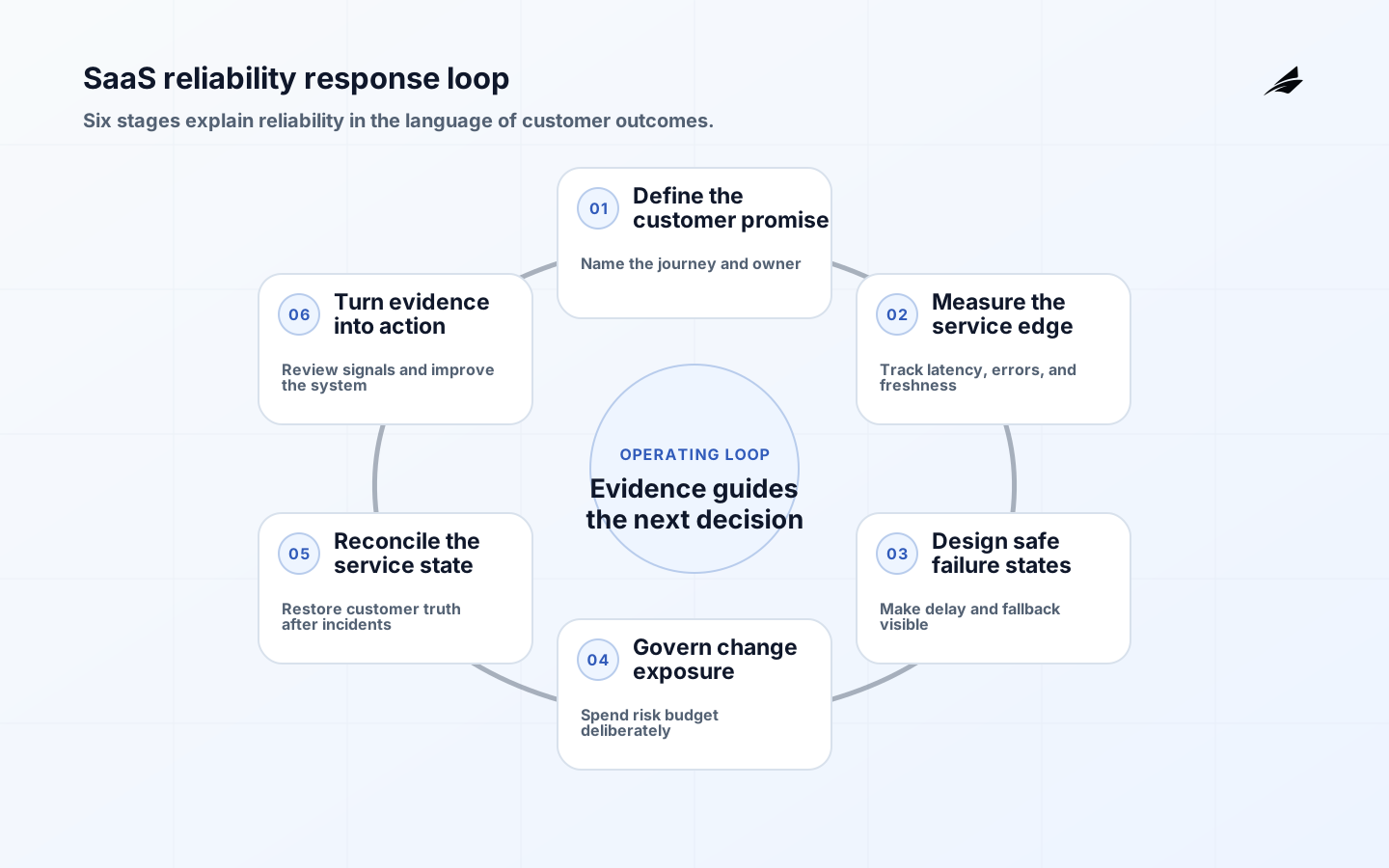
The simplest mental model is a control loop: understand the user outcome, measure it, compare it with an agreed target, act when it drifts, and improve the system. Google SRE’s SLO guidance provides the vocabulary of SLI, SLO, and error budget; AWS’s reliability pillar broadens the view to recovery, change, and resilient workload design. Use Edilec’s SaaS reliability operations playbook when the concepts need to become daily practice.
What SaaS reliability means in practice
Reliability is the probability that a user can complete an important task correctly within the expected time and with an understandable outcome. The task might be creating a workspace, processing a payment, publishing a report, or receiving a notification. Define the task in terms of the user’s goal, not the component. “The database is healthy” is an implementation observation; “an administrator can see the current member list” is a service outcome.
Reliability has several dimensions. Availability asks whether the service responds. Latency asks whether it responds soon enough. Correctness asks whether the result is right. Durability asks whether data survives. Consistency asks whether related views agree. Recoverability asks whether the team can return to a known state. Not every service needs the same depth, but ignoring a dimension does not remove its business impact.
| Dimension | Plain-language question | Example evidence |
|---|---|---|
| Availability | Can the user reach the task? | Successful completion rate |
| Latency | Does it finish within the useful window? | P95 or p99 task duration |
| Correctness | Is the result complete and accurate? | Reconciliation sample or invariant |
| Freshness | Does the view reflect the expected time? | Last-updated age and stale state |
| Recovery | Can the team restore and explain the result? | Restore drill and decision record |
Set expectations before setting technology targets
A service level objective is a promise about measured behavior over a defined population and period. It should state what is measured, who is included, the threshold, and how the result will be used. An operations leader might define that 99% of authenticated report requests return a correct result within 20 seconds each calendar month. The target is not a magic number; it is a decision tool that makes tradeoffs visible.
Avoid choosing a target because the current dashboard happens to show it. Google SRE recommends working backward from what users care about and warns that overly strict objectives can drive expensive, low-value work. Use customer commitments, support history, usage patterns, risk, and the cost of failure to set a starting point. Revisit the target when the product, customer mix, or architecture changes.
Measure the service at the edges
Instrument the user journey and the system path that supports it. A browser timing issue may not appear in a server metric; a successful HTTP response may hide a job that later fails. OpenTelemetry’s signals documentation provides common concepts for traces, metrics, and logs. Use traces to connect a request, metrics to see rates and distributions, and logs to explain a specific decision or failure. Add domain events where correctness matters.
Keep definitions stable. A latency metric needs a start, end, population, and aggregation; a “successful export” metric needs a completion and correctness rule. Version the definition when it changes. Segment by plan, region, client version, and tenant when a shared system produces different experiences. A single global average can hide the group paying the highest price for degradation.
| Signal | Useful for | Common mistake |
|---|---|---|
| Completion rate | Whether the user’s task finished | Counting HTTP 200 instead of business success |
| Tail latency | Slow users and queueing effects | Relying only on average |
| Error rate | Failure volume and trend | Mixing validation with system faults |
| Trace | Cross-service path and timing | Sampling away the rare failure |
| Log | Detailed context for diagnosis | Writing sensitive data without controls |
Make failure behavior part of the product
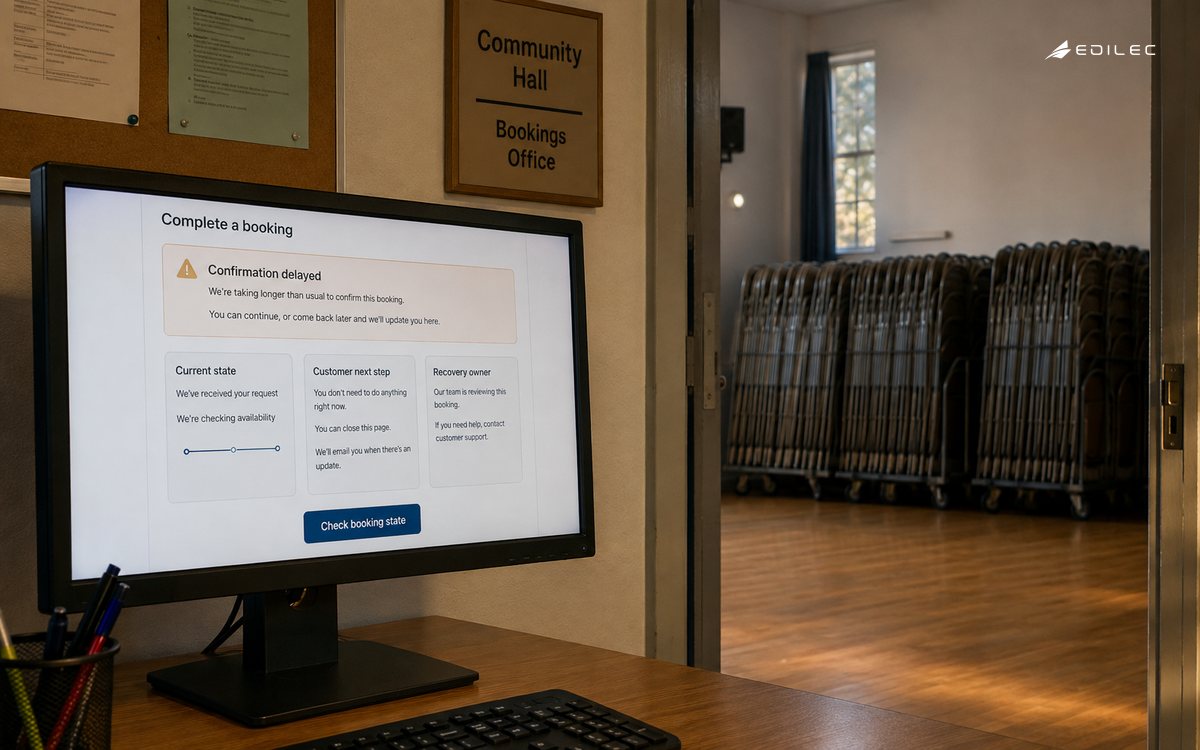
When a dependency fails, decide whether the service should retry, queue, degrade, reject, or ask the user to return later. Each choice needs a bound. Retries should not multiply load; queues should expose state and age; fallbacks should not display data that looks current when it is stale. A failure message should say what happened, what the user can do, and whether support can see the same state.
Design the failure path with the business owner. A marketing dashboard may tolerate a delayed refresh; an entitlement check may need a safe, cached decision with a short validity window; a payment workflow may require an explicit pending state. Reliability is not the same as always accepting work. It is the ability to preserve the most important outcome without hiding uncertainty or creating irreversible duplicates.
Use reliability to govern change
Every release changes the probability of failure. Tie the release decision to the service’s error budget, risk, and rollback or repair path. Use progressive exposure, compatibility windows, migration checkpoints, and a clear stop signal. When the budget is healthy, the team can take measured delivery risk; when it is depleted, reliability work becomes the next product investment. This creates a common language between operations and product instead of a recurring argument about whether a release is “safe enough. ”
Review configuration and data changes with equal care. A flag can change access, a threshold can change alerts, and a migration can change the meaning of a record. Record the actor, target, time, reason, and approval. If a change cannot be reversed, plan a forward repair and test it before launch. The AWS reliability pillar is useful as a checklist of resilient design, but the team must translate principles into service-specific evidence.
Keep shared SaaS behavior tenant-aware
A SaaS service may share compute, storage, queues, and deployment paths across customers. That sharing changes reliability decisions. A noisy tenant can consume connection pools, a large export can delay other users, and a configuration intended for one plan can alter another plan’s behavior. AWS’s SaaS guidance recommends operational views that can analyze health through the lens of a tenant or tier. Add tenant dimensions to capacity, alerting, support, and incident scope where those dimensions change action.
Do not assume that stronger isolation always means a separate stack. Use the least complex boundary that meets the customer, regulatory, performance, and recovery requirement. A per-tenant queue, database, worker pool, or deployment may be appropriate for a subset of customers. The commercial and support model should explain the difference. A hidden special case is a long-term reliability risk because the team cannot predict who is affected when it changes the shared path.
Prove recovery beyond the backup screen
Recovery is a sequence: identify the failure, protect the remaining data, restore or fail over, reconcile dependent state, reauthorize access, validate a customer journey, and communicate. Measure time to a usable result, not merely time until a database process starts. Test the records that matter, including permissions, subscriptions, search indexes, outbound events, and files. Decide who can declare the recovered state and what evidence they require.
Record recovery assumptions and their expiry. A runbook that depends on a provider console, a credential, or an undocumented manual step can become unusable after team growth. NIST’s Cybersecurity Framework places recovery alongside governance and response, a useful reminder that resilience is organizational as well as technical. Run at least one exercise with a support or product observer so the customer-visible consequences are part of the result.
Build a daily operating model
Reliability is maintained through repeated decisions: review the service indicators, inspect changes, respond to incidents, update dependencies, test restore, review access, and retire obsolete alerts. Define the meeting or asynchronous review with an owner, inputs, timebox, and outputs. The output should be a changed priority, an accepted risk, a runbook improvement, or evidence that no action is needed. If the review merely reads dashboards, it will not survive a busy quarter.
Keep support and product close to the loop. Support sees symptoms that dashboards miss; product knows which journeys are becoming more valuable; finance sees cost pressure that can influence isolation or retention. Use shared names for services and journeys. When the team says “workspace creation is degraded,” everyone should know the status page wording, the alert, the owner, and the test that confirms recovery.
A staged path to better reliability
- Name two critical journeys and write their successful, degraded, and unrecoverable states.
- Define one SLI and SLO per journey, including correctness or freshness where needed.
- Instrument the path with traces, metrics, logs, and domain evidence; test the definitions with a real incident.
- Add bounded timeouts, retries, queues, limits, and tenant dimensions where shared capacity can create harm.
- Connect error-budget status to release review and rehearse one failure and one recovery.
- Review outcomes with product, support, security, and operations; choose the next improvement from evidence.
Key takeaways
- SaaS reliability is correct, timely, recoverable service behavior—not uptime alone.
- Start with user journeys and make indicators, targets, and measurement conditions explicit.
- Design bounded failure states and tenant-aware limits before customers discover them.
- Use progressive change and error budgets to balance delivery with trust.
- Prove recovery through reconciliation and customer-visible validation.
Frequently asked questions
Is uptime the same as SaaS reliability?
No. Uptime measures reachability. Reliability also includes latency, correctness, freshness, durability, authorization, recovery, and whether the user receives an honest next step when a dependency fails.
What is a good first SLI?
Choose the completion or success rate for one important user journey, then add a latency, correctness, or freshness measure if the outcome can be wrong while the request still returns successfully.
How often should reliability targets be revisited?
Review them when customer expectations, product scope, tenancy, dependencies, or architecture change, and on a recurring cadence that matches the consequence of failure. Keep the review date in the service record.
For related operating practice, See SaaS reliability operations, production usage reporting, and Release Notes That Help SaaS Teams Operate Change to connect reliability signals with change and customer communication.
Ownership is clearer when SaaS reliability separates the service promise from its mechanism. Review reliability evidence with product, engineering, and support before changing the service boundary.
Before widening saas reliability explained, run a small rehearsal with normal, denied, delayed, and corrected cases.
The measurement plan for saas reliability explained should pair an outcome with a reason to investigate it. Keep customer language aligned with the recorded state for saas reliability explained.
For SaaS Reliability Explained, Operate - SaaS Lens defines scope. Treat saas reliability explained exceptions as evidence for the next decision.
A SaaS reliability review should rehearse a disputed customer result with a traceable identifier and visible owner. In routine operation, verify the service scope and control against that record.
Before expanding SaaS reliability, compare the normal path with a delayed dependency. Verify the evidence and recovery path while the service remains within its declared boundary.
Evidence for “SaaS Reliability Explained: The Operating Model Behind Trust” is grounded in Service Level Objectives, AWS Well-Architected Reliability: Operational Monitoring, Signals, The NIST Cybersecurity Framework 2.0, Operate - SaaS Lens; each source informs a specific decision, test, or operating trade-off described in this guide.
Conclusion
SaaS reliability becomes manageable when it is explained in the language of customer outcomes and operating decisions. Define the promise, measure it at the edges, bound failure, govern change, understand tenant impact, and rehearse recovery. That operating model gives an operations leader a clear basis for investment and a team a calmer way to earn trust.