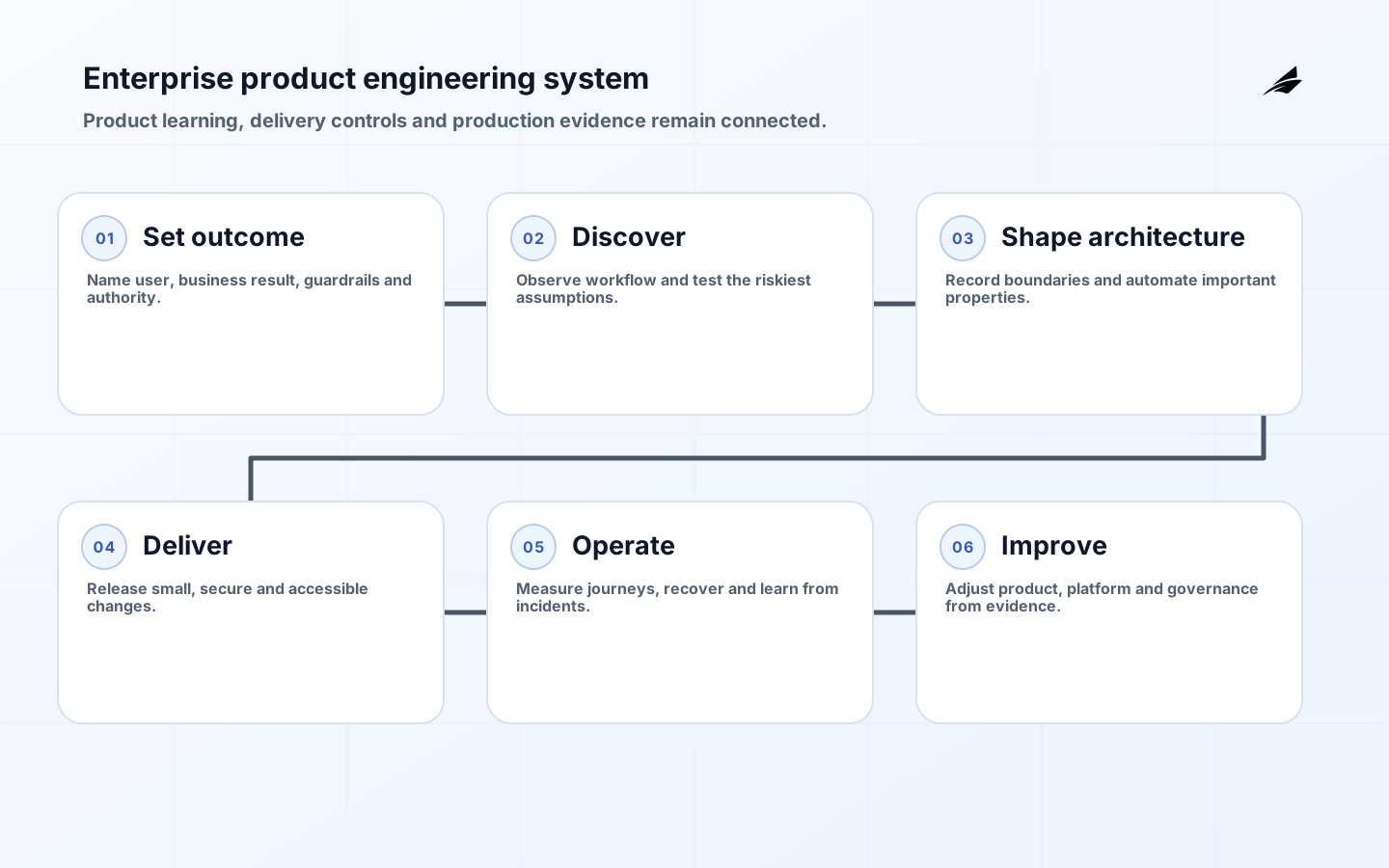
Enterprise product engineering services combine product discovery, experience design, software delivery and production improvement around a measurable user or business outcome. They differ from staff augmentation because the engagement owns an integrated slice of product evidence and delivery, not only individual capacity. They also differ from a fixed specification project because assumptions are expected to change as users, operations and technology reveal better information.
The hard part is preserving enterprise controls without turning every decision into a handoff. A successful partner works within identity, security, data, architecture and procurement constraints while keeping a small, empowered team accountable for outcomes. The following questions help buyers define that model, assess technical depth and accept a service that internal teams can continue. The objective is not maximum feature throughput; it is a product system that learns and releases safely.
What should an enterprise product engineering engagement own?
Start with a product boundary and an accountable enterprise owner. Name the users, jobs, business outcomes, affected services and decision authority. The delivery team can own discovery, design, implementation, testing and operational readiness for a bounded domain. Enterprise leaders retain portfolio priorities, risk acceptance and policy. Shared responsibilities such as data stewardship, identity and platform operation need named interfaces. A contract that says end-to-end without describing these decisions creates ambiguity, not ownership.
Use an outcome tree that connects a business result to user behavior, product capability and delivery evidence. For example, reducing supplier onboarding time may depend on fewer re-entry steps, clear validation and faster approval, not merely a new portal. Establish a baseline and guardrails such as error, fraud, accessibility and support load. Review evidence at a fixed cadence. The roadmap should change when evidence changes while strategic constraints and decisions remain visible.
| Responsibility | Enterprise owner | Engineering partner evidence |
|---|---|---|
| Product direction | Outcome, funding and priority authority | Discovery findings and tested product options |
| Architecture | Enterprise standards and risk decisions | Decision records and working fitness tests |
| Data | Purpose, classification and stewardship | Model, lineage, validation and lifecycle behavior |
| Security | Policy and residual-risk acceptance | Threat model, secure pipeline and verification |
| Operations | Service ownership and escalation | Telemetry, objectives, runbooks and exercises |
| Improvement | Portfolio trade-offs | Outcome, reliability and delivery trends |
How should the team and governance model work?
Form a stable cross-functional team with product, design, engineering and quality skills, plus reliable access to security, data and operations. Give it a clear backlog and authority within guardrails. Rotating specialists through disconnected tickets weakens context and accountability. Enterprise stakeholders should join discovery and review decisions rather than receive status after the fact. Define who can approve a release, accept a finding, change a data use or stop work when customer or operational risk appears.
Use three governance cadences. Product reviews examine outcomes and user evidence. Delivery reviews examine flow, quality and impediments. Risk and service reviews examine security, reliability, cost and dependencies. Use one evidence set across them. Avoid committees that re-evaluate detailed implementation after qualified owners have decided. Exceptions need an owner, rationale, expiry and compensating action. Escalation should resolve a decision, not simply add a meeting.
How does discovery stay connected to delivery?
Discovery observes users and operations, maps the current service, tests assumptions and identifies constraints. It should produce small options that engineers can evaluate, not a final design handed across a phase boundary. Include technical feasibility, data availability, policy and integration behavior early. Prototype the riskiest interaction or dependency. Research repositories need decisions and evidence dates so old findings are not treated as permanent facts.

Pair discovery and delivery in small batches. A thin release can test whether a new approval path works while the team researches the next uncertainty. DORA guidance supports smaller changes and continuous delivery because they reduce integration and recovery difficulty. Feature flags and cohort controls separate deployment from exposure. Define how experiments are removed or promoted; abandoned flags and parallel workflows otherwise become permanent complexity.
What architecture practices support product evolution?
Use architecture decision records for consequential choices and automated fitness tests for properties that must remain true. Examples include tenant isolation, dependency direction, response latency, accessibility and encryption. Prefer modular boundaries based on business capability and ownership. Distributed services are justified when independent scaling, isolation or team ownership outweigh operational cost. A modular monolith can provide clearer change boundaries than prematurely separated services.
Treat APIs and events as products with schemas, compatibility, ownership and deprecation. Maintain representative contract tests with consumers. Data models need stewardship, quality rules, retention and correction behavior. Build migration paths for legacy records and integrations rather than hiding them behind a new interface. Track technology lifecycle and dependency health. Modernization succeeds when change becomes safer and more economical, not when a target vocabulary appears in a diagram.
How are security and compliance built into delivery?
Apply NIST SSDF practices across preparation, software protection, secure production and vulnerability response. Translate enterprise policy into versioned requirements and pipeline checks. Protect source, build identities and artifacts; review dependencies and provenance; threat-model important workflows; and give findings owners. Security engineers should help teams design controls and risk decisions rather than operate only as a release gate. High-consequence changes may require additional independent review.
Keep evidence proportional and reusable: reviewed change, test result, signed artifact, deployment record, access decision and audit event. Link evidence to the released version. Test server-side authorization and administrative workflows, not only technical vulnerabilities. Define privacy purpose, collection, retention and deletion in the product model. Accessibility should be verified against current WCAG guidance through automated checks, manual keyboard and screen-reader review, and representative user testing.
What does quality engineering include beyond testing?
Quality engineering starts with examples and invariants before implementation. Automate fast tests near the code, contract tests at interfaces and a small set of valuable end-to-end journeys. Use production-like data shapes without exposing sensitive records. Test migration, concurrency, dependency failure, recovery and observability. Exploratory testing remains important for complex workflows and accessibility. Track escaped defects by consequence and root cause rather than rewarding test-case volume.
Release readiness should cover product behavior, security, performance, data reconciliation, operations and rollback. Progressive exposure limits consequence but does not replace acceptance. Monitor the intended user outcome and guardrails during rollout. If the team cannot identify which version changed a result or restore a compatible state, its delivery system is incomplete. Post-incident learning should produce code, test, runbook or architecture changes with owners.
| Measure | What it answers | Use with |
|---|---|---|
| Outcome change | Did the product improve the target result? | Adoption and guardrail measures |
| Lead time | How quickly can a validated change reach users? | Batch size and wait-state review |
| Change failure | How often does release require correction? | Severity and recovery time |
| Service level | Does the user journey meet expectations? | Error budget and dependency evidence |
| Escaped defect | Which assumptions or controls failed? | Root-cause and recurrence action |
| Unit cost | Can the product serve growth economically? | Support and reliability impact |
How should the product be handed over and operated?
OpenTelemetry can standardize traces, metrics and logs, but the team must instrument business and service decisions. Define indicators for important journeys and alerts tied to customer consequence. Provide dashboards, runbooks, dependency ownership, data repair procedures and emergency access. The delivery partner should participate in production support long enough to test assumptions and improve diagnosability, while enterprise service ownership remains explicit.
Accept the engagement through scenarios led by the receiving team. Ask them to deploy, investigate a failed workflow, restore data, rotate a secret, process a vulnerability and make a small change. Verify repository, infrastructure source, environments, design assets, decision history, test data, software inventory, licenses, cloud accounts and cost records. Knowledge transfer is demonstrated capability, not attendance at presentations. Define exit support and access revocation from the beginning.
Key takeaways
- Define a product outcome, bounded domain and retained enterprise decisions.
- Keep discovery and delivery together in small, reversible changes.
- Automate architecture, security and quality properties that must remain true.
- Measure customer outcomes with delivery, reliability and cost evidence.
- Prove handover through receiving-team exercises and complete asset ownership.
Frequently asked questions
Is product engineering the same as software outsourcing?
It can be outsourced, but the model integrates product learning, design, engineering and operations around outcomes. Traditional outsourcing may instead deliver a predefined scope or roles. Evaluate the actual ownership and evidence.
Should the partner own the product roadmap?
The partner can manage discovery and recommend priorities. The enterprise product owner should retain outcome, funding and portfolio authority, with decisions informed by shared user and operating evidence.
How is vendor lock-in reduced?
Retain repositories, accounts, automation, records, portable data and internal capability. Document provider-specific choices and exit implications. Avoid claiming portability that has never been exercised.
Commercial incentives should reinforce this operating model. Milestones can recognize accepted product slices, risk reduction and client capability instead of rewarding document volume or utilization. Preserve a transparent change process for discoveries that alter scope, and distinguish correction of defective work from a genuinely new product decision. Review subcontractors, intellectual property, open-source obligations and data access before work begins. When the partner supplies reusable accelerators, confirm licensing, maintenance and exit rights. These details determine whether the enterprise truly owns the product and can change delivery strategy without losing essential knowledge or operation.
Conclusion
Enterprise product engineering works when a stable team can learn from users, change software safely and improve the service in production. Set decision rights and evidence at the start, integrate security and quality into small-batch delivery, and accept operational ownership through exercises. The right partner leaves more than features: it leaves an explainable product, a dependable delivery system and a client team able to continue both.