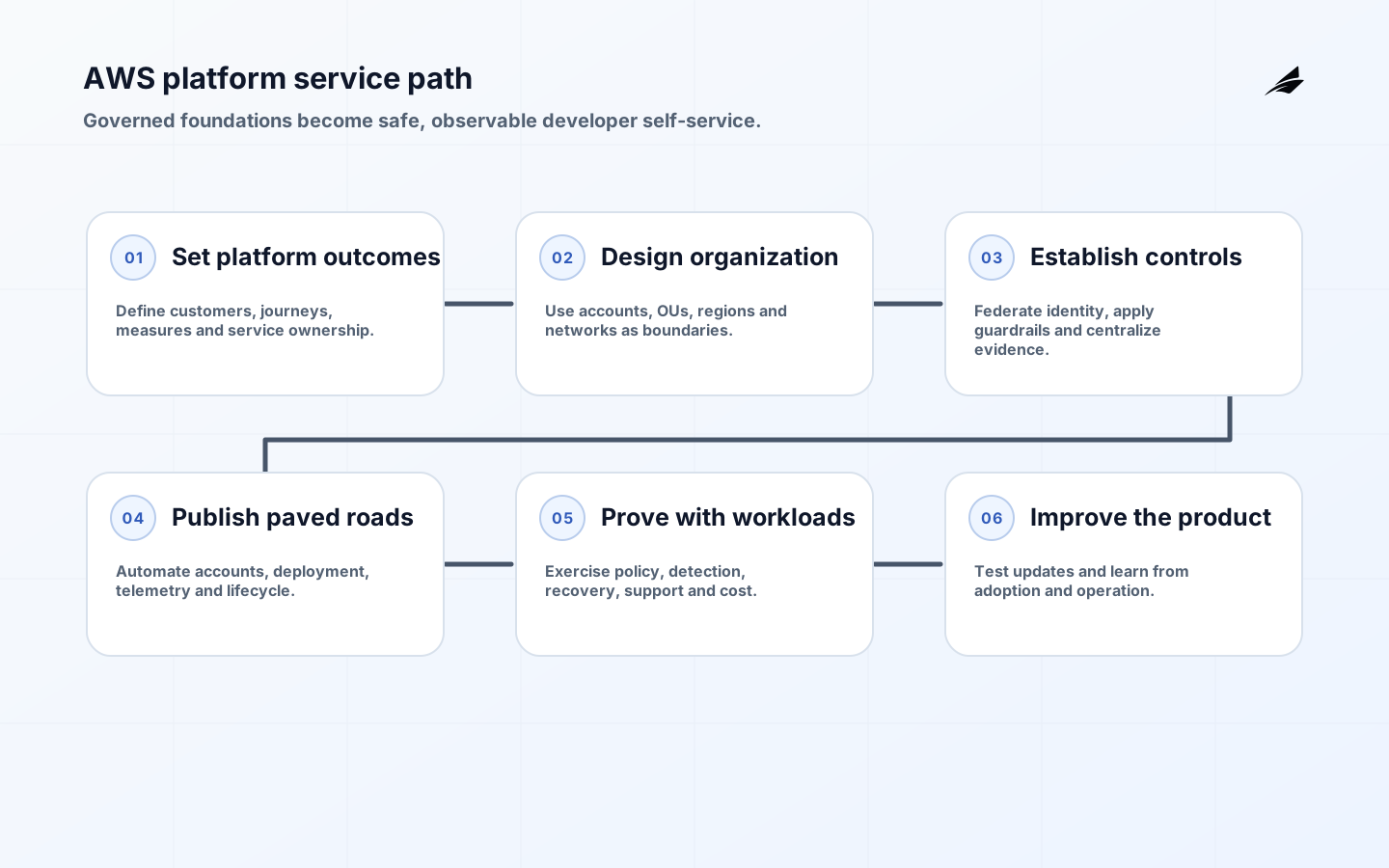
An AWS platform service is a governed product that helps teams provision, deploy and operate workloads on Amazon Web Services without rebuilding foundations for every project. It combines account vending, identity, networks, policy, observability, security, resilience, cost controls and supported deployment patterns. This AWS platform service implementation checklist moves from platform outcomes to accepted self-service, not merely a configured landing zone.
Use it with the AWS platform scope and delivery plan, AWS platform FAQ and cloud infrastructure checklist. AWS operates cloud infrastructure; the customer still owns choices and configurations under the shared responsibility model. A platform team makes those responsibilities easier to fulfill and verify.
1. Define customers, outcomes and service ownership
Identify the workload teams the platform serves, their common journeys, regulated constraints, current delays and desired autonomy. Measure outcomes such as lead time for a compliant account, workloads using supported deployment paths, restoration success, policy exception age and unit cost visibility. Avoid making number of cloud resources the goal. Name a platform product owner, engineering owner, security and finance partners, and a service owner responsible for availability and support.
Publish a catalog and responsibility model. State what the platform creates, operates, monitors and supports; what workload teams own; and what AWS owns. Define support hours, incident handoffs, change notices and lifecycle policy for each paved-road component. Include an exception route for requirements the standard platform cannot meet. An invisible exception process pushes teams toward unmanaged accounts and local workarounds.
| Platform capability | Platform team owns | Workload team owns |
|---|---|---|
| Account vending | Template, workflow, baseline and lifecycle automation | Business purpose, data classification and accountable owner |
| Identity | Federation integration, permission patterns and audit | Group membership requests and role selection |
| Network | Approved topologies, shared services and observability | Workload exposure and application restrictions |
| Delivery | Supported templates, pipeline controls and artifact integration | Application code, tests and deployment decisions |
| Operations | Central telemetry, platform alerts and escalation | Workload indicators, runbooks and business recovery |
| Cost | Allocation schema, budgets, anomaly tooling and reports | Architecture consumption and remediation actions |
2. Design the multi-account organization and landing zone
Use accounts as isolation and ownership boundaries. AWS’s multi-account strategy describes accounts as resource containers and isolation boundaries. Design organizational units around policy and lifecycle instead of mirroring a frequently changing org chart. Separate management, security, log archive, shared services, sandbox, nonproduction and production concerns as appropriate. Keep workloads out of the management account.
AWS Control Tower orchestrates Organizations, Service Catalog and IAM Identity Center to establish and govern a landing zone with controls and account provisioning. Decide whether it fits and document customizations. A product console is not the complete architecture: region strategy, DNS, addressing, egress, encryption, backup, support, quotas and enterprise integration still need owned designs.
3. Establish identity, guardrails and evidence

Federate workforce access, use short-lived credentials and map groups to job functions. Separate human, workload and pipeline identities. Follow AWS IAM security best practices, including protecting root credentials, requiring MFA, using temporary credentials, applying least privilege and reviewing unused access. Maintain tested break-glass access with strong custody and alerting. Avoid shared users and long-lived access keys.
Layer controls according to purpose. Service control policies limit maximum permissions but do not grant access. Preventive, proactive and detective controls behave differently and produce different evidence. Test policies against representative deployments before broad attachment and provide human-readable denial guidance. Centralize CloudTrail and applicable configuration or security findings in protected accounts. Reconcile accounts and regions against logging coverage; a dashboard cannot report what was never collected.
4. Build paved roads and lifecycle automation
Offer versioned templates for common workload patterns: account, network, identity integration, encryption, logs, backup, deployment, tagging and telemetry. Keep interfaces small and document support and upgrade policy. Use infrastructure as code, protected review and automated conformance tests. A paved road should be easier than a bespoke route while permitting escape through a governed exception. Do not force a pattern whose reliability or cost contradicts the workload.
Treat account creation and closure as one lifecycle. An account request needs purpose, owner, environment, data class, budget and expiry where temporary. Provision the baseline before handing access to a team. When ownership changes, update contacts and financial attribution. On closure, preserve required logs and data, remove integrations and delegated roles, verify backups or deletion, and prevent abandoned resources from remaining reachable.
- Automate account request, approval, provisioning, owner assignment, baseline verification and eventual closure.
- Provide secure network patterns for public, private, hybrid and service-to-service traffic with DNS and egress ownership.
- Publish deployment templates that use protected artifacts, minimal pipeline roles, secrets management and rollback.
- Attach standard logs, metrics, traces, alerts and cost tags at creation rather than through later campaigns.
- Test quotas, region restrictions and policy denial paths so teams receive actionable guidance.
- Maintain deprecation, upgrade and migration paths for every supported platform component.
5. Prove workloads can operate and recover
Review representative workloads with the AWS Well-Architected Framework, which covers operational excellence, security, reliability, performance efficiency, cost optimization and sustainability. Use it as a structured conversation and improvement record, not a certification badge. Test service limits, autoscaling assumptions, dependency timeouts and regional choices under realistic load. Record unresolved high-risk items and owners.
Run game days before wide adoption. Compromise a developer credential, deny a deployment through policy, disable a dependency, fill a queue, lose a zone, restore data and rotate a key. Verify central and workload teams see the event and know who acts. Test backups by restoring an application-consistent service and having the business owner validate it. Exercise support escalation with AWS and internal suppliers so contact and evidence requirements are known.
| Acceptance gate | Pass condition | Evidence |
|---|---|---|
| Account vending | Approved account arrives with owner, baseline, logs and budget intact | Workflow and conformance result |
| Identity | Joiner, role change, revocation and emergency access meet targets | Identity and CloudTrail records |
| Policy | Unsafe change is prevented or detected without blocking valid patterns | Positive and negative deployment tests |
| Observability | Platform and workload teams detect, correlate and own a scenario | Alert, trace and incident timeline |
| Recovery | Representative service restores within objectives with valid data | Timed exercise and owner sign-off |
| Cost | Team can allocate spend and respond to an anomaly | Allocation report and anomaly drill |
6. Operate the landing zone as a product
Monitor platform journeys, control coverage, account inventory, identity exceptions, policy failures, template versions, service health, quotas, support demand and cost. Establish error budgets and maintenance windows for platform components. Review customer feedback and contribution routes. Measure adoption with workload outcomes; forcing resource counts through one template can hide shadow paths and poor developer experience.
Control landing-zone change. AWS update best practices recommend centralized logging, a test environment and a current landing zone. Test Control Tower, organization policy and template updates in isolation, diff effects, communicate changes and retain recovery steps. Track AWS service and region changes affecting platform guarantees. Periodically exercise account closure and export for critical data and configuration.
Key takeaways
Practical example: a product team requests its first production AWS account through the platform catalog. The request records service owner, data class, region, budget and recovery target. Automation creates the account in the production organizational unit, assigns federated roles, enables central logs and findings, applies tested policies, configures cost allocation and deploys a supported application baseline. The team intentionally requests a prohibited public resource and receives an actionable denial, then deploys the valid pattern. During a game day, engineers revoke a compromised role, restore the application and reconcile monitoring in central and workload views. Only then does the template become the default path for later teams.
- Treat the AWS platform as a customer-facing internal product with measurable journeys and ownership.
- Use accounts and organizational units as stable isolation and policy boundaries.
- Federate identity, minimize standing privilege and reconcile telemetry across governed regions.
- Offer versioned paved roads with transparent support, upgrade and exception paths.
- Prove deployment, detection, recovery, escalation and cost response with representative workloads.
- Test landing-zone updates and improve the platform from operational and developer evidence.
Frequently asked questions
Is AWS Control Tower required for a platform service?
No. It is a supported orchestration option for a multi-account landing zone and can reduce undifferentiated setup. An organization may use other AWS-native automation if it can sustain equivalent governance and lifecycle work. Choose deliberately and understand how customizations interact with AWS-managed resources and updates.
Does every application need a separate AWS account?
Not necessarily. Use accounts to isolate ownership, policy, billing and failure according to risk. A workload may use several accounts across environments; small low-risk components may share a governed boundary. Document the rule so teams neither create excessive accounts nor place unrelated critical systems together for convenience.
Should every workload be multi-Region?
No. Multi-Region architecture adds data, consistency, deployment, testing and cost complexity. Select it when business recovery objectives and failure analysis justify that cost. Many workloads are well served by sound multi-AZ design, tested backup and a documented regional recovery strategy. Prove the chosen recovery path.
Conclusion
Set a platform adoption gate for each workload class. A team should demonstrate that it can request the right account, deploy through the supported path, interpret a policy denial, find logs, respond to a cost anomaly, restore its service and reach support. The platform team should demonstrate inventory and telemetry coverage, template upgrade and access revocation. Record approved exceptions as product feedback: repeated exceptions may indicate a missing paved road, while one high-risk request may need a deliberately bespoke boundary. This turns governance friction into evidence for the platform roadmap.
An AWS platform service succeeds when teams can obtain a governed environment, deploy through supported paths, understand responsibility and recover under pressure. Build the organization, identity and evidence foundation first; make good patterns convenient, test them with real workloads and operate the platform through continuous product learning.