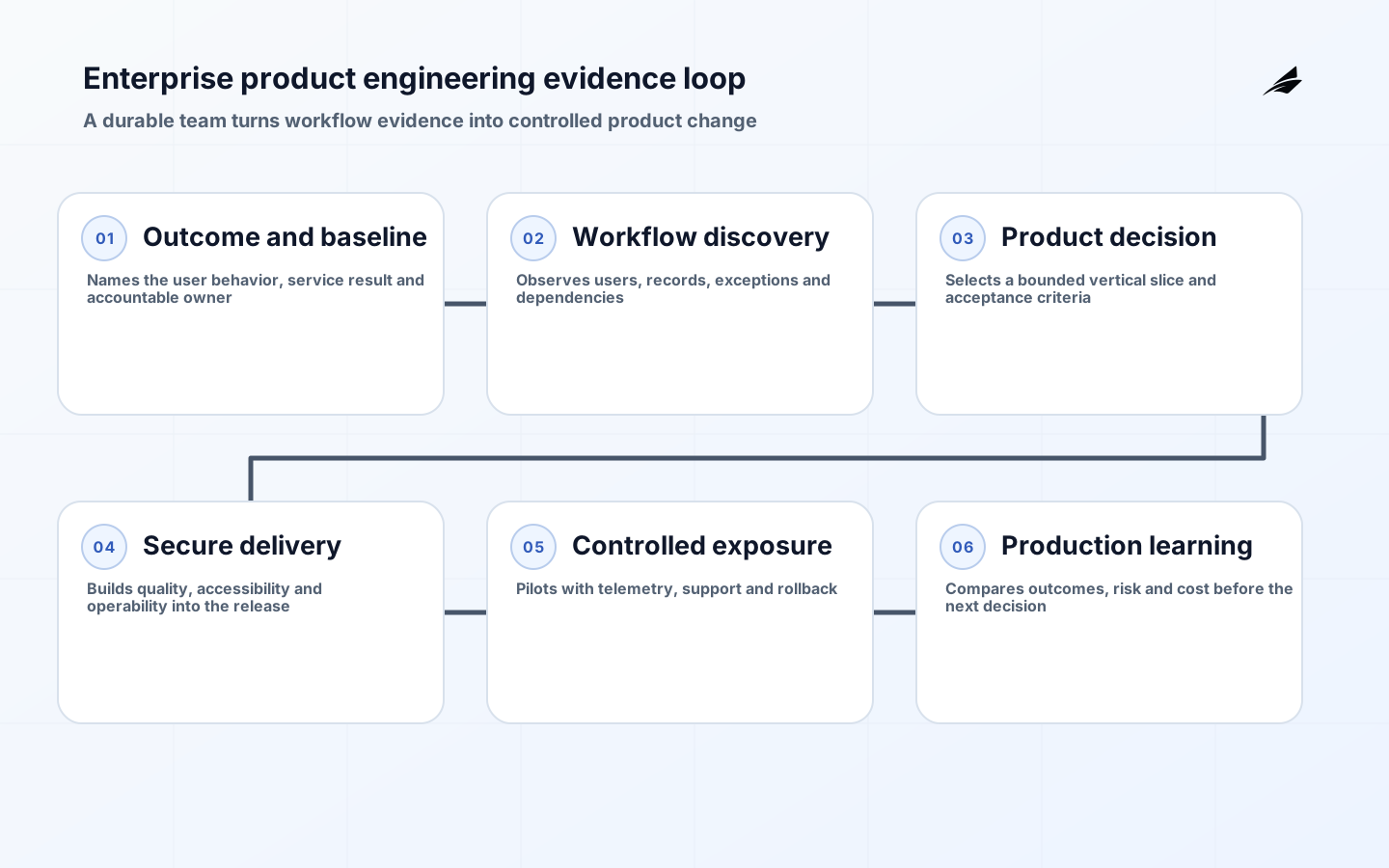
Enterprise product engineering is the sustained work of discovering, designing, building, operating and improving a digital product. It differs from a project handoff because the team remains accountable for user outcomes and production behavior after release. Services may supply product management, experience design, software engineering, quality, security, data, reliability and platform capabilities, but those disciplines need one product goal and one decision system. Otherwise the buyer receives coordinated activity without durable product ownership.
A sound engagement begins with a bounded outcome: reduce the time required to complete an approval, improve successful self-service onboarding, retire an unsafe component, or make a regulated decision traceable. It identifies the users, workflow, authoritative records, constraints, baseline and owner. The provider should not promise a generic transformation before examining dependencies and operating conditions. Enterprise environments contain identity platforms, integration contracts, release controls, support teams and records whose behavior determines whether a polished feature can actually work. Procurement, finance and operational representatives should validate assumptions that materially affect adoption, support capacity and total cost.
Key takeaways
- Fund a product outcome and accountable team, not an open-ended feature queue.
- Keep discovery, delivery and operation in one feedback loop with shared measures.
- Treat security, accessibility, reliability and support as acceptance criteria from the start.
- Estimate with ranges tied to evidence, uncertainty and transition work.
- Use small production slices, progressive exposure and explicit rollback before broad migration.
- Retain product knowledge, decision records and operational ownership inside the enterprise.
Define a product boundary that teams can own
Scope should be expressed as a product boundary, not a list of roles. Name the customer or employee journey, the business capability it supports, the systems it reads and changes, and the operational team that handles exceptions. Then state what the first release will not do. A claims intake product, for example, might capture documents, validate completeness and route a case while leaving adjudication and payment unchanged. That is a coherent vertical slice that can be observed and reversed.

Product discovery reduces uncertainty; it is not a ceremonial phase. Teams should observe real work, sample difficult cases, profile data, trace integrations, identify applicable obligations and test assumptions with prototypes. The output is a living opportunity map, service blueprint, architecture context, risk register and measurable release hypothesis. Discovery continues during delivery because production evidence changes priorities. A fixed backlog created before this work usually hides the most expensive questions until implementation.
| Scope dimension | Decision to record | Evidence before commitment |
|---|---|---|
| Outcome | Which behavior or service result should improve? | Baseline, target direction and accountable owner |
| Users and workflow | Who acts, approves, waits and handles exceptions? | Observed journeys and representative cases |
| Data | Which records are authoritative and sensitive? | Classification, quality sample, lineage and retention |
| Integration | Which contracts and service levels constrain delivery? | Dependency map, interface samples and failure behavior |
| Quality | What must be true for release? | Security, accessibility, performance and recovery criteria |
| Transition | How will old and new paths coexist? | Migration, rollback and decommission conditions |
Build an operating model around product decisions
The smallest durable unit is a cross-functional product team with authority to make routine trade-offs. A product lead owns outcomes and priority; an engineering lead owns technical integrity; design and research represent user evidence; engineers, quality and security shape the implementation; an operational owner represents support and recovery. Enterprise architecture, privacy, legal and risk partners provide constraints and review without turning every decision into a distant queue. Publish decision rights so unresolved questions have an escalation route.
A provider can fill capability gaps, accelerate a modernization wave or establish practices, but the enterprise should retain an empowered product owner, access to repositories and telemetry, architecture decisions, supplier terms and runbooks. Pair provider specialists with internal staff and make knowledge transfer observable through joint delivery, reviews and incident exercises. Documentation alone does not prove transfer. Internal engineers should be able to deploy, diagnose and change the product before provider dependence is reduced.
Make architecture and quality support frequent change
Architecture should expose product boundaries, authoritative data, identity, external dependencies and failure containment. Modularity is valuable when it lets teams test and release independently; a larger deployable can be preferable when distributed complexity offers no outcome. Record consequential decisions and the conditions that would reverse them. Standardize common capabilities such as identity, telemetry, delivery pipelines and secrets through a platform only where the platform removes repeated cognitive load and provides a supported path.
NIST's SSDF organizes secure development around preparing the organization, protecting software, producing well-secured software and responding to vulnerabilities. Translate those outcomes into the team's workflow: protected repositories, reviewed changes, dependency and artifact records, automated checks, threat modeling for material changes, defect handling and a vulnerability response path. WCAG 2.2 criteria should similarly become design and test work, not a late audit. Quality is strongest when evidence is produced by ordinary delivery.
| Quality concern | Built-in practice | Release evidence |
|---|---|---|
| Security | Threat analysis, least privilege, dependency review and protected builds | Reviewed findings, provenance and accepted residual risk |
| Accessibility | Accessible components, keyboard flows and assistive-technology testing | Criterion-level test results and resolved defects |
| Reliability | Service objectives, graceful failure and capacity tests | Telemetry, load results and recovery exercise |
| Data integrity | Validation, idempotency, lineage and reconciliation | Balanced records and explained exceptions |
| Maintainability | Clear boundaries, automated tests and ownership metadata | Change review, deployability and current runbook |
| Privacy | Purpose limitation, minimization and retention controls | Data map, approval and deletion verification |
Model cost and commercial terms honestly
No universal rate or timeline describes enterprise product engineering. Cost follows team composition, domain complexity, legacy condition, integration count, data quality, assurance depth, environments, service objectives and migration risk. Begin with a funded discovery window, then estimate releases as ranges with assumptions. Separate build, platform, licenses, cloud consumption, assurance, internal participation, dual running, support and decommissioning. A low build quote that excludes production readiness merely moves cost into a less visible column.
Commercial incentives should support product learning. Time-and-materials with transparent capacity works when priorities will evolve; a fixed price is more credible for a narrow, evidenced deliverable with stable interfaces. Outcome-based elements require measures the provider can influence and rules for external changes. In every model, define intellectual-property rights, repository access, security obligations, subcontractors, service reporting, exit assistance and acceptance. Avoid tying acceptance only to feature completion; include operability and user evidence.
Deliver in controlled vertical slices
A practical sequence is frame, discover, prove, pilot, expand and retire. Framing names the outcome and authority. Discovery traces the current service. A technical proof addresses the hardest uncertainty without masquerading as production. The pilot releases one complete journey to controlled users with telemetry and support. Expansion follows observed thresholds. Retirement removes old paths only after reconciliation, retention and rollback conditions are satisfied. Each gate should have an owner who can pause progression.
DORA describes continuous delivery as keeping software deployable and making low-risk changes on demand. Achieving that state requires fast feedback, continuous testing, pervasive security and observability, not pressure for more releases. Track change lead time, deployment frequency, failed deployment recovery time, change failure percentage and deployment rework alongside product measures such as task success, adoption, support demand and user satisfaction. Metrics should guide investigation; they should not become quotas that reward smaller reporting boundaries or hidden work.
Govern outcomes, risk and learning
Use a compact governance cadence. The product team reviews user and operational evidence weekly. Product, architecture and risk owners review material decisions and residual risks at release gates. Sponsors review outcome, cost, capacity and unresolved dependencies monthly or quarterly. Escalate exceptions rather than every routine choice. NIST CSF 2.0's Govern function is a useful reminder that cybersecurity expectations, roles, policy and supply-chain risk belong in organizational decisions, not solely in technical controls.
A balanced scorecard connects four layers: user outcome, product behavior, delivery health and operational risk. For an onboarding product, that may include completion and abandonment, validation accuracy, time from approved change to production, escaped defects, accessibility failures, incidents and support contacts. Establish the baseline before claiming improvement. Segment by meaningful user or tenant groups to reveal harm hidden by averages, but protect privacy and avoid turning telemetry into uncontrolled surveillance.
Frequently asked questions
What should product engineering services include?
The mix depends on the product, but it commonly includes product discovery and management, experience design, architecture, software and data engineering, automated quality, security, delivery automation, observability and operational readiness. The important test is whether the combined team owns a measurable product result rather than handing work between disconnected specialties.
How should an enterprise select a provider?
Give candidates a representative workflow and ask how they would discover uncertainty, structure the team, protect data, release safely and transfer knowledge. Verify relevant work, named personnel, engineering practices, security evidence, subcontractors, commercial assumptions and exit terms. A polished proposal is weaker evidence than a clear treatment of trade-offs and unknowns.
How long does enterprise product engineering take?
It is an ongoing capability. A narrow discovery or production slice may be time-bounded, but responsible timing follows evidence about dependencies, assurance and migration. Ask for ranges and gate criteria instead of a universal duration. The plan should become more precise as high-impact unknowns are tested.
Conclusion
Enterprise product engineering works when a durable team can connect user evidence, technical decisions and production behavior. Start with one owned outcome, expose the real workflow and dependencies, and build quality into the delivery path. Fund uncertainty explicitly, release a complete but narrow slice, and expand only when product and operational evidence agree. The resulting capability is more valuable than a backlog delivered on schedule: it gives the enterprise a repeatable way to learn, change software safely and remain accountable for the service after the engagement evolves.