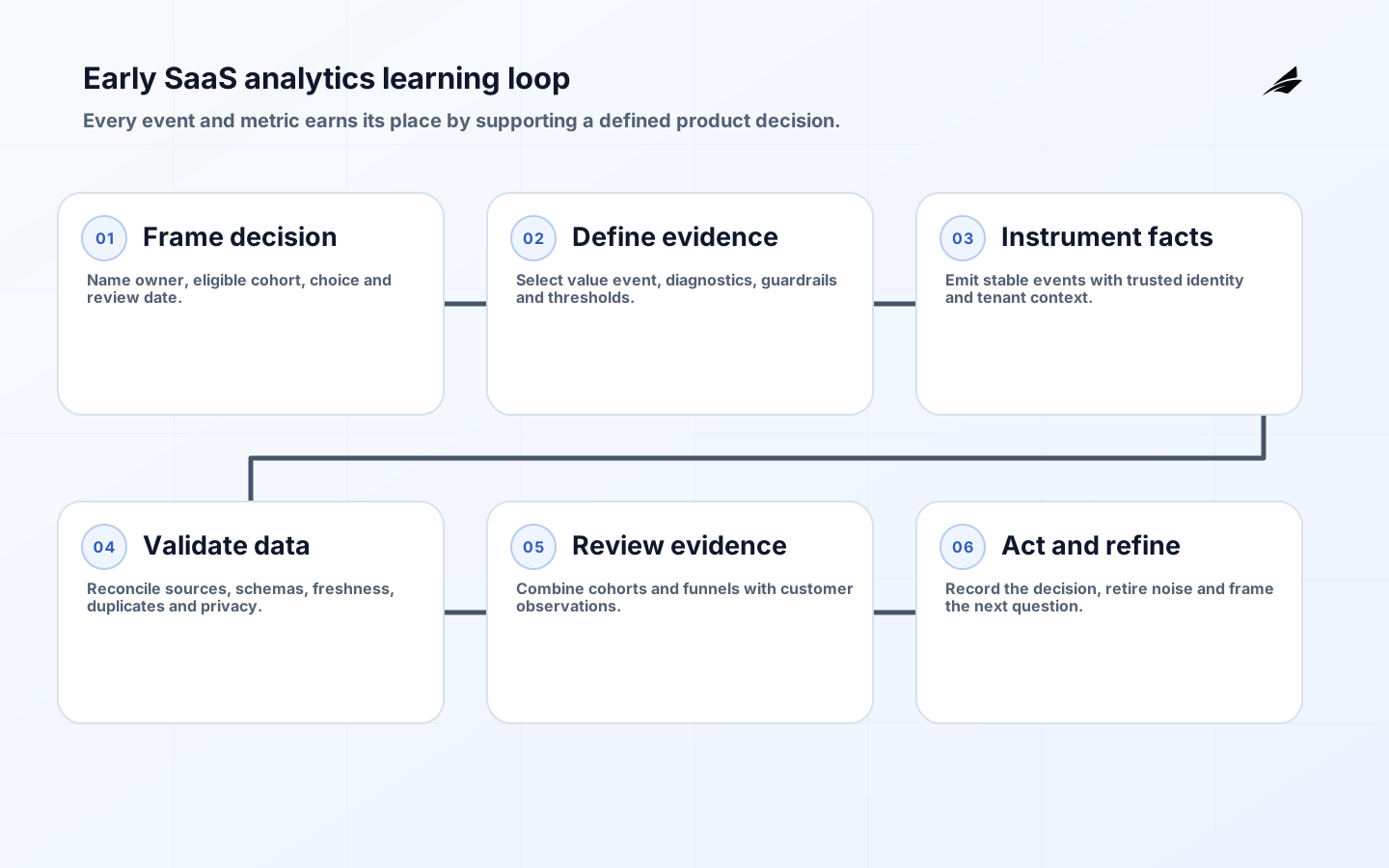
Product analytics for early SaaS teams should answer a small number of consequential questions: Do the right users reach value, where do they fail, what behavior predicts durable use, and did a product change improve the outcome without creating harm? It is not a contest to collect the most events. An early team wins when a reliable signal changes a roadmap, onboarding flow, support intervention or experiment.
This tutorial turns those questions into an implementable measurement system. It is useful before launch, while replacing ad hoc dashboards, or when a team cannot reconcile product, billing and support numbers. It complements the SaaS billing workflow guide, scalable customer onboarding architecture and tenant isolation review.
Start with decisions, not dashboards
Write each analytics question as a decision with an owner and review date. “Measure engagement” is too vague. “The product lead will decide after four weekly cohorts whether to shorten setup or improve invitation acceptance” names the choice and evidence window. Define the target account segment, because a trial administrator, invited operator and paid workspace represent different jobs and denominators. A blended activation rate can rise simply because the acquisition mix changed.
Build a compact goal-signal-metric tree. Google’s HEART framework offers reusable categories, but the important move is mapping a product goal to observable behavior. For “a team completes its first shared workflow,” signals might include successful setup, invitation acceptance, first collaborative action and return use. Select one decision metric, diagnostic measures that explain it, and guardrails such as error rate, support contacts or unwanted notifications.
| Decision | Primary evidence | Diagnostic evidence | Guardrail |
|---|---|---|---|
| Is onboarding producing value? | Eligible accounts completing the value event within 7 days | Completion by setup step and acquisition cohort | Setup errors and assisted completions |
| Should a feature graduate? | Incremental target behavior among exposed eligible users | Exposure, adoption depth and repeat use | Latency, failures and support contacts |
| Which account needs help? | Expected milestone overdue for its lifecycle stage | Last successful step and blocking state | Do not infer sensitive traits |
| Is retention improving? | Comparable activated cohorts returning to the value event | Frequency, breadth and account participation | Contraction, deletion and opt-out signals |
Design a durable event and identity contract
Model events as business facts, not screen clicks. “reportexportcompleted” survives a button redesign; “greenbuttonclicked” does not prove an export occurred. Give every event a description, trigger, owner, required properties, prohibited properties, test and version. Record both occurrence time and collection time where delayed clients or queues matter. The OpenTelemetry log data model distinguishes source and observed timestamps and supports correlation identifiers, ideas that transfer well to product events even when a separate analytics SDK is used.
Define identity before implementation. Keep anonymous device or session identity separate from authenticated user identity, and associate both with an account or workspace only through explicit transitions. Never merge people merely because they share an email domain or device. Store stable internal identifiers rather than mutable email addresses in event properties. For multi-tenant products, every server-side business event should resolve tenant context from trusted authorization state, not from a client-supplied label.
| Field | Purpose | Example rule | Quality test |
|---|---|---|---|
| event_name | Names one completed fact | workspaceinvitationaccepted | Allowed value in versioned catalog |
| event_id | Makes ingestion idempotent | Generated once at source | Duplicate replay does not double count |
| occurred_at | Orders user behavior | UTC source timestamp | Clock offset or absence is visible |
| actor_id | Links an authenticated actor | Opaque internal user ID | No email or display name |
| account_id | Defines SaaS analysis unit | Authorized workspace ID | Matches server-side tenant context |
| properties | Explains the fact | role, channel, result_code | Schema rejects unknown sensitive fields |
| schema_version | Supports controlled evolution | Integer or semantic version | Old and new producers can be compared |
Implement the smallest end-to-end analytics path
Instrument the value path first: eligibility, start, meaningful intermediate states, success and recoverable failure. Emit authoritative state changes on the server when possible. Client events remain useful for impressions and interactions, but blockers, permissions, billing state and completed transactions should not depend on a browser successfully sending telemetry. Use a shared event library or generated types so names and property types do not drift between services.
Route events through a collection boundary that can validate schemas, attach trusted context, redact disallowed fields, deduplicate identifiers and quarantine malformed records. Preserve raw, access-controlled events for a bounded period and produce documented transformations for analysis. The OpenTelemetry event conventions describe events as named occurrences at meaningful points in time; that is a better design test than asking whether an interaction is easy to capture.
Release instrumentation like product code. In a test account, execute the workflow and compare the application record, emitted event, warehouse row and dashboard result. Test retry and offline behavior, duplicate delivery, account switching, deleted users and blocked consent. Add an automated contract check in continuous integration and a production canary that alerts when a critical event disappears or its property distribution changes sharply.
Control privacy, access and data quality
Create a property allowlist and classify each field before collection. Do not place message bodies, access tokens, passwords, payment data, free-form support text or full URLs with sensitive query parameters in analytics. The GDPR’s Article 5 principles include purpose limitation, data minimization, accuracy and storage limitation. Even where that regulation is not the applicable law, those principles provide a strong engineering test; counsel should determine the actual notice, consent and retention obligations.
Separate product analysis from security audit evidence and operational logs. They may share transport or correlation IDs, but they have different access, retention and completeness requirements. Grant analysts pseudonymous views by default, restrict identity joins, record administrative queries and document deletion propagation across the collector, warehouse, reverse ETL and dashboard cache. A user deletion workflow is incomplete if derived tables continue to reveal the person.
Publish a quality scorecard next to business dashboards. Track event acceptance, schema violations, duplicate rate, missing identity, ingestion delay, producer version and reconciliation against an authoritative database count. Treat a broken metric as unavailable, not as zero. Every chart should display its definition, grain, filters, owner and freshness so a stakeholder can distinguish accounts from users and event time from processing time.
Build funnels and cohorts that support action
A funnel requires explicit eligibility and ordering. Decide whether repeated attempts count, whether steps may occur on different devices, how long the window lasts and whether account or user is the unit. Report counts and conversion at every stage; a percentage without its denominator conceals acquisition changes. Segment only by attributes known before the outcome when comparing behavior, otherwise the analysis can accidentally define success by a consequence of success.
For retention, cohort users or accounts by the date of the first verified value event, not registration alone. Select a return behavior that represents renewed value rather than any session. Pair quantitative results with interviews and support cases: a falling cohort can reveal a missing capability, a seasonal workflow, poor data quality or a changed customer mix. Analytics narrows the investigation; it does not supply intent by itself.
Evaluate changes without overstating certainty
Before exposure, write the hypothesis, eligible population, assignment unit, primary measure, guardrails, minimum practical effect and stopping rule. Log assignment and actual exposure separately. An account-randomized experiment analyzed by user can exaggerate certainty because teammates influence one another. Avoid repeatedly checking a conventional fixed-horizon test and stopping on the first favorable result; use an appropriate sequential method or honor the planned horizon with statistical review.
Early products often lack enough traffic for a decisive controlled experiment. Use staged evidence instead: moderated task testing, instrumentation in an internal cohort, a bounded customer pilot, cohort comparison and qualitative follow-up. Record uncertainty and alternative explanations. A decision can still be sound when the evidence is incomplete if the change is reversible, guardrails are strong and the next observation is planned.
Run a weekly product learning cadence
Hold a short review around decisions, not a tour of dashboards. Start with data health, then one outcome, its strongest diagnostics, customer evidence and the action. Close with an owner and date for instrument, product or research work. Track whether a metric led to a decision; unused measures should be retired. Delivery measures from the DORA guides can sit beside product outcomes so the team sees whether slow or unstable releases are limiting learning.

- Name the decision, owner, eligible population and review date.
- Define the value event, diagnostic signals and harm guardrails.
- Approve the identity model, event catalog and prohibited data.
- Instrument and reconcile one complete workflow in a test tenant.
- Release to a bounded cohort and monitor data-health checks.
- Review quantitative and qualitative evidence, decide, and record the next test.
Key takeaways
- Begin with a named product decision and a defined eligible population.
- Use stable business events, trusted tenant context and explicit identity transitions.
- Validate, reconcile and monitor telemetry as a production data product.
- Collect only properties with a justified purpose, access model and retention rule.
- Combine funnels and cohorts with customer evidence, then record the action taken.
Frequently asked questions
How many events should an early SaaS team track?
Usually enough to describe one or two value paths and their important failure states. A catalog of 15 trustworthy business events can be more useful than hundreds of unowned clicks. Add an event only when it supports a defined decision, operational control or experiment.
Should we buy a product analytics tool or use the warehouse?
Choose from the workflow and governance needs. A product tool can accelerate self-service funnels and experiments; a warehouse offers flexible joins and durable modeling. Many teams use both behind one validated collection contract. Verify identity handling, export, deletion, access control, residency, cost at expected volume and the ability to reproduce metrics.
Do we need a north-star metric?
A shared value measure can align a team, but one number cannot represent acquisition, quality, revenue and harm. Use a primary outcome with diagnostic and guardrail measures. Revisit it when the product’s target user or value mechanism changes.
Conclusion
Useful product analytics for early SaaS teams is a learning system with engineering discipline. Define the decision, model durable facts, protect customer data, prove data quality and review evidence on a fixed cadence. The payoff is not a busier dashboard. It is a team that can explain why it changed the product and what it expects to learn next.