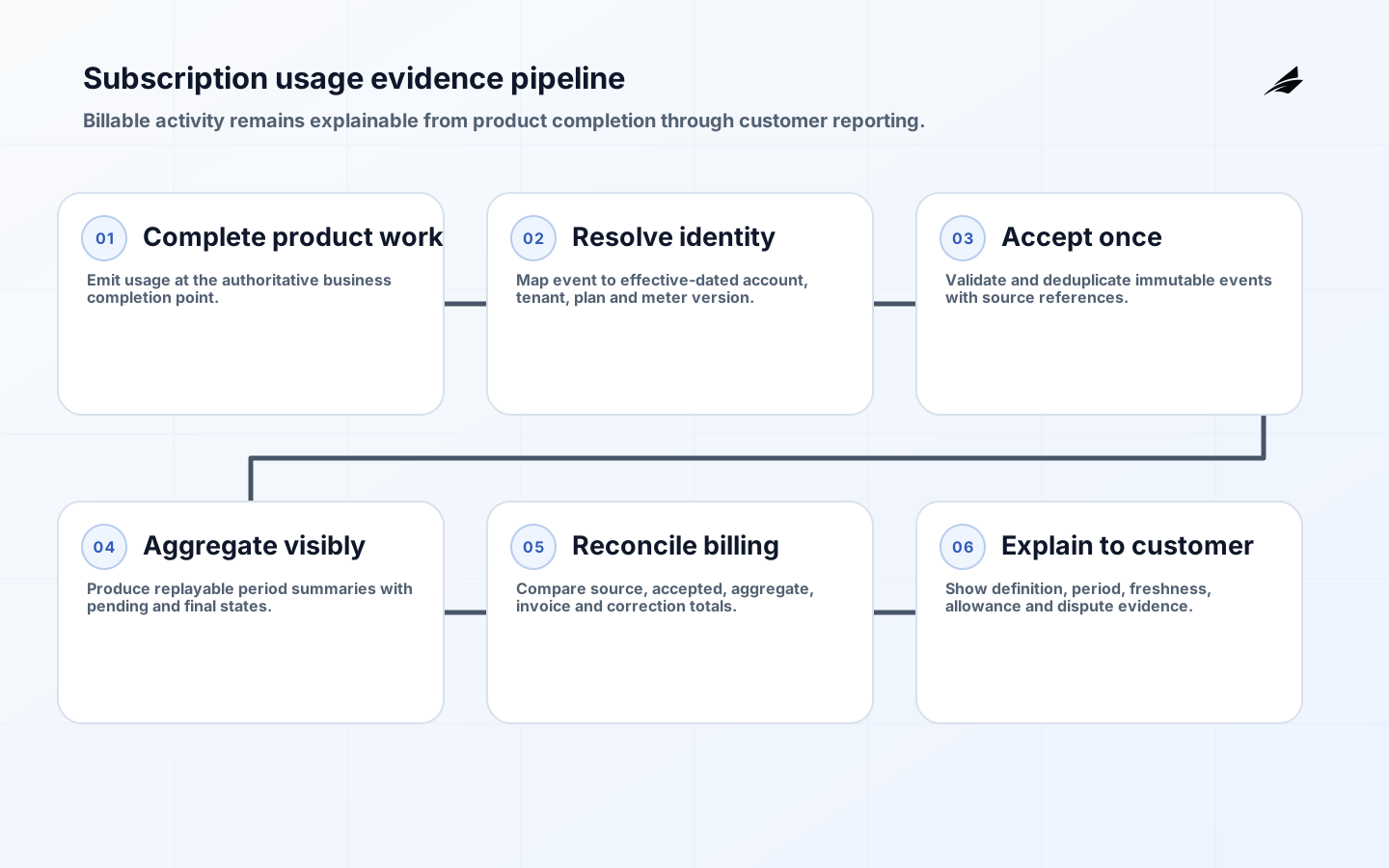
Usage reporting for subscription products turns product activity into evidence customers, product teams and finance can understand. When usage influences invoices, limits, entitlements or renewal conversations, the reporting pipeline becomes a financial and trust boundary. A chart built directly from application logs is rarely sufficient; the service needs a defined meter, durable events, identity mapping, aggregation, correction, reconciliation and customer-visible explanations.
This tutorial covers the architecture and operating controls behind trustworthy usage reporting. It applies to per-request, storage, seat, token, transaction and hybrid pricing models. The billing provider may calculate invoice lines, but the product remains responsible for generating correct usage and explaining it. Treat reporting, billing and operational telemetry as related but distinct products with explicit contracts.
Define the billable and reportable usage contract
Write the unit, event, subject, quantity, timestamp, aggregation, billing period, exclusions and correction rules. Specify whether usage is counted, summed, sampled, averaged or measured as the last value. State the timezone and boundary behavior for late events. Acceptance evidence should identify the responsible owner, the source record, the expected result and the decision required when the result is missing.
Keep commercial meter definitions versioned and effective-dated. A product metric such as API request can differ from a billable request after retries, free operations or failed work are excluded. Publish customer-facing language that matches implemented logic. Test the normal path, boundary conditions and a realistic failure path; a successful demonstration alone does not prove the subscription usage service is ready.
| Meter element | Question | Example decision |
|---|---|---|
| Subject | Whose usage is it? | Contract account, tenant, workspace or subscription item |
| Unit | What is counted? | Successful processed document, not upload attempt |
| Time | Which period receives it? | Event time in UTC with documented grace window |
| Aggregation | How is it combined? | Sum, count, maximum or latest value |
| Correction | How is error repaired? | Compensating event and visible adjustment record |
Create immutable idempotent usage events
Emit usage at the authoritative business completion point, not wherever instrumentation is convenient. Include a globally unique event identifier, meter version, account and subscription mapping, quantity, event time, producer, source reference and dimensions allowed by the contract. Keep the definition and its effective date with the implementation so later teams can explain why historical and current behavior differ.
Use idempotency so retries do not double count. Preserve raw accepted events and reject malformed or unauthorized input visibly. RFC 3339 timestamps provide a common syntax, but the contract must still distinguish event time from receipt and processing time. Make exceptions visible in the same operating workflow instead of routing them to private spreadsheets or undocumented support messages.
Resolve account, tenant and subscription identity
Separate user identity from billable account identity. A user may belong to several workspaces, and a workspace may change plans. Resolve usage against effective-dated subscription and entitlement records rather than current state alone. Use progressive exposure and explicit stop conditions so the team can learn from production without placing the entire estate at risk.
Define behavior for merged accounts, transfers, trials, internal use, deleted tenants and delayed provisioning. Track unmatched usage in an owned queue; never assign it to a convenient default. Minimize personal identifiers in metering events. Measure the business completion time and error consequence, not only component uptime or the number of tasks closed.
Aggregate without losing auditability
Build stages for validation, enrichment, deduplication, aggregation and publication. Keep raw events append-only and produce versioned summaries by account, meter and period. Use checkpoints and replay-safe transforms so a code correction can rebuild affected windows. Preserve identifiers, timestamps and version information across handoffs so reconciliation can distinguish delay, duplication and correction.
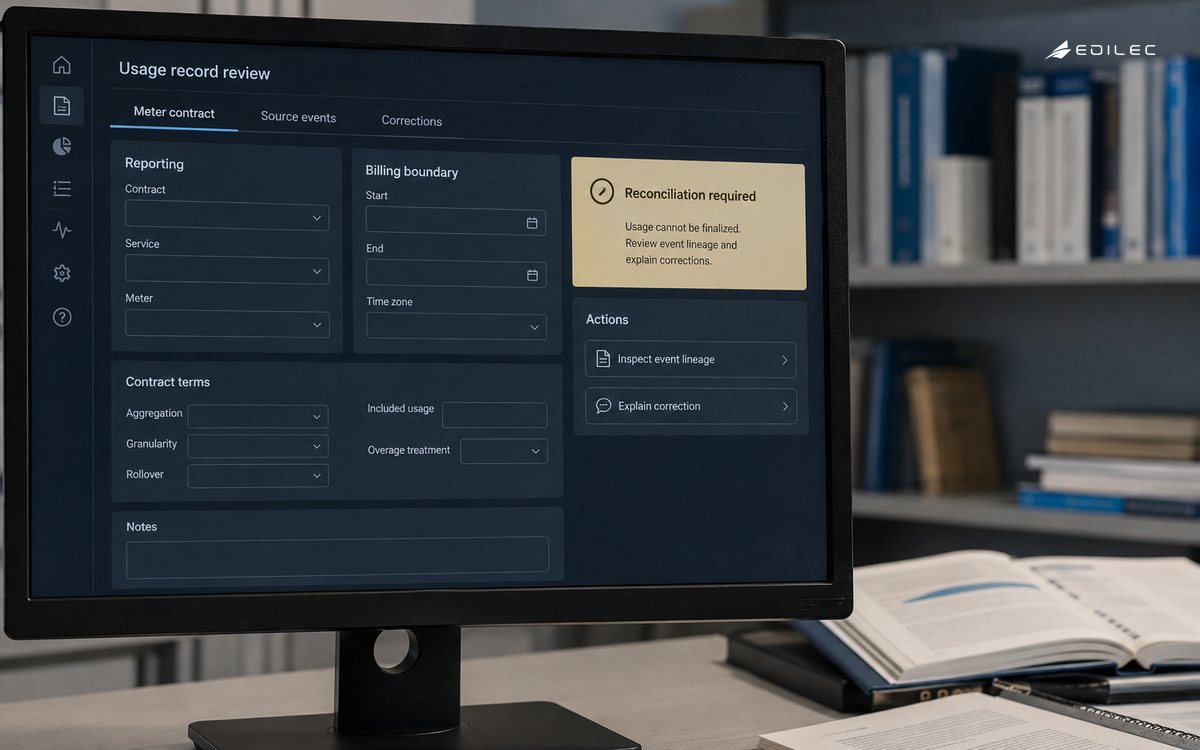
Stripe documents asynchronous meter processing, illustrating why product dashboards should not assume an external summary updates instantly. Expose pending versus finalized states and a freshness timestamp. Keep product analytics and financial summaries separate when their latency or definitions differ. Document the recovery sequence and exercise it with representative state before relying on it during a live incident.
Reconcile source events, summaries and invoices
Reconcile counts and quantities at every boundary: producer to intake, intake to accepted events, events to aggregate and aggregate to invoice input. Use control totals by tenant and period. Investigate differences before finalization and retain the explanation. Apply least privilege to people and services, and record material administrative actions with enough context for later review.
Create canary accounts with predictable activity and compare expected totals automatically. Sample real accounts across zero usage, high volume, plan change and correction. Reconciliation must account for rejected events, grace periods and rounding. Review this control when scope, integrations, users or obligations change; a launch-time decision should not become a permanent assumption.
| Boundary | Control | Failure response |
|---|---|---|
| Producer to intake | Published versus acknowledged event IDs | Replay missing events within retention |
| Intake to accepted | Accepted, rejected and duplicate totals | Route rejects with reason and owner |
| Accepted to aggregate | Quantity and partition control totals | Rebuild affected account-period window |
| Aggregate to billing | Meter-version and invoice-line comparison | Pause finalization for material variance |
| Billing to customer view | Invoice and report explanation match | Correct display or issue governed adjustment |
Design correction and dispute workflows
Never overwrite historical usage without a trace. Use cancellation, reversal or compensating events according to provider capability and accounting policy. Record reason, approver, affected event, old and new total, and whether an invoice adjustment is required. Separate a commercial promise from the operational mechanism and evidence that will make the promise dependable.
Provide a support workflow that can trace a displayed total to source events without exposing other tenants. Define dispute windows, evidence and escalation. Some providers limit when usage events can be canceled, so preserve an internal correction ledger independent of provider constraints. Give users a clear degraded state and next action instead of allowing partial data or failed automation to appear complete.
Build a customer view that explains usage
Show meter definition, current period, timezone, freshness, quantity, plan allowance and forecast where appropriate. Let customers drill from total to understandable categories or events while protecting sensitive internals. Distinguish estimated, pending and finalized totals. Automate repeatable verification where it shortens feedback, while retaining accountable human judgment for consequential ambiguity.
Add threshold notifications with rate limits and clear next actions. Avoid surprise by displaying approaching limits before enforcement. Accessibility, downloadable records and API access may be important for enterprise customers. Keep wording aligned with contracts and invoices. Version configuration with code and deployment records so a defect can be reproduced, contained and corrected without guesswork.
Operate for scale, cost and change
Measure event acceptance, duplicate rate, unmatched identity, pipeline lag, reconciliation variance, correction frequency, dispute time and cost per million events. FinOps unit economics can connect infrastructure cost with product usage, but cost allocation should not silently redefine billable units. Define a small set of leading and lagging measures, then remove metrics that have no owner or operating response.
Version meter changes and run old and new logic in parallel before commercial activation. Load-test high-cardinality tenants and period boundaries. Protect the pipeline from abusive event volume, preserve retention and rehearse replay. Assign product, finance, engineering and support ownership. Document billing-provider limits and asynchronous behavior so customer communication and internal reconciliation do not depend on assumed immediacy.
Run a meter acceptance suite before commercial launch
Build a scenario suite around the commercial contract. Include zero usage, one event, duplicate delivery, late arrival, high volume, plan change, account transfer, trial conversion, correction, refund and period close. For each scenario, calculate the expected raw events, aggregate, allowance, invoice input and customer display independently. A billing-provider sandbox response is useful, but it should be reconciled to the product's own evidence.
- Verify event identity, tenant mapping, meter version, quantity and time boundary.
- Replay duplicate and out-of-order events without changing the final quantity.
- Compare pending, finalized and corrected totals across product and billing views.
- Exercise threshold notifications, rate limits and customer dispute trace.
- Rebuild an affected account-period window from retained source events.
Retain expected-result fixtures for every active meter version and run them during pipeline or provider changes. Finance should approve invoice behavior, product should approve customer meaning, and engineering should approve replay and observability. Commercial launch is ready when those views agree and the support team can explain a total from source event to invoice without direct database editing.
Key takeaways
- Define billable units and aggregation before instrumentation.
- Emit immutable idempotent events at authoritative completion points.
- Resolve account and subscription identity with effective dates.
- Reconcile every pipeline boundary and preserve correction history.
- Explain pending and finalized usage clearly to customers.
Frequently asked questions
Can application logs serve as the usage ledger?
Usually not without additional controls. Logs may be sampled, mutable, duplicated, hard to retain and missing commercial identity. They can help investigation, but billable usage needs a stable event contract, idempotency, access control, reconciliation and governed correction.
Should product analytics and billing use the same events?
They can share an authoritative event when definitions align, but their models and latency often differ. Preserve the source event and derive separate versioned products. Never change a commercial meter merely to simplify an analytics dashboard.
How should late usage be handled?
Define a grace window, affected billing period and customer communication in advance. Use event time and receipt time, preserve the late event and apply provider or accounting rules consistently. Do not silently move usage between periods because a pipeline was delayed.
Conclusion
Trustworthy usage reporting is a product, data and financial control system. Its architecture begins with the meter contract and carries identity, idempotency and time through aggregation, reconciliation, correction and customer explanation. Billing APIs do not remove the product's accountability for accurate source events.
Start with one meter and one canary account. Prove the event contract, replay, period boundary, invoice reconciliation and dispute trace before adding more units. A narrow meter that customers can understand is a stronger foundation than broad reporting built on ambiguous logs.