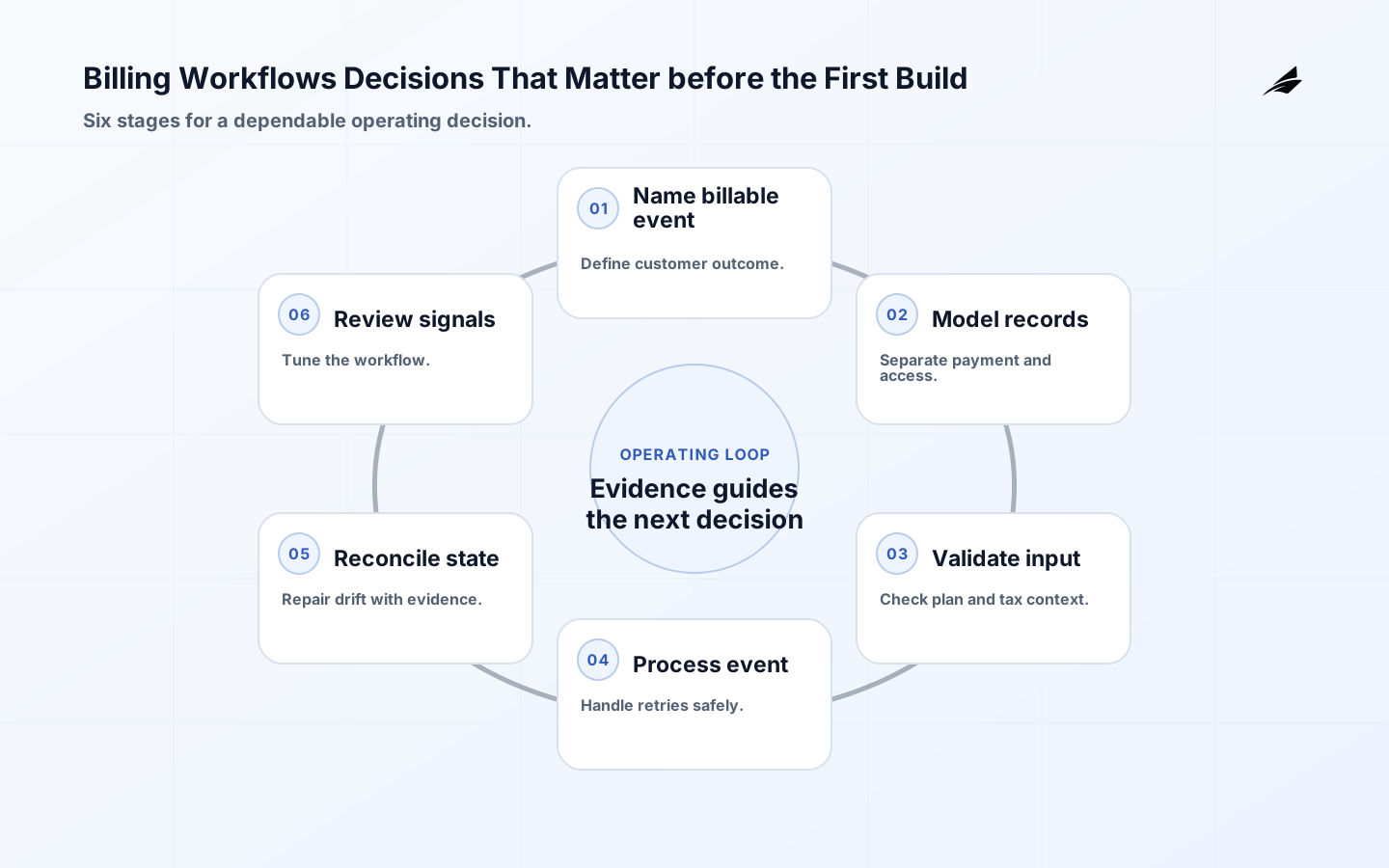
Billing workflows become dangerous when a product treats them as a single purchase event. A customer can change a plan, consume usage, receive an invoice, authenticate a payment, dispute a charge, cancel, or regain good standing at different times. Each event may arrive asynchronously and may be retried. Production billing must preserve a clear account of commercial intent, provider state, customer communication, and product entitlement. The goal is not to duplicate the payment provider; it is to keep product access and financial records reconcilable when the normal sequence breaks.
Set the billing workflows boundary before implementation
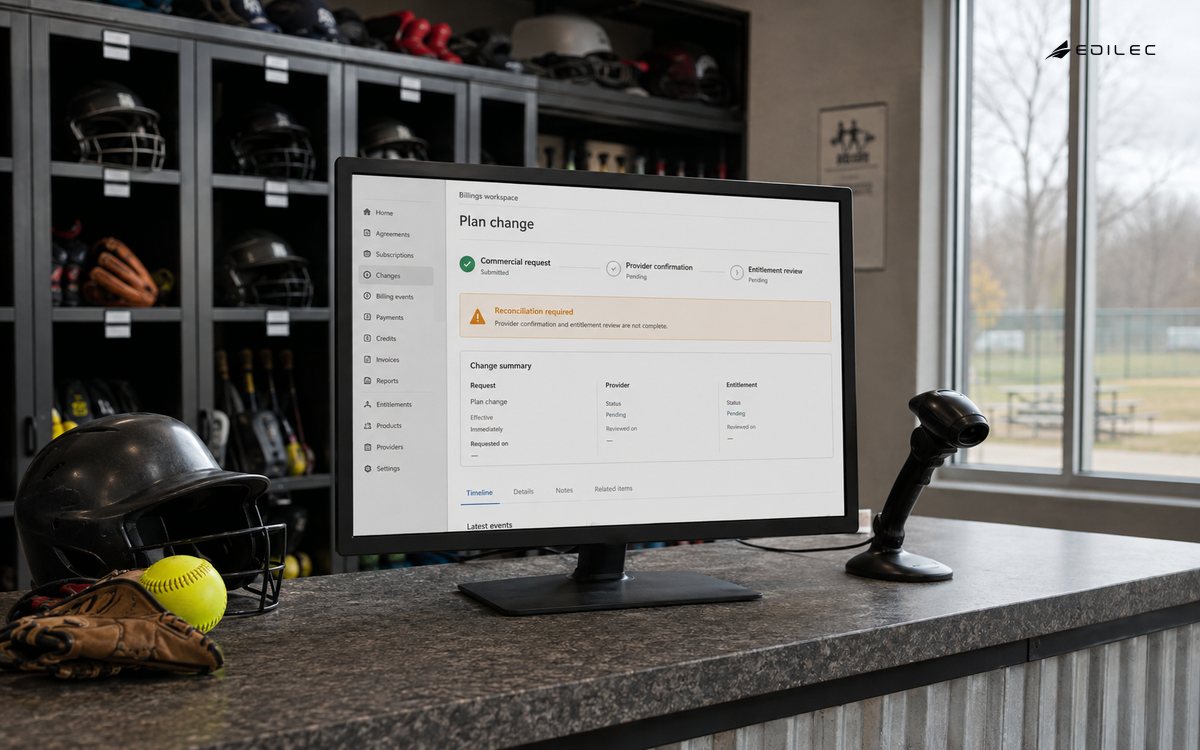
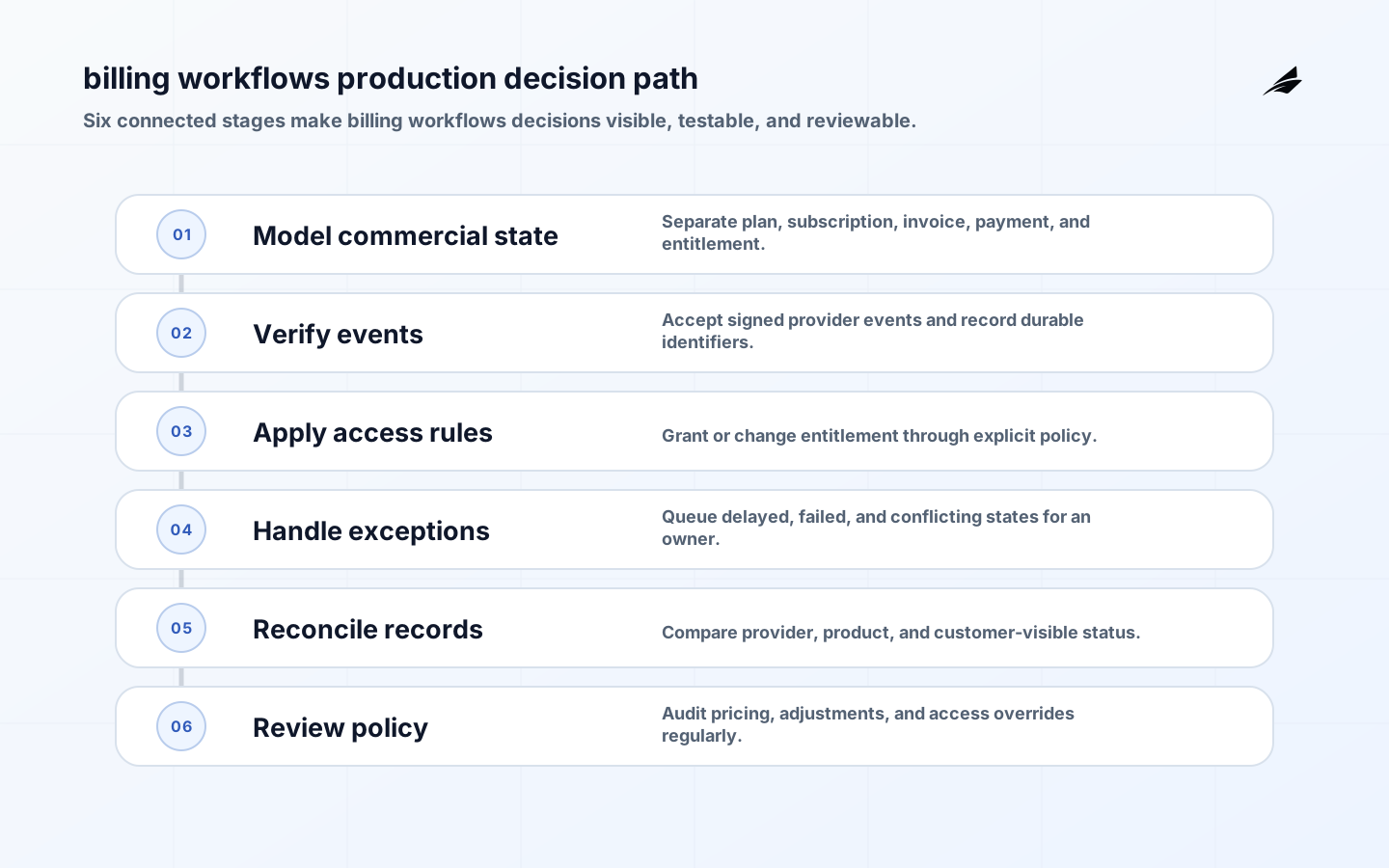
Separate the commercial objects: customer, price or plan, subscription, invoice, payment attempt, credit, entitlement, and access policy. Decide which system is authoritative for each. A pricing page can describe an offer, while the billing provider records invoice and payment status; the product must record the entitlement it granted and why. Write the lifecycle transitions in business language, including upgrade, downgrade, trial end, failed collection, refund, cancellation, and reactivation. This prevents support from using a vague paid label when the actual question is whether a specific capability should be available now. Treat the distinction as a product promise.
| Decision area | Question to settle | Evidence to retain |
|---|---|---|
| Scope | Which billing workflows outcome is being protected or improved? | Named owner and success condition |
| Authority | Which system or role may make the state change? | Policy version and decision record |
| Failure | What happens when a dependency or input is incomplete? | Visible status, retry rule, and responder |
| Review | Which signal changes the next product decision? | Threshold, cadence, and accountable team |
Design billing workflows as an explicit operational contract
Use verified provider events to drive asynchronous state changes and make the handler idempotent. Stripe’s subscription documentation describes how payment and invoice outcomes arrive through webhooks and why a subscription can remain active while an invoice cannot be finalized. Store event identifiers, signature verification result, received time, processing result, and the linked billing object. Provide customers with a readable explanation of the current state and the action they can take. Financial changes need review and correction paths; WCAG 2.2 is a useful baseline for confirmation and input-error prevention. The intent is not to predict every incident.
- Name the user-visible outcome and the state that confirms billing workflows are complete.
- Assign authority for each important record, transition, and exception.
Release billing workflows with recovery and observability
Test the billing workflow with a sandbox and a controlled production rehearsal. Cover initial purchase, duplicate request, payment requiring action, invoice finalization failure, payment failure, delayed or out-of-order webhook, plan change, refund, dispute, and cancellation. Verify that a replay of the same event does not create a second entitlement or credit. Build an operations queue for events that cannot be reconciled automatically, including an owner, customer-impact rule, and a method for correcting records without editing history. feature flag decisions is a useful adjacent decision when planning the customer-facing implications.
| Production risk | Practical control | Signal for review |
|---|---|---|
| Ambiguous state | Use an explicit lifecycle and durable identifiers | Conflicting or aged records |
| Unsafe retry | Make commands and event processing idempotent | Duplicate effects or corrections |
| Invisible exception | Create an owned queue and customer-facing status | Age of unresolved work |
| Uncontrolled change | Stage exposure and retain a rollback route | Unexpected outcome after release |
Operate billing workflows from decision-ready signals
Measure the system’s ability to reach a settled state: event processing delay, unprocessed failures, entitlement mismatch, invoice finalization problems, payment recovery, refund aging, and customer contacts per billing event. Revenue metrics have their place, but they should not be the only dashboard. A low processing error count may hide a queue that is aging because failures were never classified. Segment by plan or country only when it reveals a rule or integration condition that can be changed. Review the oldest unresolved cases alongside aggregate rates.
Keep billing workflow changes reviewable
Billing policy requires accountable review. Keep versioned records of prices, taxes or collection assumptions, customer notifications, entitlement mappings, and manual adjustments. Define who can grant temporary access, issue a credit, or alter a subscription, and require a reason that can be audited later. Reconcile provider and product records on a schedule appropriate to the volume and risk. When a correction is needed, preserve the original decision and link the compensating action rather than overwriting the past. This is not ceremony for its own sake.
Validate billing choices against primary references
The recommendations here are informed by Stripe invoicing overview, Stripe entitlements, Stripe customer portal guide, Stripe subscription schedules. For billing workflows, apply them to verified event processing, accessible financial confirmation, and reconciliation of invoice and entitlement state.
Key billing workflows takeaways
- Define billing workflows around a bounded customer outcome, not a feature inventory.
- Make ownership, state transitions, and exceptions explicit before expanding scope.
- Release with representative failure tests, traceable evidence, and a correction path.
- Use signals that trigger a concrete operational or product decision.
- Remove temporary controls once their decision has been made and verified.
Billing workflows FAQ
Should the product grant access when checkout returns successfully? Wait for the verified billing event or other recorded provider confirmation defined by your policy; a browser return is not durable financial evidence. What makes a webhook handler safe? Signature verification, durable event identity, idempotent processing, and a visible failure queue. Can we edit an invoice record to fix an error? Prefer a documented adjustment or provider-supported correction that preserves the original record. What deserves an alert? Processing delay or an entitlement mismatch that can leave a customer incorrectly blocked or incorrectly enabled.
Conclusion: make billing workflows dependable in production
Billing workflows deserve the same engineering discipline as any high-consequence product state machine. Preserve authority, make events repeatable, explain access decisions, and give operations a path to reconcile the exceptions.
Draw the billing boundary around decisions, not screens
Before implementation, name the business event the workflow must protect: a customer becomes entitled to a plan, an invoice is paid, a refund is accepted, or an account is suspended. A checkout page is only one participant. The durable boundary includes the customer, account, subscription, invoice, payment attempt, entitlement, tax context, and notification. Each record needs an owner and a reason for changing. For example, the payment provider can be authoritative for payment status while the product remains authoritative for what a paid plan unlocks. That division is easier to reconcile than a single “active” flag copied between services. Stripe’s webhook guidance makes the same operational point: subscription updates arrive asynchronously and handlers must be safe to retry. Treat the event identifier as evidence, not decoration, and store the processing result beside it.
| Decision | Practical test | Evidence |
|---|---|---|
| Boundary | Name the protected resource and owner | Scope record |
| Failure | Rehearse denial, retry, and recovery | Observed result |
| Change | Version the policy and expiry | Review decision |
Use a decision table before choosing the happy path
A small team can expose hidden work with five concrete cases: first payment succeeds, payment needs customer action, a webhook arrives twice, a refund follows entitlement, and a provider is temporarily unavailable. For each case, state the customer-visible message, the state written to the database, the retry rule, and the owner of an exception. If the team cannot answer one column, the design is not ready for a polished UI. The same table should cover manual correction. A support colleague may be able to request a resync, but should not be able to invent a paid state without evidence. This is where accessibility and operations meet: W3C guidance on error identification supports clear, actionable messages, while an internal event trail gives engineers a way to verify whether the message matches reality.
Release the workflow with reconciliation as a first-class feature
A production-ready billing flow can explain a mismatch without a database session or a provider dashboard. Add a reconciliation job that compares recent provider events, local payment records, and entitlement state; make the output a bounded queue with age, severity, and owner. Test a late event, a duplicated event, an event whose referenced object was deleted locally, and a renewal that changes plan quantity. Do not make a rollback silently revoke access. Version the mapping between provider products and internal plans, record the release version on each transition, and preserve a correction path. A useful release gate is a short, repeatable rehearsal: create a test customer, interrupt the browser after payment, replay an event, force a temporary provider failure, and then verify the customer’s next action and the operator’s evidence.
Measure trust and recovery alongside conversion
Conversion is useful only when paired with downstream signals. Review payment success, time to entitlement, unresolved reconciliation cases, duplicate side effects, refund rate, support contacts about access, and the age of the oldest exception. A payment funnel can improve even as correction work doubles; that is not a clear win. Set thresholds that trigger decisions: pause rollout when entitlement drift exceeds a reviewed limit, route aged cases to billing operations, and change copy when customers repeatedly abandon at the same step. Keep the review cadence explicit and include a recent successful case, a failure, and a manual correction. That rhythm turns a dashboard into a learning loop and gives product, engineering, finance, and support the same vocabulary for deciding what to change next.
Key takeaways
- Define the boundary and the owner before choosing implementation details.
- Test denial, delay, duplication, and recovery as first-class paths.
- Measure the customer or operator outcome, not only the control signal.
- Keep exceptions narrow, time-bound, and easy to investigate.
- Review the policy when dependencies, traffic, or business rules change.
Frequently asked questions
Which billing decision should be made first? Name the event that grants or removes access, then assign payment, entitlement, and correction authority separately. What is the most important failure rehearsal? Replay a late or duplicated provider event and verify that access, customer messaging, and reconciliation agree. When should the workflow change? Change it when payment states, plan mapping, tax rules, or support corrections show a repeated mismatch.
Conclusion
Billing Workflows Decisions That Matter before the First Build becomes dependable when the rule is understandable, the failure path is rehearsed, and the evidence survives a busy day.
For adjacent decisions, compare RBAC for growing teams, API rate limiting checklist, Security headers checklist.