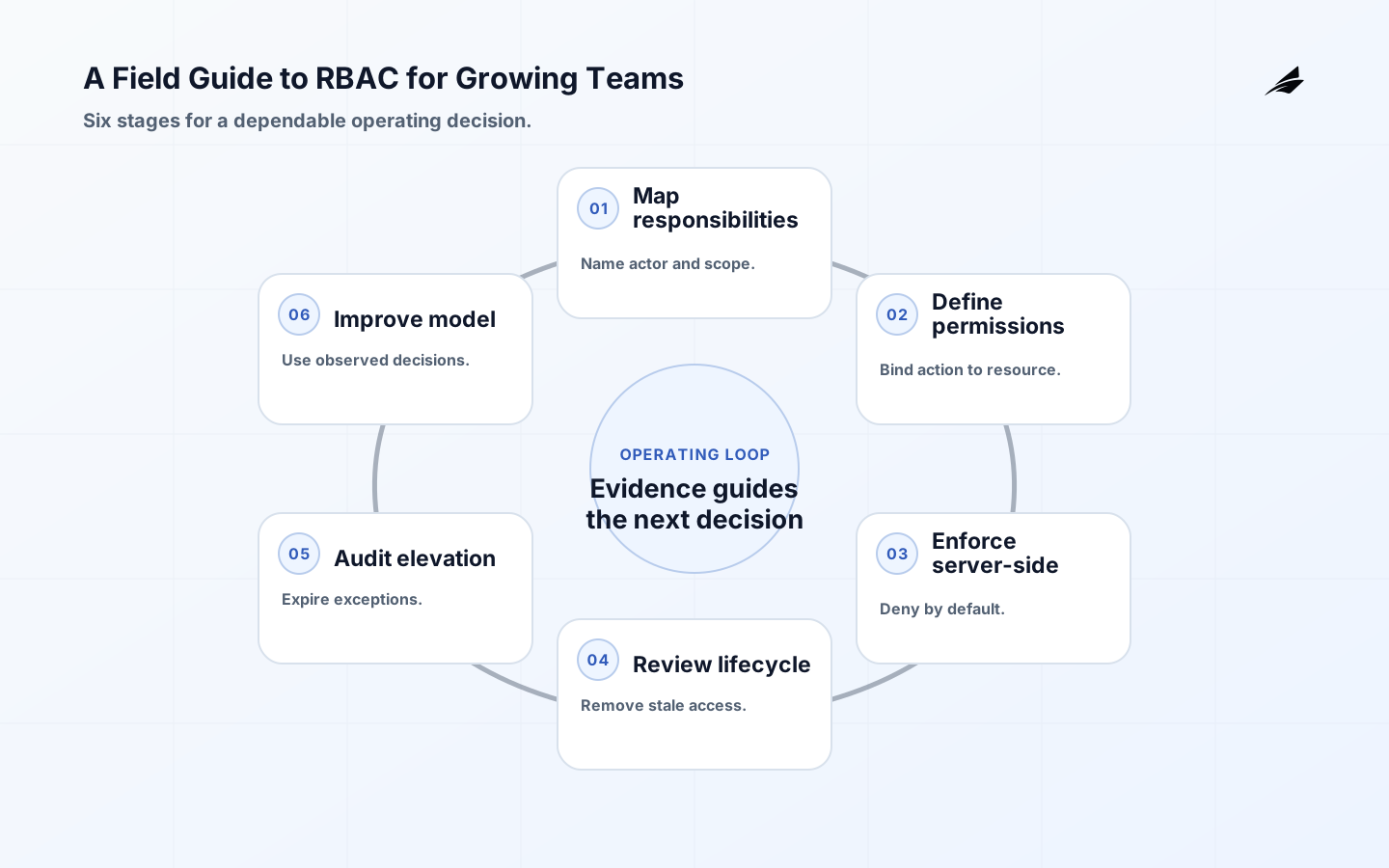
RBAC is useful only when it changes a concrete engineering decision. For CTOs, that means defining authorization through named roles that bundle permitted actions for real job functions before choosing a product or publishing a policy. The NIST least privilege glossary frames security around protecting resources rather than assuming a network location grants safety. RBAC should reduce a known failure path without making ordinary work depend on a secret exception.
Set the RBAC boundary
The boundary for RBAC is authorization through named roles that bundle permitted actions for real job functions. In this setting, the central design decision is to make a role represent a stable responsibility, not a convenient way to grant one person every permission. NIST SP 800-171 Rev. 3 is useful as a control catalogue because it connects access, configuration, monitoring, and recovery instead of treating them as unrelated checkboxes.
| Boundary question | Practical answer for this design | Evidence to keep |
|---|---|---|
| Protected outcome | State what RBAC must allow, prevent, or prove. | Scope statement, owner, and impact of failure. |
| Decision inputs | Use subject, active role, requested action, tenant or resource scope, approval context, and role assignment provenance. | Source, freshness expectation, and steward for each input. |
| Exception path | Make deviation time-bounded and approved. | Reason, compensating measure, expiry, and review record. |
Design an explainable RBAC decision
Good RBAC design is intentionally specific. The key inputs are subject, active role, requested action, tenant or resource scope, approval context, and role assignment provenance; the implementation needs a small role catalogue, deny-by-default enforcement, scoped roles, privileged role approval, and recurring access review. Those pieces should agree on vocabulary and ownership. The OWASP Top 10: Broken Access Control reinforces two durable habits: deny by default and verify authorization on the server side.
- Name one accountable owner for each RBAC policy and one reviewer for high-impact exceptions.
- Keep administrative changes versioned, attributable, and reversible through a tested path.
Avoid the failure modes that weaken RBAC
The most damaging shortcut in RBAC is creating role after role to patch individual exceptions until no one can explain effective access. The NIST role-based access control is a good reminder that interfaces exposed through browsers and APIs need exact, transaction-bound validation rather than permissive matching.
Implement RBAC in a narrow slice
A credible first release for RBAC is a single sensitive workflow with an action inventory, role-to-permission mapping, and a review of existing grants. Instrument it before broad adoption.
| Release check | Pass condition | What a miss means |
|---|---|---|
| Expected path | A legitimate RBAC request succeeds with attributable evidence. | The policy or integration is not ready to expand. |
| Negative path | An intentionally invalid request is rejected at the enforcement point. | A bypass or incomplete validation may remain. |
| Recovery path | The designated owner can restore approved access without a shared secret. | Operations will invent an unsafe workaround under pressure. |
Operate RBAC as a living control
After release, measure whether RBAC is still protecting the intended outcome. Use those findings to simplify the policy where possible.
Connect RBAC to adjacent practices
RBAC does not stand alone. The most relevant companion reading is A Field Guide to OpenID Connect for Growing Teams, A Field Guide to ABAC for Growing Teams, the least-privilege decisions guide.
RBAC takeaways
- Scope RBAC around a protected outcome and a named resource, not a generic security objective.
Review RBAC evidence
RBAC review should begin with effective permissions, not the role names displayed in an administration screen. Pick a sensitive action and trace which role assignments, hierarchy rules, tenant scopes, and service checks make it possible. That exposes accumulated grants that a role catalogue alone can hide. Review privileged roles more frequently, especially when staff change teams or leave, and make emergency elevation expire automatically. Roles should also be tested against direct API calls; A hidden navigation item does not enforce authorization. When a recurring exception appears, decide whether the job function genuinely changed or whether the underlying workflow needs a narrower action. This keeps the role model understandable as the company grows.
RBAC FAQ
Where should a team begin with RBAC? How much documentation is enough? How do we know the control works? Can a small team do this? ** Yes.
RBAC also needs a vocabulary for ownership changes. Record whether a grant came from a job role, a project assignment, a temporary approval, or a service identity, because each route has a different removal signal. A role review should compare intended access with observed calls and should explain any gap without exposing the underlying customer data. For delegated administration, bind the delegation to a tenant and action rather than copying the administrator role. For service accounts, keep the workload identity separate from a human role and rotate its trust relationship when the deployment boundary changes. When a team introduces a new permission, ask which existing permission becomes unnecessary and which test proves that neighboring tenants remain isolated. These questions turn role maintenance into a concrete product and operations practice. They also make incident response faster: an investigator can identify the grant path, locate the approver, disable the narrow assignment, and verify propagation. RBAC is dependable when its lifecycle is visible at the same granularity as the action it protects.
For a growing team, the review queue should show effective access rather than only requested roles. Include grants inherited from groups, temporary assignments, service identities, and emergency elevation. Compare that view with a small sample of real actions, then remove permissions that have no current business owner. A denied request is useful evidence when it identifies the missing scope and the safe route for correction. Keep the correction route separate from ordinary privilege so support can resolve a mistake without creating a permanent administrator path. This practice makes RBAC easier to explain during onboarding, organizational change, and incident response.
Conclusion: make RBAC operable
RBAC becomes durable when it is a clear decision made at the right boundary, backed by owned inputs and a recoverable operating path.
Start RBAC with a permission boundary and a real job
Role-based access control works when roles describe stable responsibilities rather than people’s names or every possible exception. Begin with a small matrix: actor, resource, action, scope, and business reason. A “billing operator” may view invoices and retry a failed payment but should not edit tax configuration or grant an entitlement. A “workspace administrator” may manage members inside one workspace but not read another workspace’s records. NIST’s least-privilege guidance treats privilege as something to review and remove when it is no longer needed; make that review an operating rule, not an annual spreadsheet exercise. Keep tenant scope separate from role name so the same role can be evaluated against the current resource owner.

| Decision | Practical test | Evidence |
|---|---|---|
| Boundary | Name the protected resource and owner | Scope record |
| Failure | Rehearse denial, retry, and recovery | Observed result |
| Change | Version the policy and expiry | Review decision |
Enforce the decision on the server and at the object boundary
A hidden button is not authorization. Every read and mutation should pass through a server-side policy check that receives the authenticated principal, the requested action, and the target resource. Then test the negative cases: a member changing an administrator, a user guessing another object identifier, a suspended account using a cached token, and a service account reaching a human-only action. OWASP describes broken access control as including privilege escalation, forced browsing, and missing checks on API methods. Use centralized policy code where possible, but keep domain-specific ownership rules close to the domain model. Return an unambiguous denial, log the decision context without secrets, and make the request traceable to a policy version.
Make role lifecycle and emergency access explicit
Growing teams accumulate roles faster than they retire them. Add an owner, purpose, grant path, review interval, and removal condition to each role. Separate standing access from time-bound elevation; an incident responder may need a temporary production permission, but the activation should have an approver, expiry, and audit record. On departure or team change, remove access through the identity lifecycle rather than relying on a manager remembering every application. Test stale sessions and revoked tokens. An exception that appears repeatedly is design evidence: either the ordinary role is wrong, or the workflow should be redesigned. Do not answer role sprawl by making a super-admin role the default.
Use access evidence to improve the model
Review both grants and use. A role with hundreds of permissions and no observed use is a candidate for reduction; a role with repeated denials at the same step may indicate a missing business role or a confusing workflow. Keep an access review record that names the reviewer, scope, decision, and follow-up date. Pair aggregate counts with a few sampled requests so the team can inspect the actual resource boundary. This evidence also helps product teams explain why a user can perform one action but not a neighboring one. The goal is not maximum restriction. It is a permission system whose decisions are predictable, testable, and proportionate to the work people need to do.
Key takeaways
- Define the boundary and the owner before choosing implementation details.
- Test denial, delay, duplication, and recovery as first-class paths.
- Measure the customer or operator outcome, not only the control signal.
- Keep exceptions narrow, time-bound, and easy to investigate.
- Review the policy when dependencies, traffic, or business rules change.
Frequently asked questions
Where should an RBAC check live? At the server-side action and resource boundary, not only in the interface. What makes a role healthy? A narrow purpose, owner, scope, review date, and removal condition. When is elevation acceptable? When it is explicitly approved, time-bound, logged, and narrower than standing access.
Conclusion
A Field Guide to RBAC for Growing Teams becomes dependable when the rule is understandable, the failure path is rehearsed, and the evidence survives a busy day.
For adjacent decisions, compare API rate limiting checklist, Security headers checklist, Plain-language API rate limiting.