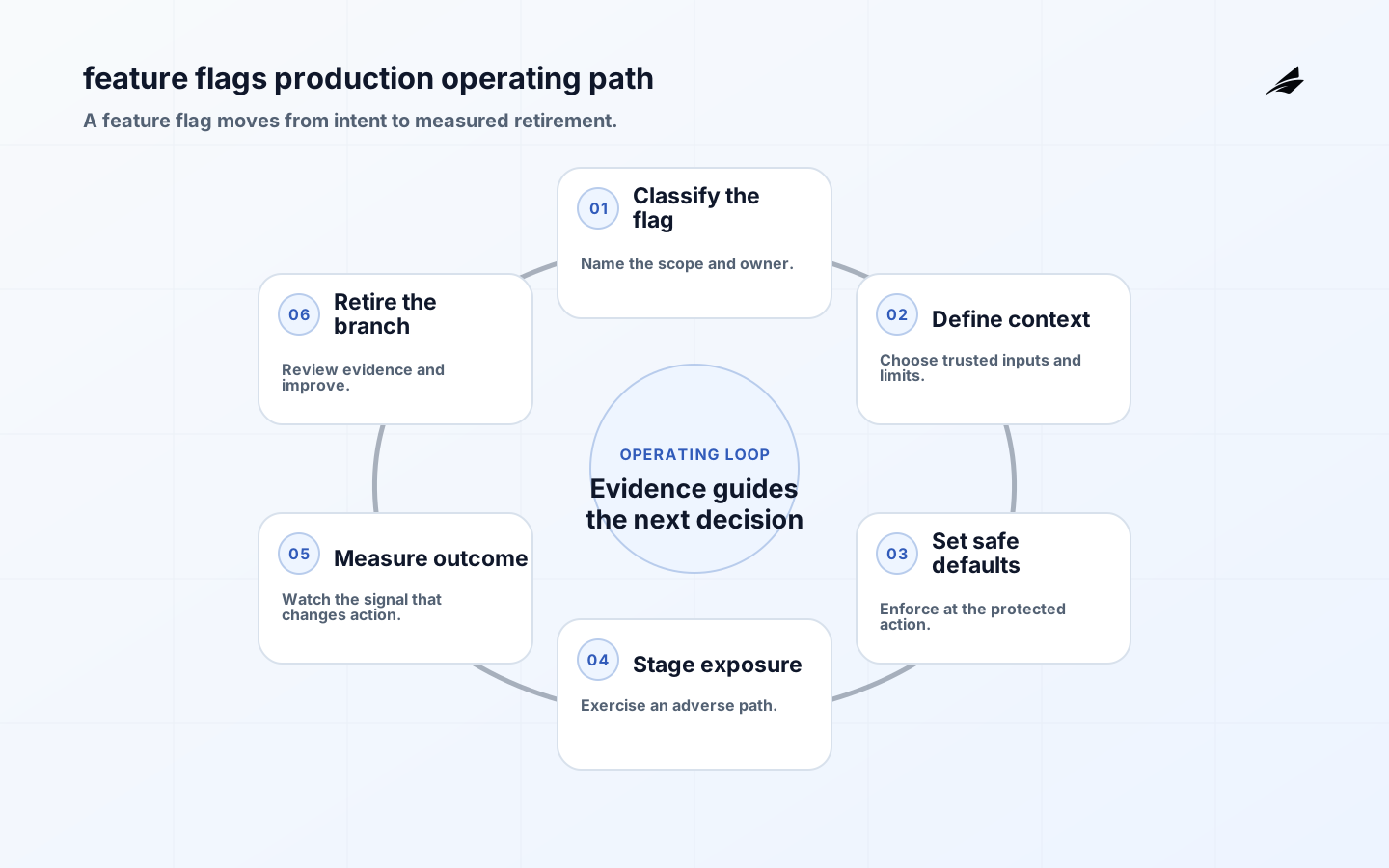
Feature flags are production controls, not a substitute for deciding what the product should do. A flag can make a release reversible, limit exposure, run a controlled experiment, or activate a customer-specific capability. It can also create an invisible maze when its purpose, default, context, owner, and removal date are unknown. Production practice starts by treating every flag as a small policy with consequences for users, operations, testing, and support. This guide gives product teams a practical way to set the boundary, design the controls, release safely, and keep improving from evidence.
Set the feature flags boundary before implementation — feature-flag rollout
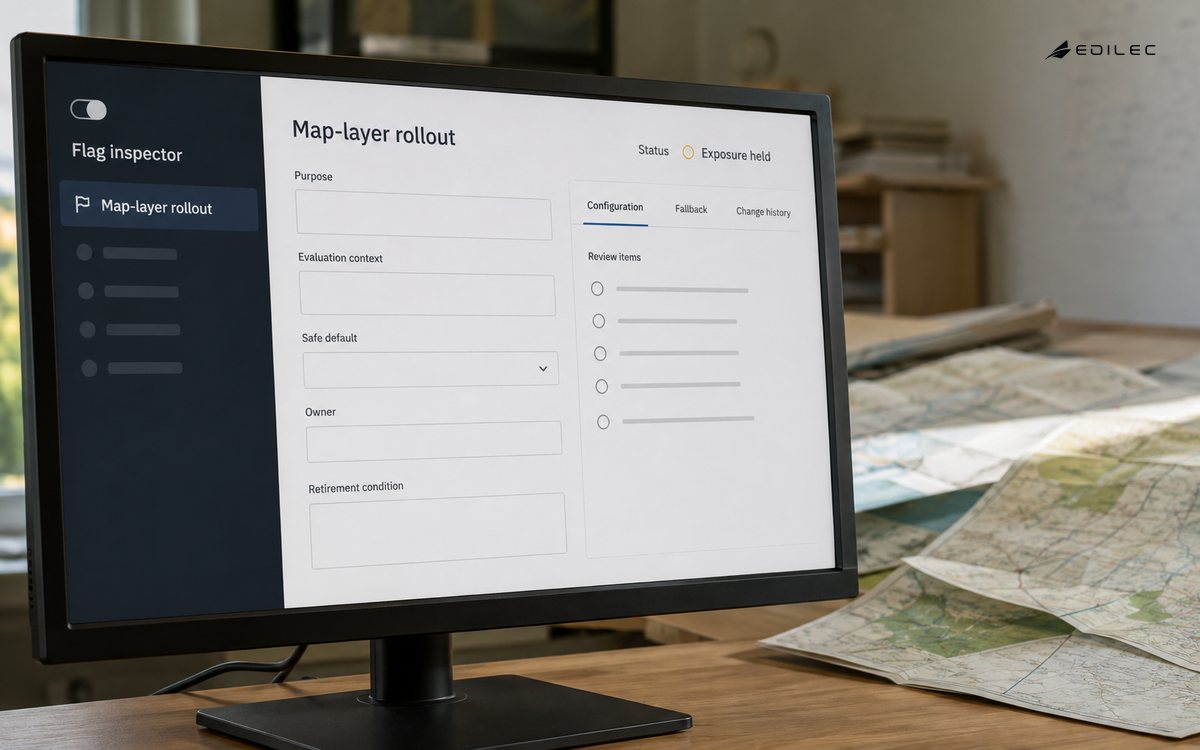
Classify flags before adding them: release, experiment, operational kill switch, permission or entitlement, and temporary migration control. A release flag should have a short lifespan; an entitlement rule may be durable but belongs in an auditable authorization model rather than an ad hoc toggle. OpenFeature’s evaluation API describes evaluation independent of a particular control plane, reinforcing the value of a stable application-side contract. Define the evaluation context deliberately: tenant, role, plan, region, device, cohort, or environment only when the attribute is lawful, available, and necessary. Before solution design, write down the outcome, the records involved, the actor who is accountable, and the evidence that proves a safe result. This narrow statement makes tradeoffs visible: some work must be synchronous and confirmed immediately, while other work can be durable and asynchronous. Treat the distinction as a product promise. A person should never have to infer whether a request completed, is pending, or requires another action.
| Decision area | Question to settle | Evidence to retain |
|---|---|---|
| Scope | Which feature flags outcome is being protected or improved? | Named owner and success condition |
| Authority | Which system or role may make the state change? | Policy version and decision record |
| Failure | What happens when a dependency or input is incomplete? | Visible status, retry rule, and responder |
| Review | Which signal changes the next product decision? | Threshold, cadence, and accountable team |
Design feature flags as an explicit operational contract — feature-flag rollout
A flag evaluation must be deterministic enough to explain. Record the key, default value, variant, context attributes used, configuration version, and reason where the platform supports it. Keep safe defaults close to the code path, and define behavior when the flag service is unavailable. Do not use a remote flag to bypass an authorization requirement or hide a data migration that lacks a reconciliation plan. Separate code deployment from exposure, but make both visible in change records so an incident responder can tell which behavior a customer received. Write acceptance criteria that include the unhappy path: a missing field, a duplicate action, a late response, an unavailable dependency, and a valid but unusual request. The intent is not to predict every incident. It is to make the normal rules and safe fallback visible enough that a colleague can reason about a new case without relying on private knowledge.
- Name the user-visible outcome and the state that confirms feature flags is complete.
- Assign authority for each important record, transition, and exception.
- Keep a durable identifier for requests, events, and corrections that may be repeated.
- Expose pending, failed, and completed states in language a customer can act on.
- Test denied or invalid paths as carefully as the intended successful path.
- Give every manual exception queue an owner, response expectation, and correction route.
Release feature flags with recovery and observability — feature-flag rollout
Test flags as part of the feature, including enabled and disabled states, incompatible configurations, targeting boundaries, cache refresh, provider outage, and rollback under load. Progressive rollout should begin with an internal or low-risk cohort, then expand based on the outcome the feature was intended to change. Use a kill switch only when it has a tested safe state; disabling an export or payment action without a user-facing explanation can cause more harm than a controlled queue. Link the rollout to the trial conversion in production work when experiments affect a commercial journey. Use a limited audience when the behavior or operating assumptions are new, but do not make the control itself contingent on a vague experiment. Capture correlation identifiers at boundaries so support and engineering can trace one real item from input to outcome. Confirm that a rollback preserves the ability to explain and correct records created during the release. tenant isolation in production is a useful adjacent decision when planning the customer-facing implications.
| Production risk | Practical control | Signal for review |
|---|---|---|
| Ambiguous state | Use an explicit lifecycle and durable identifiers | Conflicting or aged records |
| Unsafe retry | Make commands and event processing idempotent | Duplicate effects or corrections |
| Invisible exception | Create an owned queue and customer-facing status | Age of unresolved work |
| Uncontrolled change | Stage exposure and retain a rollback route | Unexpected outcome after release |
Operate feature flags from decision-ready signals — feature-flag rollout
Measure flag health and product outcome separately. Flag-evaluation errors, stale configuration, unexpected default use, and target population size show whether the control works. Task completion, latency, support contacts, and safety events show whether the feature is helping. An experiment needs a defined decision rule before exposure begins; otherwise a temporary flag tends to remain because no one owns the conclusion. Review flags that have not changed recently, especially those in high-traffic or sensitive paths. Choose measures that lead to a named action: investigate a specific backlog, pause a rollout, contact affected customers, correct a record, or change a policy. Review the oldest unresolved cases alongside aggregate rates. Averages are useful for trend, but they can make a single consequential failure disappear. Keep event history proportionate to the need to reconstruct a decision and protect it with the same care as the workflow itself.
Keep feature flags changes reviewable — feature-flag rollout
Give each flag an owner, purpose, creation date, expected removal date, affected systems, and rollback behavior. Require approval for targeting that changes billing, privacy, access, or legal commitments. Include flags in incident and release runbooks, then retire them through a tested change rather than deleting a configuration entry and hoping the code path no longer matters. The flag inventory is part of the production system; keep it searchable by support and engineering teams with appropriate access controls. Keep the record short enough to use: purpose, affected users and records, accountable owner, release condition, recovery method, and review date. This is not ceremony for its own sake. It lets product, engineering, support, and operations distinguish a change in presentation from a change in authority, cost, or customer commitment. Retire old exceptions and temporary rules deliberately; they are part of the production behavior even when no longer visible in the interface.
Use authoritative guidance to check the design — feature-flag rollout
The recommendations here are informed by Flag Evaluation API, OpenFeature specification sections, Implementing SLOs, HTTP Semantics. These sources provide durable reference points for access decisions, accessible interaction, asynchronous integration behavior, reliable operation, or controlled delivery, depending on the problem at hand. For feature flags, apply them to deterministic evaluation, safe defaults, controlled exposure, and prompt retirement. They do not replace customer research, contractual obligations, or domain-specific review. Use them to challenge assumptions, then record the product-specific rule your team adopts and the evidence that will show whether it is working.
Feature Flags: make the decision record useful — feature-flag rollout
A concrete decision example — feature-flag rollout
For a feature flag, make one release decision reviewable: name the cohort, protected behavior, trusted context, failure state, owner, and evidence that proves the result. Keep the case small enough to test in code and specific enough to guide support when the rollout path fails.
OpenFeature’s evaluation API keeps evaluation semantics separate from a vendor control plane. Use that separation to define context fields, safe defaults, and evidence before implementation.
A release flag should disappear after exposure; an experiment needs a hypothesis and decision date; a kill switch needs a tested degraded state; an entitlement belongs in durable policy. Keeping those lifecycles distinct prevents a boolean from becoming invisible authorization.
| Decision point | Minimum record | Proof |
|---|---|---|
| Scope | Protected action and owner | Named boundary |
| Failure | Safe fallback and escalation | Adverse-path test |
| Change | Review trigger and expiry | Versioned evidence |
| Outcome | Signal and next action | Owner review |
For a small team, the first review can be a thirty-minute trace of one customer request. Record the flag key, evaluation context, provider response, chosen variant, downstream effect, and the person who can change it. Then repeat the trace with the provider unavailable and with a context field missing. If the result is surprising, change the contract before adding more targeting rules. This exercise also gives support a useful explanation: which behavior was selected, why it was selected, and what the customer should expect while the rollout is paused. A flag inventory should be searchable, but it should not become a second product backlog. Keep only the fields that change a decision, make an incident easier to investigate, or tell the team when a temporary control has earned retirement.
Key feature flags takeaways
- Define feature flags around a bounded customer outcome, not a feature inventory.
- Make ownership, state transitions, and exceptions explicit before expanding scope.
- Release with representative failure tests, traceable evidence, and a correction path.
- Use signals that trigger a concrete operational or product decision.
- Keep policy and change records understandable to the people who support the service.
- Remove temporary controls once their decision has been made and verified.
Feature flags FAQ
For implementation context, compare the OpenFeature flag evaluation specification, its evaluation context guidance, its hooks reference, and the Google SRE monitoring workbook. Apply those references to the flag lifecycle, context quality, instrumentation, and review cadence used by the product.
When should we use a flag instead of a deployment? Use a flag when controlled exposure, reversibility, or a bounded experiment is needed; do not add one solely to avoid making a product decision. Can a flag be permanent? Durable policy should usually move into a named entitlement or configuration model with clear ownership, not remain a forgotten release switch. What is the safest default? The behavior that preserves data integrity and avoids granting unintended access when evaluation fails. How do we remove a flag? Confirm the chosen state, remove unused branches and configuration, update tests and runbooks, then verify no clients still request it.
Conclusion: make feature flags dependable in production
Feature flags are valuable when they make change safer and evidence clearer. Define their policy, test both states, measure the intended result, and remove them before temporary control becomes permanent complexity.
For adjacent implementation context, see related Edilec guide 1, related Edilec guide 2, related Edilec guide 3 In the feature-flag rollout workflow, the owner records that result.
The final design review should ask what happens when the flag service is slow, the context is incomplete, or a rollout is reversed after side effects have occurred. Keep the answer close to the code path and the runbook. A customer-facing state should explain whether the feature is unavailable, pending, or intentionally limited. Support should be able to identify the flag and its owner without receiving unrestricted configuration access. This small operating contract prevents a temporary release mechanism from becoming a hidden dependency that only its original author understands.