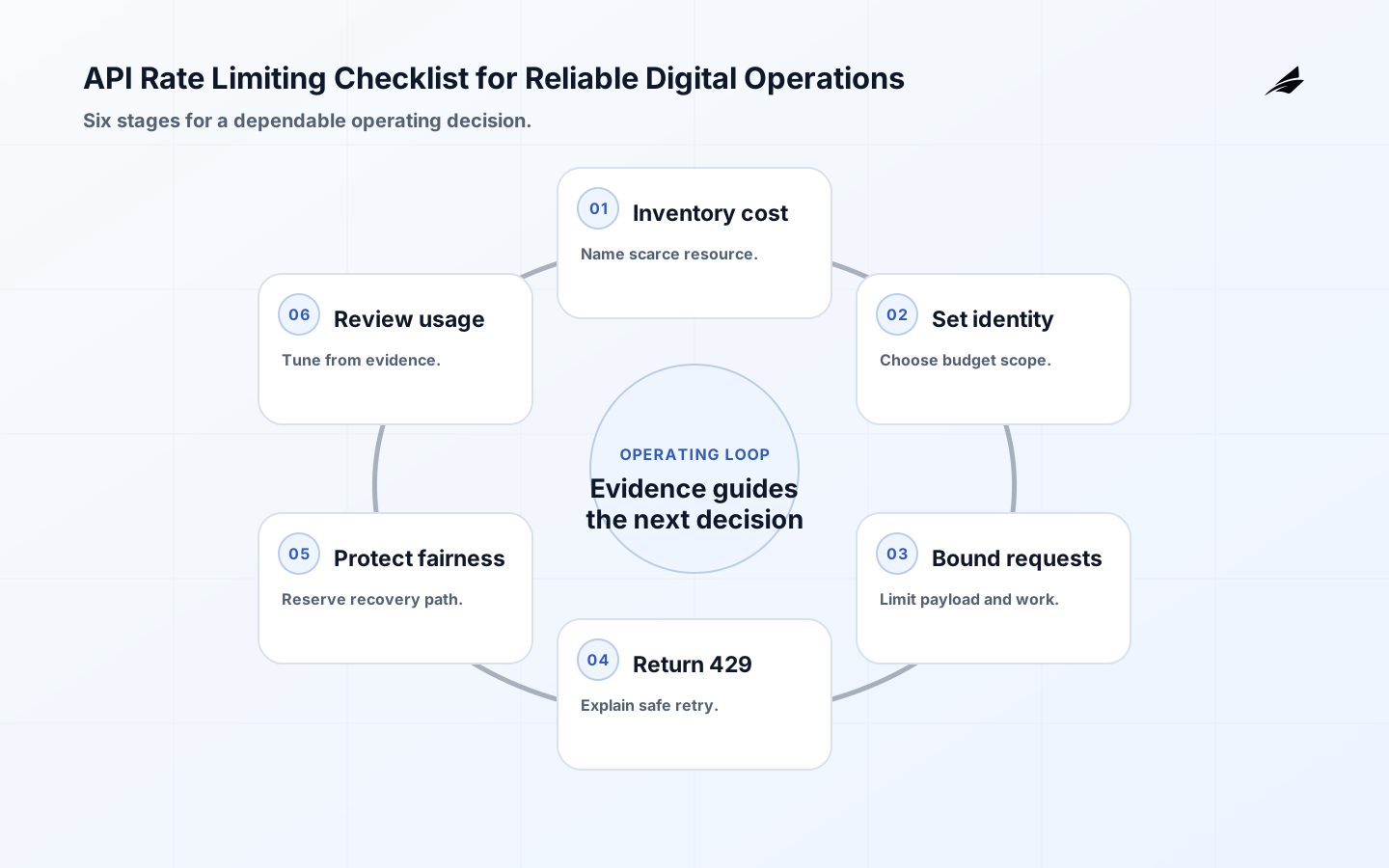
API rate limiting is a production capability with consequences for people, software, and recovery. API rate limiting work should begin with the decision that must remain true when a request, change, or failure reaches the sensitive boundary. API rate limiting is not improved by a larger checklist alone; it improves when ownership, enforcement, evidence, and repair are explicit. API rate limiting decisions below draw on API Gateway throttling guide and Cloudflare rate limiting guidance. API rate limiting designs benefit from that source-backed framing because it makes a later investigation possible without relying on the memory of the person who made the original configuration.
Set the API rate limiting operating decision
API rate limiting begins with the risk the system must control, not a product setting. Identify the operation that becomes unsafe first: a login verifier, database lookup, billable vendor call, message publisher, or tenant export. Calibrate limits to that dependency and legitimate bursts, not just average requests per second. Use a meaningful identity key rather than IP address alone. API rate limiting is a capacity and abuse control, not a number pasted into a gateway. A useful limit identifies callers fairly, protects the narrowest scarce dependency, gives clients a predictable response, and lets operators distinguish a broken integration from hostile traffic.
Map API rate limiting boundaries and dependencies
Enforce close to the resource while maintaining policy across gateway, application, and asynchronous paths. State whether rejected requests consume quota, how retries behave, and how idempotency keys interact with limits. A 429 response needs a consistent contract that does not reveal sensitive account or capacity details.
| Design element | Question to answer | Evidence to retain |
|---|---|---|
| Protected resource | What becomes scarce first? | Latency and saturation baseline |
| Limit key | Who is charged for use? | Authenticated or tenant identity |
| Bucket | What burst and sustained rate are safe? | Documented algorithm and values |
| Response | What does a client receive? | 429 contract and retry behavior |
Use proportionate API rate limiting controls
Use independent budgets for authentication, write-heavy actions, expensive searches, and bulk export. Protect the limiter from unbounded key cardinality and document fail-open or fail-closed behavior by endpoint risk. Scope emergency overrides to one tenant with an expiry instead of widening global thresholds. Match each safeguard to a credible failure mode.
OWASP Top 10: Broken Access Control is useful for making enforcement and verification concrete. The nearby guides on API Rate Limiting: Engineering Notes for Reliable Services, OAuth Security Architecture: Flows, Token Boundaries and Production Controls, Incident Playbooks: Hands-on Planning Guide cover adjacent choices that commonly affect this design.
Operate API rate limiting with evidence
Measure allowed and rejected requests by endpoint and key type, limiter errors, backend saturation, retry patterns, and support contacts. If many 429 responses do not reduce downstream latency, the limiter is likely in the wrong place or keyed too broadly. Load-test coordinated retries. Decide before implementation which movement triggers investigation, pause, or rollback.
| Signal | What it can reveal | Review action |
|---|---|---|
| Rejected requests | Overload, abuse, or bad client behavior | Break down by endpoint and key |
| Backend latency | Whether limits protect the dependency | Compare before and after |
| Limiter failures | A control-plane availability risk | Alert separately from app errors |
| Retries | Clients amplifying load | Watch storms after 429s |
Roll out API rate limiting in six controlled stages
- Name the owner, protected boundary, and unacceptable outcome for API rate limiting.
- Capture a baseline for rejected requests before changing enforcement.
- Implement the smallest scope that can provide real production evidence.
- Review customer impact, support load, and recovery evidence before widening exposure.
- Convert observed gaps into a policy, test, alert, or runbook improvement.
Implementation details for API rate limiting
Choose an algorithm that matches the customer contract. A token bucket can accommodate a short legitimate burst while holding a sustained rate; a concurrency cap can protect a costly long-running operation. Document semantics across regions and how distributed counters behave during cache loss or delayed replication.
Fairness belongs in the architecture. A tenant-wide limit protects a shared database but lets one tenant user affect another; a per-user limit may be bypassed by mass account creation. Combine keys only when each addresses a real abuse or capacity risk, and do not mistake a corporate proxy for one customer.
Recovery planning is part of the security design. Publish a stable rejection contract so clients can back off and avoid blindly retrying non-idempotent work. The server still must defend itself because compliant client behavior is an optimization, not a security assumption.
Before expanding API rate limiting, review the design with the owner of protected resource and the operator who will respond when response fails.
Set a review date and a measurable completion condition for this API rate limiting change.
API rate limiting takeaways
- API rate limiting works when the boundary and owner are explicit.
- Use controls because they interrupt a specific credible harm.
- Keep exceptions narrow, expiring, and reviewable.
- Measure the customer or system outcome as well as control health.
- Practice recovery, preserve evidence, and revise the operating record.
API rate limiting FAQ
What is the first implementation step? Start with what becomes scarce first, and retain a latency and saturation baseline. How should an exception be handled? What proves the design is working? ** Look for the operating signals above, a successful adverse-path exercise, and evidence that the relevant owner can explain who is charged for use without undocumented behavior. GitHub REST API rate-limit documentation provides a useful verification reference for that final test.
Conclusion: make API rate limiting an operating capability
The durable version of API rate limiting is neither a one-time configuration nor a document completed in isolation.
The Kubernetes flow control documentation is a useful comparison for queueing and fairness: it shows why a rate limit should state which work is admitted, how pressure is signaled, and what recovery path remains available.
Inventory expensive API work before setting numbers
A rate limit is a control around a resource budget, not a decorative number on an API gateway. List endpoints by cost and consequence: a cached read, a database-heavy search, a file upload, a password reset, a report export, and an action that calls a paid vendor. For each, choose the identity dimensions that matter: account, API key, user, IP, tenant, route, and sometimes a shared downstream dependency. OWASP’s resource-consumption guidance pairs request limits with payload bounds, page-size limits, timeouts, and memory or process controls. A client allowed to make ten cheap reads may still be able to exhaust a database with one unbounded query.

| Decision | Practical test | Evidence |
|---|---|---|
| Boundary | Name the protected resource and owner | Scope record |
| Failure | Rehearse denial, retry, and recovery | Observed result |
| Change | Version the policy and expiry | Review decision |
Publish a client contract for rejection and recovery
Clients need more than a 429. RFC 6585 defines the status for too many requests and allows Retry-After; use it when the retry time is meaningful, and include a stable error code plus the limit scope in the response body. Decide whether failed authentication attempts consume a separate budget and document whether limits are fixed-window, sliding-window, token-bucket, or concurrency-based. A mobile client should use bounded backoff with jitter, while an internal batch job may need a queue and a larger declared budget. Never tell clients to retry immediately in a loop. Make headers and examples part of the versioned API contract so teams can build a safe response before an incident forces a rushed fix.
Protect fairness across tenants and dependencies
A global limit can protect the service while starving small customers behind one noisy tenant. Combine a shared safety ceiling with tenant or credential budgets, then reserve capacity for health checks and operator recovery. When a downstream vendor has a stricter quota, enforce that budget near the call site and expose queue depth rather than allowing every request to fan out. Consider cost weighting: an export that scans a million records should consume more budget than a cache hit. Test burst behavior at window boundaries, failover between gateway nodes, and clock differences. The right question is not “how many requests per second?” but “which users can make progress, under what work mix, while the service remains within its resource envelope?”
Alert on rejected work and on silent depletion
Track allowed requests, rejected requests, queue age, latency, downstream saturation, and the remaining budget for representative tenants. A rising 429 rate may show an attack, a bad client, or a limit that is too low for a legitimate release. Sample enough context to identify the route, scope, policy version, and correlation identifier without logging credentials. Exercise the limiter in a staging load test and in a controlled production canary. Verify that a limiter outage fails according to an explicit choice: deny expensive work, use a conservative local budget, or route to a protected queue. The fallback must not turn a control dependency into an unlimited path.
Key takeaways
- Define the boundary and the owner before choosing implementation details.
- Test denial, delay, duplication, and recovery as first-class paths.
- Measure the customer or operator outcome, not only the control signal.
- Keep exceptions narrow, time-bound, and easy to investigate.
- Review the policy when dependencies, traffic, or business rules change.
Frequently asked questions
How should an API limit be chosen? Start with the scarce resource and the cost of the endpoint, then set identity and tenant scope. What should a client do after 429? Honor the documented retry signal and use bounded backoff with jitter. What proves the policy is fair? Compare rejected work, latency, and capacity share across representative tenants and routes.
Conclusion
API Rate Limiting Checklist for Reliable Digital Operations becomes dependable when the rule is understandable, the failure path is rehearsed, and the evidence survives a busy day.
For adjacent decisions, compare Security headers checklist, Plain-language API rate limiting, API rate limiting engineering notes.