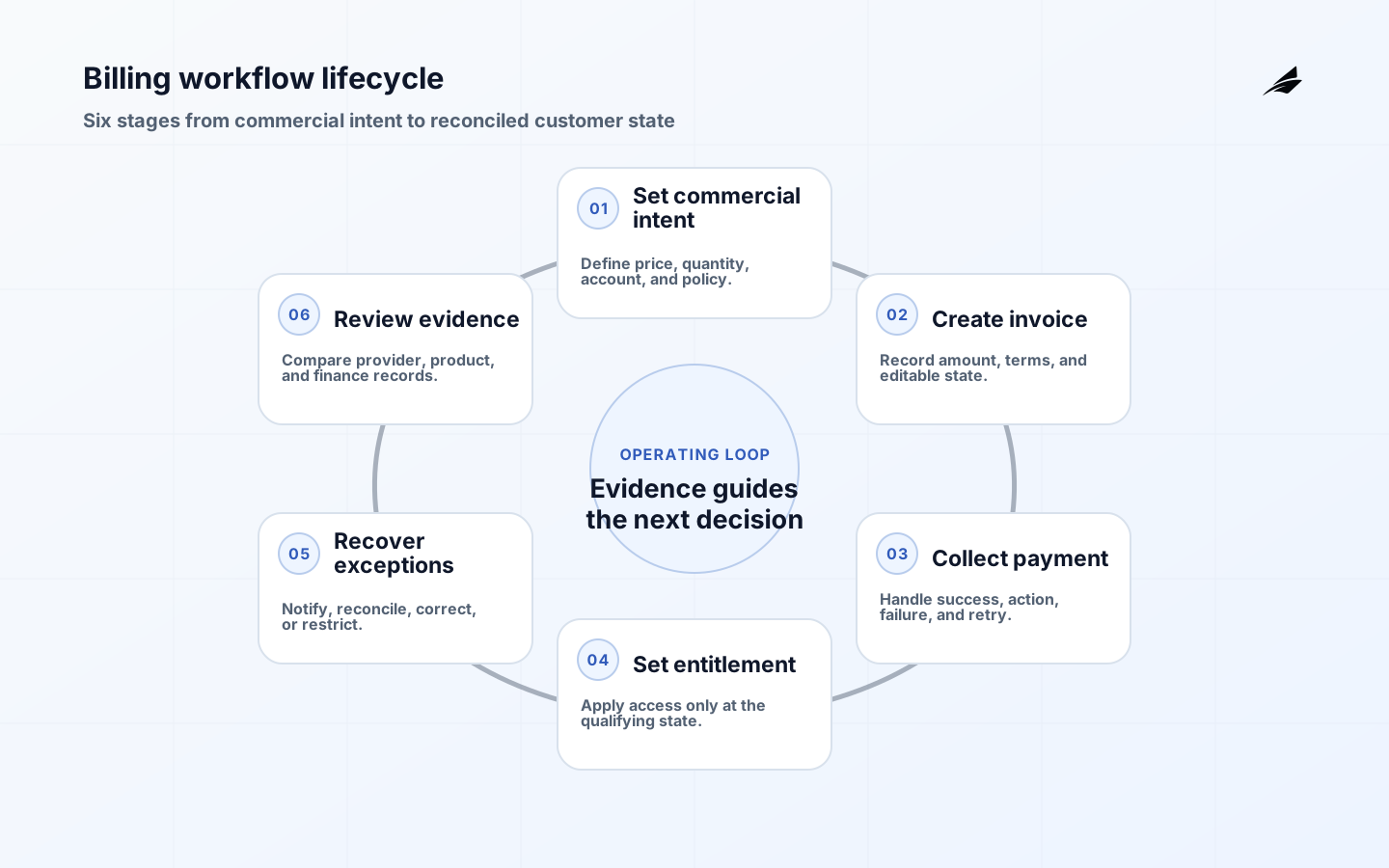
Billing workflows are the connective tissue between what a company sells and what a customer can use. A plan is not access, an invoice is not payment, and a successful payment event is not necessarily a complete accounting record. The workflow must carry identity, price, quantity, tax context, invoice state, payment outcome, entitlement, and evidence of the decision. Stripe's documentation describes invoices, subscriptions, PaymentIntents, and webhooks as related resources with distinct states. For a team, the practical lesson is simple: model those states explicitly instead of letting a single boolean such as paid decide every downstream behavior. Edilec's plain-language guide to usage reporting provides useful context for the quantity side of this problem.
Define the billing boundary before choosing tools
Write the commercial decision in a sentence: a customer receives a named capability when a qualifying account, price, and payment state are true. Then list the exceptions. Does a free trial grant access before a payment method exists? Does an unpaid invoice permit a grace period? Can a support agent issue a credit? Are metered units billable when an event arrives late? These are product rules, not merely provider settings. The boundary also names the system of record for price, invoice, payment, entitlement, and customer identity. A provider may own the payment object while your application owns the access decision; the integration must say how those records are joined and corrected.
Read the lifecycle as a chain of states
A useful lifecycle begins with a commercial intent, creates a subscription or one-time order, produces an invoice, attempts collection, records a payment outcome, and then updates entitlement and finance reporting. Each step can pause. A first subscription payment may leave the subscription incomplete; a renewal can become past_due; authentication can require customer action; a trial can end without a payment method. Do not collapse these states to avoid complexity. A pending state tells the application to wait or ask for an action, while a failed state may need retry or escalation. The user experience should reflect the same vocabulary as the integration, otherwise support agents will translate inconsistent labels under pressure.
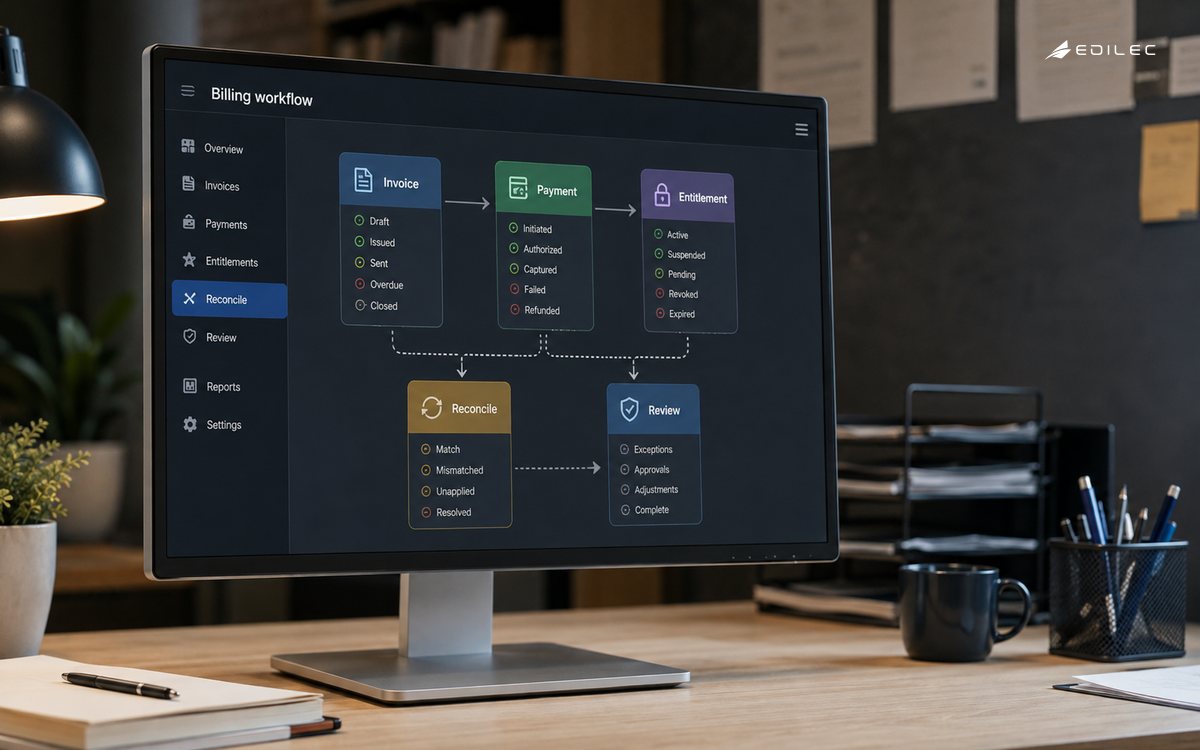
| State | Meaning | Safe application response |
|---|---|---|
| Draft invoice | Amounts may still be changed. | Allow approved adjustments; do not claim collection. |
| Open invoice | An amount is due or collection is pending. | Show due state and follow the configured collection path. |
| Paid invoice | The qualifying payment succeeded. | Grant or retain the defined entitlement and record evidence. |
| Past due | The latest payment failed or was not completed. | Start recovery, communicate, and apply the grace rule. |
| Unpaid or canceled | Configured recovery ended without settlement. | Restrict according to policy and preserve the audit trail. |
Keep commercial, payment, and access records separate
A durable data model has at least three views. The commercial view stores customer, product, price, quantity, discount, tax, and effective dates. The collection view stores invoice, PaymentIntent or equivalent, attempts, authentication, provider event identifiers, and recovery decisions. The access view stores the entitlement, its source, start and end, current state, and correction history. A single customer can have several subscriptions and invoices, so a row keyed only by email will fail as soon as a user changes address or belongs to multiple workspaces. Use stable provider and internal identifiers, idempotency keys, event timestamps, and a clear policy for late events.
Treat provider events as evidence, not commands
A webhook says that a provider observed a state transition; it does not grant permission to run an unsafe side effect without validation. Verify authenticity, store the event ID, reject duplicates safely, fetch the authoritative object when needed, and apply a transition only when the event is valid for the current record. Process out-of-order messages with timestamps or version checks rather than assuming delivery order. Stripe documents events such as invoice. Paymentfailed and invoice. Paymentaction_required for payment recovery. Your handler should turn them into an internal decision such as notify, retry, wait for authentication, or route to review. Never email a customer or revoke access twice because a provider retried delivery.
Design recovery as a customer journey
Payment recovery is not just a retry schedule. A recoverable decline may need another attempt; a missing payment method needs a secure update path; a hard decline may need a different instrument; a dispute needs a case owner. Define how many attempts occur, which messages are sent, when access changes, and what happens after the final attempt. Keep the decision reversible when possible. A grace period may preserve access while a customer resolves a temporary problem, but it should have an expiry and an owner. Record the reason for an exception and its end date so a friendly manual correction does not become a permanent leak.
- Make invoice, payment, entitlement, and finance states observable separately.
- Use idempotent handlers and provider event identifiers to contain retries.
- Define past-due, grace, pause, cancel, and manual-review behavior before launch.
- Tell customers what happened, what they can do, and when the next decision occurs.
- Reconcile provider data with internal access and finance records on a deliberate cadence.
Example: a workspace plan change
Suppose a workspace moves from ten seats to twenty in the middle of a month. The request changes commercial quantity, may create a prorated invoice, and should not silently expand access if the new charge needs customer authentication. A good workflow records the requested quantity, computes the expected adjustment, creates the pending update, waits for a successful payment result, then changes the entitlement. If payment fails, the workspace remains at ten seats or enters a documented pending state; it does not receive twenty seats simply because an update request was accepted. Support can explain the exact boundary, and finance can reconcile the invoice against the entitlement history.
| Control | Question | Failure it prevents |
|---|---|---|
| Stable identity | Which account and workspace does this event address? | Access applied to the wrong customer. |
| Transition rule | Which state permits the next side effect? | Granting service on invoice creation. |
| Idempotency | What happens if the message arrives twice? | Duplicate credits, emails, or revocations. |
| Reconciliation | How is divergence found and assigned? | A stale entitlement surviving a failed payment. |
| Correction | Who can fix an exception and why? | Unattributed manual changes. |
Measure the workflow, not only revenue
Operational measures show whether billing works for people. Track invoice finalization failures, time from payment success to entitlement, webhook lag, duplicate-event rate, recovery rate by failure class, manual correction age, and the number of accounts in a pending state beyond its expected window. Pair those with customer measures such as payment-action completion and support contacts after a failed renewal. A high recovery rate can still hide an unacceptable number of accidental access revocations. Review sampled account histories end to end: commercial request, provider objects, events, application state, customer message, and finance output should tell the same story.
Key takeaways
- Billing workflows connect commercial intent to verified payment, access, and reconciliation.
- Invoices, payments, subscriptions, and entitlements have different meanings and should retain separate states.
- Webhooks need authentication, idempotency, ordering protection, and a correction path.
- Recovery should specify customer communication, grace, final state, and ownership.
- A short account history is one of the best tests of whether the design is coherent.
FAQ: Billing workflow questions
FAQ: Should invoice creation grant product access?
Usually not by itself. Invoice creation says that an amount has been calculated; access should follow the commercial policy and a qualifying account or payment state. Trials and approved credit terms are deliberate exceptions that must be modeled explicitly.
FAQ: How many payment retries should a billing workflow use?
There is no universal number. Choose a schedule based on failure types, customer expectations, payment method, and the point at which continued access or collection cost becomes unacceptable. Document the terminal state and customer message.
FAQ: Why can webhook processing not be a simple queue consumer?
Provider delivery can be duplicated, delayed, or out of order. A safe consumer verifies the event, checks the current record, applies an allowed transition, and records what happened so a replay does not create another side effect.
Write the operating contract for every transition
For each billing transition, Write the input, decision, side effect, failure result, and owner. When an invoice is finalized, which service may attempt collection? When payment succeeds, which event grants entitlement? When a payment requires customer action, which screen or message explains it? When a provider is unavailable, does the account wait, retain access under grace, or enter review? These answers should appear in tests and runbooks, not only in the provider dashboard. A small transition contract also makes migrations safer: the team can compare old and new behavior, replay representative events, and identify which records need backfill. Keep the policy close to the code that enforces it and link the customer wording so operators do not translate a technical state differently from the product.
Billing also needs a clear separation between correction and override. A correction restores a state supported by evidence; an override deliberately changes the commercial or access result under an approved exception. Label them differently, require a reason, and record an expiry for temporary treatment. This distinction helps finance understand why totals differ and helps security review privileged access. It prevents a support shortcut from silently becoming a second billing system. The more valuable or sensitive the account, the stronger the approval and reconciliation path should be.
Ownership is clearer when billing separates the commercial promise from payment state. Trace each entitlement decision to its invoice, payment state, and accountable owner.
Before widening the plain-language guide to billing workflows, run a small rehearsal with normal, denied, delayed, and corrected cases.
For billing workflows, pair invoice accuracy and entitlement correctness with evidence that explains each correction, then use it to investigate exceptions.
A durable operating note for the plain-language guide to billing workflows records the assumptions that made the decision safe: the authoritative source, effective time, permitted actor, protected resource, and recovery route.
For billing workflows, a good handoff ends with observable evidence rather than a verbal promise. Confirm the scope, owner and next action during normal handling.
For Billing Workflows, Subscription invoices defines scope; How subscriptions work supports the control; Automate payment retries clarifies evidence; Using webhooks with subscriptions guides recovery; Pending updates frames review. Measure billing workflows outcomes alongside correction effort.
For billing workflows, review recovery for billing workflows during normal handling. For billing workflows, review evidence for billing workflows during a dependency failure. For billing workflows, apply this point during a corrected record.
For billing workflows, review recovery for billing workflows during a measured rollout. For billing workflows, apply this point during a denied request.
For billing workflows, review control for billing workflows during a measured rollout. For billing workflows, apply this point during a delayed handoff.
Conclusion
The plain-language guide to billing workflows starts with a useful separation: a price is a commercial promise, an invoice is an amount due, a payment is collection evidence, and an entitlement is a product decision. Build the integration around those distinctions, then add recovery, reconciliation, and correction as first-class paths. Edilec's pricing gates guide helps frame commercial rules, while the billing workflows practical guide can extend the implementation discussion. A dependable billing workflow is one a customer can understand and an operator can repair.
Evidence for “The Plain-language Guide to Billing Workflows” is grounded in Subscription invoices, How subscriptions work, Automate payment retries, Using webhooks with subscriptions, Pending updates; each source informs a specific decision, test, or operating trade-off described in this guide.