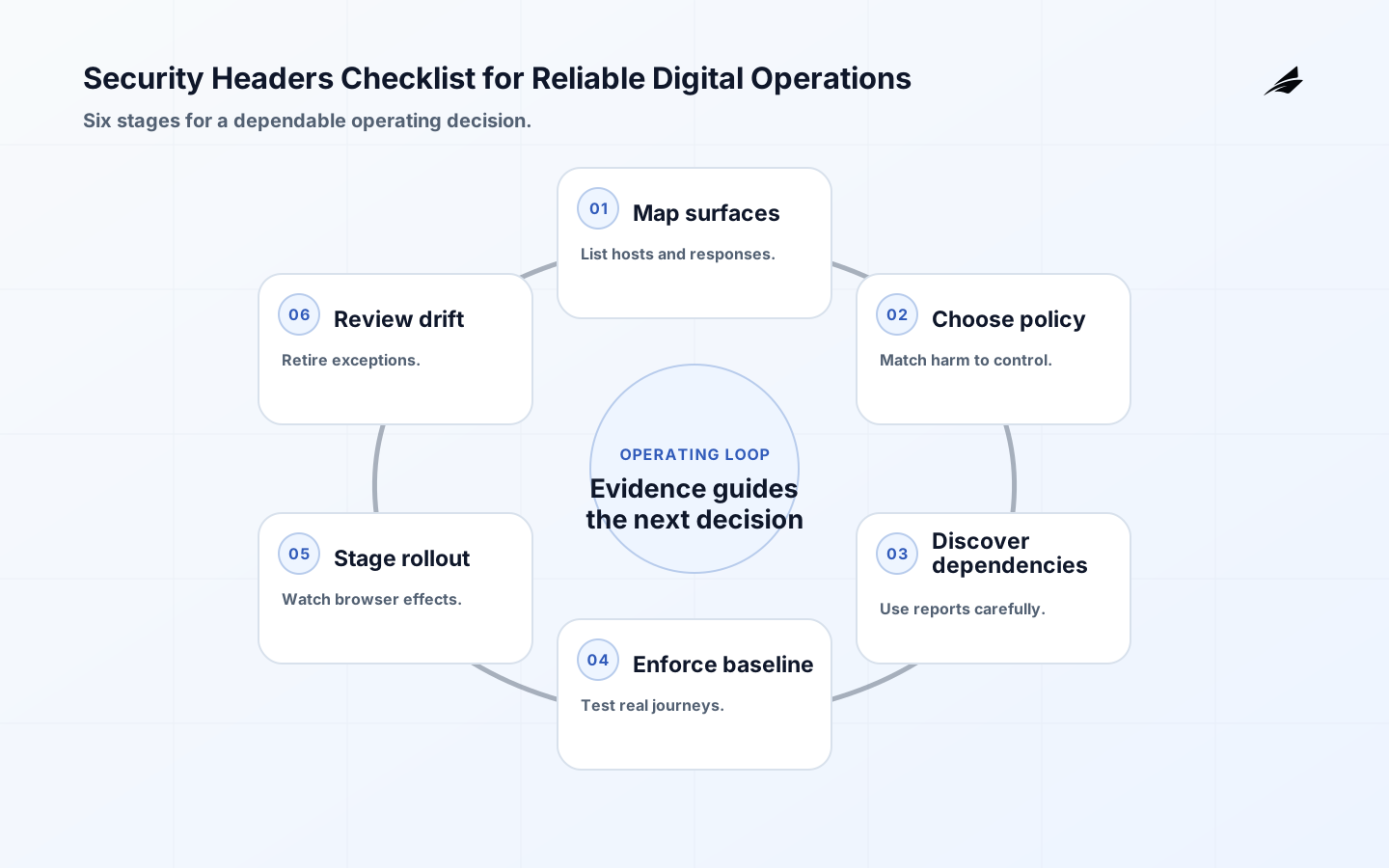
Security Headers Checklist for Reliable Digital Operations is a practical guide for product teams. Security headers are credible only when a team can name the protected action, the accountable owner, the decision inputs, and the evidence left behind. Start with one high-value workflow, from browser route to header policy, instead of trying to secure every system at once. Security headers express browser policy at the HTTP boundary. OWASP explains that CSP can reduce exposure to injection while frame-ancestors prevents unwanted framing in supporting browsers. The appropriate set differs for rendered HTML, downloads, redirects, and APIs, so a copied header list is not a deployment strategy. Test the final response at the edge. X-Content-Type-Options guidance provides useful architectural language for putting policy decisions near protected resources.
Define the security headers boundary
Create a small request map before choosing products. For every HTTP response, list the initiator, target, action, sensitivity, dependency, owner, and expected lifetime. Include support access, background jobs, administrators, and emergency procedures. A boundary is testable when it says what is permitted, what is denied, what requires review, and what should happen if the authoritative browser route is unavailable or stale. That record gives implementation and incident response the same vocabulary.
| Decision | Question | Evidence |
|---|---|---|
| Scope | Which HTTP response is protected first? | Named workflow and owner |
| Authority | Who can change header policy? | Reviewed change record |
| Failure | How is a failed browser route handled? | Tested fallback and escalation |
| Review | When is deployment check revisited? | Scheduled review result |
Put policy at the browser response boundary
Controls fail when they exist only in a user interface while another route reaches the same action. Enforce header policy at the service, gateway, workflow engine, or other point that actually permits the outcome. Keep authoritative identity and configuration sources distinct from cached convenience data.
- Inventory every HTTP response and the systems that create, alter, or consume it.
- Document which browser route is authoritative and how freshness is assessed.
- Apply header policy before the protected operation, not after it appears in a screen.
- Exercise an allowed request, a denied request, and a failed dependency.
- Remove or renew exceptions before they become unexamined permanent access.
Stage browser policies around dependency evidence
Pilot one cohort and keep a rollback boundary. Put header policy configuration under reviewed change management; production behavior should be traceable to an approver and a verification result.
| Stage | Deliverable | Exit condition |
|---|---|---|
| Model | Request and dependency map | Owners agree on scope |
| Configure | Reviewed header policy rule | Representative tests pass |
| Pilot | Bounded cohort and support path | Rollback owner is available |
| Operate | Signals and exception queue | Observed behavior matches intent |
Exercise policy failures across real journeys
Test more than a successful request. Referrer-Policy guidance is a useful verification catalog, but the most persuasive test is one that exercises the exact path users and integrations take in production.
Turn browser reports into owned signals
Choose a few signals with owners: denied outcomes by reason, time-limited exceptions, policy changes, configuration drift, alert quality, and unresolved review items. A spike prompts investigation; it does not prove misuse. The Cross-Origin-Opener-Policy guidance can help prioritize foundational operational practices while the team develops more context-specific measures.
Make exception cost explicit
Security headers can add friction, latency, recovery work, and administrative overhead. The aim is not maximum denials.
Key takeaways
- Security headers should protect a named resource or action, not an abstract compliance goal.
- Enforce header policy where the protected outcome occurs.
- Keep exceptions short-lived, owned, and reviewable.
- Pilot with observable signals and a tested rollback path.
- Revisit deployment check after material changes or incidents.
Frequently asked questions
Do security headers require a new platform? Often no. How often should it be reviewed?
What proves that the control works? Evidence comes from representative tests, production telemetry, sampled decision records, and a trained operator handling a denied request or dependency outage. A static policy document does not prove enforcement. Can a small team start?
Field review for security headers
For security headers, begin with a report-only Content Security Policy when a legacy page depends on third-party scripts or inline behavior, then fix observed violations before enforcement. Configure headers at the final delivery layer and test error pages, redirects, subdomains, authenticated screens, file downloads, and cached responses. The HSTS rollout requires deliberate planning because a mistaken long-lived configuration can block legitimate recovery. Never apply a browser policy blindly to JSON APIs where the browser behavior cannot use it.
- Assign one accountable owner for the security headers decision and a reachable backup.
- Keep a dated record of the current security headers rule, its exception path, and its next review.
- Sample real security headers outcomes each month; compare the evidence with the stated policy.
- Use production changes, new integrations, and incident findings to trigger a focused security headers reassessment.
Evidence review for security headers
Evidence review for security headers should be brief enough to happen and concrete enough to challenge assumptions. This habit turns security headers from a document into an operational practice.
A useful review also tests the human side of security headers. The review is successful when the next change is smaller, clearer, and supported by evidence specific to security headers.
A header policy should have an owner for each response surface, not only one platform owner. The edge, application server, object store, error handler, and redirect service may emit different responses, so sample each path after a deployment and after a proxy change. Keep a small matrix of route class, expected headers, allowed origins, cookie attributes, and report destination. When a violation appears, classify it by release, route, browser behavior, and dependency before changing the policy. A missing header on a static file may need an infrastructure fix; a blocked frame on an authenticated route may need a product decision; a new reporting destination may need a trust review. Record the decision and its expiry. This makes browser behavior reviewable by engineers, support, and security together. The practical test is simple: a colleague should be able to reproduce the response, explain why each directive exists, identify the safe rollback, and find the evidence that the repair worked.
Conclusion
Reliable security-header policy is a maintained capability, not a one-time configuration. Continue with Security Headers: Engineering Notes, Security Headers for Founders: Browser Trust and Content Policy, and What Changes When Security Headers Moves into Production for related implementation context.
Two additional browser contracts deserve explicit checks: Cross-Origin-Resource-Policy guidance clarifies resource sharing boundaries, while Cross-Origin-Embedder-Policy guidance frames the dependency work required for isolation.
Treat security headers as browser contracts
Headers are instructions to user agents, not a substitute for server authorization or safe application code. Map each response class: HTML, JSON API, static assets, downloads, images, and embedded documents. Then decide which policy applies to each surface. MDN describes CSP as a resource-loading policy, HSTS as a browser instruction to use HTTPS on future connections, and Permissions-Policy as a mechanism for enabling or denying browser features. Those controls have different owners and failure modes. A CSP that blocks an essential script is a release defect; HSTS sent broadly before every hostname supports HTTPS can create a domain-wide outage. Keep the policy boundary visible in configuration and review it with the teams that own the affected pages.

| Decision | Practical test | Evidence |
|---|---|---|
| Boundary | Name the protected resource and owner | Scope record |
| Failure | Rehearse denial, retry, and recovery | Observed result |
| Change | Version the policy and expiry | Review decision |
Build a conservative baseline and test its consequences
Start with headers whose intent is clear for the application: Content-Security-Policy, Strict-Transport-Security after HTTPS coverage is verified, X-Content-Type-Options: nosniff, framing protection through CSP or X-Frame-Options where needed, and a deliberately scoped Referrer-Policy. Add Permissions-Policy only for features the product understands and browsers support. Use CSP Report-Only while discovering violations, but treat reports as evidence to triage rather than a permanent substitute for enforcement. Test login, payments, third-party analytics, uploads, downloads, error pages, and embedded support widgets. Capture the exact response headers in automated tests so a proxy or CDN change cannot quietly remove them.
Make CSP a dependency inventory exercise
A useful CSP begins with knowing why every script, style, image, font, connection, frame, and worker is loaded. Prefer nonces or hashes for inline code where architecture requires it, and avoid widening sources to broad wildcards just to silence reports. Separate development and production policies if their dependencies differ, but keep production exceptions reviewable. A report endpoint should be rate-limited and privacy-aware; reports may contain paths or snippets that should not be treated as harmless telemetry. When a violation appears, decide whether the dependency is required, can be self-hosted, or should be removed. This creates a feedback loop between frontend architecture and browser protection instead of a header owned only by infrastructure.
Roll out policies with a rollback that preserves intent
Deploy to a representative cohort and compare blocked resources, report volume, page errors, authentication completion, and support contacts. A rollback should restore a known-good policy, not delete all protections. Keep policy versions beside the release record and note affected domains, subdomains, frames, and third-party services. Recheck HSTS before extending max-age or includeSubDomains; MDN notes that HSTS takes effect from a secure response and changes future browser behavior. Review exception owners and expiry dates. Once the policy is stable, schedule a periodic dependency review because a new vendor or frontend bundle can change the security contract without changing the header deployment code.
Key takeaways
- Define the boundary and the owner before choosing implementation details.
- Test denial, delay, duplication, and recovery as first-class paths.
- Measure the customer or operator outcome, not only the control signal.
- Keep exceptions narrow, time-bound, and easy to investigate.
- Review the policy when dependencies, traffic, or business rules change.
Frequently asked questions
Which security headers belong in the first review? Map the application surfaces, then choose controls for HTTPS, resource loading, framing, MIME handling, and browser features. Should CSP start in enforcement mode? Use report-only discovery when dependencies are unknown, then enforce a tested policy. What should be retained? The policy version, response samples, dependency exceptions, and review owner.
Conclusion
Security Headers Checklist for Reliable Digital Operations becomes dependable when the rule is understandable, the failure path is rehearsed, and the evidence survives a busy day.
For adjacent decisions, compare Plain-language API rate limiting, API rate limiting engineering notes, Security headers engineering notes.