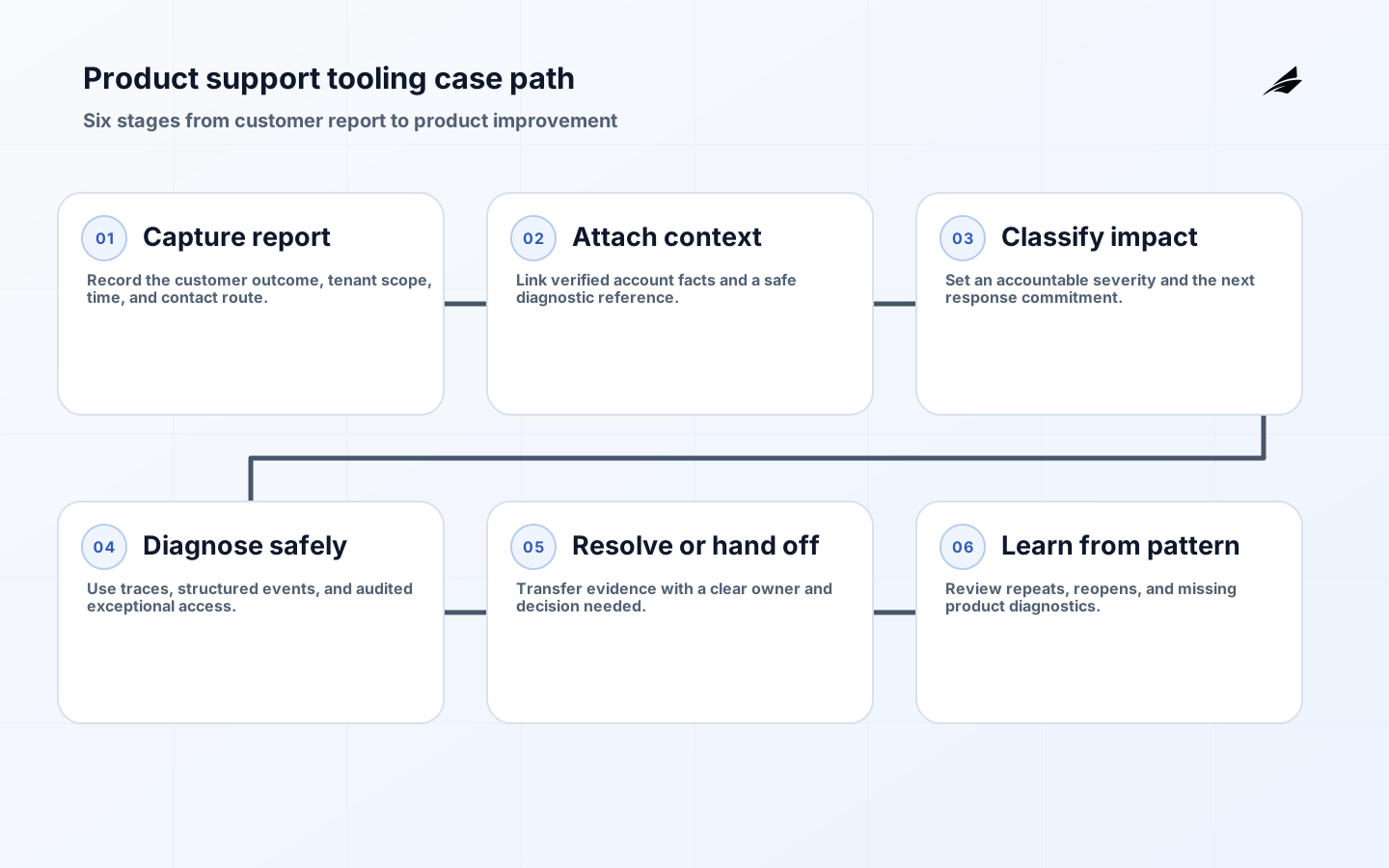
Product support tooling is not a collection of inboxes, chat widgets, and dashboards. It is the route by which a customer problem becomes an accountable technical decision. A support agent needs enough context to confirm identity, reproduce the issue, understand scope, communicate status, and either resolve or transfer the case. Engineering needs a durable report with timestamps, version, tenant scope, and correlation evidence. Security needs to know what data was viewed and which exceptional access was granted. Design the workflow around those questions before buying or integrating tools. A polished ticket form cannot compensate for missing identifiers, invisible background-job failures, or a support role that can view every customer by default. The first useful release should make one high-volume case noticeably easier to diagnose and close.
Start product support tooling with a supportable case
Choose a concrete journey, such as “an administrator cannot invite a colleague” or “an import remains processing.” Map the customer report, the system event, the evidence required, the owner of the next action, and the time at which the customer should hear back. Avoid a generic severity field without a definition. Severity is a decision about impact, urgency, and who must respond, so document examples that distinguish a single-user inconvenience from a tenant-wide loss of service. The case record should link, rather than copy, relevant account facts, consent state, product version, and trace or request identifier. That reduces duplication and prevents stale profile details from becoming the support team’s accidental source of truth. When a case becomes a defect, preserve the customer-facing narrative and the technical evidence together.
| Case field | Why it matters | Control |
|---|---|---|
| Tenant and actor | Separates one customer’s context from another’s. | Derive scope from the authenticated request where possible. |
| Observed time | Lets teams compare the report with logs and deployments. | Store timezone and source of the timestamp. |
| Reproduction route | Turns a complaint into a testable scenario. | Remove sensitive data before sharing externally. |
| Next owner | Prevents a case from being “with engineering” indefinitely. | Use an explicit handoff state and due time. |
Build evidence for diagnosis, not surveillance
Good product support tooling makes normal evidence easy to retrieve and exceptional access difficult but possible. Instrument customer-critical workflows with a request or trace identifier that appears in the interface, the ticket, and telemetry. Record events such as invitation requested, authorization denied, import accepted, import failed, and notification delivered; do not indiscriminately log tokens, passwords, payment details, or free-text content. Use structured fields and retention rules so that evidence can be searched without creating a shadow customer database. A support session that needs impersonation or account access should require a reason, a named operator, a short expiry, and an audit event. The customer’s routine history should be enough for most cases. This design respects the difference between observing system behavior and collecting every detail a person happened to type.
Design the handoff loop between support and engineering
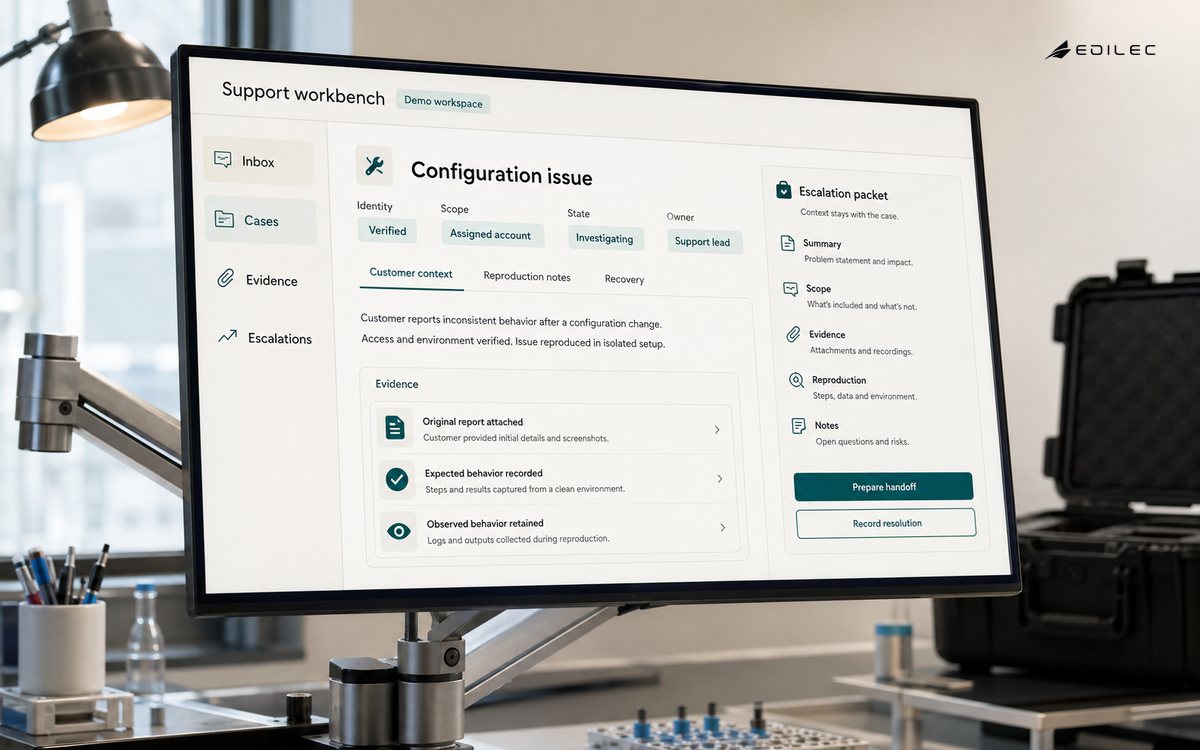
A handoff should answer more than “please investigate.” It should carry the customer impact, affected tenant, first known occurrence, last known good behavior, reproducible steps, evidence link, mitigation tried, and decision needed. Engineering should return a classified result: product defect, configuration issue, documentation gap, incident, feature request, or not reproducible. Each result has a different owner and follow-up. For example, a defect needs a versioned fix and release confirmation; a configuration problem may need a safe support action; a documentation gap needs customer language and a product owner. Review reopened cases and repeated escalations weekly. They often reveal a missing diagnostic, unclear state transition, or interface that teaches the wrong mental model. The support-team delivery guide can help teams set a sensible scope for those improvements.
| Handoff result | Owner after triage | Evidence of completion |
|---|---|---|
| Product defect | Engineering lead | Linked change, test, release version, and customer update. |
| Configuration issue | Support owner | Checked configuration and recorded customer confirmation. |
| Service incident | Incident lead | Timeline, mitigation, status communication, and follow-up. |
| Usability gap | Product owner | Observed task, proposed change, and decision date. |
Operate support tooling as a governed service
Assign an owner for the case taxonomy, integrations, permissions, retention, and change control. Support tools commonly accumulate undocumented automations: a tag triggers a webhook, a status sends an email, or a group has inherited access nobody remembers. Inventory those behaviors and test the failure modes. What happens when the identity provider is unavailable, an alert integration duplicates a case, or a customer requests deletion? Give agents a clear fallback for a degraded system, such as a restricted incident form and a later reconciliation queue. Measure time to first meaningful response, time to resolution by category, transfer count, reopen rate, backlog age, and the percentage of cases with usable technical evidence. These measures should guide a conversation about customer outcomes, not become a reason to close difficult cases prematurely.
- Define one representative case before configuring broad queues.
- Carry tenant scope and a support reference through the product and diagnostic path.
- Log meaningful security and workflow events with retention limits.
- Make exceptional access auditable, brief, and separately approved.
- Classify handoff outcomes so each result has a real owner.
Roll out support tooling in slices
Start with the case type that creates the most repeat investigation, not the tool’s most attractive automation. Configure its intake, evidence, handoff, and closure standards with the people who do the work. Train a small group, listen to their friction, and inspect actual cases after the first week. They may show that a required field is impossible for customers to answer, a tag has no decision behind it, or an integration adds noise without diagnostic value. Make changes to templates and routing visible, just as you would a production workflow change. A support system is part of the product’s operating surface; its rules can alter response times, disclose data, and change what the organization learns from customers.
Plan for ownership transitions. A team should know who manages vendor accounts, group membership, automation credentials, retention settings, and incident contacts when the original administrator is unavailable. Keep a tested export and recovery process for case records, but restrict access to that archive and document the retention basis. If the support platform has an outage, preserve a minimal customer contact channel and a method for reconciling work back into the main record once it returns. The practical test is simple: can a new support lead understand why a case moved, what was disclosed, and what still needs action without reading private chat messages? If not, the workflow has accumulated operational debt.
Run a monthly quality review using a small, randomly selected set of closed cases and a second set of cases with long resolution times. Check whether the stated category matched the eventual result, whether the customer received a useful status update, whether the next owner had sufficient evidence, and whether any access or data handling decision needs correction. Do not turn the review into a scorecard for individual agents. Its purpose is to expose gaps in product instrumentation, case design, documentation, and handoff policy. Publish a short set of changes back to the team so people can see that careful case records improve the system they work in.
Design customer communications as part of the technical workflow. A status update should say what the customer can observe, what the team is doing next, when another update will arrive, and any safe workaround. Do not make a support agent translate an unstructured engineering comment under pressure. Store approved incident and escalation templates near the case workflow, and distinguish an acknowledgement from a resolution. When a defect is fixed, record the version or rollout condition that changes the customer outcome and confirm whether a retry, data correction, or customer action is still needed. Closing that loop avoids the familiar pattern where a ticket is marked solved because engineering shipped something, while the customer’s original work remains incomplete.
- Verify customer identity and tenant scope before opening diagnostic evidence.
- Capture observed time and a safe correlation reference at intake.
- Set a response commitment that matches actual customer impact.
- Restrict elevated support access by reason, duration, and audit trail.
- Return a classified outcome from every engineering handoff.
- Review closed cases for missing diagnostics and recurring product friction.
Key takeaways
- Support tooling should reduce uncertainty, not merely collect tickets.
- A shared reference links customer reports to technical evidence.
- Structured events are safer and more useful than indiscriminate logs.
- Every escalation needs an owner, a decision, and closure evidence.
- Permissions and automation deserve the same review as product code.
Frequently asked questions
Should support agents have direct production access?
Most cases should be resolved from tenant-scoped records, telemetry, and approved support actions. When elevated access is genuinely needed, make it purpose-limited, time-bounded, auditable, and subject to review rather than granting a standing administrative role.
What is the first support metric worth improving?
Start with the percentage of cases that have enough evidence for the next owner to act. Faster response is valuable, but a fast transfer with no context simply relocates delay and forces the customer to repeat the problem.
Conclusion: build the route to a responsible answer
Product support tooling earns its place when it turns an uncertain report into a bounded, explainable response. Begin with one customer journey, join it to structured evidence, protect access, and close the feedback loop with engineering and product. That operating model creates calmer support work and a more reliable product because recurring cases become visible design signals rather than private workarounds.