The Plain-language Guide to Multi-tenant Architecture
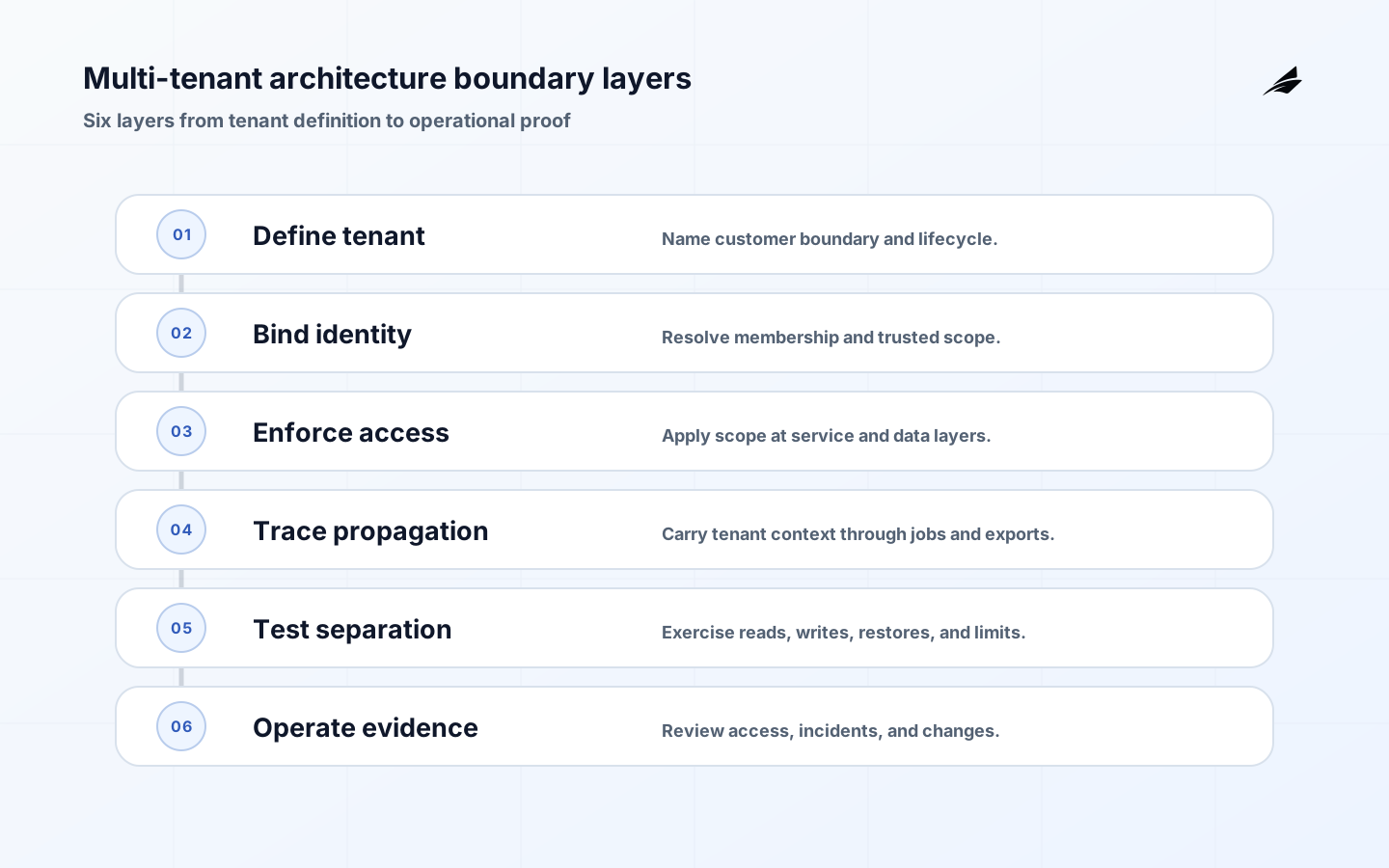
The plain-language guide to multi-tenant architecture begins with a promise customers can understand: one organization’s work must remain separate from another organization’s work, even when the service shares code, infrastructure, and operational tooling. That promise crosses more paths than the visible application. It includes background jobs, exports, search indexes, analytics, support access, rate limits, and restores. A useful architecture guide turns those paths into explicit boundaries and gives the team evidence that each boundary is still working after a release.
Define the multi-tenant architecture boundary
Begin by defining a tenant in business terms. It might be a company account, a regulated division, or a reseller-managed customer; a user can belong to more than one of them. Give the tenant a durable identifier and decide which system creates it, who may change its lifecycle, and how deletion or suspension propagates. Then map every route that crosses the boundary: browser requests, service calls, asynchronous messages, analytics events, storage objects, search indexes, and staff consoles. A tenant filter in a screen is presentation, not enforcement. The protected service or data-access layer must derive scope from trusted identity and apply it to every query and command.
| Decision area | Question to settle | Evidence to retain |
|---|---|---|
| Authoritative records | Which tenant identity, membership, resource ownership, entitlement, and lifecycle state establish the current state? | Source, steward, effective time, and correction path. |
| Protected actions | Who may perform read, write, export, search, background processing, and support access? | Policy version, actor, target, and decision result. |
| Exception route | When may the normal rule be bypassed? | Named approver, reason, compensating control, and expiry. |
| Recovery | How is a wrong or incomplete result corrected? | Runbook, owner, verification signal, and review date. |
Model multi-tenant architecture as accountable decisions
Choose isolation per resource rather than declaring one universal pattern. A shared table with a tenant key can work when every access path is centrally constrained and the operational team can test for missing predicates. Separate schemas or databases can reduce blast radius and simplify residency or restore requirements, but add migration, reporting, and cost work. Hybrid designs are common: shared application services, separate encryption keys or stores for selected customers, and tenant-aware queues. OWASP ASVS provides a useful baseline for verification around access control; the architecture still needs threat modeling for the actual objects, roles, and operators in this product.
- Give each consequential multi-tenant architecture decision a business owner and a technical owner.
- Keep source facts, derived state, and human overrides distinguishable in records and logs
- Version rules and interfaces so a disputed result can be reproduced for the relevant time
- Limit sensitive context to the roles and services that need it, then test denied paths deliberately
- Use cross-tenant test failures, missing-scope events, tenant-level saturation, and exception age as operating signals, not as a substitute for reviewing representative cases.
Build and test the first multi-tenant architecture path
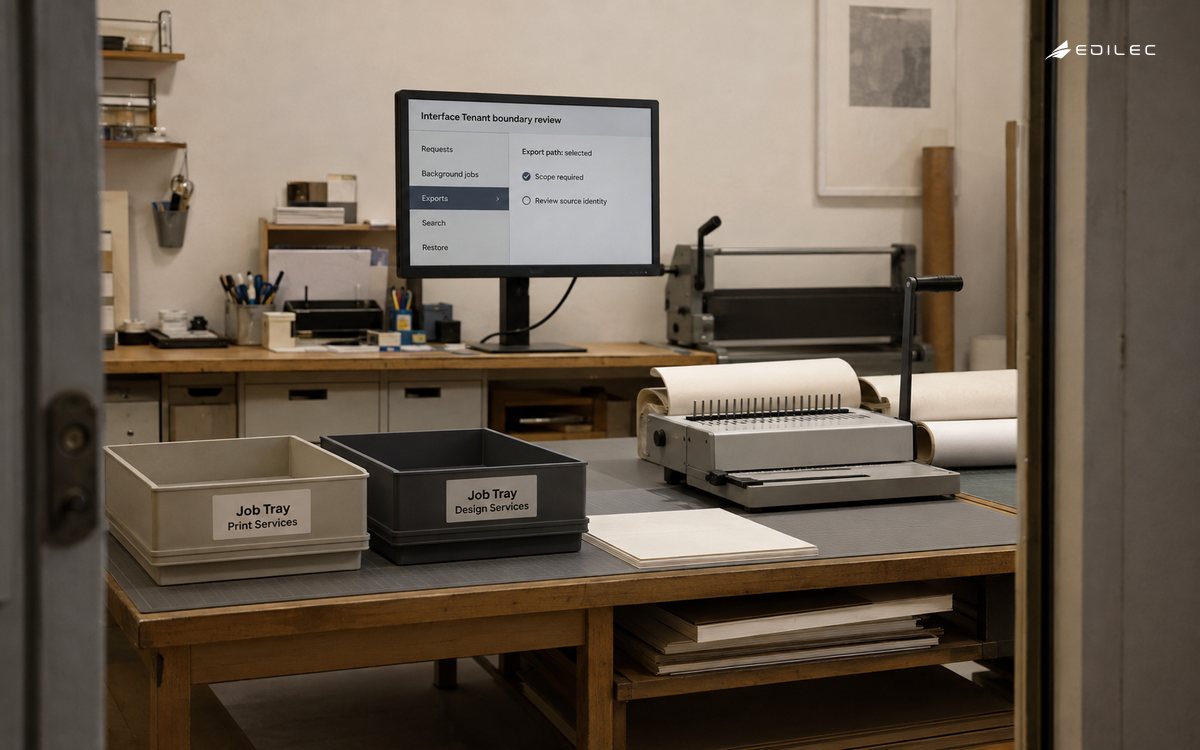
Build a thin vertical slice that creates a tenant, admits an authenticated member, writes one scoped record, reads it back through a different route, and records the decision in logs. Include a denied cross-tenant attempt, a retry with the same idempotency key, and a background task whose tenant context is serialized explicitly. HTTP method semantics matter here: RFC 9110 distinguishes safe and idempotent behavior, which helps a team decide what a retry may repeat. Test the slice with two tenants holding deliberately similar identifiers. That catches accidental joins, cache keys, object paths, and search filters that look correct when only one account exists.
| Release step | What to exercise | Exit evidence |
|---|---|---|
| Representative input | Use ordinary and adverse examples involving tenant identity, membership, resource ownership, entitlement, and lifecycle state. | Expected result and owner-reviewed test record. |
| Dependency behavior | Simulate delay, retry, duplicate delivery, or unavailable context for read, write, export, search, background processing, and support access. | Visible state, containment choice, and recovery action. |
| Permission boundary | Attempt the action with an authorized, unauthorized, and recently changed actor | Server-side decision and audit event match expectations |
| Operational handoff | Ask a second operator to investigate a realistic failure without private context | Runbook works, escalation is reachable, and status is explainable |
Measure multi-tenant architecture with context
Measure isolation with signals that expose real boundary health: authorization denials by route, queries or jobs missing tenant context, cross-tenant test results, restore time for a single tenant, noisy-neighbor saturation, and the age of unresolved access exceptions. Do not treat a low number of complaints as proof that isolation works. Add synthetic checks that create data in tenant A and prove tenant B cannot read, mutate, or infer it. Segment latency and error rates by tenant class only when doing so does not leak sensitive information. A capacity review should also show whether one customer's workload is consuming a disproportionate share of shared queues, cache, or database capacity.
Control Multi-tenant Architecture failure modes
The hard cases are usually administrative or asynchronous. A support impersonation tool can bypass normal scope; a dead-letter message can lose the original tenant; an export can be placed in a predictable object prefix; a global cache can retain a response after access changes. Treat each as a designed path with a purpose, short-lived authority, and audit event. PROV-DM offers a practical vocabulary for linking an output to the agent, activity, and source records that produced it. In an incident, that lineage helps answer which tenant was affected, what action was taken, and whether the correction reached replicas and derived data.
Multi-tenant Architecture: Use the underlying references
This guide is grounded in NIST Privacy Framework, OWASP Application Security Verification Standard, RFC 9110: HTTP Semantics, PROV-DM: The PROV Data Model. Keep multi-tenant architecture observable, owned, and recoverable through the next review.
An operating review for multi-tenant architecture should use a real account rather than a generic diagram. Trace one request from login through an API, a queue, a cache lookup, a storage object, and a staff investigation. At each point ask where tenant context came from, whether it can be changed by an untrusted caller, and which control rejects an impossible cross-tenant result. Then rehearse a customer deletion, a point-in-time restore, and an emergency support action. These exercises expose whether the isolation model is a collection of conventions or a property the system actively maintains. They also reveal important trade-offs: stronger separation can raise migration and observability cost, while shared capacity needs quotas and fairness controls. Record the chosen trade-off and its review trigger so growth does not quietly invalidate the original design.
For a concrete capacity decision, define a tenant class from observable needs rather than account size alone. A tenant with a large nightly import may need queue isolation, a regulated tenant may need a dedicated key or region, and a small but latency-sensitive tenant may need a separate rate budget. Encode those differences in reviewed policy and test the downgrade path as well as provisioning. This keeps a special arrangement from becoming an undocumented fork of the platform.
Make tenant boundaries visible beyond the request path
A request-level tenant check is necessary but not sufficient. Trace a representative record through creation, read, update, asynchronous processing, notification, export, deletion, and recovery. At each stage ask where tenant context comes from, whether it can be absent, and what the system does when it is contradictory. If a queue message contains only a record ID, the worker may be forced to guess scope; include tenant identity or resolve it through a trusted repository before touching data.
Choose isolation as a set of resource-specific decisions. A shared table can be appropriate for low-sensitivity data when the data layer enforces scope and tests prove that missing predicates fail safely. A separate store may be justified for residency, restore, or blast-radius requirements. The decision should include migrations, reporting, support tooling, and incident response, because a design that isolates reads but neither exports nor backups are incomplete. Revisit the choice when a new resource class or customer promise appears.
| Decision point | Required record | Safe review question |
|---|---|---|
| Boundary | Actor, resource, scope, and policy | Can the service decide without guessing? |
| State | Current value, effective time, and source | What does the customer see and why? |
| Recovery | Owner, reason, expiry, and result | Can the team correct or contain it safely? |
Multi-tenant architecture: Multi-tenant Architecture: Evidence that changes Multi-tenant Architecture — to multi tenant architecture workflow
The NIST Privacy Framework encourages organizations to identify, govern, control, communicate, and protect privacy risk. OWASP ASVS provides verification topics for access control and validation. RFC 9110 makes request semantics and safe handling relevant at the HTTP boundary, while the W3C PROV data model supplies a vocabulary for describing entities, activities, and agents. Use these as design prompts, then test the actual tenant paths.
For related product boundaries, Read the workspace models guide, product analytics guide, and admin console guide. Together they show how tenancy interacts with identity, evidence, and operator actions.
Multi-tenant architecture: Multi-tenant Architecture: Multi-tenant Architecture: practical questions before rollout — to multi tenant architecture workflow
Is a shared database automatically unsafe for multi-tenant architecture?
No. Safety depends on how every access path derives and enforces tenant scope, including jobs, exports, support tools, and restores. A shared store is a design choice that needs strong constraints, tests, and operational evidence.
Where should tenant context be established?
Establish it from trusted identity and the requested resource at the service boundary, then pass it explicitly to repositories and jobs. Do not infer scope from a client-provided label or a browser-selected workspace alone.
What is the first isolation test to write?
Use two tenants with similar records and attempt read, write, export, search, and background-job access across the boundary. Verify that the result is denied or safely absent and that the event is attributable without exposing the other tenant.
Key takeaways
- Multi-tenant architecture works best when its decision boundary and record authority are explicit.
- Design corrections as visible, attributable actions rather than silent edits to a current-state field
- Pilot one consequential path with normal, adverse, and recovery cases before expanding scope
- Review operational signals alongside examples, because aggregate numbers can hide a broken boundary
Multi-tenant architecture: Multi-tenant architecture FAQ — to multi tenant architecture workflow
Should every tenant have a separate database? No. The right choice follows consequence, volume, legal obligations, recovery needs, and the team's ability to verify the controls. Can an organization ID in a JSON Web Token solve isolation? It can carry context, but a service must still validate the token, membership, and requested action, then enforce scope close to the protected resource. What is the first test to automate? Create two tenants with matching records and assert that every supported read, update, export, and background path rejects cross-tenant access. Keep that suite in the release gate, because a newly added endpoint is a common place for the boundary to disappear.
The measurement plan for the plain-language guide to multi-tenant architecture should pair an outcome with a reason to investigate it.
A durable operating note for the plain-language guide to multi-tenant architecture records the assumptions that made the decision safe: the authoritative source, effective time, permitted actor, protected resource, and recovery route.
For the plain-language guide to multi-tenant architecture, a good handoff ends with observable evidence rather than a verbal promise.
For Multi-tenant Architecture, OWASP Application Security Verification Standard defines scope. Give multi-tenant architecture a named owner and a review date for multi tenant architecture.
Conclusion
A durable multi-tenant architecture makes tenant context an accountable input to every consequential operation. Start with the records and actions that could cause the greatest harm, verify normal and denied paths, and make staff tooling as disciplined as customer-facing requests. The next useful decisions sit in workspace model design, product analytics, and admin-console controls.
Evidence for “The Plain-language Guide to Multi-tenant Architecture” is grounded in NIST Glossary: Data Processing, OWASP Application Security Verification Standard, RFC 9110: HTTP Semantics, PROV-DM: The PROV Data Model; each source informs a specific decision, test, or operating trade-off described in this guide.