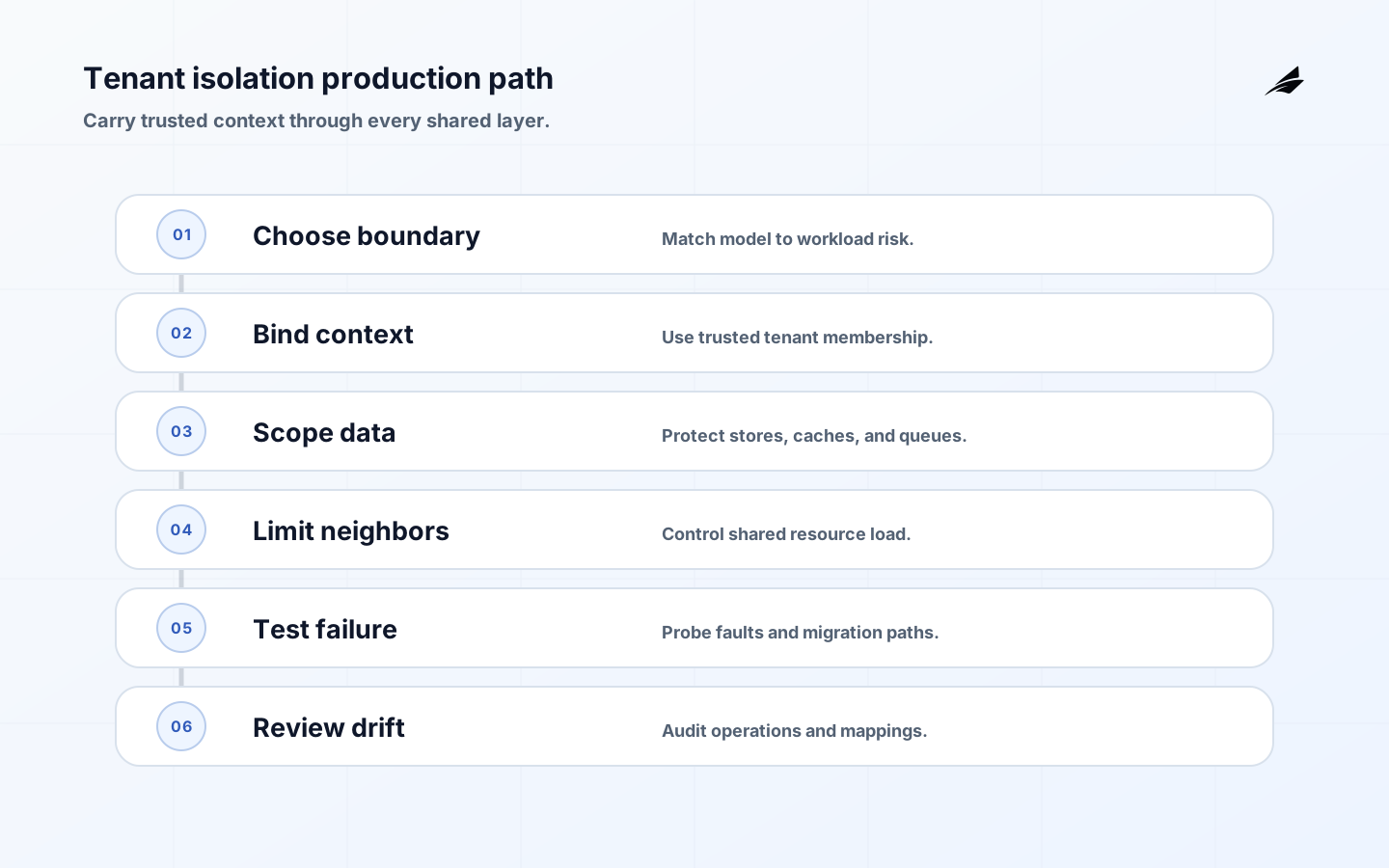
Tenant isolation moves into production when a SaaS product must prove that one customer’s users, data, workload, and operational state cannot accidentally become another customer’s experience. A tenant identifier in a database is not the whole boundary. Isolation spans identity, authorization, storage, caches, queues, compute, telemetry, exports, deployment, support, and recovery. AWS’s SaaS Lens describes isolation as foundational, while Azure’s multitenant guidance presents it as a spectrum with trade-offs. Production work is choosing and enforcing that spectrum deliberately.
The related tenant isolation guide for operations leaders, multi-tenant architecture production guide, and workspace model decisions provide neighboring context. This article focuses on what changes when the boundary must survive real traffic, failures, migrations, and operators.
Choose the isolation boundary by workload
Define the tenant, the protected resources, the actors, the actions, and the failure impact before choosing shared or dedicated infrastructure. Some workloads can share compute while isolating data; others may need a dedicated stamp because of compliance, noisy neighbors, or regional requirements. Document the reason for each boundary and the operational work it creates. A silo can reduce cross-tenant blast radius while multiplying deployment and support work. A pool can improve efficiency while requiring stronger application and data controls. Treat isolation as a per-layer decision within one coherent model.
| Model | Strength | Trade-off |
|---|---|---|
| Pool | High density and simpler fleet management. | More dependence on application and data controls. |
| Bridge | Selective isolation for sensitive or noisy workloads. | Routing and operations become more complex. |
| Silo | Strong blast-radius and customization boundary. | Higher cost and repeated lifecycle work. |
| Mixed layers | Match boundary to data or workload risk. | Requires consistent tenant mapping across layers. |
Make tenant context a trusted authorization input
A request needs both user identity and tenant context. Derive tenant membership from trusted account, domain, session, or routing state; do not treat a tenant ID in a URL or body as permission. The authorization check should evaluate actor, tenant, resource, action, and current lifecycle state at the service boundary. Test horizontal access, cross-tenant administrator paths, background jobs, exports, and support tooling. When a user belongs to more than one tenant, make the active context visible and require an explicit, validated switch. An old token or cached permission must not silently expand scope.
Carry isolation through data, cache, and queues
Azure’s guidance warns about tenant leakage in-memory caches and recommends tenant-aware keys; the same principle applies to object storage, search indexes, message queues, batch partitions, and analytics exports. Use a consistent context propagation contract and fail when it is missing. Validate that database queries include the correct scope and that an operator or migration cannot accidentally run across all tenants. Record tenant context in logs and traces only when it is safe and necessary, with access controls proportional to the data. A correct row-level query does not protect a cache or file path that omits the same boundary.
- Define tenant context once and validate it at every service boundary.
- Use tenant-aware keys for caches, objects, queues, indexes, and exports.
- Keep support and analytics views scoped and auditable.
- Bound one tenant’s resource consumption so a noisy neighbor cannot exhaust shared capacity.
- Test missing, stale, and conflicting tenant context as explicit failures.
Control noisy neighbors and blast radius
Tenant isolation protects more than confidentiality. A tenant that consumes disproportionate CPU, queue capacity, storage, or connection pools can degrade other customers. AWS’s SaaS foundations call out tenant load variation and isolation testing; use that as a prompt for quotas, rate limits, scheduling, shard strategy, and tier-specific capacity. Decide whether a breach of a resource budget should throttle one tenant, move it to a dedicated path, or degrade a noncritical feature. Make the response visible to operators and customers where it changes service behavior. Avoid limits that cannot be measured or whose enforcement itself becomes a single point of failure.
| Layer | Isolation check | Operational signal |
|---|---|---|
| Identity | Membership and active context match. | Denied cross-tenant attempts. |
| Data | Reads and writes use the intended scope. | Scope assertion failures and query tests. |
| Compute | One tenant cannot starve shared workers. | Per-tenant saturation and queue age. |
| Operations | Admins and exports remain scoped. | Exceptional access and audit review. |
Test isolation under failure and change
Happy-path tests are not enough because leakage often appears when a timeout, retry, cache hit, migration, or operator shortcut changes the path. Use automated negative tests for every resource type and endpoint. Inject worker failure, delayed routing, stale cache, partial deployment, and queue replay. Run noisy-neighbor load with uneven tenant profiles. Test restore, re-sharding, and tenant moves because a migration can be less isolated than the steady state. Keep fixtures for tenants with different plans, regions, sizes, and membership relationships. Make a failed isolation assertion stop the release or quarantine the affected path.
Migrate boundaries without losing context
Changing from pooled to bridged or siloed infrastructure affects routing, identifiers, deployment, billing, analytics, support, and recovery. Give each tenant a stable mapping from tenant ID to deployment or partition, and make the mapping versioned and observable. Move one cohort at a time, dual-read or reconcile where necessary, and define what happens if the migration stops after data is copied but routing has not changed. Keep the old path until integrity and tenant-scoped behavior are verified. A migration is complete only when operators can locate the tenant, support can see the right state, and rollback does not merge contexts.
Roll out with tenant-aware evidence
Choose a cohort that exercises the intended isolation model and includes realistic load. Baseline authorization denials, cross-tenant negative tests, latency, capacity, queue age, support workflows, and deployment duration. Expand only when the evidence shows both security and service quality. Keep a pause authority and a return action that leaves each tenant in a known mapping. Review logs and exports for accidental exposure during the rollout; isolation failure is not only an application response problem. Communicate customer-impacting moves and maintenance when they affect locality, performance, or recovery expectations.
Operate isolation as a continuous control
Review tenant context failures, denied access, resource saturation, cache misses and hits by scope, cross-tenant test results, exceptional support access, migration status, and tenant-to-deployment mapping. Watch for a rise in manual data movement or operator queries that bypass normal paths; those are design signals. Keep a tenant-aware incident runbook that identifies containment, evidence preservation, customer communication, and data review. Run isolation tests continuously enough to catch drift after changes to code, infrastructure, policy, or operational tooling. The goal is to make a boundary observable before a customer discovers it is missing.
- Attempt cross-tenant reads through UI, API, batch, export, and support paths.
- Fill a shared cache with one tenant and request the same key as another.
- Replay a queued job after tenant routing changes.
- Throttle one tenant and verify the protected cohort remains within its objective.
- Restore a tenant and prove its mapping, data, and permissions remain aligned.
A production review should produce an isolation matrix that names every path by which tenant information can move: request routing, authorization, database query, cache key, object path, queue message, search index, export, metric, support view, backup, and deployment mapping. Keep tenant isolation in production observable, owned, and recoverable through the next review.
Key takeaways for tenant isolation
- Choose isolation per workload and document the business reason.
- Treat trusted tenant context as an authorization input at every boundary.
- Carry scope through data, caches, queues, compute, telemetry, and tools.
- Control noisy neighbors as an availability and fairness problem.
- Test failures, migrations, and operator paths continuously.
Tenant isolation FAQ
Production isolation is an end-to-end contract. These answers help teams review the scope of that contract before choosing an architecture or approving a migration.
What changes when tenant isolation reaches production?
Isolation becomes an end-to-end operating contract across identity, storage, caches, queues, compute, analytics, support, deployment, and recovery. The team must prove the boundary under change and failure.
Is a separate database enough?
No. It helps one layer, but tenant context must also be enforced in authorization, caches, jobs, logs, exports, and operator tools. Test all paths that can read or mutate customer state.
Should every tenant have dedicated infrastructure?
Not necessarily. Choose a shared, bridge, or silo model per workload and document the cost, performance, compliance, and operational trade-off. A mixed model can be valid when routing remains coherent.
How should isolation be tested?
Use negative access tests, fault injection, noisy-neighbor load, migration tests, cache and queue checks, and tenant-aware operational exercises. Repeat them after meaningful code or infrastructure changes.
When tenant isolation enters production, the operating burden becomes visible. Verify tenant context at request boundaries, background jobs, exports, caches, search indexes, and support tools; a database pattern alone cannot prove isolation. Define a small set of negative tests that attempt cross-tenant reads and writes, then run them during deployment and after changes to shared infrastructure. Keep an incident path that can disable risky flows without taking every customer offline. The production review should name the evidence owner, the alert threshold, and the decision rule for moving from shared capacity to a stronger boundary.
Conclusion: make the boundary follow the customer
Tenant isolation becomes production-grade when the boundary follows customer identity, data, work, and operations through every layer that can affect the outcome. Choose the model that matches the risk, enforce trusted context, control noisy neighbors, migrate with evidence, and test the failure paths. The result is not a claim that tenants never share infrastructure; it is a system that can explain what is shared, what is isolated, and how that promise is continuously verified.
For what changes when tenant isolation enters production, a good handoff ends with observable evidence rather than a verbal promise. Give product, engineering, and support teams a shared evidence record to review.
The smallest useful improvement to what changes when tenant isolation enters production is often a sharper boundary, not another feature. Review what changes when tenant isolation enters production evidence with product, engineering, and support for moves into production.
During normal handling, verify tenant-isolation scope and keep customer language aligned with the recorded state.
A practical example for what changes when tenant isolation enters production is a customer-visible result remains pending. Measure what changes when tenant isolation enters production outcomes alongside correction effort.
For What Changes When Tenant Isolation Enters Production, AWS SaaS Lens: Isolation Mindset defines scope; AWS SaaS Lens: General Design Principles supports the control; AWS SaaS Lens: Foundations clarifies evidence; Azure Tenancy Models for a Multitenant Solution guides recovery; Azure Multitenant Compute Approaches frames review. Document the cited control, its scope, and the conditions for expansion.
During normal handling, verify tenant-isolation controls and evidence, then confirm the customer explanation reflects the recorded state.
A practical example for what changes when tenant isolation enters production is a delayed dependency. Test a delayed dependency and document the recovery decision.
Production tenant isolation requires a clear customer promise, an enforceable boundary, and a named owner. Document which identity, data, workload, and operational paths are isolated, how failures are contained, and what evidence proves the boundary remains intact.
Evidence for “What Changes When Tenant Isolation Enters Production” is grounded in AWS SaaS Lens: Isolation Mindset, AWS SaaS Lens: General Design Principles, AWS SaaS Lens: Foundations, Azure Tenancy Models for a Multitenant Solution, Azure Multitenant Compute Approaches; each source informs a specific decision, test, or operating trade-off described in this guide.