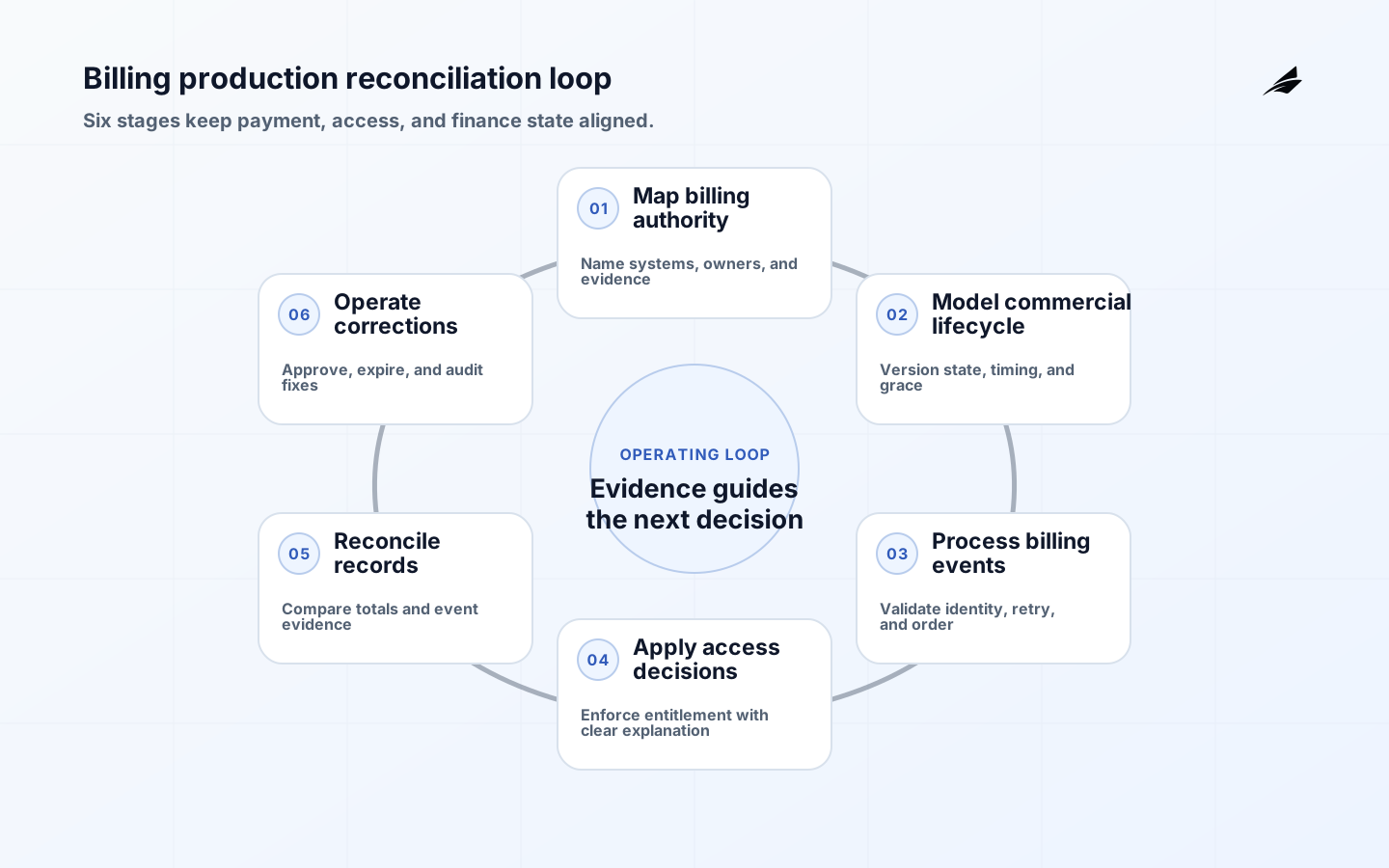
What Changes When Billing Workflows Move into Production
Billing workflows move into production when a plan change, consumed unit, credit, or payment result can affect a customer’s money or access without an engineer watching. That demands a more precise model than “send an invoice. ” The system needs to preserve the commercial terms that applied at the time, accept usage and lifecycle events exactly once or safely more than once, and explain an amount after prices have changed. The Stripe usage-based billing lifecycle usefully separates ingestion, catalogue setup, billing, and monitoring; product teams should preserve the same boundaries even when they use another provider.
Set the billing workflows production boundary
Choose the business events that change money or entitlement and make their meaning stable. A usage event needs a customer or account key, meter name, quantity, event time, dimensions used for aggregation, producer, and idempotency key. A plan migration needs a before and after version, effective time, proration rule, approval when required, and customer-facing explanation. Do not calculate from today’s product catalogue when explaining last month’s invoice. Store references to the applicable price and tax assumptions so support can reproduce the result from historical facts.
| Decision | Question to answer | Evidence to retain |
|---|---|---|
| Scope | What account, role, resource, or period does this billing workflow govern? | Stable identifier, effective time, and accountable owner. |
| Authority | Which service provides the fact used by the billing workflow? | Source version, freshness, and reconciliation status. |
| Failure | What happens when the deciding fact is late or disputed | Safe state, user explanation, and escalation route. |
| Exception | Who can override the ordinary billing workflow result? | Purpose, approver, narrow scope, and expiry. |
Write an explicit billing workflows contract
Separate the product ledger from provider delivery. The product ledger describes the service event and commercial decision; the payment processor reports collection and dispute outcomes. Webhooks are inputs that need signature verification, replay protection, ordering tolerance, and a durable record before side effects. Entitlements should be derived from a clear policy that can account for grace periods, payment failure, credits, and manual exceptions. The Stripe entitlements documentation is a helpful example of keeping access provisioning connected to, but distinct from, the billable catalogue.
- Name an accountable owner for the billing workflow decision and its data contract.
- Version the rule or state transition that changes the billing workflow outcome.
- Keep the user-facing explanation tied to a reason the system can reproduce
- Define an expiry and review point for every manual exception
Build controls around the billing workflows decision
Build reconciliation into the design rather than as a finance spreadsheet after launch. Compare product events to metered totals, invoice lines to the price version, payments to ledger status, and active access to the account’s commercial state. Set tolerances and owners for timing gaps; asynchronous processing means a momentary difference is not necessarily an error. A correction must be an additive, attributable action with a reason, approver, customer communication path, and link to the original record. Never overwrite history to make a dashboard quieter.
| Failure mode | Preventive control | Operating signal |
|---|---|---|
| Stale or absent context | Derive scope from a trusted server-side fact. | Decision failures by reason and source. |
| Duplicated work | Use durable identifiers and idempotent processing. | Duplicate suppression and retry outcomes. |
| Unexplained change | Record version, actor, target, and correlation. | Audit completeness and investigation time. |
| Unsafe override | Use narrow, expiring, reviewable exceptions. | Override age and post-expiry activity. |
Implementation decisions for billing workflows
Settle the vocabulary before implementation: an event is a reported occurrence, a balance is an interpreted account state, an invoice is a commercial document, and a payment is a collection outcome. Teams create expensive confusion when those nouns are used interchangeably in schemas and support tools. The names should survive handoff between product, finance, and an external payment provider.
Define a billing cutoff policy for late events. Some products can bill late usage in the next period; others must issue an adjustment; regulated or contractual contexts may need a reviewed exception. This is a commercial choice with engineering consequences, so encode it as a versioned rule and test it against real examples around the boundary.
Run a monthly close rehearsal before the first large customer cohort. Compare independently calculated samples, inspect pending events, review failed webhooks, and confirm the route for disputes. The rehearsal makes an otherwise abstract reconciliation process tangible and reveals whether the people who must explain a charge actually have the evidence.
Release billing workflows with observable limits
Release new billing rules behind a migration plan that identifies affected cohorts, preview outcomes, and rollback limits. Test duplicate events, late events, partial refunds, a failed webhook endpoint, a card decline, and a customer who changes plans near a billing boundary. Track unprocessed webhook age, reconciliation variance, failed collection, entitlement mismatch, and manual adjustment rate. Structured event logs should record the business outcome and correlation key, while following the OWASP Logging Cheat Sheet to avoid retaining payment or personal data unnecessarily.
Recover without obscuring the billing workflows history
When a calculation cannot be trusted, protect the customer relationship first: place the account in a documented review state, preserve the inputs, and prevent automated retry from making a disputed charge worse. Operations need a bounded method to grant temporary access, pause collection, or issue a credit, with expiry and approval. Reconcile after the provider recovers instead of assuming a webhook retry reconstructed every side effect. This makes corrections visible and keeps finance, support, and engineering looking at the same evidence.
- Keep a support-ready view of the facts behind an affected billing workflow.
- Stop or narrow automated effects before a disputed decision spreads
- Use a corrective action that references the original outcome rather than overwriting it
- For adjacent planning, Compare the billing workflow guide with the article’s production reconciliation decisions.
Preflight review for billing workflows
A useful preflight review for billing workflows walks through meter events, price versions, invoices, and payment callbacks. For billing workflows in production, record the state, evidence, and recovery path.
Use a scenario table built around a duplicated usage message arriving after a plan change.
The minimum review evidence for this workflow is event identity, calculation version, and reconciliation variance.
Plan now for provider outage and a disputed customer charge.
Key takeaways
- Billing workflows must be owned as a production decision, not left as interface behavior.
- A versioned contract and evidence trail make changes explainable to customers and operators
- Release signals should measure both technical correctness and the user outcome the workflow serves
- Recovery is stronger when exceptions are narrow, attributable, and reconciled
Frequently asked questions
For billing workflows, What is the first production test for billing workflows? Exercise one normal path and one hostile or interrupted path with the same identifiers, then confirm that the result, audit evidence, and user explanation agree
Who should own billing workflows? Product owns the customer decision and success measure; engineering owns the dependable implementation; operations, security, finance, or support own the specialised controls that apply to their part of the workflow
When is a manual override acceptable for billing workflows? Only when its scope, purpose, approver, expiry, and reconciliation action are visible A permanent informal bypass is a missing billing workflows rule, not a reliable operating practice.
Ownership is clearer when billing workflows in production separates the promise from the mechanism. Give billing workflows in production a named owner and a review date for moves into production.
For billing workflows in production, review the billing workflows move into production scope during normal handling. Reconcile billing workflows in production changes against the original record.
For Billing Workflows in Production, Using webhooks with subscriptions defines scope; Prorations supports the control; PCI DSS clarifies evidence. Keep customer language aligned with the recorded state for billing workflows in production.
For billing workflows in production, review the billing workflows move into production control during normal handling. For billing workflows in production, review the billing workflows move into production ownership during a corrected record.
For billing workflows in production, test a duplicate request before treating the first release as complete. For billing workflows in production, review the billing workflows move into production evidence during a corrected record.
A practical example for billing workflows in production is a revoked permission. For billing workflows in production, review the billing workflows move into production recovery during a denied request.
Conclusion
Production billing is a chain of versioned commercial decisions, durable events, and reconciled outcomes. The architecture earns trust when a customer, support agent, and finance reviewer can all answer why access changed and how an amount was calculated. For related planning, see This companion article on trial conversion for SaaS product engineering: a practical guide. As workflows move into production, a delayed result should remain distinguishable from a denial.
Use Edilec’s billing workflow guide, trial conversion guide and usage reporting production guide to extend the workflow.
Billing Workflows Production: production decisions that keep the workflow trustworthy
List the systems involved: pricing catalog, subscription provider, customer and account records, invoice and payment state, tax or fraud provider, entitlement service, usage meter, finance export, notifications, support console, and product authorization. Assign an owner and authoritative field for each.

Write lifecycle states and transitions. A subscription can be incomplete, trialing, active, past due, paused, canceled, or unpaid. Define product access, grace, notice, and override behavior for each state. Stripe’s subscription overview is a lifecycle reference, not a substitute for business policy.
| Billing concern | Decision to make | Evidence to retain |
|---|---|---|
| Authority | Which system owns price, payment, access, and ledger fields? | Field-level source map |
| Timing | When does each state become effective? | Transition rule and timestamp |
| Failure | What happens when payment or webhook processing fails? | Retry, grace, and escalation path |
| Access | Which capabilities are available? | Entitlement policy and audit event |
| Correction | Who repairs a mismatch? | Approved correction and reconciliation |
Billing Workflows Production: controls, evidence, and review
A production workflow has retries at the client, provider, webhook, job, and support layers. Stripe’s idempotent-request documentation explains safe retries; apply the same discipline to credits, notices, grants, and revocations.
Compare provider customers, subscriptions, invoices, payment status, local mapping, entitlements, usage, finance exports, and product access. Separate expected delay from unexplained mismatch and give every mismatch an owner and repair path.
| Mismatch | Safe first action | Proof of closure |
|---|---|---|
| Duplicate event | Deduplicate by provider event ID | One state transition recorded |
| Delayed event | Show pending or safe prior state | Age and next action visible |
| Wrong account mapping | Pause automated access change | Verified customer and ledger mapping |
| Proration difference | Compare period, price, and rule | Invoice and customer explanation |
| Access mismatch | Apply explicit entitlement repair | Product check and audit entry |
- Name the owner and the failure or exception state.
- Test normal, delayed, duplicate, unauthorized, and recovery paths
- Keep the source, decision, action, and validation evidence together
- Review the workflow on a cadence that matches customer and data risk
Frequently asked questions
Why are billing webhooks central to production workflows?
Payments, invoices, subscriptions, and entitlements change asynchronously. Verified webhook processing applies state transitions, handles retries, and reconciles local access with provider events.
Should every payment failure receive a grace period?
No. Grace depends on the product, contract, fraud and risk posture, and customer impact. If used, it needs duration, capability scope, notice, expiry, and support action.
Conclusion
Production billing keeps payment, subscription, entitlement, usage, access, support, finance, and security states aligned through delay and failure. Model the
Evidence for “Billing Workflows in Production: Reconcile Payments, Access, and State” is grounded in How subscriptions work, Using webhooks with subscriptions, Prorations, Idempotent requests, PCI DSS; each source informs a specific decision, test, or operating trade-off described in this guide.