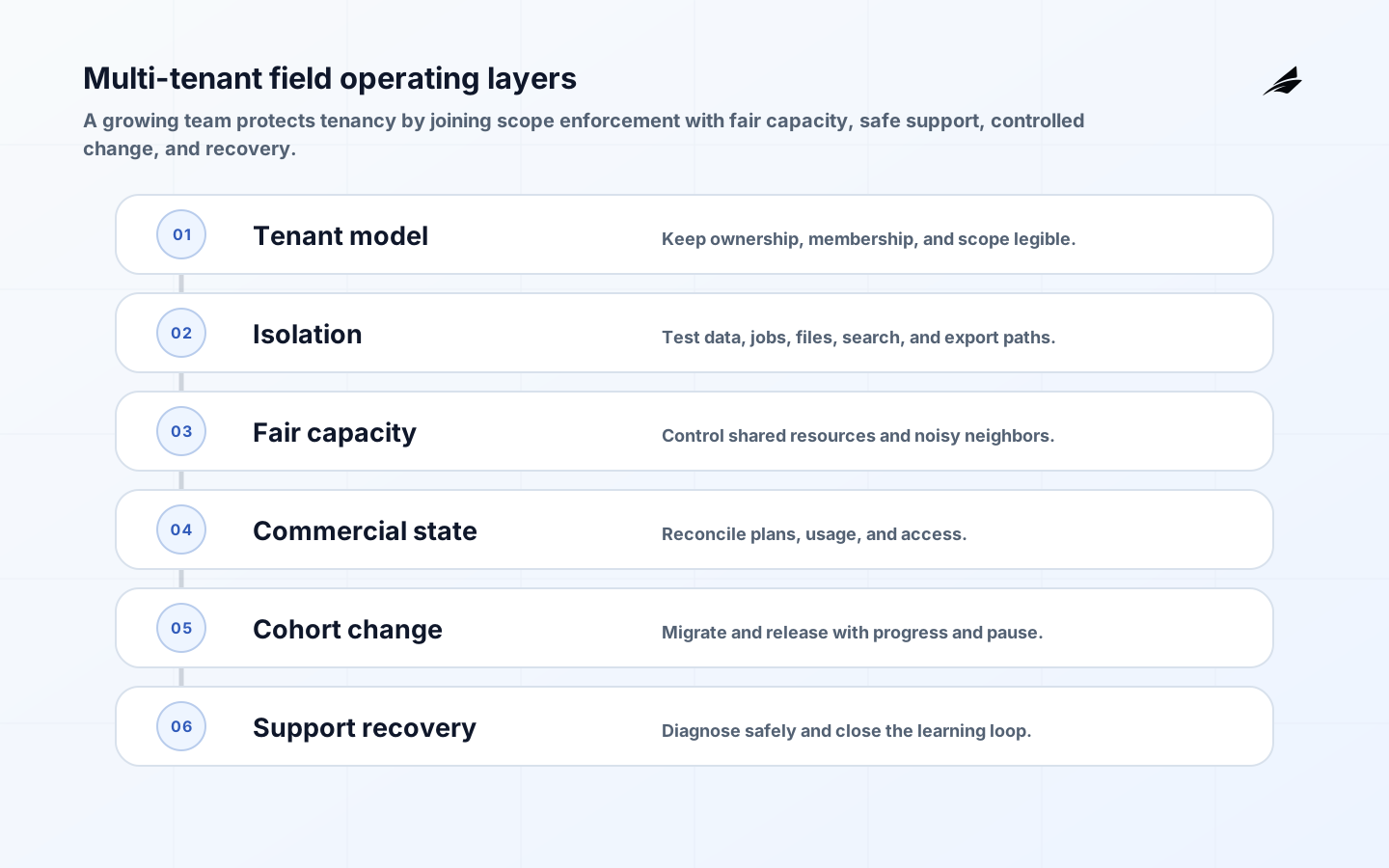
Multi-tenant Architecture for Growing SaaS Teams
Growing teams usually feel multi-tenant architecture through incidents and friction: a query is slow for everyone, a support tool grants too much access, a migration needs a customer-by-customer exception, or a large import consumes shared workers. A field guide should therefore connect design to operation. The goal is a tenant model that protects boundaries, behaves fairly under load, can be changed in cohorts, and leaves evidence when something goes wrong. The AWS SaaS tenant-isolation guidance is a useful official reference for organizing those concerns across the product and platform.
Keep the tenant model legible
Write down whether your tenant is an account, organization, customer, workspace, or legal entity, then define its children and collaborators. Growing teams often inherit several names for the same boundary. Resolve that ambiguity before it spreads into URLs, queues, exports, billing, and analytics. Model user identity separately from tenant membership and resource permissions. A person may belong to several tenants, a service may act for one integration, and support access may be temporary. The PostgreSQL row security policies are a helpful reminder to tie the model to enforceable predicates and ownership rather than implementation vocabulary.
Choose and test isolation
Shared rows, schemas, databases, and deployments each trade isolation, cost, migration effort, and operational complexity. Compare them against data sensitivity, customer commitments, recovery objectives, team experience, and expected load. Then test the whole path: application queries, background jobs, caches, search, files, webhooks, notifications, analytics, support tools, and exports. A database design cannot compensate for a job that loses tenant context. Keep the isolation claim narrow enough that an engineer can prove it with tests and a support owner can explain it after an incident.
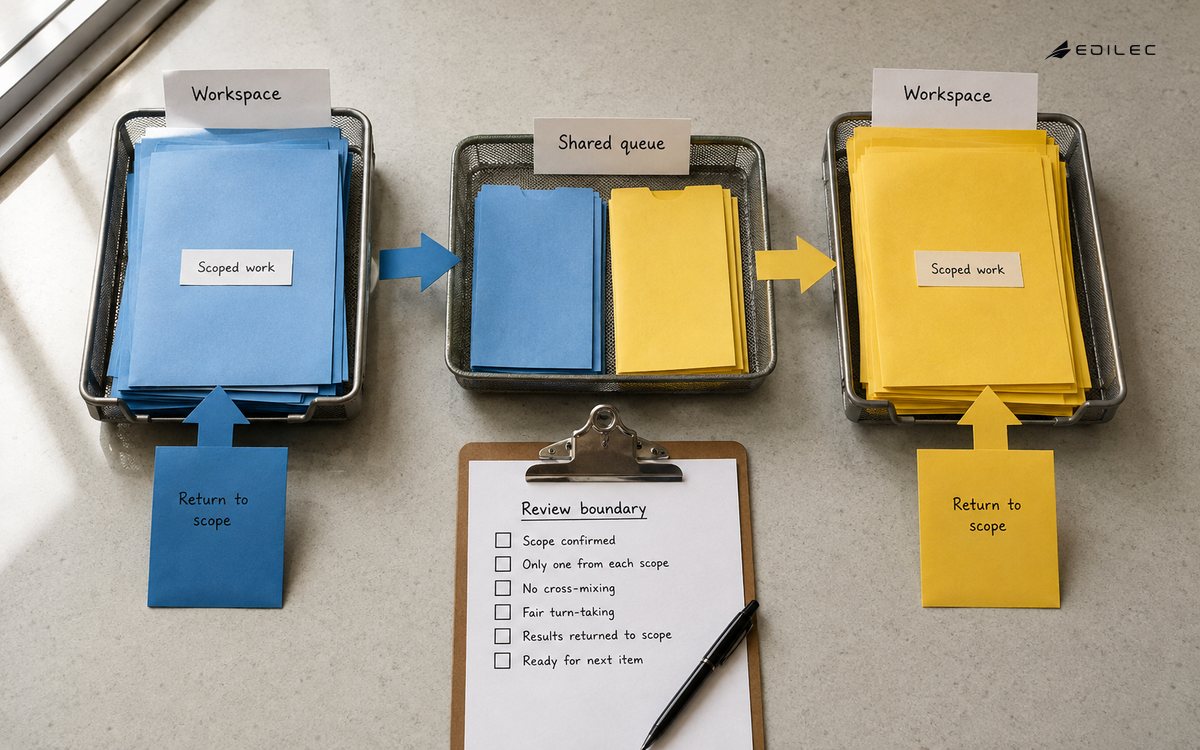
| Operating area | Decision | Proof to keep |
|---|---|---|
| Data | Shared or separated storage and access enforcement. | Scope tests, query policy, and restore check. |
| Identity | Membership, delegation, support, and service roles. | Policy decisions and audit history. |
| Work | Tenant context across jobs, queues, and retries. | Job envelope, owner, and failure state. |
| Files | Object namespace, sharing, export, and retention. | Path check and delivery record. |
| Recovery | Containment, correction, and customer communication. | Incident runbook and rehearsal evidence. |
Make shared capacity fair
List every shared bottleneck and the customer-visible consequence of saturation. Requests, database connections, queues, storage, search, third-party APIs, and human support all need different controls. Use tenant-aware quotas, concurrency, fair scheduling, backpressure, and circuit breakers where they protect an important outcome. OpenTelemetry semantic conventions can support consistent latency and error signals, but add dimensions only when the team can act on them. A useful alert names the affected tenant cohort, resource, owner, and first safe response.
- A large import cannot claim every worker indefinitely.
- A slow tenant query cannot exhaust shared database connections.
- A third-party quota has a backoff and customer-facing state.
- Plan limits are tied to a real dependency or value, not an arbitrary screen restriction.
- A tenant can see its own usage and recovery path where the contract requires it.
- Operators can distinguish one tenant's problem from a platform-wide failure.
Keep plans and access aligned
Entitlements, membership, and authorization must agree without becoming one mutable flag. Store a versioned capability result with its source and effective period. Stripe Entitlements provides useful official context for explicit capability state; use a similar discipline for internal plan state, usage, and grace periods. When a customer upgrades, the new capability should become visible according to a defined time and reconciliation rule. When a payment fails, restrict the promised surface without deleting records or leaving support to edit access by hand.
Operate migrations by cohort
Growing teams need migrations that can pause, resume, and show which tenants remain incomplete. Use compatibility windows, idempotent backfills, per-tenant progress, and a forward-fix plan. Feature flags should be tenant-scoped, reviewed, and removable. Vercel Edge Network Regions is useful deployment guidance, but the field-level rule is broader: the same artifact may be deployed everywhere while behavior is exposed to a measured cohort. Record the migration owner, stop condition, customer communication, and verification evidence before starting.
| Migration step | Control | Decision signal |
|---|---|---|
| Prepare | Add compatible fields and code paths. | Old and new versions behave safely together. |
| Backfill | Process bounded tenant cohorts with checkpoints. | Progress, error, and retry state are visible. |
| Expose | Enable behavior by tenant or plan cohort. | Outcome and support impact are acceptable. |
| Verify | Compare counts, access, latency, and customer-visible results. | No unresolved scope or data mismatch. |
| Clean up | Remove flags and obsolete paths after evidence. | Operating model is simpler and documented. |
Equip support without widening scope
Support needs enough visibility to answer customer questions without becoming a privileged data reader. Provide tenant-scoped search, masked identifiers, reasoned access requests, expiry, and audit events. A support agent should be able to see why access was denied, which entitlement version applied, or why a job is delayed without opening every raw record. When an emergency override is necessary, make it narrow and reversible. Review support access by person, tenant, reason, age, and outcome. The quality of the support tool is part of the isolation boundary because it handles the paths customers cannot see.
Example: scaling a shared work management app
A work management app starts with shared tables and grows to thousands of customer accounts. The team introduces an explicit tenant context object, row-level access tests, job envelopes that include tenant and workspace, fair scheduling for imports, and object paths that include a verified tenant namespace. A large customer receives a higher import quota but cannot consume every worker. A migration runs by cohort and compares task counts before and after. Support sessions expire and record a reason. No single change is glamorous, but together they turn implicit assumptions into an operating system the team can maintain.
Prepare for the uncomfortable cases
Rehearse a cross-tenant query, a misrouted export, a noisy neighbor, a failed backfill, a stale entitlement, a revoked member, a compromised support session, and a restore from backup. For each, define detection, containment, evidence, affected-scope identification, communication, correction, and prevention. An incident runbook should say who can pause a feature or queue and who decides when to resume. Growing teams should prefer an architecture with visible failure states over one that looks simple only while all dependencies are healthy.
Measure the boundary
Monitor scope-related errors, authorization denials, support access, tail latency, queue age, resource saturation, export delivery, migration progress, usage, cost, and recovery time by tenant cohort. Add a direct customer measure such as time to complete onboarding, percentage of work completed without support, or disputed access decisions. Beware high-cardinality telemetry that makes the observability system itself expensive; choose controlled dimensions and sampled evidence. Metrics should reveal the next operating decision, such as increasing a pool, changing a limit, isolating a workload, or fixing a policy.
Review these measures in an operating meeting with product, engineering, support, and finance represented. A queue-age increase may call for fair scheduling, while a rise in support access may reveal a missing self-service explanation or a weak permission model. Cost per tenant should be read with workload and service level, not used as a blunt ranking of customers. For every tenancy change, log the boundary test that triggered it, the cohort exposed, the approving owner, and the customer-visible result; revisit that entry after the cohort completes a migration and support cycle. This gives future engineers context for why a limit, deployment split, or support control exists. Also compare an isolated tenant's outcome with the shared baseline before changing architecture; a local symptom may be a data or workflow issue rather than a capacity problem. Include one customer-facing metric in every review so internal efficiency does not hide a degraded experience.
- Can the team explain the tenant boundary without opening source code?
- Can an operator pause a risky tenant cohort or job class safely?
- Can support investigate a customer issue without permanent broad access?
- Can a release prove which tenants were exposed and what changed?
- Can a restore or export prove that tenant scope remained intact?
- Can the team state which metric would justify an architecture change?
Growth-stage tenancy controls to retain
- Keep the tenant model and its ownership rules legible to every operating role.
- Test isolation across data, jobs, files, search, exports, integrations, and support.
- Control shared capacity with fairness rules that match customer impact.
- Treat entitlements and billing as versioned state with reconciliation.
- Operate migrations and flags by cohort with pause and verification evidence.
- Measure the boundary through safety, fairness, support, cost, and recovery outcomes.
Multi-tenant architecture field guide FAQ
When is a shared model reasonable?
When the team can enforce and test scope, control shared capacity, meet customer commitments, and recover from a boundary failure. Shared storage is not inherently careless; implicit behavior is.
How should support access be controlled?
Use tenant scope, explicit reason, approval where needed, short expiry, masked data, and an audit trail. Give support diagnostic views that do not require unrestricted raw access.
What makes a tenant migration safe?
Compatibility, bounded cohorts, idempotent progress, pause and resume, comparison evidence, customer communication, and a recovery or forward-fix plan.
Conclusion: turn growth pressure into explicit controls
Growth makes tenant boundaries operational: shared queues fill, migrations pause, support needs scoped visibility, and commercial state changes while customers are working. Give IT managers evidence for each of those decisions rather than a single architecture diagram. The workspace models field guide, usage reporting field guide, and SaaS MVP checklist offer related patterns. Safer growth means knowing which tenant cohort is affected, who can pause the change, and how the team will verify recovery. Document the owner. Record the decision in the tenant runbook and link it to the next cohort review.