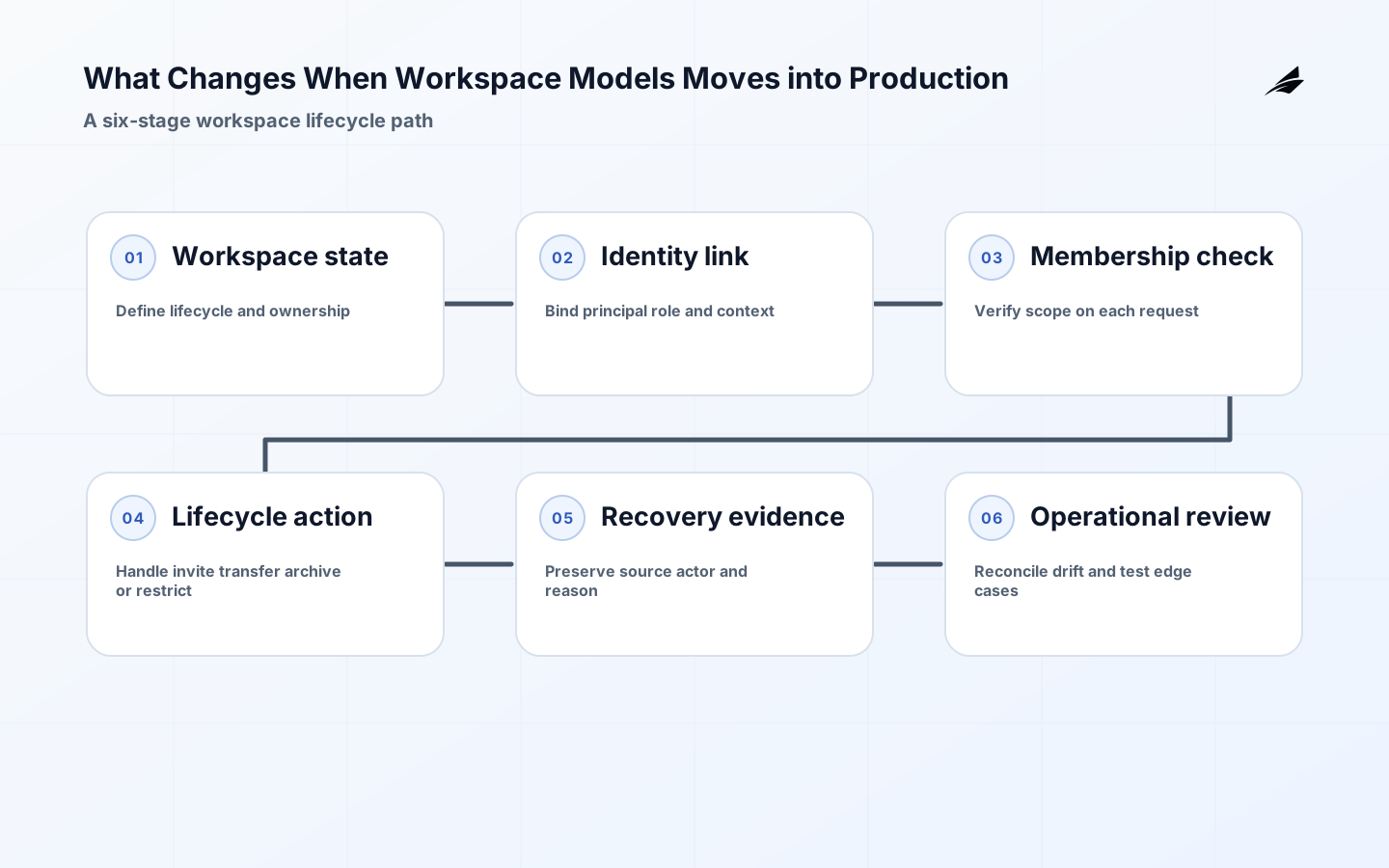
Workspace Models in Production: What Changes for Growing SaaS Teams
A workspace model becomes operational when “workspace” stops being a convenient grouping in the interface and becomes the unit that governs membership, ownership, data scope, billing, and support. Founders often meet the complexity later: an invited person has access before acceptance, an owner leaves, one person belongs to several customers, or an integration performs work without an interactive session. Production design must describe those states explicitly. A workspace selector is only a presentation of current context; it cannot be the authority that decides which records a request may touch.
Set the workspace models production boundary
Define a lifecycle with named transitions: created, active, restricted, pending transfer, archived, and deleted or retained. Decide who can create a workspace, who becomes its initial owner, whether an invitation is single-use, and what happens to connected resources when membership ends. A person may be authenticated across several workspaces, so each request must carry or derive an active context that the server verifies against current membership. The NIST Digital Identity Guidelines help separate identity assurance from the application-specific decision about workspace access.

| Decision | Question to answer | Evidence to retain |
|---|---|---|
| Scope | What account, role, resource, or period does this workspace model govern? | Stable identifier, effective time, and accountable owner. |
| Authority | Which service provides the fact used by the workspace model? | Source version, freshness, and reconciliation status. |
| Failure | What happens when the deciding fact is late or disputed? | Safe state, user explanation, and escalation route. |
| Exception | Who can override the ordinary workspace model result? | Purpose, approver, narrow scope, and expiry. |
Write an explicit workspace models contract
Make membership an auditable relationship, not a Boolean attached to a user record. Store workspace ID, principal ID, role, state, issuer, effective time, and any expiry or delegated authority. Define whether role changes take effect immediately in long-running sessions and jobs; if they do, revoke or re-evaluate tokens appropriately. Owner transfer deserves its own command with two-sided confirmation where the domain needs it, a timeout, and a clear outcome. The OWASP authorization guidance supports a deny-by-default posture, which is particularly helpful during ambiguous lifecycle states.
- Name an accountable owner for the workspace model decision and its data contract.
- Version the rule or state transition that changes the workspace model outcome.
- Keep the user-facing explanation tied to a reason the system can reproduce.
- Define an expiry and review point for every manual exception.
Build controls around the workspace models decision
Test the model by changing context at awkward moments: accept an old invitation after a role change, remove a member while an export runs, switch a browser tab between workspaces, and replay a webhook after a transfer. Assert that each operation uses current server-side membership rather than a stale screen value. Admin staff should enter an explicit support session with a reason and expiry instead of being granted an unbounded customer role. These controls reduce both accidental overreach and the support burden of explaining what a person could see at a particular time.
| Failure mode | Preventive control | Operating signal |
|---|---|---|
| Stale or absent context | Derive scope from a trusted server-side fact. | Decision failures by reason and source. |
| Duplicated work | Use durable identifiers and idempotent processing. | Duplicate suppression and retry outcomes. |
| Unexplained change | Record version, actor, target, and correlation. | Audit completeness and investigation time. |
| Unsafe override | Use narrow, expiring, reviewable exceptions. | Override age and post-expiry activity. |
Implementation decisions for workspace models
Choose whether a workspace is the billing account, a collaboration container, or both. Combining those roles can work early, but it makes transfer and archival rules consequential: a departing owner might otherwise strand invoices, integrations, or retained data. A written separation between workspace identity and billing identity keeps later enterprise contracts from forcing a risky migration through the user interface.
Invitation design needs a policy for domain changes and duplicate identities. An email invitation may be sent to an address that later maps to a different identity-provider subject; acceptance should verify the intended principal rather than grant membership solely because a mailbox received a link. Record who sent it and why it was still valid at acceptance.
Membership cleanup deserves an operating cadence. Reconcile deprovisioning signals, dormant invitations, unaccepted transfers, and service accounts with the workspace register. The output should be actionable: remove an expired grant, assign a successor owner, or flag an account that needs a business decision. Silent cleanup that removes a legitimate member is no improvement.
Release workspace models with observable limits
Instrument state transitions, not every click. Useful signals include invitations sent versus accepted, expired invitations, role-change failures, ownership-transfer age, membership reconciliation results, and requests denied for stale context. Link a trace across invitation creation, email provider callback, acceptance, and membership activation so a team can distinguish a delivery failure from a policy decision. OpenTelemetry documentation is a practical reference for correlating those distributed operations without treating logs as the only record.
Recover without obscuring the workspace models history
Failures should leave a workspace in a safe, comprehensible state. A failed transfer should not create two silent owners or none; it should remain pending with the prior owner intact until a reviewed resolution. If an external identity mapping breaks, restrict sensitive actions and preserve the evidence needed to restore membership, rather than fabricating a new relationship. Periodic reconciliation between identity, membership, and billing records finds the drift that ordinary happy-path tests miss.
- Keep a support-ready view of the facts behind an affected workspace model.
- Stop or narrow automated effects before a disputed decision spreads.
- Use a corrective action that references the original outcome rather than overwriting it.
- For related planning, see the related workspace models for SaaS product engineering: a practical guide.
Preflight review for workspace models
A useful preflight review for workspace models walks through invitations, ownership changes, service accounts, and archived spaces. For workspace models in production, name the decision boundary and its owner.
Use a scenario table built around a member removed while a background export is still running.
The minimum review evidence for this workflow is membership state, active context, and approval history.
Plan now for identity-provider deprovisioning and account consolidation.
Key takeaways
- Workspace models must be owned as a production decision, not left as interface behavior.
- A versioned contract and evidence trail make changes explainable to customers and operators.
- Release signals should measure both technical correctness and the user outcome the workflow serves.
- Recovery is stronger when exceptions are narrow, attributable, and reconciled.
Frequently asked questions
For workspace models, What is the first production test for workspace models? Exercise one normal path and one hostile or interrupted path with the same identifiers, then confirm that the result, audit evidence, and user explanation agree.
Who should own workspace models? Product owns the customer decision and success measure; engineering owns the dependable implementation; operations, security, finance, or support own the specialised controls that apply to their part of the workflow.
When is a manual override acceptable for workspace models? Only when its scope, purpose, approver, expiry, and reconciliation action are visible. A permanent informal bypass is a missing workspace models rule, not a reliable operating practice.
For Workspace Models in Production, NIST SP 800-63 Digital Identity Guidelines defines scope. Measure workspace models in production outcomes alongside correction effort.
Before widening workspace models in production, rehearse normal, denied, delayed, and corrected cases with realistic identifiers. For workspace models in production, review recovery during a denied request.
The measurement plan for workspace models in production should pair an outcome with a reason to investigate it. For workspace models in production, review evidence during a denied request.
A durable operating note for workspace models in production records the authoritative source, effective time, permitted actor, protected resource, and recovery route. For workspace models in production, review measurement during a delayed handoff.
For workspace models in production, test a revoked permission before treating the first release as complete.
Compare a permitted workspace action with a changed-permission case, and verify that the workspace, membership, and ownership records remain consistent.
When a workspace event arrives late or conflicts with another record, preserve the observed state and explain whether the result is a delay, denial, or correction.
A concrete operating test for workspace models in production is to rehearse workspace models in production during a recovery drill. For workspace models in production, review ownership during a denied request. For workspace models in production, review ownership during a denied request For workspace models in production, review ownership during a denied request
Conclusion
A dependable workspace model makes context, membership and ownership first-class facts. That clarity lets a product grow from a small team space into a multi-workspace service without turning invitations, transfers and support access into undocumented exceptions. For related planning, see this companion article on self-serve onboarding for SaaS product engineering: a practical guide. For workspace models in production, a delayed result should remain distinguishable from a denial.
Make workspace state explicit
A workspace model becomes a production contract when it governs membership, ownership, data scope, billing relationship, integrations, and support access. Define lifecycle states such as created, active, restricted, pending transfer, archived, and retained. The NIST Digital Identity Guidelines distinguish identity proofing, authentication, and federation; authenticating a person does not by itself prove membership in the selected workspace or authority to act there.
| Workspace decision | Question | Evidence |
|---|---|---|
| Membership | Who belongs and with what role? | Principal, workspace, role, state, effective time |
| Context | How is the active workspace selected? | Server-verified request context |
| Ownership | How does transfer work? | Two-sided approval and timeout |
| Lifecycle | What happens on archive or restriction? | Job, integration, and data policy |
| Support | How can staff assist safely? | Scoped session, reason, and expiry |
Store membership as an auditable relationship rather than a Boolean on a person. Every request and background job should derive or carry workspace context that the server validates against current membership. The OWASP Authorization Cheat Sheet recommends deny-by-default behavior and permission checks on every request. Apply that to invitations, exports, webhooks, service accounts, and staff tooling.
Design invitations and identity changes
An invitation is a pending relationship with an issuer, intended workspace, recipient or identity binding, expiry, and acceptance rule. Do not grant membership solely because a link reached a mailbox if the intended principal can change. Re-evaluate role and workspace state at acceptance. If an identity provider deprovisions a user, decide whether membership is disabled immediately, placed in recovery, or transferred under a documented process.
Ownership transfer deserves a command of its own. Require the current owner or authorized administrator, verify the successor, define whether both parties confirm, set a timeout, and make the result visible. A failed transfer should not create two owners or none. Pending transfer is a safe state when the system cannot establish the next authority.
Connect operations to evidence
The Azure multitenancy checklist highlights tenant mapping, lifecycle automation, monitoring, isolation, and resource consumption. Use the same discipline for workspace operations: invitation acceptance and expiry, role-change failures, ownership-transfer age, deprovisioning drift, service-account use, and requests denied for stale context. The OpenTelemetry observability primer supports correlating a distributed invitation or transfer across services while keeping sensitive data out of broad telemetry.
Recover without erasing history
When a workspace decision is disputed, narrow high-risk actions, preserve the last verified state, and route the case to an owner. A corrective action should reference the original outcome, actor, source, and reason. Reconcile identity, membership, billing, integrations, and retained data on a cadence. The output should be actionable: remove an expired grant, complete a transfer, restore a legitimate member, or escalate a business decision.
Test context changes at awkward moments: remove a member while an export runs, switch tabs between workspaces, replay a webhook after transfer, accept an old invitation, and run a job with a stale token. Review both the customer explanation and operator evidence. A workspace model is ready for growth when these scenarios have deterministic outcomes and a named recovery owner. Pair this review with Workspace Models for SaaS: Choose Tenant Boundaries That Scale, Self-serve Onboarding for SaaS Product Engineering: a Practical Guide, and Subscription Access Control for SaaS Product Engineering: a Practical Guide.
Evidence for “Workspace Models in Production: What Changes for Growing SaaS Teams” is grounded in NIST SP 800-63 Digital Identity Guidelines, Authorization Cheat Sheet, Multitenancy Checklist on Azure, Observability primer; each source informs a specific decision, test, or operating trade-off described in this guide.