How Product Teams Should Think Pricing Gates
Pricing gates become a leadership concern when it changes who can act, what a customer experiences, and how the team explains a result under pressure. For product teams, the useful question is not whether a familiar pattern can be installed. It is whether the system makes entitlements, commercial eligibility, customer messaging, and reliable enforcement explicit enough to operate. The target is concrete: access reflects a current commercial agreement and customers understand what action will change their available capabilities. For pricing gates in saas, record the state, evidence, and recovery path.
Make the pricing gates decision explicit
The central decision for pricing gates is that a pricing gate is an entitlement decision, not a UI prompt. Those details make disagreements tractable. The earlier related guide, trial conversion engineering notes, is useful context when the work touches adjacent product operations, but it does not replace a decision record for this specific workflow. In this context, pricing gates need its own decision record.
| Decision area | Question to resolve | Evidence to keep |
|---|---|---|
| Authority | Which record can decide pricing gates now? | Owner, version, and effective time. |
| Boundary | Where is the rule enforced? | Policy result, actor, target, and reason. |
| Exception | Who may change the normal path? | Approver, expiry, and recovery action. |
| Review | How will drift be detected? | A trend tied to entitlement mismatch, stale-cache age, post-payment denial, override count, and capability-level denials. |
Build a Pricing Gates SaaS model people can explain
A practical model for pricing gates have three layers: a stable business definition, an enforceable system rule, and an observable operating loop. The commercial system answers what was purchased and when it is effective; the entitlement service answers whether a tenant may use a named capability now. This separation prevents a marketing-plan label from becoming the only logic protecting a costly or regulated operation. It also makes trials, grace periods, credits, and negotiated exceptions explicit states rather than scattered conditionals.
Implement the smallest dependable Pricing Gates SaaS path
Enforce the decision at the server boundary before doing work or exposing protected data. In the product surface, describe the current limit, the upgrade path, and the result of a successful change in plain language. Test upgrade, downgrade, cancellation, delayed payment event, refund, trial expiry, and provider outage scenarios; each is an entitlement transition, not merely a billing event.
- Write the pricing gates rule in plain language before encoding it.
- Keep customer-facing status aligned with the authoritative record
- Assign an expiry or review date to temporary exceptions
Operate Pricing Gates SaaS with evidence, not assumptions
Operating pricing gates requires a short, reviewable set of signals instead of a broad dashboard with no decision attached. Monitor entitlement mismatch, stale-cache age, post-payment denial, override count, and capability-level denials. Preserve an audit trail for grants and revocations with their source and effective time. Review expensive capabilities for unintended access and make emergency override procedures time-bound. Pricing changes are safer when they are released as versioned agreements with compatibility checks for existing customers.
| Signal | What it can reveal | First response |
|---|---|---|
| Unexpected denial or failure | A boundary, context, or data-quality problem. | Inspect the decision record and affected scope. |
| Manual override | A missing path or unclear responsibility. | Require a reason, expiry, and follow-up review. |
| Stale or inconsistent state | A delayed dependency or weak reconciliation. | Compare source evidence and replay safely. |
| Customer confusion | A mismatch between system state and explanation. | Improve the visible state before adding more controls. |
Key takeaways for product teams
- Pricing gates should have a written business definition and a named owner.
- Record reasons, effective times, and expiry for exceptional handling
Frequently asked questions pricing gates
Where should the Pricing Gates SaaS team start?
For pricing gates, a prototype is only persuasive when it uses representative identities, records, and failure conditions.
Who should own Pricing Gates SaaS?
Ownership for pricing gates is shared but not vague.
What should trigger a Pricing Gates SaaS review?
For pricing gates, Investigate when a customer has completed a commercial change but the product still denies a capability, or when access continues after a contract state should have changed. Trace the agreement version, entitlement computation, cache or propagation delay, request context, and enforcement decision. A pricing change needs an effective-time rule that is understood by billing, support, and the application; otherwise each team may be correct within its own system and still produce a broken customer experience. Test the unhappy paths deliberately: payment event delay, downgrade with existing usage, refund, trial expiry, plan migration, and a provider outage. Manual overrides should be time-bound, attributable, and reconciled later. The customer-facing message should distinguish a temporary processing state from a real limit so an understandable delay does not look like an arbitrary refusal.
A practical example for pricing gates in saas is a customer-visible result remains pending. Make pricing gates in saas corrections visible, scoped, and reversible during about pricing gates.
Ownership is clearer when pricing gates in saas separates the promise from the mechanism. Measure pricing gates in saas outcomes alongside correction effort.
Before widening pricing gates in saas, run a small rehearsal with normal, denied, delayed, and corrected cases.
For pricing gates in saas, review the think about pricing gates scope during normal handling.
A durable operating note for pricing gates in saas records the assumptions that made the decision safe: the authoritative source, effective time, permitted actor, protected resource, and recovery route. Review pricing gates in saas evidence with product, engineering, and support for about pricing gates.
For pricing gates in saas, a good handoff ends with observable evidence rather than a verbal promise.
For Pricing Gates in SaaS, Entitlements defines scope; How subscriptions work supports the control; Authorization Cheat Sheet clarifies evidence. For pricing gates in saas, name the decision boundary and its owner.
A practical example for pricing gates in saas is an unexpected load spike. For pricing gates in saas, review the think about pricing gates measurement during a delayed handoff.
For pricing gates in saas, review the think about pricing gates control during a denied request. The pricing gates in saas review applies this point to think about pricing gates during the normal path.
Before widening pricing gates in saas, rehearse normal, denied, delayed, and corrected cases with realistic identifiers. For pricing gates in saas, review the think about pricing gates scope during a corrected record.
For pricing gates in saas, review the think about pricing gates control during normal handling. For pricing gates in saas, review the think about pricing gates measurement during a denied request.
A durable operating note for pricing gates in saas records the authoritative source, effective time, permitted actor, protected resource, and recovery route. For pricing gates in saas, review the think about pricing gates evidence during a denied request.
For pricing gates in saas, test an incomplete setup before treating the first release as complete. For pricing gates in saas, review the think about pricing gates ownership during a denied request.
A disputed pricing decision is a practical test: verify the plan, entitlement rule, effective time, and customer-visible explanation before support changes access. Record the scope and owner for the correction.
The pricing gates in saas review applies this point to think about pricing gates during a delayed handoff.
Before release, compare a successful entitlement change with a changed-permission case and a corrected record. Measure whether pricing rules produce the intended access state and whether the evidence supports a later explanation.
During normal handling, verify that the pricing rule reads the intended plan and usage state. For a late billing or lifecycle event, preserve the prior entitlement, apply the documented precedence rule, and record the recovery path.
A concrete operating test for pricing gates in saas is to rehearse think about pricing gates during a recovery drill. For pricing gates in saas, review the think about pricing gates control during a corrected record. For pricing gates in saas, review the think about pricing gates control during a corrected record For pricing gates in saas, review the think about pricing gates control during a corrected record
In a support review, trace a pricing decision from billing or plan state through entitlement evaluation to access. Confirm the scope of any correction and avoid repeating a stale permission change.
Use the measured rollout to test pricing-control behavior for delayed, duplicate, and corrected lifecycle events. Name the owner for the entitlement state and define when the case pauses for review.
Conclusion
Pricing gates earn trust when a customer, operator, and engineer can reach the same explanation of what happened and what should happen next. The result is not bureaucracy. Before changing packaging, run entitlement scenarios for existing customers as well as new buyers: upgrade, downgrade, trial expiry, temporary grace, cancellation, refund, and delayed provider event. Verify the server decision and the customer message together. Versioned commercial records and explicit effective times protect customers from surprises while allowing product teams to evolve offers without spreading plan-name conditionals throughout the code.
Review a sample of denied and newly granted capabilities after each commercial release. Check the underlying agreement, entitlement state, server result, and message shown to the customer. The sample reveals timing and migration problems that conversion metrics alone can hide, and it keeps product packaging connected to a dependable operational contract.
Sources for usage reporting
- Stripe Billing features
- Stripe usage-based billing
- OWASP Authorization Cheat Sheet
- OpenTelemetry semantic conventions
Connect this guide to Edilec’s subscription access control architecture, pricing gates principles and billing workflow guide.
Pricing Gates SaaS: production decisions that keep the workflow trustworthy
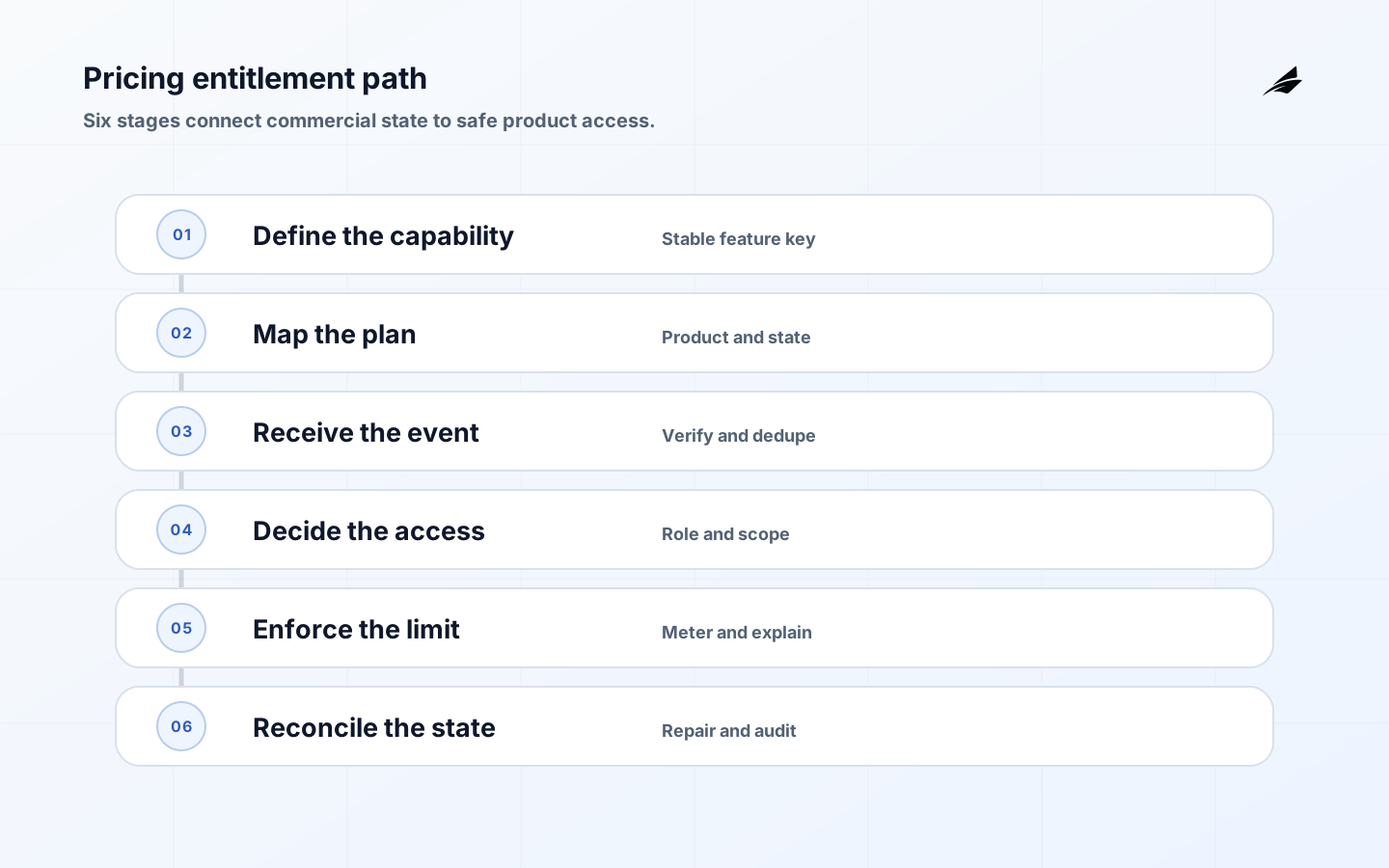
Create a stable capability key with a description, lifecycle state, and owner. Map plans or products to capabilities, then evaluate a customer’s active entitlement at request time or from a controlled local projection. Keep keys stable when marketing names change.

Subscription activity is asynchronous. Stripe’s webhook guidance emphasizes verified endpoints and lifecycle events. Persist the provider event ID, process duplicates safely, and define behavior for out-of-order delivery. A front-end success screen should not be the sole authority for granting access.
| Gate state | Customer-visible behavior | Engineering rule |
|---|---|---|
| Allowed | Capability works in current scope | Proceed and record material action |
| Pending | Change is being confirmed | Do not grant irreversible capability |
| Grace | Temporary access remains | Set expiry and customer notice |
| Quota reached | Limit and next option are clear | Block or queue by policy |
| Revoked | Access is denied safely | Stop new work and preserve allowed data |
Pricing Gates SaaS: controls, evidence, and review
A quantity gate needs a meter, window, unit, reset rule, and handling when the count is uncertain. Test exactly at the limit, one request over, concurrent requests, failed work, refunds, time-zone boundaries, and accounts with several workspaces.
Stripe’s idempotent-request documentation explains safe retries. Apply the same discipline to grants, credits, notices, and revocations, then reconcile provider events, local entitlements, and audit records.
| Test case | Expected result | Evidence |
|---|---|---|
| Duplicate event | One state transition | Event ID and idempotency record |
| Delayed event | Pending or safe prior state | Age and next action visible |
| Concurrent limit | No overspend or double grant | Meter and decision trace |
| Downgrade | Effective date and data rule hold | Entitlement and customer notice |
- Name the owner and the failure or exception state.
- Test normal, delayed, duplicate, unauthorized, and recovery paths
- Keep the source, decision, action, and validation evidence together
- Review the workflow on a cadence that matches customer and data risk
Frequently asked questions
Should billing be the source of truth for product access?
Billing is authoritative for commercial events, but the product still needs a controlled entitlement projection and server-side authorization policy.
What should happen on a downgrade?
Define effective timing, in-progress work, stored data, exports, users, and grace behavior before implementation.
Conclusion
Pricing gates are durable entitlement decisions with customer, security, and revenue consequences. Stable capability keys, explicit lifecycle states, server-side enforcement, safe event handling, and clear limits let product teams change packaging without weakening trust.
Evidence for “Pricing Gates in SaaS: Design Entitlements Without Surprises” is grounded in Entitlements, How subscriptions work, Using webhooks with subscriptions, Idempotent requests, Authorization Cheat Sheet; each source informs a specific decision, test, or operating trade-off described in this guide.