Subscription Access Control: Architecture Guide
Subscription access control architecture is the bridge between a commercial promise and a running product. The architecture has to decide what counts as an active entitlement, where that decision is enforced, how delayed provider events are reconciled, and what a support teammate can safely correct. Operations leaders should be able to see the same customer outcome that engineering sees in a trace: the account, capability, effective time, reason, and next action. If those facts are scattered across a dashboard, billing console, and application cache, the architecture is already difficult to operate.
Start with the customer decision: Subscription Access Control
The core job in commercial entitlement decisions is specific: a customer receives the features they have paid for without an unexplained lockout or over-grant. Write that sentence before selecting tools. Then state which actor makes or carries the decision: here it is the billing service. For subscription access control, review the access decision and its evidence during normal handling.
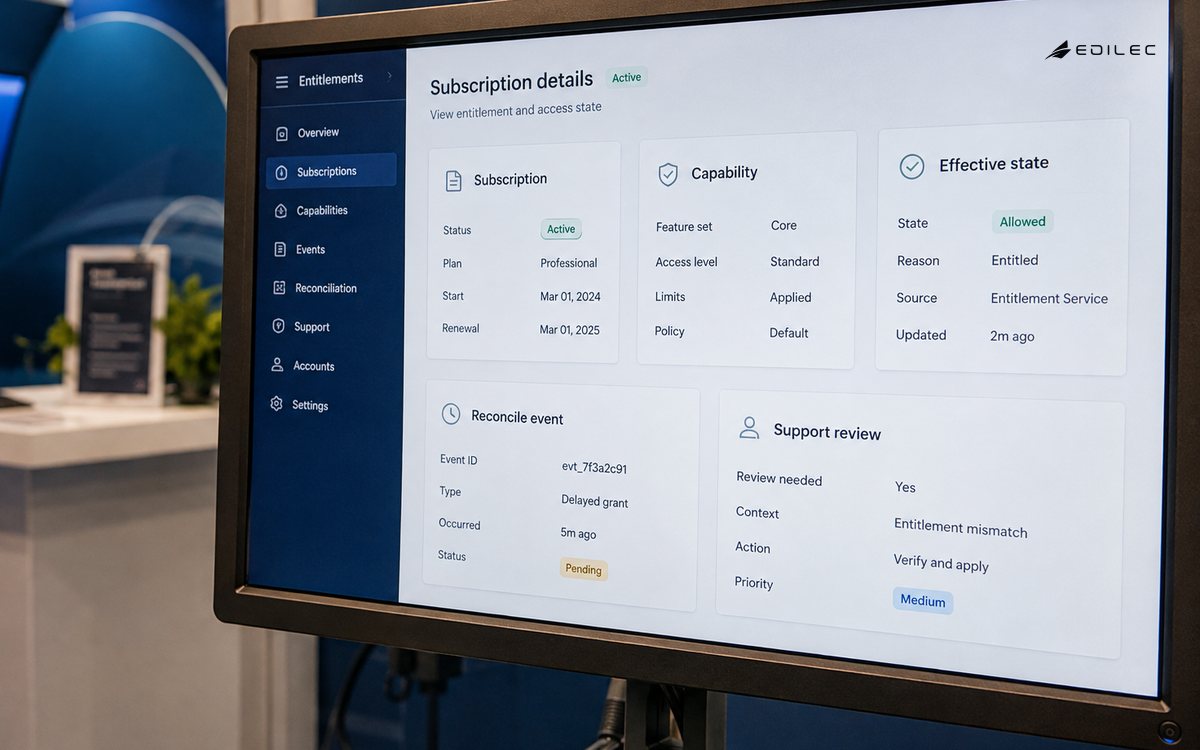
The authoritative input should be the entitlement record derived from a verified subscription event. That does not mean every caller can read it directly.
| Decision | Question to settle | Evidence to retain |
|---|---|---|
| Customer promise | What outcome does subscription access control make dependable? | Expected result and affected cohort |
| Authority | Which input wins when records disagree? | The entitlement record derived from a verified subscription event |
| Owner | Who resolves an incorrect result? | Named role, scope, and escalation time |
| Recovery | What happens after a delayed, duplicated, or out-of-order billing event? | Reversible action and audit record |
Design the boundary, not just the interface: Subscription Access Control
The enforcement point for subscription access control is the server-side permission check used by every product surface.
Plan explicitly for a delayed, duplicated, or out-of-order billing event.
Build an observable first release: Subscription Access Control
Begin with a small set of plans and one high-value feature.
- Name the product owner, technical owner, and recovery owner for subscription access control.
- Exercise the normal path, a delayed, duplicated, or out-of-order billing event, and a permissions or data-quality failure.
- Keep machine events linked to the account, request, and policy version
- Give the customer an understandable state and a next action for pending or denied work
- Expand only when the support path is tested and the correction record is reviewable
| Release check | Concrete test | Signal after launch |
|---|---|---|
| Authority | Force two inputs to disagree and verify the resolution rule | Mismatch and reconciliation count |
| Boundary | Try the same action through API, job, and operator paths. | Unauthorized or bypass attempts |
| Recovery | Simulate a partial failure and use the documented correction | Time to recover and correction reversals |
| Customer clarity | Ask a representative user what the current state means. | Repeat contacts and abandonment |
Measure quality at the customer boundary: Subscription Access Control
Track incorrect grant or revoke rate, recovery time, and entitlement event lag.
Subscription Access Control: Sources and design references
The recommendations here are informed by Stripe Billing Entitlements, Stripe subscription lifecycle, AWS SaaS Lens foundations, NIST Secure Software Development Framework. Keep subscription access control observable, owned, and recoverable through the next review.
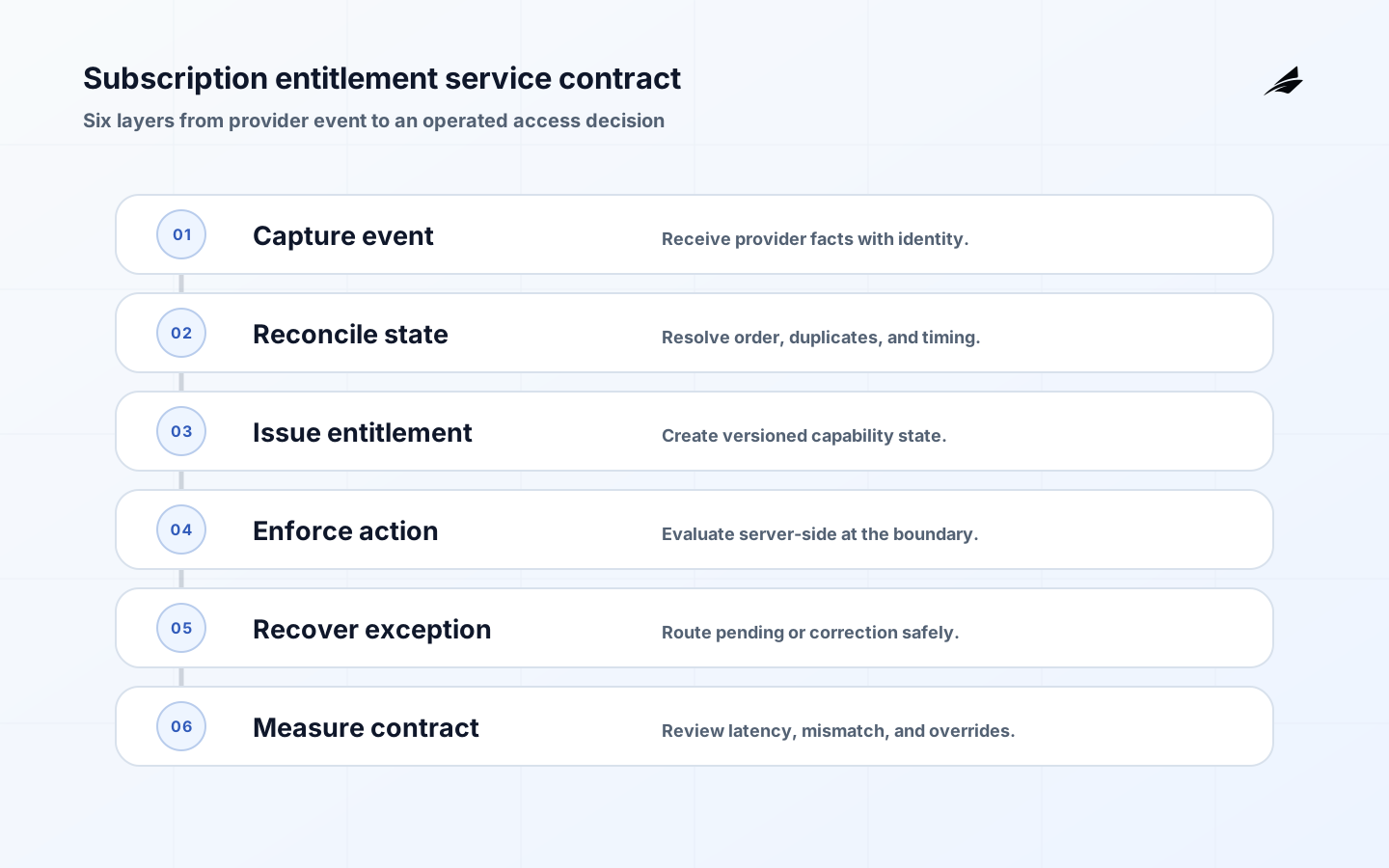
Design the entitlement boundary as a service contract
Keep commercial events, entitlement state, and authorization decisions distinct even when one service owns them at first. The event says what a provider reported; the entitlement record says what the product currently believes; the authorization result says whether this action is allowed now. Give each object an identifier and effective time. Consumers should be able to ask for a decision with the account, capability, and actor context, while the service retains the reason and policy version used.
The service contract needs a recovery vocabulary. “Pending” should mean the system is waiting for a named fact or retry, not that a developer forgot to finish an edge case. “Denied” should identify the policy result without leaking sensitive billing detail. “Exception” should point to a controlled operator workflow with an owner and expiry. These distinctions make queues, support macros, dashboards, and incident reviews more consistent, and they help the team decide which failures deserve automation.
| Decision point | Required record | Safe review question |
|---|---|---|
| Boundary | Actor, resource, scope, and policy | Can the service decide without guessing? |
| State | Current value, effective time, and source | What does the customer see and why? |
| Recovery | Owner, reason, expiry, and result | Can the team correct or contain it safely? |
Subscription access control: Record the evidence that changes entitlement, authorization, and recovery decisions.
Stripe entitlements and the Stripe subscription lifecycle provide concrete commercial-state vocabulary. The AWS SaaS Lens foundations connect tenant context to operating responsibility, while the NIST SSDF supports repeatable review and change control. Use these references to challenge the service contract, then validate the contract against real billing delays and customer support cases.
Place this architecture beside the multi-tenant SaaS architecture plan, SaaS MVP delivery plan, and SaaS product development guide so entitlement design is reviewed with tenancy, rollout, and product scope.
Subscription access control: Practical questions to answer before rollout.
Where should entitlement evaluation happen?
Evaluate it in a trusted server-side boundary close to the action that needs permission. Client-side state can improve presentation, but it should not be the final authority for paid or sensitive capabilities.
How should the architecture handle a late cancellation event?
Preserve the event and its received time, reconcile it against the current subscription record, and apply a policy-defined effective time. If the result is ambiguous, expose a bounded pending or exception state instead of silently guessing.
What does a good entitlement contract expose to support?
Expose capability, current state, effective time, reason code, source event, policy version, and available recovery action. Limit sensitive payment details to the roles that need them.
Key takeaways
- Subscription access control should be defined by the customer decision it makes dependable.
- Choose an authoritative record and preserve the evidence behind each outcome
- Enforce the boundary across background and operator paths, not only the main interface
- Treat recovery as a designed, scoped workflow rather than an emergency habit
- Use customer outcome and recovery signals together before expanding scope
FAQ
What should the team decide first for subscription access control? Start with the customer outcome, the authoritative record, and the person accountable. End the handoff with a named owner, a review date, and evidence that the customer-facing state is correct.
Subscription access control: Review the practice before expanding access controls.
Before adding plans or features, review one entitlement decision end to end with product, billing, engineering, and support in the room. Start from a real account and identify the subscription, invoice, entitlement, feature, request, and policy identifiers used at each hop. Change one condition at a time: replay a webhook, delay it, revoke a plan, let a cache serve old data, and request the same action through an API or background worker. The group should be able to say which record wins, whether the customer sees a temporary state, and how reconciliation will repair drift. Then inspect a manual correction. It should grant only the needed feature, have a recorded reason and expiry where appropriate, and trigger later reconciliation rather than becoming a permanent shadow state. This review catches a common commercial failure: the billing system, product database, and support tool all look plausible alone but disagree about the same customer. Treat disagreement as a designed operating case, not an embarrassing surprise. The output should be a small set of tests and a clear owner for any gap, which is much more valuable than an undocumented promise that access will eventually sort itself out.
Ownership is clearer when subscription access control separates the promise from the mechanism. Reconcile subscription access control changes against the original record.
Before widening subscription access control, run a small rehearsal with normal, denied, delayed, and corrected cases. Make subscription access control corrections visible, scoped, and reversible during control architecture guide.
Review subscription access control evidence with product, engineering, and support for control architecture guide.
Rehearse the control and evidence path before release.
For subscription access control, review the access control architecture guide ownership during a support review.
For subscription access control, review the access control architecture guide ownership during normal handling.
For subscription access control, review the access control architecture guide ownership during a recovery drill.
For subscription access control, review the access control architecture guide recovery during a recovery drill.
For subscription access control, review the access control architecture guide evidence during a recovery drill.
Compare normal and interrupted cases before release.
For subscription access control, review the access control architecture guide measurement during a support review.
Before expanding subscription access, test an ordinary entitlement grant against a policy change and a dependency failure. Confirm that the decision boundary rejects unauthorized access, preserves the recorded reason, and restores the correct state.
Record the owner and recovery decision for the next review.
Tie each access-control measure to a customer decision: grant, deny, suspend, restore, or escalate. The review should name the signal, owner, and action that follows.
During a support review, trace one entitlement decision from subscription state through policy evaluation to the customer-visible result. Record the owner, evidence, and recovery date before expanding the workflow.
Verify the control at its boundary and during recovery.
A concrete operating test for subscription access control is to rehearse access control architecture guide during a dependency failure. For
Conclusion
Subscription access control becomes durable when the customer promise, authority, enforcement, and recovery path agree. Add a scheduled reconciliation that compares the billing provider's current entitlement view with the product's enforced feature state. It should report differences before changing anything automatically, retain the input snapshots used for the comparison, and distinguish expected grace periods from unexplained drift. This gives the team a measured way to improve correctness without turning customers into the monitoring system. Start with a small set of plans and one high-value feature, keep the decision history legible, and use observed failure to refine the model rather than patching symptoms. For related planning context, see multi-tenant architecture planning, SaaS MVP delivery, SaaS product delivery planning.
Evidence for “Subscription Access Control: Architecture Guide” is grounded in Stripe Billing Entitlements, Stripe subscription lifecycle, AWS SaaS Lens foundations, NIST Secure Software Development Framework; each source informs a specific decision, test, or operating trade-off described in this guide.