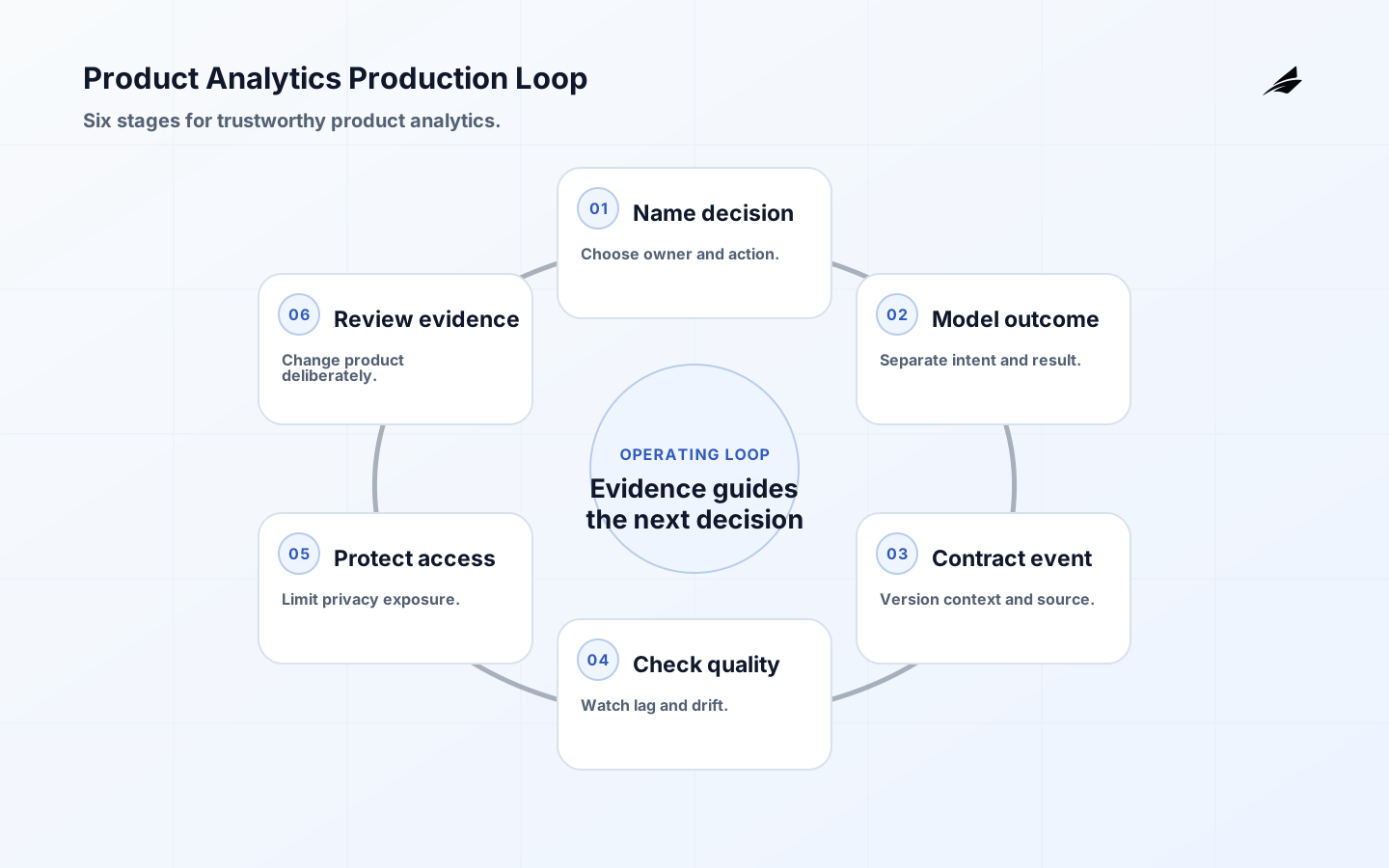
Product analytics in production changes when it moves from a prototype dashboard into decision-making. The team is no longer asking whether an event can be captured; it is responsible for whether the event means what people think it means, whether collection remains healthy, whether identities are handled appropriately, and whether a metric can support a product or operational decision. A spike in activation may reflect a real improvement, a duplicate event, a changed release, or a broken identity join. Production analytics needs a contract that connects user action, source, time, version, privacy expectation, and decision owner. OpenTelemetry’s semantic-convention work is a useful reference for consistent names and context, but the product team still owns the business meaning.
Name the decisions before the events
Start with decisions such as whether onboarding is working, which workflow creates repeat value, where a user becomes blocked, or whether a release reduced support work. Each decision needs a population, time window, action owner, and acceptable uncertainty. Only then define the events that provide evidence. This prevents event catalogs from becoming a list of clicks nobody uses. Write an example using real behavior: an account administrator invites a colleague, the colleague accepts, creates a first project, and returns within seven days. Decide whether the product records each step, how anonymous and authenticated activity joins, and what a partial completion means.
| Analytics decision | Minimum context | Review question |
|---|---|---|
| Activation | Account, actor, version, timestamps | Can we distinguish completion from retries? |
| Retention | Stable cohort and return definition | Is the cohort definition still valid? |
| Feature use | Intent, outcome, and entitlement | Does usage reflect value or obligation? |
| Support reduction | Workflow and resolution state | Can the metric be tied to fewer manual steps? |
Create an event contract
Define event name, actor, account or tenant, object, action, event time, received time, source, schema version, client version, consent or collection basis where relevant, and quality state. Keep event properties stable and avoid sending arbitrary UI text as a substitute for a model. Distinguish a user intent from a server outcome: clicking submit is not the same as a record being created. RFC 9110’s HTTP semantics are a useful reminder that request handling has distinct method, response, and status meanings. An analytics event should carry enough context to explain the state without exposing more personal or sensitive information than the decision requires.
Protect quality and identity joins
Production data quality fails quietly. A mobile retry duplicates an event, a browser loses a session, an account changes ownership, or a backfill uses a new definition against old records. Monitor event volume by release and source, duplicate rate, missing required fields, late arrival, invalid enum values, identity-join failure, and unexpected cardinality. Keep an event schema registry or equivalent versioned contract. Decide whether a correction updates history, appends a correction event, or marks a record as invalid. Users should not have to discover a tracking change through a dashboard surprise; record the change and communicate its effect to metric owners.
| Quality signal | Likely cause | Action |
|---|---|---|
| Volume drops | Release or transport regression | Compare source, client, and ingestion health |
| Duplicates rise | Retry or listener change | Use event identity and deduplicate |
| Unknown properties | Schema drift | Reject or quarantine with reason |
| Identity joins fail | Session or account change | Show coverage and investigate scope |
Make privacy and access part of design
Collect what the decision needs, define retention, restrict access, and avoid treating analytics data as harmless by default. Event payloads can reveal behavior, organizations, locations, or sensitive workflows. Separate product metrics from support or security evidence when their audiences and retention differ. Use role-based access, tenant scope, audit logs, and a process for correcting or deleting data where applicable. NIST SP 800-53 provides a broad control vocabulary; it does not choose the right collection boundary for your product. The practical test is whether a metric owner can explain why each field exists and whether an analyst can answer a question without downloading an entire customer history.
Instrument the pipeline, not only the UI
A production analytics view needs collection, transport, ingestion, validation, storage, transformation, query, and presentation signals. Use metrics for throughput and lag, logs for rejection and configuration decisions, and traces for a request path that crosses services. OpenTelemetry’s observability model helps separate these signals. Instrument the path so a user can tell whether a chart is empty because no one acted, the event was rejected, the transformation failed, or the query is stale. Alert on decision-impacting degradation rather than every volume fluctuation. Give support a compact runbook with a sample event, expected fields, last healthy time, and escalation owner.
Roll out analytics changes safely
Release event changes with the feature that creates them, but test collection separately from user-facing behavior. Use a staging or shadow path, representative accounts, and a release annotation. When a metric changes definition, publish the old and new values for a bounded comparison period where possible. Do not silently mix data from incompatible versions. A dashboard query is part of the product contract too; version or review it when semantics change. Before enabling a new event for every customer, verify that its fields are necessary, access is correct, and the system can handle the expected volume.
Key takeaways
- Start with decisions and owners, then define the events that provide evidence.
- Separate intent, request, outcome, and correction in the data model.
- Monitor quality, identity coverage, schema drift, lag, and access—not only event volume.
- Treat privacy, retention, and tenant scope as product requirements.
- Version metric definitions and release changes with enough evidence to explain the impact.

The OpenTelemetry semantic conventions provide a shared vocabulary for telemetry context, while the OWASP Logging Cheat Sheet supports deliberate diagnostic fields. Use NIST SP 800-53 for control evidence, HTTP Semantics for request and response meaning, and the OpenTelemetry Metrics Data Model for consistent metric structure. The product decision still determines what each signal means.
Frequently asked questions
Should a product track every user action?
No. Track actions that support a named decision, meet a justified operational need, or provide necessary reliability evidence. More events do not guarantee more insight.
What is the source of truth for product analytics?
Use the system that records the business outcome as the authority, then reconcile client events and server records. A click stream alone rarely proves completion.
When is product analytics production-ready?
When event meaning, privacy, quality, access, ownership, monitoring, correction, and change management are clear enough for another team to operate and trust.
Conclusion
Product analytics becomes a production capability when people can use its evidence to make decisions and explain how that evidence was produced. The central operating question is not how many events arrive. It is whether the product can connect a named decision to a trustworthy outcome, with clear ownership when the data is late, incomplete, duplicated, restricted, or redefined. Keep the event contract close to the decision. Record the actor or subject, object, action, source, event time, received time, context, schema version, and privacy classification. Separate a client observation from a server-confirmed outcome. A button click may show intent, while a completed workflow belongs to a business system of record. When those distinctions are explicit, dashboards stop turning guesses into facts and support can trace a disputed metric to the source. Quality checks should run at the boundaries where errors can still be corrected. Monitor missing context, unexpected cardinality, schema drift, delayed delivery, duplicate identifiers, and reconciliation gaps between client events and authoritative outcomes. Quarantine or flag questionable records instead of silently repairing them in a report. Keep enough lineage to explain a metric after an instrumentation release, and show users when a view is partial or based on a changing definition. Privacy and access are part of the analytics design. Collect only fields needed for a decision, classify sensitive attributes, restrict joins and exports, and give support a diagnosis path that does not expose unnecessary customer content. Review retention and deletion behavior across event storage, warehouses, logs, traces, and derived tables. A technically accurate metric can still be an unacceptable product feature if its evidence cannot be used within the intended privacy boundary. Operate the pipeline as a service. Assign owners for collection, contracts, storage, transformations, dashboards, privacy review, and incident response. Give them measures such as event age, rejected records, coverage of required context, reconciliation rate, query freshness, and time to correct a broken definition. A healthy collector with an incorrect schema is not healthy for the decision. Keep a sample of normal traffic and a sample from a known degraded period so reviewers can test what the system actually tells a user. Release analytics changes with the product change that gives them meaning, but validate the data path separately. Stage new fields or definitions, compare old and new measures, document any intentional break, and provide a rollback or interpretation note. Do not merge incomparable history without marking the boundary. When a metric changes, tell its consumers what changed, why, and which decision should use it now. Finally, judge analytics by decisions and customer trust. Retire events that no longer change a product choice, reduce a support problem, or provide necessary reliability evidence. If teams keep exporting data to answer basic questions, investigate missing ownership or weak definitions before adding another dashboard. Production readiness means another team can find the source, interpret uncertainty, protect the data, and correct the record. That standard produces fewer events, better evidence, and a product that learns without losing accountability. Keep the production analytics contract connected to pre-build product analytics decisions, analytics for growing teams, and tenant isolation before build. The first link clarifies the intended decision, the second sets an operating cadence, and the third is a reminder that event and diagnostic data still carry customer scope. Together they give reviewers a practical way to question whether a metric is useful, lawful, and supportable. The final handoff should include one metric definition, one lineage sample, one privacy decision, one degraded-data example, and one named owner for correction.
Production product analytics is a governed evidence system. Connect events to decisions, protect identity and privacy, monitor the pipeline, and version meaning as the product evolves. The goal is not more tracking; it is better decisions that remain explainable.