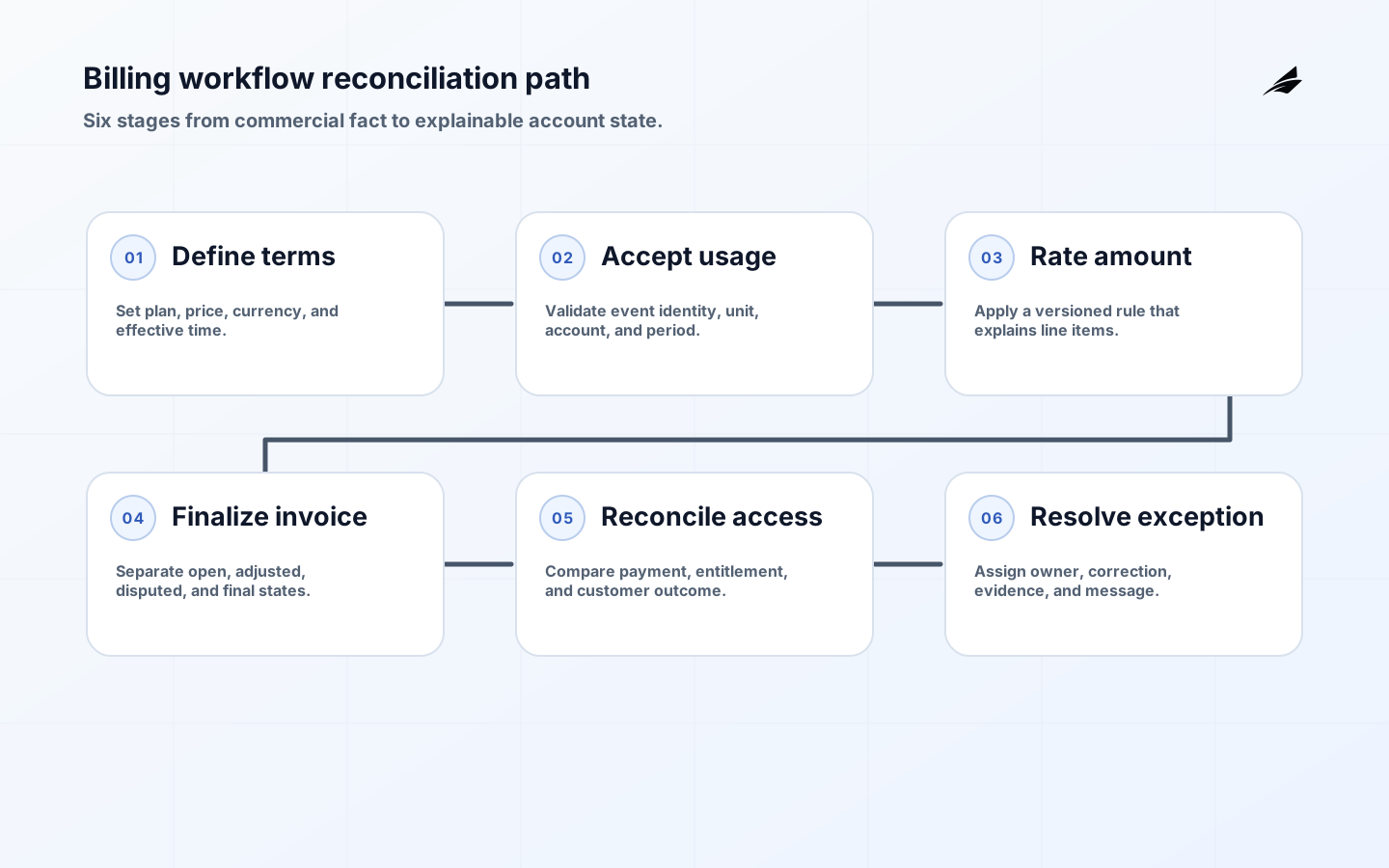
How Operations Leaders Should Think About Billing Workflows
Billing workflows turn changing commercial facts into invoices, payments, credits, access decisions, notifications, and records that people rely on. The visible invoice is only one output. Operations leaders need to know which source establishes a plan or usage event, when that fact becomes effective, what happens when events are late or duplicated, and who can correct an exception. Treat billing as a chain of accountable decisions rather than a single integration. This guide focuses on the boundaries and operating evidence that keep billing understandable when products have subscriptions, usage, credits, trials, tax rules, or multiple systems of record.
Name the commercial decision first
Write the promise in a way that can be tested: “this account is charged for billable units accepted during the period under plan X, subject to the documented adjustment policy. ” Identify the source of plan, price, currency, tax status, usage, payment status, and entitlement. Distinguish observed usage from accepted billable usage. Decide which system owns the invoice after finalization and which system owns access when payment status changes. Stripe’s usage-based billing documentation is useful for thinking about meter events and aggregation, but the product still needs its own definitions, corrections, and customer communication rules.
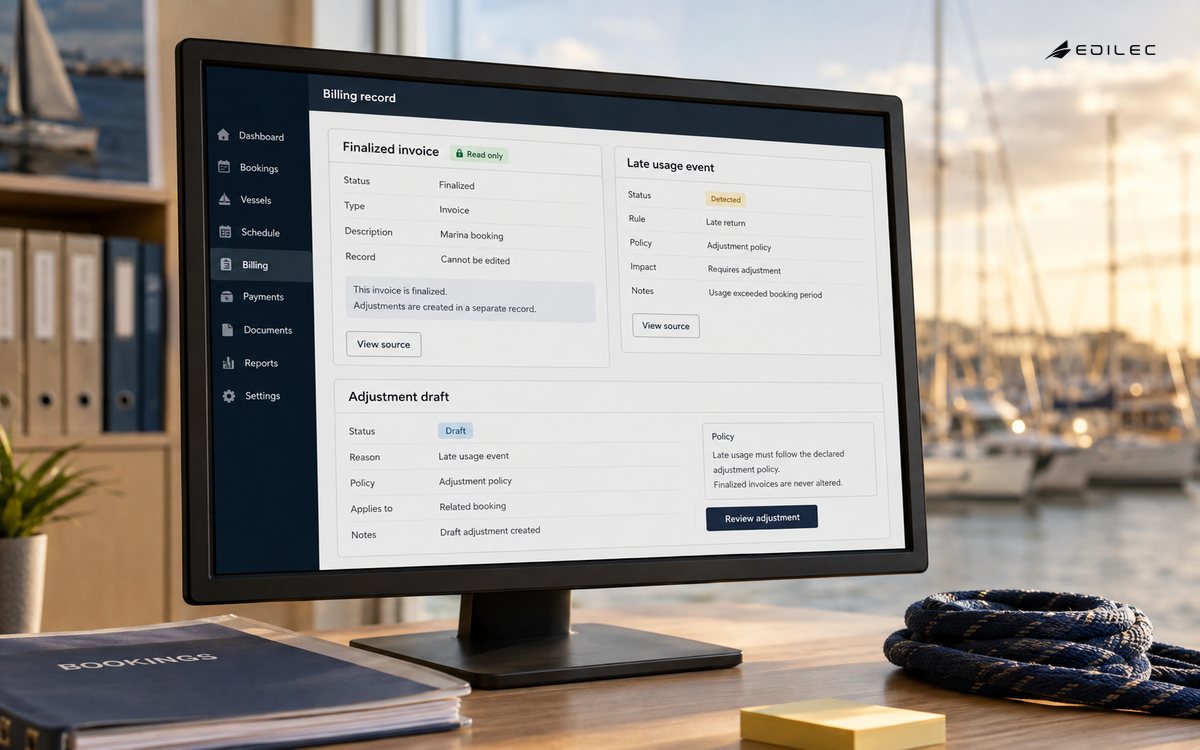
| Billing fact | Authority question | Evidence to preserve |
|---|---|---|
| Commercial terms | Which plan, price, currency, and tax rule apply? | Version, effective time, and approval |
| Usage | Which events count and for which period? | Event ID, event time, quantity, and source |
| Invoice | When is the amount final? | Line-item inputs, adjustments, and status |
| Access | What does payment or entitlement change? | Decision, reason, and notification |
Model time, state, and correction separately
Billing errors often come from confusing when something happened with when the system processed it. Store event time, ingestion time, evaluation time, and finalization time where they affect money or access. Model states such as received, validated, accepted, rejected, rated, invoiced, paid, disputed, adjusted, and voided. A late usage event should follow a known adjustment or next-period policy rather than silently rewriting a closed invoice. A duplicate should be identified by a durable event or idempotency key. The customer-facing explanation should name the relevant period and reason without exposing internal processing details.
Build a narrow path from event to outcome
Start with one plan, one currency, one usage shape, and one payment path if possible. Validate the event contract close to ingestion, reject missing account or unit context, and retain the original payload or a safe reference for investigation. Apply pricing in a versioned component that can explain each line item. Make retries idempotent and separate retryable transport failure from a business rejection. Use a preview or simulation for operators before a correction, then require a clear verification step after the invoice or entitlement changes. A small slice makes reconciliation and support language testable.
| Failure mode | Preventive control | Recovery signal |
|---|---|---|
| Duplicate usage | Idempotency key and unique event identity | Suppression reason and source count |
| Late event | Period policy and adjustment state | Adjustment created or queued |
| Wrong plan | Versioned price and effective date | Line-item explanation |
| Payment state mismatch | Reconciliation with provider and ledger | Unmatched account and owner |
Give operations a reconciliation rhythm
Reconciliation is the operating heartbeat of billing. Compare source usage to accepted usage, rated line items to invoice totals, payment provider status to internal status, and entitlement state to the commercial decision. Run checks before period close and again after late adjustments. The output should be a queue with an owner, severity, reason, and expected next action, not only a dashboard of differences. Use a sample of accounts to trace from a source event through invoice and access. A mismatch with no customer impact still deserves a disposition; otherwise small exceptions accumulate into an undocumented parallel process.
Control access, corrections, and communication
Separate who can view financial detail, approve an adjustment, issue a credit, change a plan, and alter entitlement. Require purpose, scope, and an expiry for manual exceptions. Record the original value and the correction rather than overwriting the amount. Use stable problem types for API errors and return a correlation reference so support can explain a rejected change. Do not make access revocation depend on a single webhook without a reconciliation path. When the commercial rule is uncertain, keep the account in a known pending or review state and communicate what is known, what is not, and when the next update will arrive.
Measure trust, not only collection
Track invoice accuracy, unmatched events, adjustment age, payment-state lag, entitlement mismatches, dispute rate, support contacts about charges, and time to explain a line item. OpenTelemetry metrics conventions can help standardize measurement vocabulary, but each metric needs a business owner and a response. Pair a rate with a case sample and a financial severity band. A low error count may still be unacceptable if the errors affect one strategic customer or remove access incorrectly. Review trends by plan, integration, period boundary, and release so the team can distinguish a source problem from a pricing rule change.
Use a billing review pack before close
Before a billing period closes, assemble a compact review pack for a representative set of accounts. Show source events, accepted usage, rated quantities, invoice lines, payment state, and entitlement outcome. Include one account with a late event and one with a correction. The purpose is not to inspect every line by hand; it is to verify that the chain of decisions is still coherent and that exceptions have an owner.
Ask finance, operations, engineering, and support to read the same account. Finance should be able to explain the amount, engineering the processing path, and support the customer message. If each function requires a different private export, the workflow has a visibility problem. Add a shared reference or reason code rather than growing another spreadsheet that can drift from the source.
Test the boundary between open and closed periods deliberately. Send a duplicate event, a late event, a plan change near the boundary, and a payment update that arrives after entitlement was evaluated. Confirm the chosen policy, customer-facing adjustment, and audit history. A period close is a business state transition, not merely a scheduled job finishing.
Use the review pack to decide whether a new pricing model is ready. The team should know how the model handles missing units, corrections, rounding, currency, taxes, credits, and failed payment. If any answer is “we will reconcile later,” define the queue, owner, and customer communication before launch. Operational clarity is part of the price a product promises.
Keep a clear distinction between a commercial exception and a technical retry. A retry asks the same rule to process work again; an adjustment changes the financial outcome and needs a reason, authority, and customer-visible record. Mixing the two makes reconciliation and approval difficult, especially when a provider later sends a duplicate or delayed event.
Review entitlements alongside amounts. A correct invoice with incorrect access is still a billing incident, and correct access with a wrong invoice still creates customer harm. The shared account reference, effective time, and decision reason should let finance, engineering, and support see which state diverged and who owns the correction.
Create a single account timeline for commercial events and decisions. It should show plan changes, usage acceptance, invoice state, payment updates, entitlement changes, adjustments, and customer communication with effective times. This does not replace specialist finance records; it gives operations a shared route for explaining why the customer sees a particular amount or access state.
Keep commercial and technical ownership visible in the exception queue. A finance reviewer may approve a credit while engineering repairs the event path and support explains the result. The queue should show the handoff, not merely the final status, so an unresolved mismatch cannot disappear between teams.
When a billing rule changes, run the old and new definitions against a fixed sample of accounts. Compare line items, adjustments, access decisions, and customer messages. Preserve the comparison with the change record so a later discrepancy can be traced to the rule version rather than reconstructed from a moving production report.
Key takeaways
- Define authoritative commercial facts and their effective times before selecting billing features.
- Separate event time, processing time, invoice finalization, payment state, and entitlement state.
- Make usage, pricing, corrections, and retries explainable and idempotent.
- Run reconciliation as a queue with owners and severity, not as an unattended report.
- For nearby decisions, See billing workflow mistakes and fixes, usage reporting, and subscription access control.
Frequently asked questions
What is the first billing decision to document?
Document which plan, price, usage event, and time period determine a charge, then state which record becomes authoritative for the invoice and which rule handles corrections. This gives finance, engineering, and support the same definition of “correct” before they debate implementation.
What happens when usage arrives late?
Record the original event time and apply a declared policy: adjust the open period, create a credit or debit in the next period, or route the event for review. Do not silently change a finalized invoice. Make the adjustment visible to the customer and traceable to the source event.
Who owns an exception?
Ownership should be shared but specific. Finance or operations owns the commercial decision, engineering owns reliable processing and reconciliation, and support owns the customer explanation and case path. A named approver should own a high-impact adjustment, with reason, scope, and review date recorded.
Conclusion: make every amount explainable
Billing workflows earn trust when an operations leader can follow an amount from source fact to line item, payment state, access outcome, and customer message. Start with a narrow product slice, separate time and state, reconcile continuously, and make corrections additive and attributable. That discipline makes expansion safer because the team knows where a new plan or usage rule belongs and how it will be checked.
For billing workflows, test an incomplete setup before treating the first release as complete. Review billing-workflow evidence with product, engineering, and support.
A practical example for how operations leaders should think about billing workflows is support and engineering initially read different evidence.
Ownership is clearer when billing workflows separate the promise from the mechanism. For billing workflows, review control during normal handling.
Before widening how operations leaders should think billing workflows, run a small rehearsal with normal, denied, delayed, and corrected cases. Give billing workflows a named owner and a review date for billing workflows.
This decision also connects to Billing Workflows: Mistakes and Fixes, Usage Reporting: Hands-on Planning Guide, Subscription Access Control: Architecture Guide. Review those boundaries together when how operations leaders should think billing workflows shares identity, data, billing, or support evidence with another workflow.
For Billing Workflows, Stripe Billing features defines scope; RFC 9110: HTTP Semantics supports the control.
Evidence for “How Operations Leaders Should Think About Billing Workflows” is grounded in Usage-based billing: how it works, Stripe Billing features, RFC 9110: HTTP Semantics, OpenTelemetry metrics conventions; each source informs a specific decision, test, or operating trade-off described in this guide.