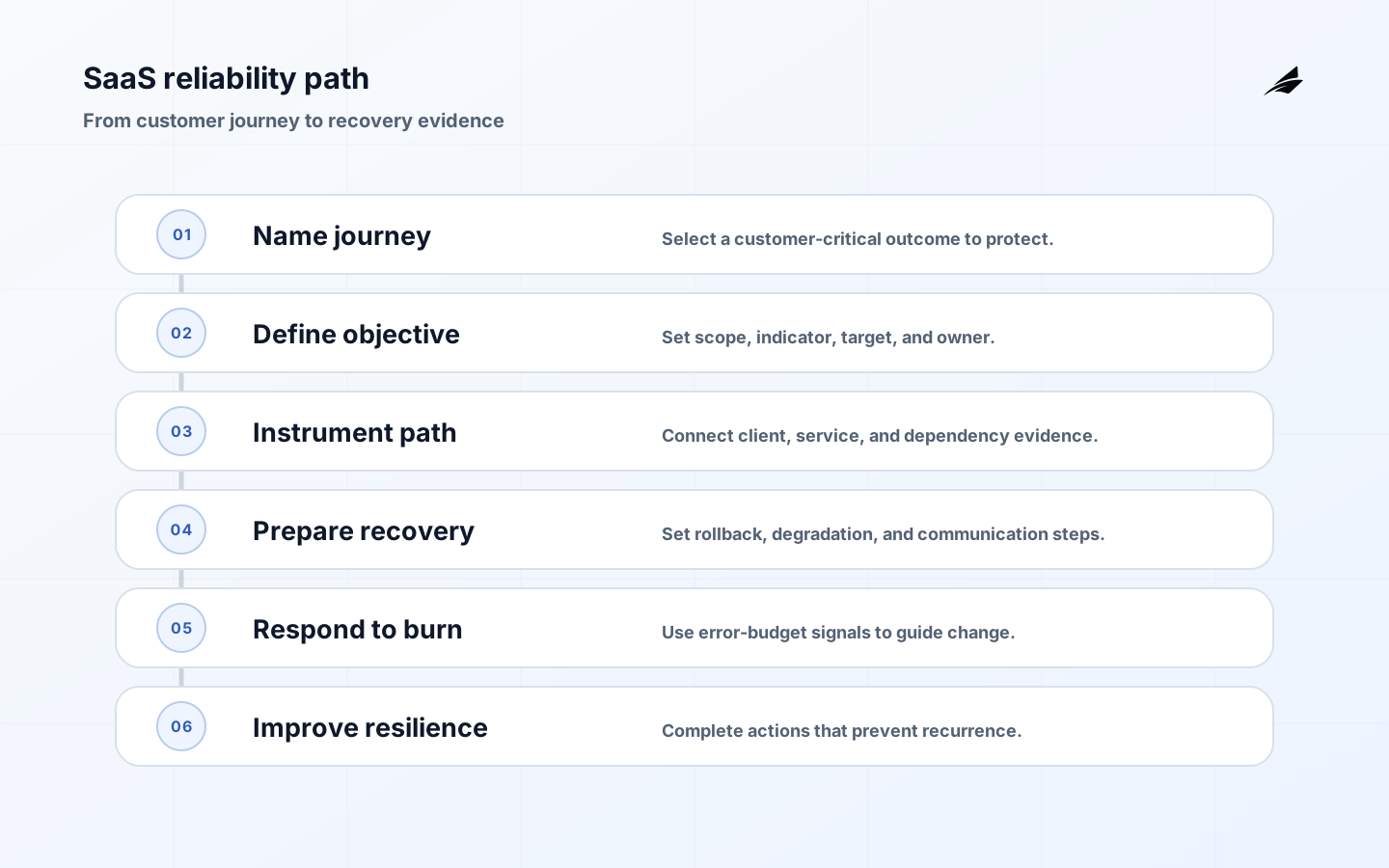
SaaS reliability is a product-engineering concern because it shapes what a customer can trust in the product, what an operator can explain, and what a delivery team can change safely. For operations leaders, the work is not to collect more tooling or policy language. It is to make one important decision visible: what state is authoritative, who owns it, which controls enforce it, and how the team learns when reality differs from the plan.
Why SaaS reliability Matters
SaaS reliability is not the same as an uptime number on an infrastructure dashboard. A service can return successful responses while customers cannot complete the business action they came to perform: a report stays stale, an invitation never arrives, an approval is delayed, or an integration silently drops updates. Operations leaders need reliability goals that express these customer outcomes and create clear tradeoffs between feature delivery, incident response, and the work required to prevent recurrence.
Define a small initial set of service-level objectives around important customer journeys. An availability target can cover a critical API, while a freshness objective can cover data ingestion and a completion objective can cover a workflow such as invoice approval. Each objective needs a measurement method, scope, target, window, owner, and consequence when it is missed. An error budget is useful only when the organization agrees how it changes release or investment decisions.
Build the Operating Model
Reliability has four connected layers: user journey, service behavior, dependency behavior, and recovery capability. Start from the journey and work backward to the indicators that approximate it. Instrument the services and client path so a responder can separate a product defect from a provider outage or a customer configuration problem. Then practice recovery: backups, rollbacks, safe degradation, and communication. Monitoring without an operational response is a dashboard, not a reliability program.

| Reliability view | Question it answers | Example |
|---|---|---|
| Availability | Can a request receive a valid response? | Users can load the approval queue. |
| Latency | Can it respond quickly enough? | The queue opens within the agreed time. |
| Freshness | Is asynchronous information current? | Imported records appear within the promised delay. |
| Journey completion | Can a user finish the intended job? | An approver can submit and receive confirmation. |
Write a reliability contract for each critical journey. Name the customer action, the users in scope, successful outcome, allowed latency or delay, dependencies, measurement source, and escalation owner. Include exclusions sparingly and explain them. A target of 100 percent sounds reassuring but gives no room for deliberate change and can lead to costly, brittle decisions. The contract should be reviewed by product, engineering, and operations because its target is a business promise expressed through technical evidence.
Design the Architecture and Controls
Build observability around correlation and cardinality discipline. Traces can connect a customer request to dependent services, while metrics alert on aggregate behavior and logs preserve diagnostic details. Use structured events for asynchronous workflows so the team can see where a job paused or retried. Protect telemetry from becoming a privacy leak or a cost sink by defining fields, retention, sampling, and access. The system should make an incident easier to understand without making every request permanently inspectable.
Reliability incidents often begin with ordinary change: an untested migration, a configuration drift, a slow dependency, or a retry loop that amplifies load. Plan for partial failure. Define timeouts, circuit breakers, idempotent jobs, rollback criteria, and user-facing degraded states before the incident. During recovery, communicate the affected outcome and next update time rather than claiming broad success too early. Afterward, track corrective actions to completion, especially those that reduce recurrence or speed detection.
Roll Out with Evidence
Choose one customer-critical journey and establish its baseline before setting an ambitious target. Instrument it end to end, validate the alert against a realistic failure, and write the response playbook with the people who will use it. Add an error-budget policy only after stakeholders agree what it means for releases. Expand gradually to adjacent journeys. A small set of trusted objectives changes decisions more effectively than a long catalogue of unowned metrics.
| Signal | What it can reveal | First response |
|---|---|---|
| Fast error-budget burn | Customer impact is consuming planned risk | Pause risky changes and investigate the affected journey. |
| Growing queue age | A background workflow is degrading | Check dependency health, retries, and worker capacity. |
| Alert without customer impact | Indicator scope is too technical | Adjust the SLI to the user outcome. |
| Repeated incident class | The response restored service but not resilience | Fund the corrective action and verify it. |
Operate and Measure
Track SLO compliance, error-budget burn, latency or freshness distribution, incident detection time, recovery time, change failure rate, and repeat incident classes. Segment by journey when possible so an overall average does not hide a damaged workflow. Review both leading and lagging signals: queued work and dependency saturation can warn of trouble before a missed objective, while customer contact volume can reveal a gap in the chosen indicator. Every metric needs an owner and a response.
- Measure reliability through important customer outcomes.
- Make objectives explicit about scope, method, and consequence.
- Use error budgets to guide tradeoffs, not punish teams.
- Instrument asynchronous and dependency paths.
- Practice recovery and finish corrective actions.
Implementation Detail
For an approval workflow, an availability target on the API is not enough. The user journey may require loading the item, validating permissions, saving the decision, writing an audit record, and notifying the next person. Define which of those steps are included in the objective and how long each may take. If notifications are eventually consistent, measure their freshness separately. This turns a vague claim of reliable approvals into a set of observable promises and helps the team diagnose the layer where a customer is actually blocked.
An error-budget policy needs pre-agreed actions, not an improvised meeting after an outage. For example, normal release velocity can continue while burn stays within a defined threshold; a sustained high burn can require a pause on risky changes, extra review, or capacity directed to the affected journey. Make exceptions explicit, such as a security fix or a failure outside the agreed scope. The policy should be proportional to service maturity and transparent to product leaders, otherwise it will be seen as a technical veto rather than a customer-protection mechanism.
Review Before Scaling
Test recovery with realistic dependencies. Disable a downstream provider in a nonproduction environment, introduce a delayed queue message, or rehearse rolling back a configuration change. Observe whether alerts reach the right owner, whether the runbook has enough decision points, and whether the customer-facing state communicates useful information. Restore tests are especially valuable for data-bearing systems: a backup is only a control when the team can recover the required records within the promised window and verify their integrity.
Reliability reviews should connect incident learning to planning. A post-incident item without an owner, due decision, or evidence of completion will age quietly until the next outage repeats it. Group repeated incidents by customer impact and underlying control gap, then decide whether a product change, dependency redesign, or operating improvement offers the strongest reduction in risk. This is how reliability becomes a sustained product capability rather than a burst of attention whenever a dashboard turns red.
Reliability targets should be revisited when customer behavior or product architecture changes. A target derived from an early cohort may become too loose for a critical workflow or too strict for a low-impact background task. Revisit the user journey, indicator validity, dependency assumptions, and response policy together. Changing a target is responsible when it reflects better evidence, rather than an attempt to make a difficult dashboard look healthy. Review this evidence with the owner of SaaS reliability, the people who operate the surrounding workflow, and the team responsible for customer communication. Agree on one change, one measure, and one follow-up date. That closed loop keeps local fixes from becoming unexamined policy and makes the next decision easier to defend.
Key Takeaways
- Make SaaS reliability a named operating decision rather than an implicit implementation detail.
- Keep customer impact, evidence, and recovery visible to the team that owns the workflow.
- Start with a narrow path, learn from real outcomes, and expand only after the controls hold.
Frequently Asked Questions
Where should a team start with SaaS reliability? Start where an incorrect decision would create meaningful customer, commercial, or operational harm. Map the current state, the owner, the boundary, and the evidence available during failure. How much process is enough? Use the smallest process that makes the decision repeatable, reviewable, and recoverable. Add rigor when the data, action, or customer consequence makes a shortcut unsafe.
Conclusion
Strong SaaS reliability work is not a one-time project. It is a durable agreement between product, engineering, and operations about how the system behaves under ordinary and difficult conditions. When the contract, controls, telemetry, and recovery path agree, operations leaders can improve the product without turning each release or customer exception into a new source of uncertainty.
The practical continuity test for SaaS reliability is whether a qualified teammate who did not design the workflow can inspect the current state, understand the relevant decision and its limits, and take the next safe action without improvised access or tribal knowledge. Keep the owner, evidence location, escalation route, and recovery rule visible. That discipline makes routine operations calmer and gives the organization a reliable starting point when a customer, release, or incident exposes a new edge case.
Sources
The implementation advice in this SaaS reliability guide is grounded in Google SRE service-level objectives, Google SRE error budget policy, OpenTelemetry documentation, NIST SP 800-34 Rev. 1. These references are useful for checking platform-specific controls and terminology during delivery; the decisions here still need to be applied to the product's data, risk, and customer context.