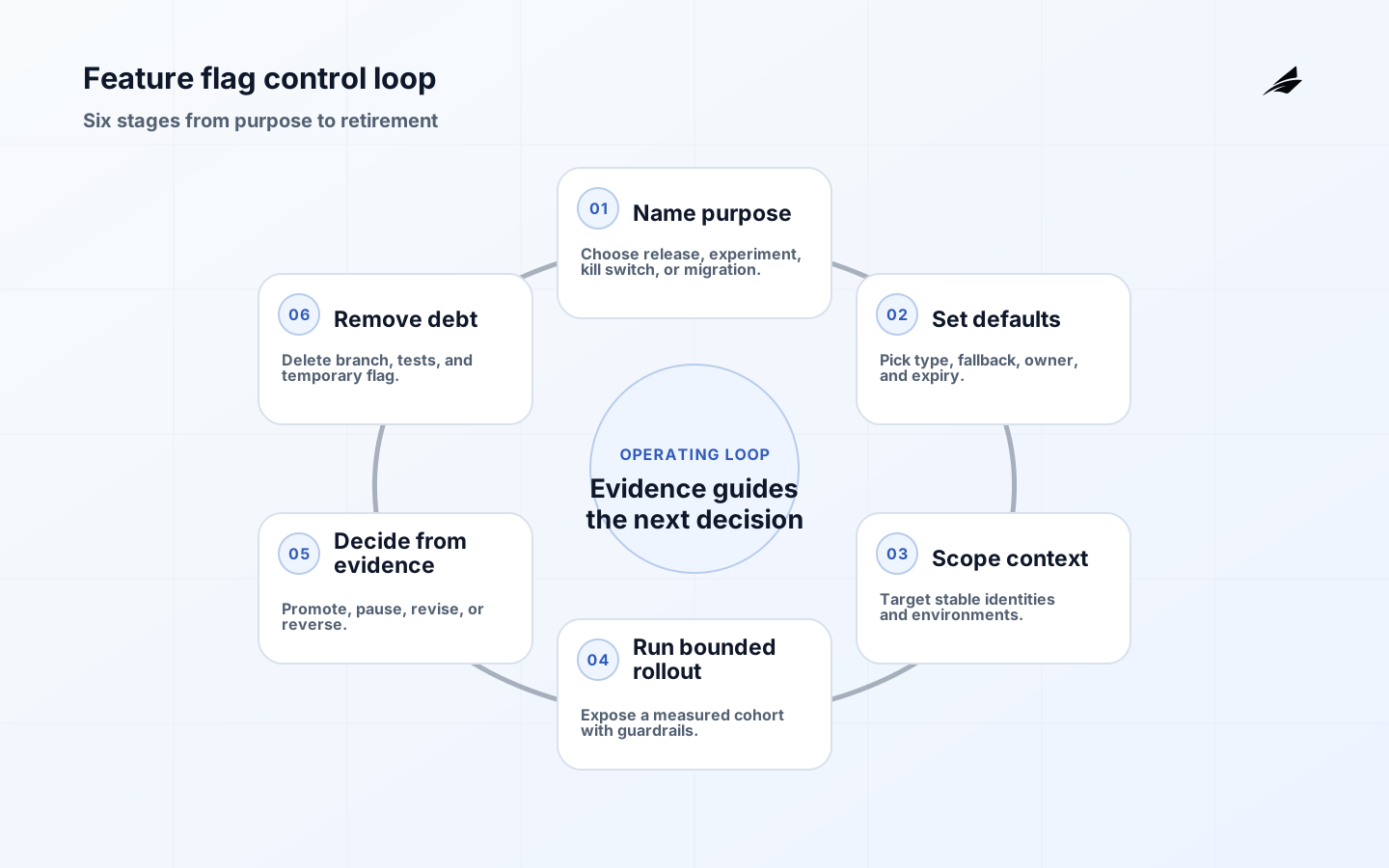
Feature flags let a team change product behavior at runtime, but they do not remove the need for product judgment. The first question is why a decision must remain changeable after deployment. A release flag can stage exposure; an experiment flag can compare outcomes; a kill switch can reduce harm during an incident; a migration flag can coordinate old and new paths. Each purpose needs a different owner, default, metric, and removal rule. OpenFeature describes flags as a vendor-neutral evaluation layer, while LaunchDarkly distinguishes temporary release flags from permanent operational controls. Edilec's feature flags security review is a useful companion when a flag crosses trust or permission boundaries. "
Choose the purpose before creating the flag
A name such as new-checkout hides too many decisions. Is this a release, experiment, emergency control, entitlement, or data migration? Write a purpose sentence that includes the behavior and the decision owner: "The checkout-v2 release flag controls exposure while payment and completion signals are compared. " Then choose whether it is temporary or permanent. A temporary flag should have a removal date or condition. A permanent flag should have an operational rationale, a change authority, and a test for the default state. If the product need is stable configuration, use configuration management instead of accumulating another runtime branch. "
| Flag purpose | Best use | Exit or review rule |
|---|---|---|
| Release | Expose a completed capability gradually. | Remove after the intended audience reaches the new path. |
| Experiment | Compare defined variations against a hypothesis. | Stop after the decision window and analyze the result. |
| Kill switch | Disable a risky or degraded capability. | Review ownership, default, and incident use periodically. |
| Migration | Coordinate old and new data or service paths. | Remove after reconciliation and old-path retirement. |
| Entitlement | Control an approved plan or account capability. | Keep governed with authorization and commercial policy. |
Design evaluation as a product contract
A flag evaluation needs a key, a default, and context. Context may include a stable user, account, workspace, region, or device identifier. Use the smallest context that supports the decision and document whether targeting must remain sticky for an experiment or cohort. OpenFeature's typed evaluation API makes the default explicit and supports detailed results for telemetry and troubleshooting. In application code, validate the returned type, handle provider failure, and make the fallback behavior safe. A flag that returns a structured object should not become an unbounded configuration document; keep variations small enough to test and reason about. "
Control targeting and environment boundaries
The same flag key can have different values in development, staging, and production, but that convenience creates a boundary that needs governance. Separate environments, restrict who can change production targeting, and review prerequisite relationships. Targeting by percentage is useful only when the context identifier is stable and the decision is observable. A percentage rollout that changes users on every request produces noisy evidence and an inconsistent experience. Client-side exposure also deserves a security review: a value that is safe to display is not necessarily safe to use as authorization. Enforce permission on the server or domain service. "
Keep flag checks narrow in code
A flag should wrap a meaningful product boundary, not every small commit. Keep the check close to the behavior it controls and give the off path a maintained contract. Avoid nested flags that make every combination a hidden test matrix. Record the flag key in telemetry so a support investigation can tell which behavior a user received. When the flag is removed, delete the obsolete branch, tests, documentation, and configuration rather than merely archiving the dashboard object. LaunchDarkly's guidance on flag hygiene emphasizes that teams often add flags faster than they remove them; treat removal as planned delivery work. "
Connect the flag to an evidence plan
Before increasing exposure, define the primary outcome, guardrails, observation window, sample, and stop condition. For a new search filter, the primary result might be task completion, while guardrails include latency, empty-result rate, and support contact. A green flag status only says that the configuration is on; it does not say the product outcome improved. Capture evaluation reason, variation, context type, and relevant version where privacy and retention rules permit. Let the owner decide at a checkpoint whether to promote, pause, revise, or remove the flag. An experiment should not remain a permanent rollout switch because no one scheduled the decision. "
- Give every flag a purpose, owner, type, default, and removal or review condition.
- Use stable context identifiers and test evaluation failure as well as success.
- Separate flag visibility from authorization and protect production administration.
- Keep variations small, code checks understandable, and combinations limited.
- Measure user outcome and guardrails before promoting or retiring a flag.
Example: rolling out a new invoice view
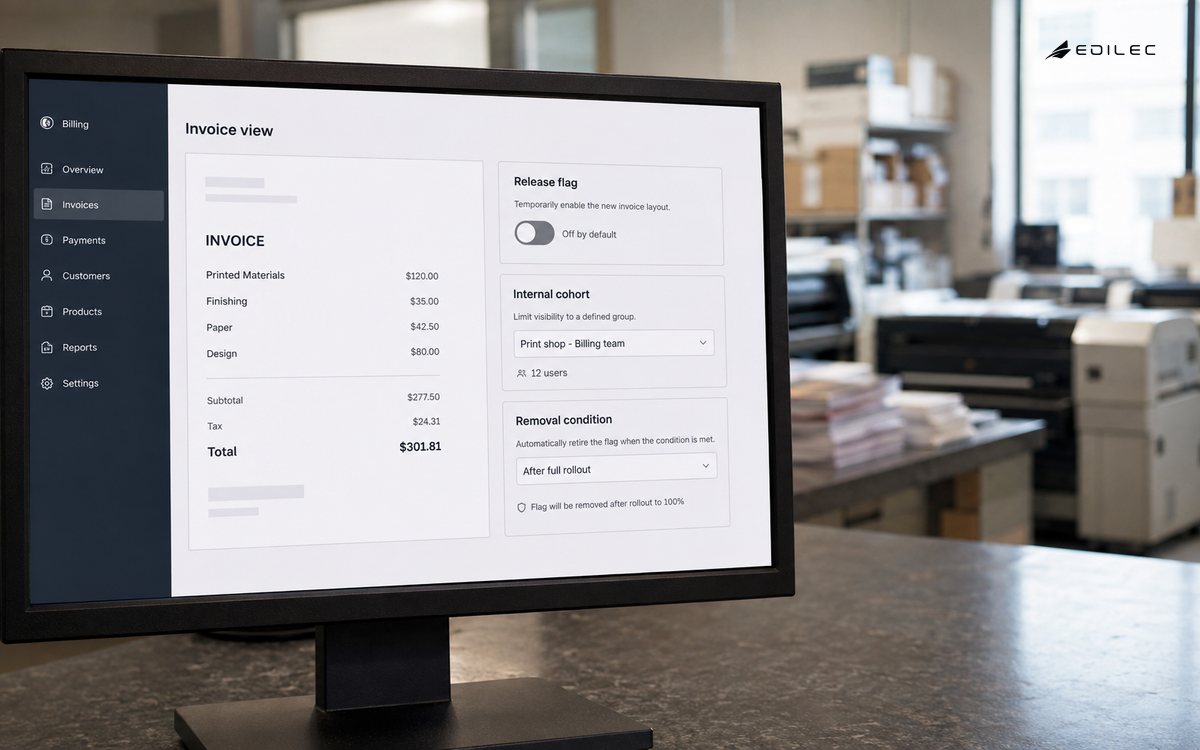
A product team wants to replace an invoice screen. It creates a temporary release flag with an off default, a product owner, a support owner, and a removal condition: the new view is stable for all workspaces for one billing cycle. The rollout starts with internal accounts, then five percent of stable workspace identifiers. The team measures invoice load time, payment-action completion, support contacts, and rendering failures. If the new view causes an unacceptable error rate, the flag returns to the old path while engineering investigates. Once the new path is general, the team deletes the old component and flag check. The value comes from the bounded decision, not from the toggle itself. "
| Design choice | Good question | Evidence before promotion |
|---|---|---|
| Default | What should happen if the provider is unavailable? | A tested fallback on representative clients. |
| Context | Which identity must receive a stable result? | Consistent assignment across sessions. |
| Guardrail | What failure stops expansion? | Threshold, window, and alert owner. |
| Authority | Who can change production exposure? | Role, approval, and audit record. |
| Retirement | What proves the flag is no longer needed? | Code removal, reconciliation, and final outcome. |
Make flag debt visible to product planning
Flag debt is product debt because it increases the number of behaviors a team must explain and support. Review a flag inventory by age, purpose, owner, environment, code references, and last evaluation. An old release flag with all contexts on is a removal candidate; an unused kill switch may still be intentional but needs an operational test. Use tags or naming conventions that help people find related flags without creating a vocabulary nobody follows. Include flag cleanup in the roadmap and release notes so support knows when a temporary control has become normal behavior. "
Key takeaways
- Feature flags are runtime decision points, not a substitute for product strategy or authorization.
- Purpose determines owner, default, metrics, environment, and retirement rule.
- Safe evaluation includes typed values, stable context, provider failure handling, and tested fallbacks.
- Promotion requires outcome evidence and guardrails, not merely a successful configuration change.
- Retire temporary flags with the code path and documentation they made necessary.
FAQ: Feature flag questions
FAQ: Should every feature flag default to off?
No. Off is common for a new release, but a permanent operational control or migration may need a different safe default. Choose the fallback that limits harm and aligns with the capability's failure mode, then test it explicitly.
FAQ: Can a feature flag enforce access control?
A flag can help select an experience or entitlement, but it should not be the only authorization check. The domain service must verify identity, role, account state, and policy before performing a protected action.
FAQ: How do teams reduce feature flag debt?
Record removal criteria when creating a temporary flag, review old flags regularly, instrument code references, and schedule branch deletion as part of the rollout completion rather than treating the dashboard archive as the end.
Review flags as part of product operations
A flag inventory should answer more than how many toggles exist. Review which flags are evaluated in production, which code paths still reference them, which environments differ, who changed them recently, and whether the recorded purpose still matches use. Sample a production evaluation and confirm that the context, variation, fallback, and telemetry are what the owner expects. For client-side flags, review what value is visible to an untrusted device and make sure no secret or authorization decision depends on it. For permanent controls, test the emergency path under controlled conditions so the team knows whether a change is fast, attributable, and reversible.
Product teams should also decide when not to create a flag. If a change can be deployed safely with a normal release, a temporary branch may cost more in testing and cleanup than it saves. If a value has many arbitrary combinations, a typed configuration object with validation may be clearer. If a decision is really a plan entitlement, model it with the commercial and authorization systems rather than a hidden product toggle. The best feature flag strategy is selective: use runtime control where it reduces a meaningful uncertainty, and keep the rest of the product easier to understand.
Document the flag's failure mode in the same place as its purpose. An unavailable provider, invalid context, stale configuration, or unexpected variation should each have a defined fallback and observable signal. This is especially important for flags that change payment, access, data movement, or an incident response. A default that is safe for a cosmetic button may be unsafe for an entitlement, so product owners should review the consequence rather than inherit a platform-wide convention.
Before widening how product teams should think about feature flags, run a small rehearsal with normal, denied, delayed, and corrected cases. Keep customer language aligned with the recorded state for how product teams should think about feature flags.
The measurement plan for how product teams should think about feature flags should pair an outcome with a reason to investigate it. For how product teams should think about feature flags, name the decision boundary and its owner.
A durable operating note for how product teams should think about feature flags records the assumptions that made the decision safe: the authoritative source, effective time, permitted actor, protected resource, and recovery route. Use how product teams should think about feature flags support evidence to decide whether the workflow is ready.
For how product teams should think about feature flags, a good handoff ends with observable evidence rather than a verbal promise.
The smallest useful improvement to how product teams should think about feature flags is often a sharper boundary, not another feature. Measure how product teams should think about feature flags outcomes alongside correction effort.
For How Product Teams Should Think About Feature Flags, Creating flags defines scope; Improving flag usage in code supports the control; Feature Flags API clarifies evidence; OpenFeature introduction guides recovery; OpenFeature Flag Evaluation API frames review. Give how product teams should think about feature flags a named owner and a review date for about feature flags.
A durable operating note for how product teams should think about feature flags records the authoritative source, effective time, permitted actor, protected resource, and recovery route. For how product teams should think about feature flags, review the think about feature flags measurement during a measured rollout.
For how product teams should think about feature flags, test a delayed dependency before treating the first release as complete. For how product teams should think about feature flags, review the think about feature flags recovery during a measured rollout.
Use a duplicate request to verify that flag evaluation produces one consistent decision and that the outcome is measurable during support review.
Conclusion
Product teams should think about feature flags as explicit operating decisions. Name the purpose, define context and defaults, separate exposure from authorization, measure the outcome, and make retirement visible. Edilec's pricing gates guide helps when a flag represents a commercial capability, and the SaaS reliability operations playbook adds incident and recovery context. A well-governed flag earns its place by making a risky decision smaller, clearer, and reversible.
Evidence for “How Product Teams Should Think About Feature Flags” is grounded in Creating flags, Improving flag usage in code, Feature Flags API, OpenFeature introduction, OpenFeature Flag Evaluation API; each source informs a specific decision, test, or operating trade-off described in this guide.