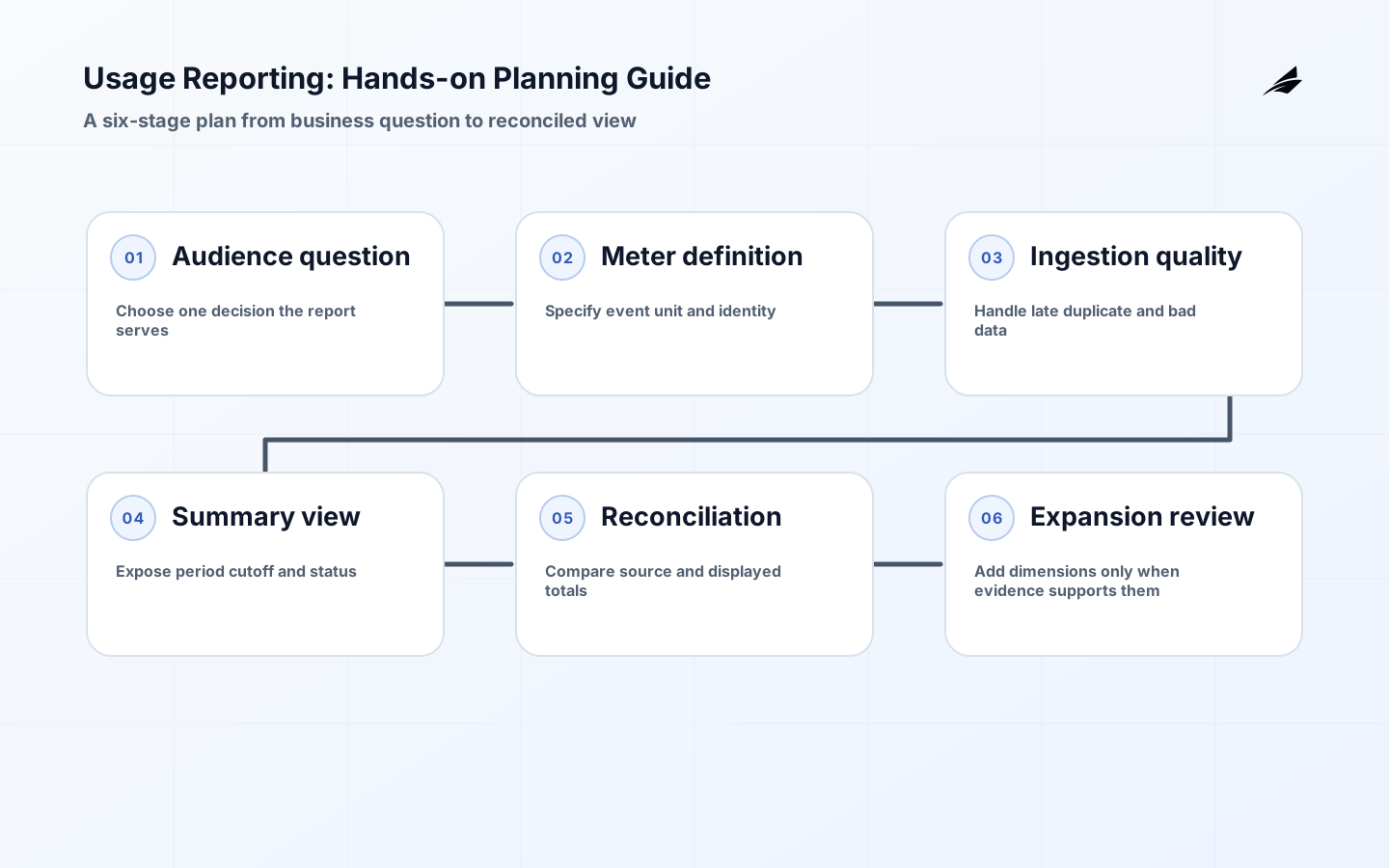
Usage Reporting: Hands-on Planning Guide
Usage reporting is a product-engineering decision about how a system will present customers and internal teams with a defensible account of consumption, limits, and trends that agrees with product behavior and billing rules. For usage reporting, review the hands on planning guide control during normal handling.
Define the usage reporting decision
Start by writing the boundary in ordinary language. For usage reporting, that boundary includes usage event, measurement unit, aggregation window, identity, late-arrival policy, displayed total, export, and correction. The first design decision is what counts as a billable or visible unit, when a period closes, and how the report distinguishes provisional usage from a reconciled total.
| Decision area | Question to answer | Evidence to retain |
|---|---|---|
| Authority | Which record is allowed to decide the current state? | Owner, source, and effective time for usage reporting. |
| Enforcement | Where is the rule applied rather than merely shown? | Policy version, actor, target, and result. |
| Exception | Who may override the normal path, and for how long? | Reason, approver, expiry, and recovery action. |
| Review | How will a team know the design still matches reality? | Sampled decisions, operational signal, and review date. |
Model the usage reporting lifecycle
A useful usage reporting model makes state transitions and responsibility explicit.
- Name one business owner and one technical owner for each consequential usage reporting rule.
- Version policies and interfaces so a past decision can be reproduced for its effective time.
- Design a denied path and a recovery path; successful demonstrations rarely expose the risky behavior.
- Make support actions visible to the same audit model as automated actions.
- Use the OWASP ASVS access-control checks to test who may view, correct, export, or explain usage data.
Build a narrow usage reporting path first
Define the unit in plain language before building charts: for example, a successful processed document rather than a request attempt. Give events stable identifiers, include the account and relevant product context, and document how retries, reversals, and backfills behave. Build a small reconciliation view that compares raw events, aggregates, and displayed totals for a selected customer and period.

Test Usage Reporting failure behavior before expanding
Reports lose trust when they silently change after a customer has used them for planning or when the product counter disagrees with an invoice. Typical causes are timezone assumptions, duplicate events, late delivery, and a new event version. Label provisional periods, publish the cutoff policy, and expose a correction note instead of replacing a disputed number without explanation.
| Test condition | Expected behavior | Review signal |
|---|---|---|
| Missing context | Contain the action or require a safe recovery step. | A clear denial or pending state with no silent side effect. |
| Duplicate delivery | Produce one durable outcome or a documented idempotent result. | Stable event identity and an investigation trail. |
| Late dependency event | Reconcile the new fact without hiding the earlier decision. | Visible correction, timestamp, and accountable owner. |
| Operator intervention | Apply the same scoped policy and capture the reason. | Actor, target, action, result, and expiry in the record. |
Operate usage reporting with evidence
Track event lateness, duplicate suppression, aggregation freshness, report-to-invoice differences, correction count, export failures, and support questions about units. Set service objectives for freshness separately from correctness; a fresh but incomplete report can mislead users more than a delayed, clearly labeled one. OpenTelemetry documentation is useful for thinking about traces, metrics, and logs as correlated signals, but telemetry must be scoped to the decision a team needs to make.
Usage events often arrive again after network recovery or pipeline replay, so retries must be accounted for in the measurement definition. Deduplicate using a durable event identity, retain receipt time, and mark whether an event was accepted, excluded, or corrected. A late event may change a provisional total, but it should not silently rewrite a finalized customer report without a correction trail and a clear period policy.
Connect Usage Reporting to adjacent product work
Usage Reporting does not sit alone. Teams often need to align it with Billing Workflows: Mistakes and Fixes, Product Analytics: Cost and Scaling Guide, Pricing Gates: Explained from First Principles.
Review usage reporting in real operating conditions
Give every report a freshness contract. State the aggregation window, timezone, processing cutoff, late-arrival policy, and whether the total is provisional. Put that information close to the number, including in exports. Customers make planning and budget decisions from usage reports; a precisely computed but ambiguously timed total causes avoidable confusion. The contract also gives support staff a shared explanation instead of an improvised answer.
Run a usage reporting pre-launch review
Before publishing a usage report, reconcile a small set of known accounts from the raw event stream to the displayed number and any relevant invoice. Test the period boundary in every customer timezone that matters, a late event, a retry, a reversal, and an export. Ask a customer-facing teammate to explain the unit, freshness label, and correction route using only the product. If they need engineering interpretation, the report lacks essential context. Record the chosen cutoff and adjustment policy next to the implementation so a later backfill is understood as a governed change rather than a mysterious shift in historical consumption.
Usage Reporting takeaways
- Define usage reporting in terms of a decision, its evidence, and its accountable owner.
- Enforce consequential rules where the resource or action is protected, not only in the user interface.
- Make retries, late events, and human exceptions first-class states.
- Use operating signals to trigger review, then inspect representative decisions before changing policy.
- Retire temporary controls, overrides, and obsolete event versions on a named schedule.
Usage reporting: planning FAQ
What should a team build first for usage reporting?
Begin with one customer-visible metric and trace it from a product event to an aggregate and a report. Pick a boundary case: a retry, a reversal, a late event, or a timezone transition. If the team cannot explain its effect on the displayed total and invoice, the metric is not ready for broad reporting. A small reconciliation view is more valuable than a large dashboard at this stage.
How should teams use guidance for Usage Reporting?
For usage reporting, Technical guidance can help establish durable event and delivery practices, while the business still has to define the unit, cutoff, and correction policy. Provenance is particularly useful when a customer disputes a total: retain what was measured, how it was aggregated, and which activity produced a correction. Check contractual commitments and billing rules separately from implementation guidance.
A practical example for usage reporting is two workers attempt the same transition.
Ownership is clearer when usage reporting separates the promise from the mechanism.
Before widening usage reporting, run a small rehearsal with normal, denied, delayed, and corrected cases.
For Usage Reporting, Analyze and query meter usage defines scope. Keep customer language aligned with the recorded state for usage reporting.
For usage reporting, review the hands on planning guide scope during a delayed handoff. For usage reporting, review the hands on planning guide scope during normal handling.
For usage reporting, review the hands on planning guide measurement during normal handling. For usage reporting, review the hands on planning guide evidence during normal handling.
For usage reporting, review the hands on planning guide recovery during normal handling.
A practical example for usage reporting is a duplicate or late usage event that changes a customer-visible total. Preserve the original event, record the adjustment, and label the affected period.
Ownership for usage reporting is clearer when the customer promise is separated from the mechanism.
For usage reporting, review the hands on planning guide control during a delayed handoff. The usage reporting review applies this point to hands on planning guide during a denied request.
Teams adopting usage reporting should compare a normal usage total with a changed-identity or late-event case. Review the event ledger, aggregate, and customer-visible result during a delayed handoff.
For usage reporting, review the hands on planning guide scope during normal handling For usage reporting, review the hands on planning guide scope during normal handling For usage reporting, review the hands on planning guide control during a delayed handoff
A concrete operating test for usage reporting is to rehearse hands on planning guide during a recovery drill. For usage reporting, review the hands on planning guide control during a delayed handoff For usage reporting, review the hands on planning guide control during a delayed handoff For usage reporting, review the hands on planning guide control during a delayed handoff
Teams adopting usage reporting should compare a normal support explanation with a corrected usage total. Review the recovery record and customer-visible result during a delayed handoff.
For usage reporting, review the hands on planning guide control during normal handling For usage reporting, review the hands on planning guide scope during normal handling For usage reporting, review the hands on planning guide evidence during a delayed handoff
A concrete operating test for usage reporting is to rehearse hands on planning guide during a dependency failure. For usage reporting, review the hands on planning guide evidence during a delayed handoff For usage reporting, review the hands on planning guide evidence during a delayed handoff For usage reporting, review the hands on planning guide evidence during a delayed handoff
Conclusion
The durable version of usage reporting is not the most elaborate one.
Choose a planning scope
A usage reporting plan should answer one business question completely before it attempts to cover every event. Decide whether the first audience is customers checking consumption, finance reconciling invoices, product teams studying adoption, or operators protecting a quota. The audiences may share events but not definitions. Stripe’s usage-based billing overview separates ingestion, pricing, billing, and monitoring, which helps a team estimate the work instead of calling a dashboard a complete reporting system.
| Planning decision | Smallest credible choice | Expansion signal |
|---|---|---|
| Unit | One event with a clear quantity | Users need a second unit or dimension |
| Identity | Stable customer and internal account mapping | Mergers or workspace changes appear |
| Time | UTC storage plus explicit display timezone | Late data affects decisions |
| Quality | Completeness and duplicate checks | Disputes or adjustments repeat |
| Audience | One documented view and owner | Another team relies on the result |
Design the event before designing the chart. The event should name the customer or account, measured value, timestamp, source, and idempotency key. If dimensions are useful, document their allowed values and retention. The Stripe meter configuration guidance shows why aggregation method and event ingestion mode are consequential: sum, count, last-value, raw, and pre-aggregated inputs produce different meanings.
Plan for data quality
Build a reconciliation path before launch. Compare source event count, accepted event count, normalized records, aggregate totals, and customer-visible totals for a known period. Include a late event, duplicate delivery, malformed value, changed customer mapping, and correction after the summary was viewed. Preserve the original and the adjustment. If a provider’s analytics view updates asynchronously, label the view as processing rather than presenting an apparently final number.
Set alerts around decisions, not vanity thresholds. Stripe’s usage alerts documentation notes that alerts depend on reported usage and have product-specific limitations; document whether an alert is advisory, customer-facing, or an access-control trigger. A quota action needs a deterministic decision record and safe pending state when usage is incomplete.
Sequence delivery
A sensible sequence is event contract, ingestion validation, normalized ledger, one summary query, customer or operator view, reconciliation, and only then segmentation or forecasting. Give each stage a fixture and owner. This keeps the team from tuning visualizations while identity or time policy is still changing, and makes retention, query frequency, and high-cardinality dimensions visible in the operating model.
Review the plan with support and finance using concrete examples. Ask them to explain a normal month, a late event, a duplicate, and a corrected record without opening the database. If they cannot, add an evidence view or simplify the contract. The first useful release is the one that makes a disputed number traceable.
Evidence for “Usage Reporting: Hands-on Planning Guide” is grounded in How usage-based billing works, Create and configure a meter, Analyze and query meter usage, Monitor usage with alerts; each source informs a specific decision, test, or operating trade-off described in this guide.