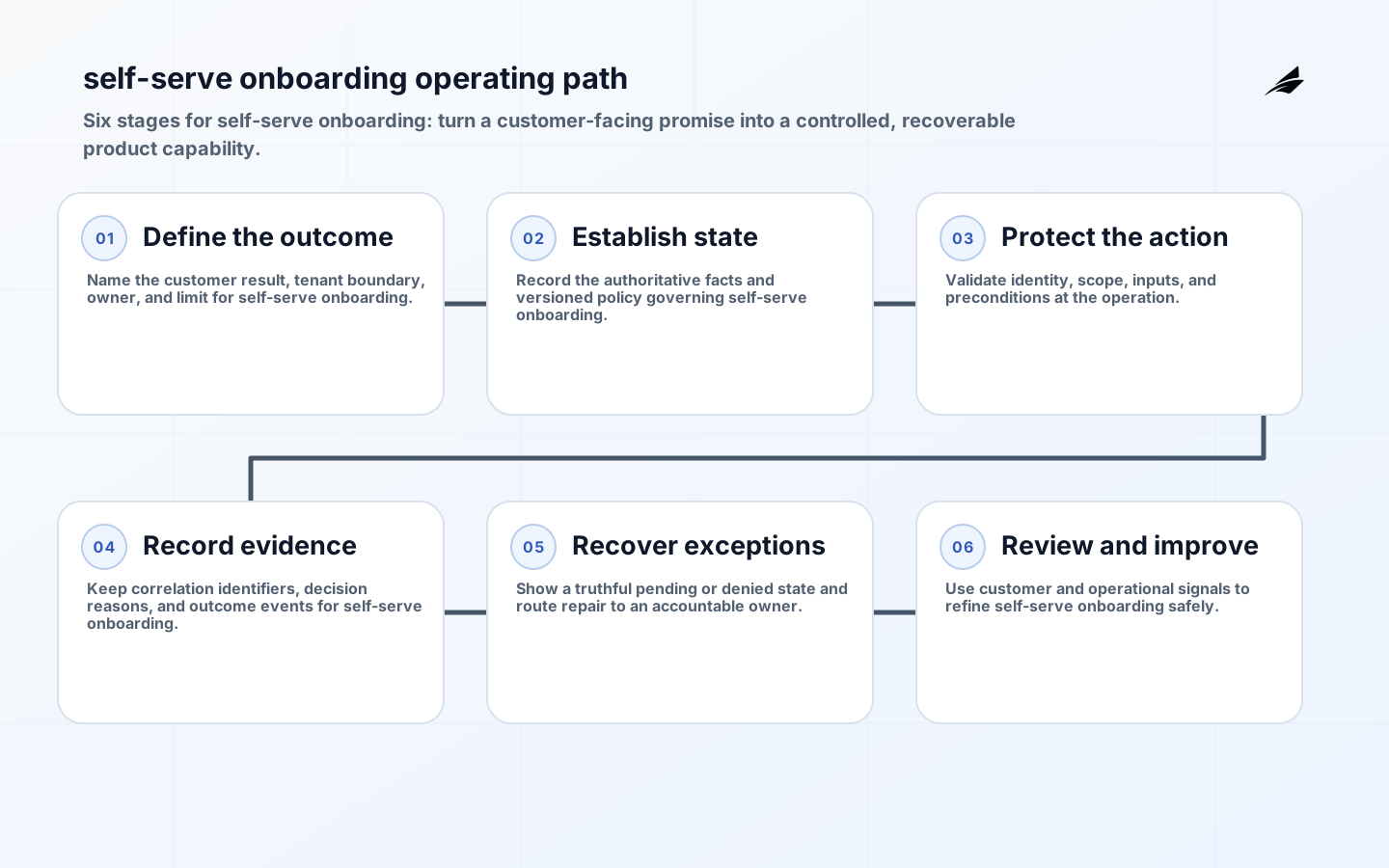
Self-serve onboarding is a product-engineering concern because it changes what customers can safely do, what teams must explain, and what evidence is available when the path fails. Self-serve onboarding is a reliable, permissioned path from signup to first value, designed for recovery when an account has missing information, the wrong role, or a real-world exception. The practical work is to define the boundary, make state authoritative, design for exceptions, and inspect the outcome after a release rather than trusting a happy-path demonstration.
Why Self-Serve Onboarding Matters
Self-serve onboarding is real only when a customer can complete intended setup without an invisible manual intervention. The product must establish a tenant boundary, verify the right person, collect necessary configuration, provision safely, and direct the workspace toward first value. AWS treats repeatable tenant onboarding as architecture because growth, security, and operations all depend on it.
The durable pattern is to translate a promised experience into explicit states and decisions. AWS Well-Architected SaaS Lens: General design principles gives domain-specific evidence, while GOV.UK Service Manual: Plan user research for your service frames the surrounding architecture and operating practice. A team does not need an oversized platform to begin; it needs a shared definition of the customer outcome and a way to demonstrate that the system produced it.
| Decision | Practical rule | Evidence to retain |
|---|---|---|
| Customer boundary | Name the tenant, actor, and scope governing self-serve onboarding. | Validated context and authorization outcome. |
| Authoritative state | Keep the server-side source of truth, not a browser assumption. | Version, source event, and transition time. |
| Exception path | State the response when a dependency or prerequisite is missing. | Reason code, owner, and recovery outcome. |
| Change control | Expose behavior gradually and make reversal possible. | Cohort, rollout decision, and audit trail. |
Design The Self-Serve Onboarding Decision
Define workspace states before designing prompts: requested, verified, provisioned, configured, active, suspended, and closed. Model membership separately. For every transition name the initiator, prerequisites, irreversible effects, timeout, and audit event. This distinguishes invitation acceptance from tenant creation and makes a failed background step resumable.
- Write a one-sentence outcome statement for self-serve onboarding that a customer and operator both recognize.
- Give each consequential transition an owner, stable identifier, and causal record.
- Make the default path safe for asynchronous work, retries, and repeated requests.
- Keep a human-readable explanation next to the machine decision so support does not guess.
Build A Safe Self-Serve Onboarding Path
Use one server-side provisioning command keyed by a stable request identifier. It creates or reconciles resources, applies baseline configuration, and emits progress events. Validate identity and authority before accepting configuration; do not place broad administration rights in emailed links. When human input is needed, state what is missing and who can provide it.

Self-serve onboarding needs security and reliability controls across the entire path, including administration and background work. Security and reliability apply to the entire path, including administration and background work. OWASP Application Security Verification Standard is a useful verification reference for controls around access, input, and logging where they apply. Fail closed or fail predictably according to the consequence of the action; a friendly message is useful only when it accurately represents a state the customer can recover from.
| Failure mode | Design response | Customer-safe result |
|---|---|---|
| Repeated request | Use a stable idempotency key and replay-safe transition. | One outcome with the same confirmation on retry. |
| Delayed dependency | Persist intent and show a pending, inspectable state. | Work is not lost and status can be refreshed. |
| Invalid scope | Validate tenant and actor at the protected operation. | Access is denied without exposing another customer's data. |
| Partial completion | Record the completed step and route a compensating action. | The customer sees the next safe action or support route. |
Operate And Measure Self-Serve Onboarding
Give operations a lifecycle view with state, latest transition, correlation identifier, owner, and safe retry or escalation action. Monitor provisioning queues, verification delivery, and abandoned steps. Treat a manual repair as an audited state transition, not a database change. Its reason is valuable evidence for simplifying the path.
Measure verified-to-provisioned time, first-value completion, retry success, manual-assistance rate, invalid invitations, and configuration failures by step. Pair completion with time and support contacts.
Release Self-Serve Onboarding With Evidence
Start with a narrow profile and observable states. Run synthetic signups and inject duplicate requests, unavailable dependencies, and expired invitations. Add a clear support handoff before expanding acquisition channels. NIST SP 800-207: Zero Trust Architecture supports the surrounding practice. Before wider exposure, exercise a meaningful unhappy path and confirm that a named person can find the event, understand the status, and take the documented recovery action.
Test Self-Serve Onboarding In Real Conditions
An onboarding exercise should deliberately interrupt provisioning after the tenant record exists but before every resource is ready. The customer should see that setup is still in progress, not a generic success page; a retry should use the same request identifier and converge on one workspace. Then test an expired invitation, a duplicate signup, and a configuration attempt by a member without authority. Operations should be able to identify the state and safely resume or escalate. These cases are productive because they expose the hidden scripts and browser assumptions that make an apparently self-serve journey depend on manual repair.
Turn the exercise into a repeatable release check for self-serve onboarding. Record the fixture, policy version, expected outcome, observed outcome, and owner for any repair. Keep customer-safe test data separate from production records, but make the sequence close enough to real work that it tests queues, permissions, integrations, and human handoffs together. When the result differs from the design, update the workflow or its documentation before broadening exposure; a known exception is useful evidence only when it changes the next decision.
There is also a governance benefit to this discipline. Self-serve onboarding decisions often cross product, engineering, support, security, and commercial responsibilities, so a narrowly defined scenario gives those groups a concrete artifact to review. It makes assumptions visible: which system is authoritative, who can override a state, how long a pending condition may last, and what communication is owed to a customer. That clarity reduces the temptation to solve a production surprise with an undocumented manual change.
Governance And Ownership For Self-Serve Onboarding
Onboarding governance begins with data minimization. Each requested field should have a purpose in provisioning, product configuration, or compliance, along with an owner and retention decision. Teams should also decide who can repair a partially created workspace and what evidence is required before changing ownership or membership. These controls protect customers and prevent operations from becoming a hidden second onboarding system. A stable policy for assisted onboarding lets the team help legitimate edge cases without weakening the standard self-serve boundary.
Make the decision record practical enough to use in normal work. For self-serve onboarding, capture the proposed change, the customer segments affected, the policy or state version, the reviewer, the intended effective time, and the evidence that will confirm or challenge the decision. Link that record to the deployment, support, and operational artifacts rather than burying it in a meeting note. This does not add bureaucracy for its own sake: it gives the person responding to a customer or incident a reliable account of why the product behaved as it did and who can make the next correction.
Ownership also improves learning after release. A weekly review can sample exceptions, unexpected outcomes, and customer questions for self-serve onboarding, then decide whether the next improvement belongs in policy, interface design, automation, documentation, training, or a deeper architectural change. Close the loop by assigning a due date and checking the outcome against the original evidence. Teams gain confidence when they can see that a small operational signal led to a specific, traceable improvement instead of being filed away as an anecdote.
Use a short operational review to keep self-serve onboarding connected to the product's actual conditions. Ask whether the customer promise still matches the enforced behavior; whether the authoritative record can be located quickly; whether the exception route has an accountable owner and expiry; and whether recent support or telemetry evidence reveals an unrepresented state. Review changes in customer segment, plan, region, integration, or role because these often create a valid new case that a narrow initial design did not cover. The outcome should be concrete: confirm the current policy, add a test case, adjust documentation, refine a control, or schedule a larger piece of work. Avoid a meeting that only restates metrics. A review is valuable when it changes a future decision and leaves evidence that the next operator can understand. That discipline turns self-serve onboarding from a one-off implementation into a maintained product capability.
Self-Serve Onboarding Takeaways
- Self-Serve Onboarding should be a product contract, not an informal convention.
- Keep authoritative state, protected operation, and customer explanation connected.
- Design retries, missing prerequisites, and partial completion as first-class states.
- Use telemetry and case evidence to improve the path after release.
Self-Serve Onboarding FAQ
Where should a team begin? Start with the journey where a poor self-serve onboarding decision creates the most customer confusion, risk, or manual repair. Define its state and evidence before expanding scope. Is a tool enough? No. A product team still owns the boundary, policy, accountable person, and recovery behavior. When is it ready? When the normal path, a meaningful failure, an audit trail, and a safe correction can all be demonstrated.
Conclusion: Make Self-Serve Onboarding Reviewable
The useful test for self-serve onboarding is simple: can a customer get a truthful answer, can an operator explain the decision, and can the team recover without improvising in production? Build the smallest path that meets that test, observe real cohorts, and refine the model as the product and its obligations grow.