Billing workflows are often introduced as a checkout screen and a provider integration. In production they govern a much larger promise: a customer should know what was purchased, the product should grant the corresponding access, finance should be able to reconcile it, and support should be able to explain a mismatch without editing a database. That promise crosses asynchronous events, retries, refunds, tax, credits, manual adjustments, and access decisions.
Why Billing Workflows Matter
The dangerous shortcut is making a single provider field directly control every premium action. Payment systems report lifecycle events asynchronously and may retry or deliver them out of order. A product also has concepts the provider does not: workspace membership, per-feature limits, grandfathered terms, customer-specific grace, and a support-approved exception. Billing data is important evidence, but it should not force every application service to become an expert in provider event semantics.
Separate commercial records from product entitlements. The billing provider remains authoritative for charges, invoices, and payment state. An entitlement component translates verified commercial events and approved changes into a product-facing record: this workspace may use capability X, up to limit Y, during window Z. Protected services then evaluate that record at the time of action. This split makes a refund, renewal, or downgrade easier to reason about and test.
Separate the Billing Responsibilities
Write a catalogue that maps plans and add-ons to observable product capabilities. Avoid labels such as 'pro' as a permission check; use versioned rules that identify the feature, limit, effective date, and source. Plan changes should produce a clear policy transition, including whether a downgrade is immediate or takes effect at renewal. A customer-facing invoice description and an internal capability rule do not need identical wording, but they must be reconcilable.
| Responsibility | Authoritative record | Why separation helps |
|---|---|---|
| Charge and invoice | Billing provider. | Keeps payment history and tax records coherent. |
| Entitlement | Product entitlement store. | Normalizes capabilities across plans and providers. |
| Authorization | Resource-owning product service. | Checks access near the consequential action. |
| Exception | Attributable override with expiry. | Lets support help without permanent drift. |
Verify event signatures before accepting provider webhooks, store the raw event ID and payload reference, and process idempotently. A duplicate renewal must not create duplicate seats. Track event ordering explicitly rather than assuming delivery order; a cancellation that arrives after a successful renewal may describe an older state. Keep enough immutable history to replay the projection after a bug fix. A ledger-like trail is more useful than a set of overwritten status fields.
Design for Asynchrony and Failure
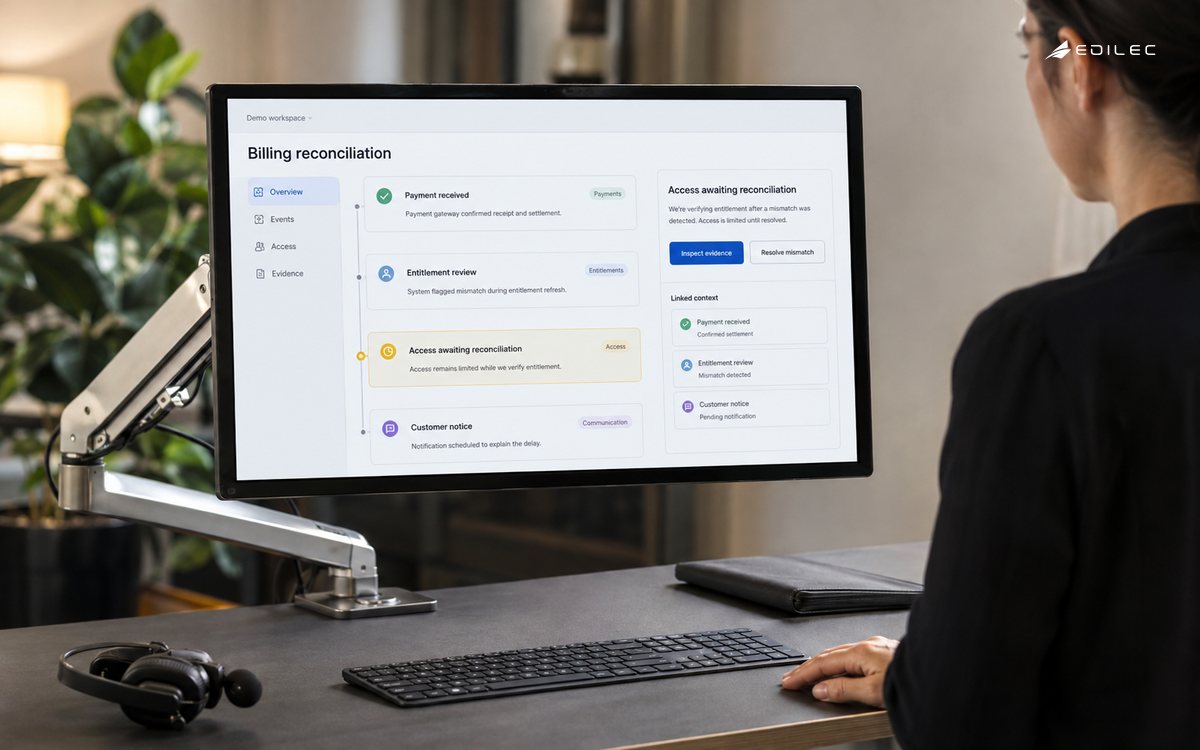
Choose the customer experience for delay before the outage happens. If a payment is confirmed but entitlement projection lags, should the product grant a short grace period, show a processing state, or deny the new capability until confirmation? There is no universal answer, but an accidental answer is hard to defend. The decision should depend on commercial risk, fraud risk, the capability's cost, and the time needed to recover the event pipeline.
Manual adjustments are part of the operating model, not evidence that the model failed. Give support a controlled tool that records the approver, reason, scope, created time, expiry, and ticket reference. It should create a separate override layer rather than editing provider-derived history. The next projection can then preserve or deliberately supersede the exception. Periodically review overrides that were renewed repeatedly; they often expose an unmodeled contract term or product gap.
Implement the Decision Path
At a protected action, evaluate identity, workspace, capability, limit, current effective time, and policy version. For a countable limit such as active seats, decide whether the operation reserves capacity atomically or merely reports usage. Sending an invitation, creating an export, and invoking a costly model can all race under concurrent requests. The response should state a customer-safe reason without revealing internal provider or policy details.
| Scenario | Expected behavior | Evidence to retain |
|---|---|---|
| Duplicate webhook | Projection is unchanged after the first event. | Event ID and idempotency outcome. |
| Downgrade at renewal | Existing use follows documented effective date. | Old and new policy versions. |
| Payment reversal | Access changes by stated reversal policy. | Provider event and entitlement transition. |
| Temporary concession | Override expires or is formally extended. | Actor, reason, and expiry. |
Run a reconciliation that compares provider subscriptions, processed events, entitlement state, and a sample of protected-action outcomes. It need not be a daily manual spreadsheet: a small report that highlights missing events, stale projections, unexpired exceptions, and quantity disagreements is enough to focus attention. Reconciliation is especially valuable after changing plans or data mappings because it catches semantic drift before it becomes a customer dispute.
Monitor Customer Impact
Track projection lag, failed signature verification, duplicate-event handling, unexpected denials after payment, access granted after cancellation, override age, and reconciliation exceptions. Pair operational metrics with support tags such as 'paid but locked out' or 'incorrect limit' so the team can see whether internal correctness matches customer experience. Alerts should identify the affected workflow and owner, not simply report that a queue is nonempty.
Example: A Seat Upgrade
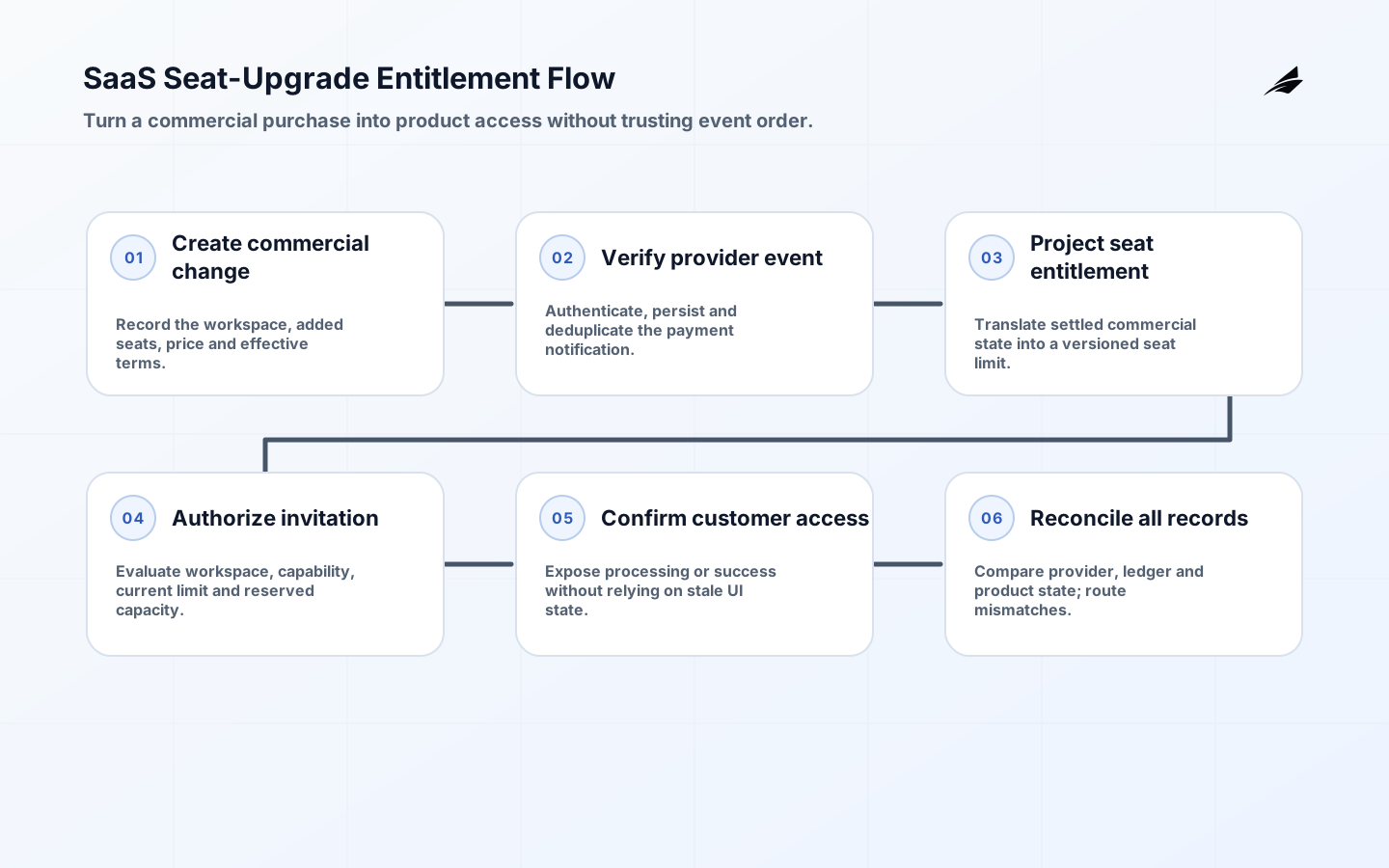
A workspace administrator buys five extra seats. Checkout creates the commercial change. A verified event is stored and projected into a new seat limit with an effective time. When a manager invites users, the membership service reserves a seat atomically and records the policy version. If the event is delayed, the interface shows the purchase as processing and support can view the exact event status. If the charge later reverses, a documented policy decides whether future invites stop immediately or at a specified date.
The billing-ready SaaS workflows guide offers a useful companion for teams defining that contract before launch. Bring finance, support, and product into the review: each group sees a different failure mode, and the workflow is only complete when they share the same source-of-truth story.
Review Commercial State
Create a small runbook for the cases that most often confuse customers: a payment that succeeded while access is pending, a cancelled plan still within a paid period, a failed renewal, a refund, a plan migration, and a support concession. For each case, show the expected provider record, entitlement result, customer message, support action, and escalation owner. A runbook becomes especially valuable during a provider incident, when improvising access changes can multiply the original problem and leave finance with unexplained differences.
Review plan changes as software changes. A new add-on can alter plan mapping, invoices, access checks, customer messaging, reporting, and support procedures at once. Test with a clean workspace and a long-lived customer with older terms. Reconcile a sample after release and watch the first renewal boundary. This reduces the common failure where the catalogue is technically updated but a legacy entitlement projector or product endpoint still applies yesterday's commercial interpretation.
Keep customer communication in the workflow rather than treating it as a separate campaign. Receipt, failed-payment, cancellation, invoice, and in-product messages should use the same effective dates and capability language as the entitlement policy. When a policy is uncertain, communicate the pending state and next check rather than a promise that may be invalidated by an event retry. This consistency gives support a dependable script and gives customers a coherent explanation across email, account pages, and protected actions.
Protect the workflow against accidental commercial changes. Separate test and production provider credentials, make webhook endpoints environment-specific, verify provider event signing, and restrict who can create manual adjustments. Build alerting around unexpected price or quantity mappings as well as technical failures. A configuration error that grants a high-cost feature widely can be as damaging as a code defect. Practice a rollback that restores the last known entitlement mapping and identifies affected workspaces, rather than relying on an emergency database edit.
Decide what evidence an auditor, finance colleague, or customer-success lead needs to answer a basic question six months later: why did this workspace have this access on this date? Preserve the plan terms, relevant provider event, processed timestamp, entitlement version, protected-action decision, and any approved override. These records need retention and access rules, but they should remain linkable by safe identifiers. Reconstructing a commercial decision from screenshots and memory is slow, error-prone, and unfair to both the customer and the staff asked to resolve it.
Assign an owner to the reconciliation queue and agree on a service level for investigating differences. A report that simply lists mismatches becomes background noise; a queue with a responsible team, severity rules, and closure evidence becomes a control. Review recurring causes monthly and use them to improve mappings, tests, customer communication, or the entitlement model.
Key Takeaways
- Keep charges, entitlements, and protected-action authorization separate.
- Process signed billing events idempotently and retain replayable history.
- Make delay, reversal, downgrade, and override behavior explicit.
- Reconcile commercial events with the access customers actually receive.
Frequently Asked Questions
Should a payment webhook immediately change every product screen? It can update product state quickly, but server-side entitlement remains the dependable access decision. User-interface state may lag briefly and should communicate that honestly. How long should a grace period be? Set it by capability risk and recovery expectations, then document and test it. A grace period should be a deliberate product rule, not an unbounded cache.
Conclusion
Dependable billing workflows make commercial change legible to both people and systems. A customer gets predictable access, finance gets reconcilable records, support gets a safe recovery path, and engineers get a bounded policy contract. That is a much stronger foundation than treating checkout success as the end of the workflow.
Sources
Check provider-specific behavior against Stripe Billing and Stripe webhooks, then apply verification practices from the OWASP ASVS and access-control principles from NIST SP 800-207.