The Plain-language Guide to Usage Reporting
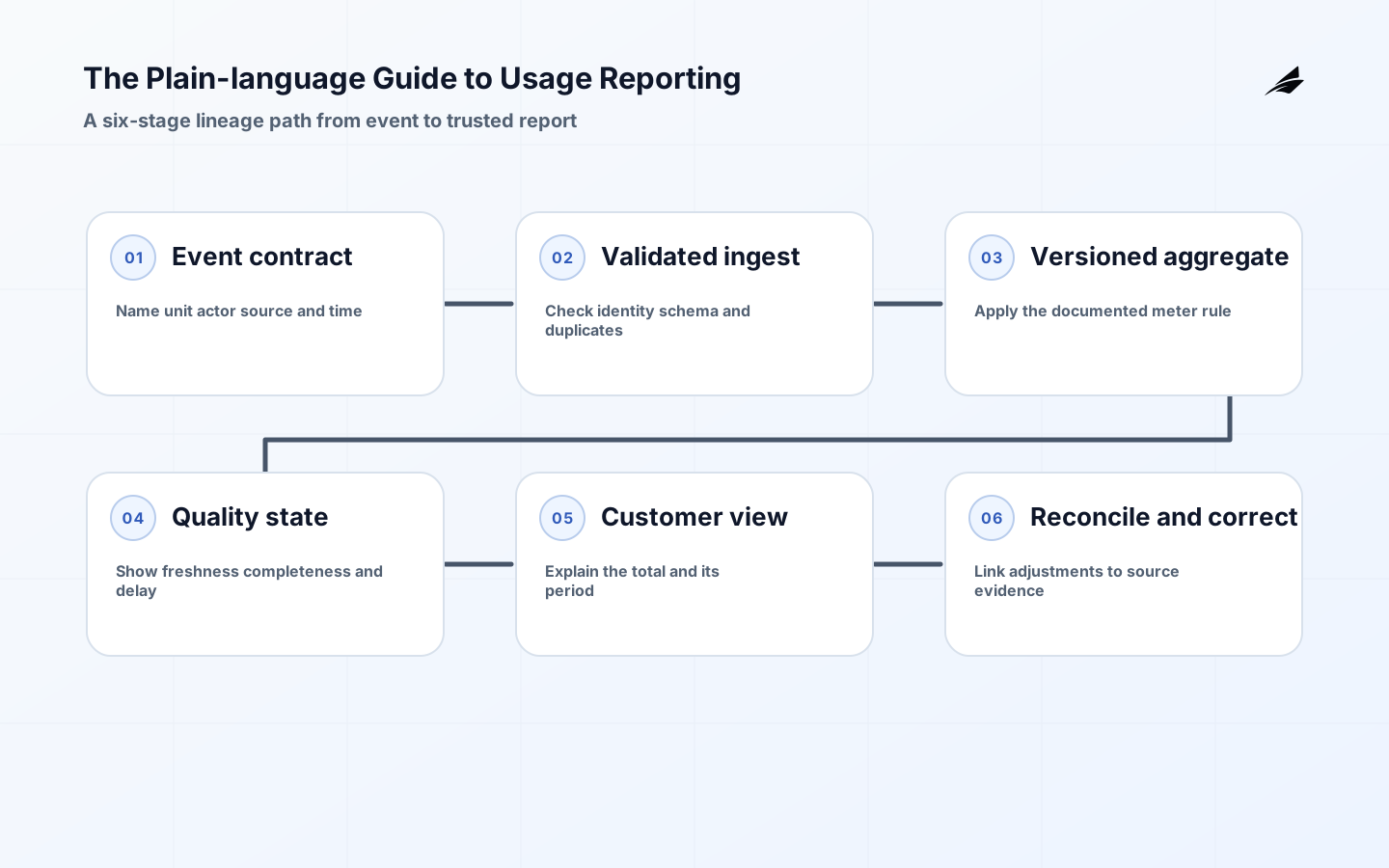
Usage reporting is where a product explains consumption to customers, operators, and sometimes a billing system. That explanation must be consistent enough for a customer to plan, a support team to investigate, and finance to reconcile. A counter on a dashboard is not automatically a meter. Define the unit, event boundary, aggregation period, account or tenant scope, inclusion rules, and freshness expectation before the number influences a limit or invoice. Different views may use different cutoffs, but they should say so. The report becomes trustworthy when the team can trace a displayed total back to identifiable source events and explain known gaps without improvisation.
Define the usage reporting boundary
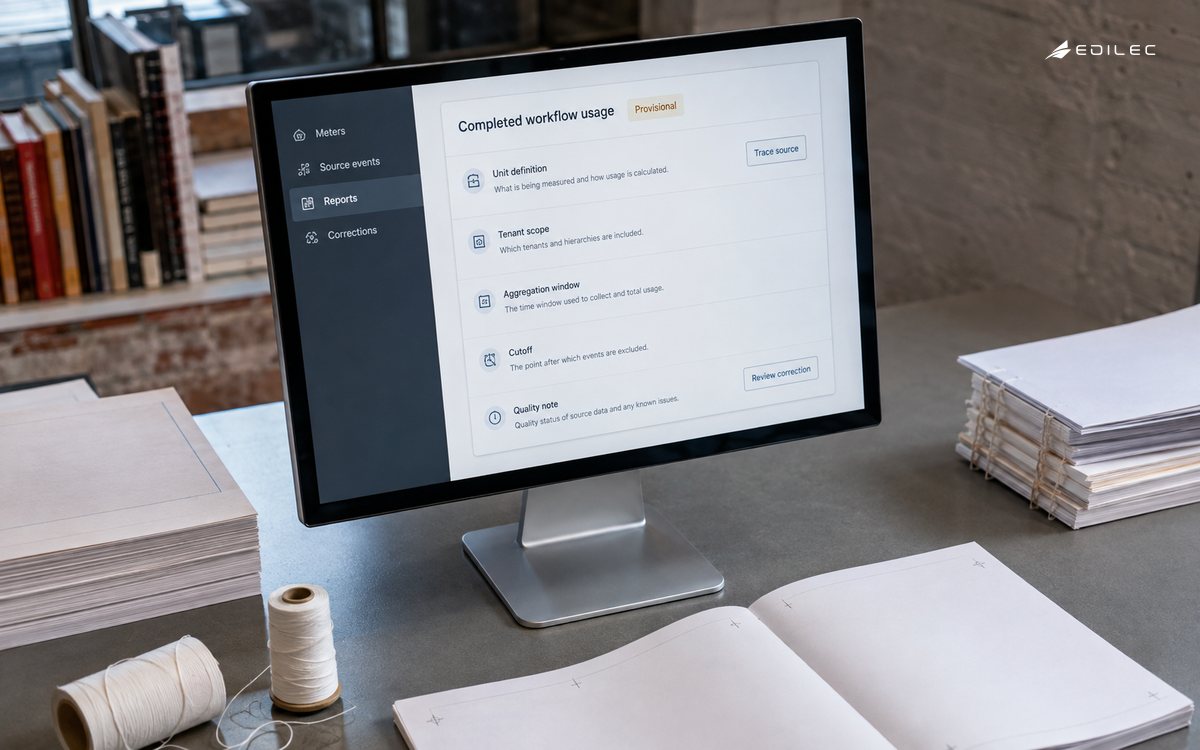
Choose the business meaning of a unit first. An API request, active seat, byte stored, completed workflow, or compute second each needs a distinct rule for when it counts and who owns the source. Decide whether failed, retried, internal, or test activity is included; whether a late event amends a closed period; and how events are associated when an account changes plan or workspace. Do not derive a customer bill from an operational chart that was designed for rough capacity estimation. Give each published view a period, cutoff, version, and quality status so it does not pretend that provisional data is final. This boundary also clarifies which disputes need an adjustment and which require a telemetry fix.
| Decision area | Question to settle | Evidence to retain |
|---|---|---|
| Authoritative records | Which meter definition, raw usage event, aggregation window, account context, quality status, and published report version establish the current state? | Source, steward, effective time, and correction path. |
| Protected actions | Who may perform emit, ingest, deduplicate, aggregate, publish, reconcile, and correct? | Policy version, actor, target, and decision result. |
| Exception route | When may the normal rule be bypassed? | Named approver, reason, compensating control, and expiry. |
| Recovery | How is a wrong or incomplete result corrected? | Runbook, owner, verification signal, and review date. |
Model usage reporting as accountable decisions
Use immutable source events with stable identifiers, event time and ingestion time, account context, meter version, and enough attributes to apply the documented rule. Separate collection from aggregation so a reporting logic change can be evaluated without rewriting source history. OpenTelemetry is useful for consistent service telemetry and context, although product meters need their own commercial definitions. PROV-DM gives a helpful way to describe how a total was generated from events and activities. Preserve that lineage for customer-visible or billable reports; it makes a support investigation about a sample and rule version instead of a broad search through logs.
- Give each consequential usage reporting decision a business owner and a technical owner.
- Keep source facts, derived state, and human overrides distinguishable in records and logs.
- Version rules and interfaces so a disputed result can be reproduced for the relevant time.
- Limit sensitive context to the roles and services that need it, then test denied paths deliberately.
- Use source-to-report latency, duplicate rejection, late events, reconciliation difference, and customer dispute rate as operating signals, not as a substitute for reviewing representative cases.
Build and test the first usage reporting path
Release one meter through the full path: produce an event, validate schema and identity, store it durably, aggregate a short window, present a customer view, and reconcile a sample against the source. Test duplicates, late arrival, a failed ingestion batch, account transfer, time-zone boundary, and a correction. Decide what the customer sees during a delay. A blank chart or a silently low total can be more misleading than a clear provisional status. Give support a drill-down that is appropriately scoped and can show event count, cutoff, and quality state without exposing unrelated customer data. Keep billing consumption decoupled until the meter has passed the required reconciliation standard.
| Release step | What to exercise | Exit evidence |
|---|---|---|
| Representative input | Use ordinary and adverse examples involving meter definition, raw usage event, aggregation window, account context, quality status, and published report version. | Expected result and owner-reviewed test record. |
| Dependency behavior | Simulate delay, retry, duplicate delivery, or unavailable context for emit, ingest, deduplicate, aggregate, publish, reconcile, and correct. | Visible state, containment choice, and recovery action. |
| Permission boundary | Attempt the action with an authorized, unauthorized, and recently changed actor. | Server-side decision and audit event match expectations. |
| Operational handoff | Ask a second operator to investigate a realistic failure without private context. | Runbook works, escalation is reachable, and status is explainable. |
Run a Usage Reporting operating review
Before expanding usage reporting, convene the business owner, engineering owner, support representative, and source-record owner. Walk one routine case and one disputed case from meter definition and raw event through aggregation, publication, reconciliation, and correction. For each result, record the authoritative source, effective time, quality status, and report version so the customer-facing total can be explained.
Measure usage reporting with context
Monitor source-to-report latency, duplicate rejection, event-schema failures, late-arrival distribution, reconciliation difference, report freshness, and customer disputes. The W3C Data Quality Vocabulary can help teams name quality measurements and conditions consistently. Review totals at the same grain at which decisions are made: a monthly aggregate might look fine while a daily entitlement gate has a gap. Publish quality metadata next to the number and alert an owner when the agreed freshness or completeness threshold is breached. That operational transparency prevents a dashboard consumer from treating a data-pipeline incident as a sudden behavioral change.
Control Usage Reporting failure modes
Usage systems fail at time and identity boundaries. Events may be repeated after a retry, arrive after a period closes, lose account context in a queue, or be aggregated under a changed meter rule. Use deterministic event IDs, explicit watermarks, a dead-letter process that preserves context, and versioned aggregation. RFC 9110 informs which delivery operations should tolerate retry, but idempotent ingestion remains an application responsibility. When a defect affects published usage, identify the window and customers, preserve the old report version, rerun the corrected logic, and communicate whether access or billing requires an adjustment.
Usage Reporting: Use the underlying references
This guide is grounded in OpenTelemetry Specification, PROV-DM: The PROV Data Model, Data Quality Vocabulary, RFC 9110: HTTP Semantics.
Usage-reporting review should compare a published total with the records that produced it at more than one grain. Trace a single customer day, a customer billing period, and a system-wide interval through collection, validation, aggregation, and display. Note the cutoff and data-quality status at each view. Then inject a late event and a duplicate event to verify that the report changes, or does not change, according to its written rule. This makes the important trade-off explicit: a near-real-time estimate may be valuable for customer planning, while a settled financial total needs stronger completeness and reconciliation checks. Keep both views honest about their purpose. When teams collapse them into one counter, customers and operators inherit uncertainty that the software could have explained.
Key takeaways
- Usage reporting works best when its decision boundary and record authority are explicit.
- Design corrections as visible, attributable actions rather than silent edits to a current-state field.
- Pilot one consequential path with normal, adverse, and recovery cases before expanding scope.
- Review operational signals alongside examples, because aggregate numbers can hide a broken boundary.
Usage reporting: Usage Reporting: Usage Reporting FAQ — guide to usage reporting workflow
Can one event feed product analytics and billing? It can, but the two consumers may use different validation, timing, retention, and correction rules. Keep those distinctions explicit. When is a usage number final? When the agreed cutoff, completeness checks, and reconciliation rules have passed; until then it should be labeled provisional where that matters. How much detail should customers see? Enough to understand the meter and challenge a total, without exposing internal topology or other customers' data. A downloadable audit view should be scoped, rate-limited, and protected like other account data.
A durable operating note for the plain-language guide to usage reporting records the assumptions that made the decision safe: the authoritative source, effective time, permitted actor, protected resource, and recovery route.
For the plain-language guide to usage reporting, a good handoff ends with observable evidence rather than a verbal promise.
The smallest useful improvement to the plain-language guide to usage reporting is often a sharper boundary, not another feature. Test usage reporting with normal, delayed, denied, and corrected workflow cases.
For Usage Reporting, Create and configure a meter defines scope; Analyze and query meter usage supports the control.
During normal handling, retain the meter definition, source event, aggregation window, and report version that support each published usage total.
Control usage reporting by validating meter inputs, enforcing account scope, deduplicating events, and labeling totals provisional until completeness and reconciliation checks pass.
For recovery, preserve the original usage events and processing attempts, route late or disputed records to an owner, and reconcile corrected totals before changing an invoice or customer-visible report.
Compare a normal usage total with a changed meter permission or account boundary. Confirm that authorization, event provenance, aggregation result, and customer-visible explanation remain aligned.
When a usage event is late, duplicated, incomplete, or disputed, keep the affected total provisional, record the source state, and assign an owner for reconciliation. Base the next review action on the evidence and preserve the reason for any correction rather than overwriting the original history.
Rehearse a recovery drill in which an event arrives late or a corrected meter total must be published. Verify idempotent processing, report versioning, customer communication, and reconciliation ownership.
Run a support review against a normal and corrected usage report. Confirm that the operator can trace the meter definition, source event, adjustment reason, and final published total without editing the original history.
Conclusion
Trustworthy usage reporting joins a clear meter definition to verifiable source events and candid quality status. It supports billing workflows, product analytics, and pricing gates.
Make usage reporting a data contract
Usage reporting needs a definition that survives three audiences: a customer deciding what they consumed, finance preparing an invoice, and an operator explaining a discrepancy. Start with an event name, actor or customer identifier, unit, timestamp policy, source system, and correction rule. Stripe’s usage-based billing lifecycle separates ingestion, catalog setup, billing, and monitoring; that separation is a useful design boundary even when your product uses another provider. Do not publish a number until its population, period, and freshness are clear.
| Reporting question | Design choice | Correction path |
|---|---|---|
| What counts? | Named event and aggregation rule | Reject or quarantine malformed event |
| Which period? | Timezone, cutoff, and late-arrival policy | Recalculate with a recorded version |
| Who owns it? | Customer, billing, and support owner | Route dispute with source evidence |
| Can it change? | Immutable event plus adjustment record | Link adjustment to original event |
A practical implementation keeps raw events, normalized usage, and customer-facing summaries distinct. Raw events preserve what the producing system emitted; normalized records apply validation and identity mapping; summaries answer a product or billing question. Keep an idempotency key or durable event identifier so retries do not inflate totals. If a number is estimated, label it as estimated and show when it will be reconciled. A polished a chart that hides lateness can create more support work than a plain table that tells the truth.
Review usage at the edges
Inspect zero-usage accounts, unusually large jumps, late events, duplicate identifiers, and customers whose dashboard total differs from the invoice input. The OpenTelemetry observability primer supports separating metrics for aggregate movement from traces and logs for a particular ingestion path. This makes a dispute actionable: the team can identify whether the issue began at event creation, transport, normalization, aggregation, or presentation.
Give support a correction workflow that does not overwrite history. A support person should be able to see the source event, normalized record, summary version, and permitted adjustment. Require a reason, scope, approver where needed, and expiry for exceptional changes. Review adjustment volume as a product signal: repeated corrections often mean the unit definition or source integration is wrong, not that support needs a faster button.
Questions to settle before launch
Ask whether a customer can reproduce the number from a documented event definition, whether finance can explain the billing period, and whether an operator can identify a late or duplicate input. If any answer depends on private knowledge, the usage reporting contract is incomplete. The first release should support a small number of well-defined metrics and an honest pending state before adding every possible dimension.
Evidence for “The Plain-language Guide to Usage Reporting” is grounded in How usage-based billing works, Create and configure a meter, Analyze and query meter usage, Observability primer; each source informs a specific decision, test, or operating trade-off described in this guide.