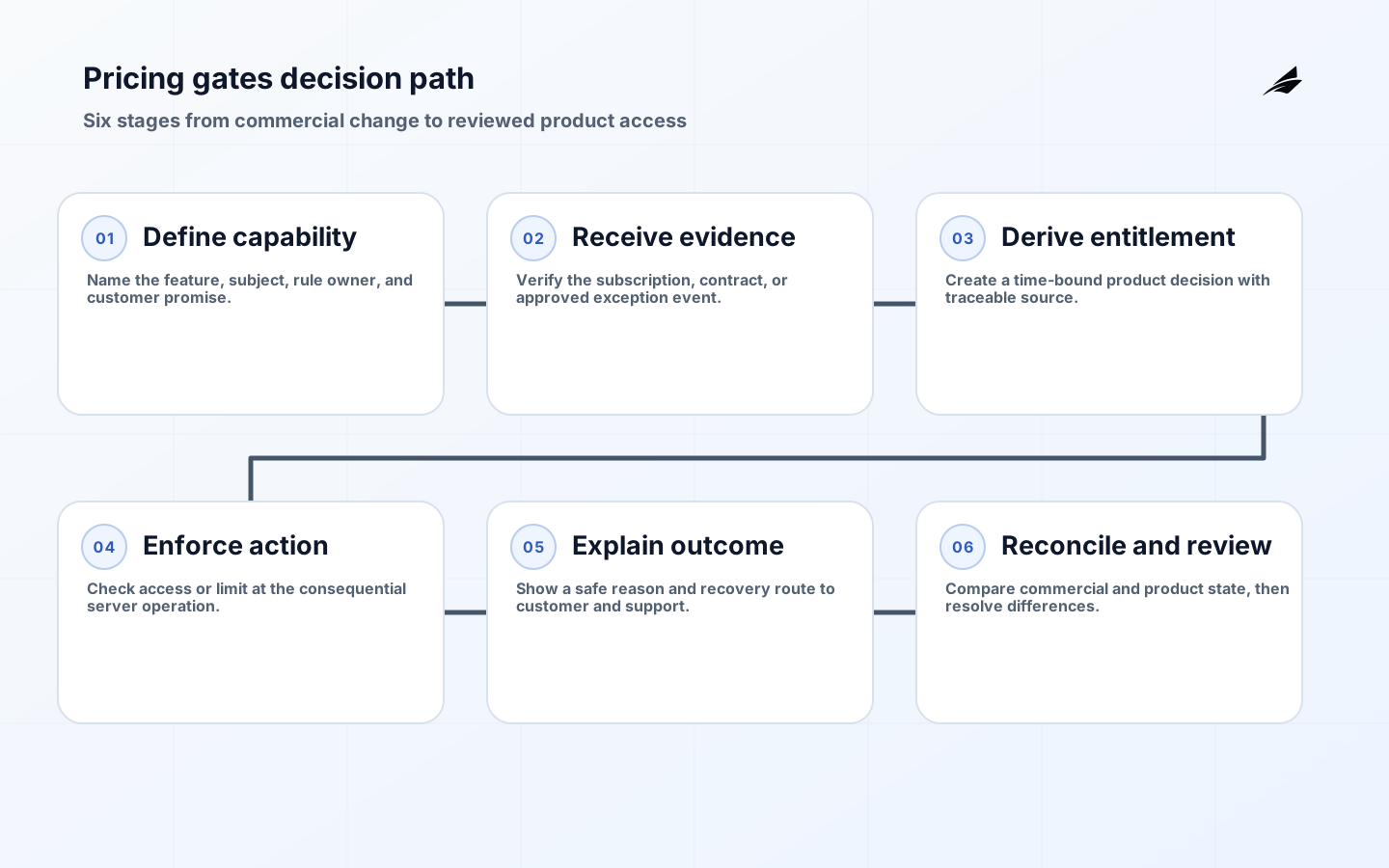
Pricing gates are the rules that decide whether a person, workspace, or machine may use a product capability at a particular moment. The phrase sounds commercial, but the implementation belongs squarely in product engineering. A gate may depend on plan, contract term, seat count, region, trial status, payment state, administrator choice, or a negotiated exception. If those facts live only in a checkout page or a sales spreadsheet, the product will eventually show the wrong control, allow access after a cancellation, or block a customer who has paid. Start by treating a pricing gate as a decision with inputs, an owner, an observable result, and a recovery path. That framing keeps the interface, billing connector, authorization layer, and support process aligned when a customer’s commercial state changes.
Model the commercial decision before building pricing gates
Write down the decision in plain language: “This workspace may create more than five active projects while its contracted entitlement includes the portfolio feature.” Then separate product facts from presentation. A button can be hidden for clarity, but hiding it is not enforcement; the API, background job, export, and integration must all reach the same decision. Define an entitlement record with a stable subject identifier, feature key, state, effective time, source event, and expiry or review rule. For metered limits, decide whether the check is synchronous, approximate, or reconciled later. A quota that is calculated from stale analytics data should not silently become a hard denial. The SaaS product development implementation guide is a useful companion when this decision needs to be made part of a broader delivery plan.
| Decision element | Useful implementation question | Failure to prevent |
|---|---|---|
| Subject | Is access attached to a user, workspace, account, or resource? | Granting a former employee a workspace entitlement. |
| Feature | Does one stable key describe the capability across UI and API? | Different names producing different checks. |
| Effective time | When does the change begin and end? | A scheduled downgrade taking effect immediately. |
| Evidence | Which event or approved override produced the state? | Support staff guessing why access changed. |
Connect billing events to entitlements, not directly to screens
Payment providers expose a lifecycle, not a single “paid” truth. For example, a subscription can be trialing, incomplete, active, past due, unpaid, paused, or canceled, and asynchronous payment methods can change the timing of a usable state. Build an adapter that receives verified provider events, records them idempotently, and translates them into your product’s small entitlement vocabulary. Do not let a webhook handler rewrite authorization tables with no audit record. Persist the provider event identifier, received time, parsed version, resulting decision, and any retry outcome. The application should read the derived entitlement rather than repeatedly querying the payment provider during a customer request. That reduces latency and isolates provider outages, while a reconciliation job compares the derived record with the commercial source of truth. An override should be explicit, time-bounded, and visible to finance and support; it is a business decision, not a hidden database edit.
Choose an enforcement point for each kind of limit
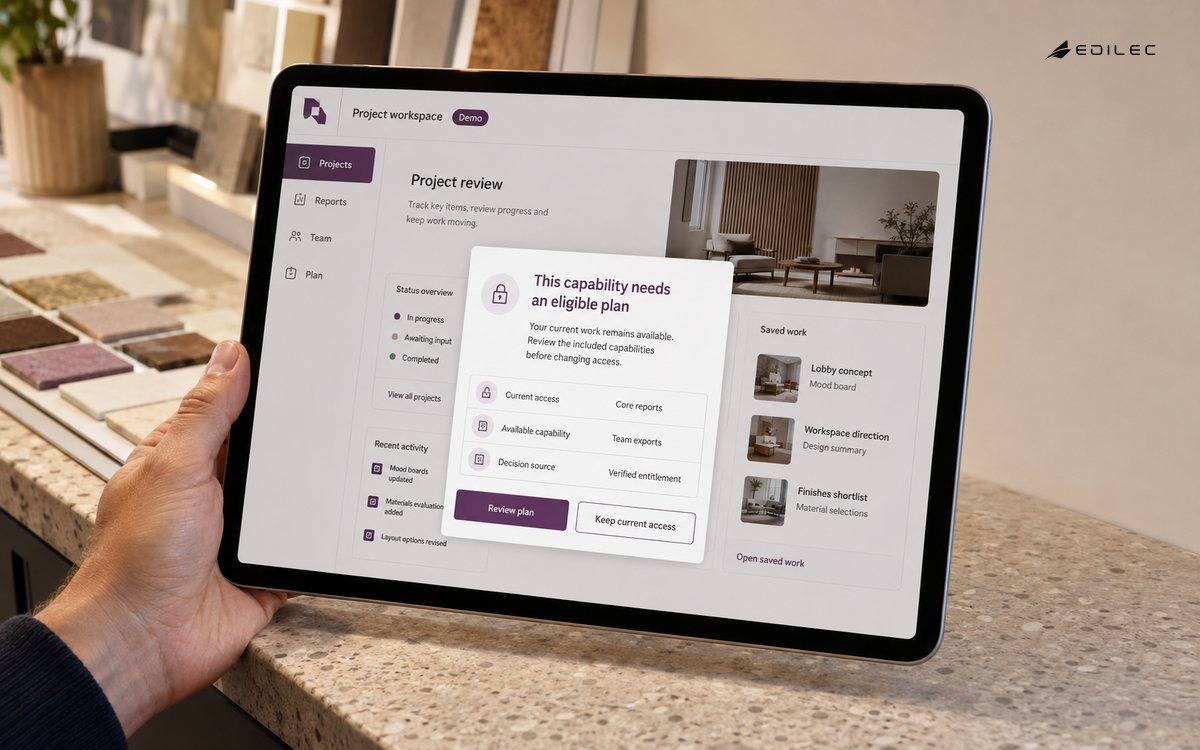
Feature flags, authorization policies, quotas, and upgrade prompts solve different problems. A feature flag is excellent for controlled rollout but is a poor permanent substitute for a contractual gate because it often lacks entitlement evidence and customer-facing explanations. Authorization answers whether a caller may act on a resource; it should consume the feature decision where relevant. A quota answers whether a workspace may create, store, send, or process more of something. The upgrade prompt is only the explanation and path forward. Put the irreversible check next to the irreversible operation: before creating a sixth project, issuing a high-volume export, or starting a billable compute job. Return a structured reason such as plan_limit_reached so the interface can explain the outcome accessibly and support can diagnose it. Never rely on a client-side counter for a paid limit.
| Gate type | Best location | Example |
|---|---|---|
| Feature access | Server authorization policy | Export requires the reporting entitlement. |
| Creation limit | Transactional write path | New project checks the workspace count before commit. |
| Usage allowance | Usage ledger plus periodic reconciliation | Monthly processing units are reserved then settled. |
| Contract exception | Entitlement service with expiry | A migration grace period ends on an agreed date. |
Design pricing gates for changes, disputes, and support
The difficult cases arrive after launch: a renewal is delayed, a reseller changes the package, an administrator buys seats in another system, or a customer disputes a limit that was calculated from a deleted resource. Give support a tenant-scoped explanation view rather than database access. It should show the current entitlement, source event, effective dates, usage calculation, recent decisions, and any approved override. Give customers a clear message that identifies the affected capability and the action available to them, without exposing another customer’s data or internal billing detail. Accessibility matters here too: an upgrade path must be keyboard-operable, named clearly, and not depend solely on color or a tooltip. Test the system with retries, out-of-order events, duplicate events, scheduled changes, and a provider outage. The point is not perfect synchronization; it is a safe and explainable outcome while synchronization catches up.
Measure whether the pricing model works in the product
Track outcomes that reveal a broken contract between product and commerce. Useful signals include denied requests by reason, entitlement propagation delay, overrides created and expired, webhook retries, reconciliation differences, support contacts after a denial, and upgrade completion after a limit message. Segment carefully: a spike in denials can mean healthy adoption of a limit, a packaging mistake, or an event-processing incident. Review a small sample of decisions with product, support, and finance each month. Compare the displayed plan, the entitlement record, the provider status, and the operation log. This makes packaging changes testable rather than mystical. Before a large price migration, simulate representative accounts and publish the expected feature differences for support staff. Teams can use the implementation readiness checklist to make those operational checks visible before release.
- Give every commercial capability a stable feature key and documented owner.
- Derive entitlements from verified events and retain the decision evidence.
- Enforce limits on the server where the irreversible action occurs.
- Expose a tenant-scoped explanation and an expiry-controlled override route.
- Monitor propagation, denials, reconciliation, and customer recovery outcomes.
Test pricing gates with lifecycle scenarios
Create a fixture set that represents the commercial situations the product must handle: a new trial, an active annual account, a scheduled upgrade, a failed renewal, a manual credit, a seat reduction, and a terminated customer returning after a gap. For each fixture, test the interface, direct API, integration, background job, export, and audit log. Verify both permission and explanation. The test should prove not only that the right request is denied, but that the returned reason is suitable for the customer and does not leak commercial information from another account. Include time boundaries by advancing a controlled clock around start and expiry. When the billing provider replays an event or delivers it out of order, assert that the entitlement reaches the expected final state rather than the state of the last message received.
Release changes to gates in a controlled way. Version the feature keys and decision rules, keep a migration record, and calculate the proposed decision for affected accounts before changing enforcement. That dry run is where product and finance can find an unintended downgrade or a contract exception that has never been codified. During rollout, compare expected and actual denials, watch for a rise in override requests, and give support a named escalation route. A rollback should restore the prior decision rule without losing the evidence that a customer was evaluated under the newer one. This care is especially important when packaging is changed by a non-engineering team: commercial flexibility is healthy, but it needs a dependable route into the product.
Treat new packaging as a product change with a written acceptance test. Before launch, product should describe the customer-visible capability, finance should confirm the commercial rule, engineering should identify the source events and enforcement points, and support should approve the explanation for denials and exceptions. Run an account-impact report that names every customer whose current capability would differ under the new rule, then resolve the unexpected cases before the rule becomes live. This is also the right moment to settle wording around grandfathering, temporary credits, and sales commitments. The visible price is only part of the release; the access decision customers experience is the rest of it. A lightweight cross-functional review protects both the customer relationship and the engineering team from being asked to reverse a silent commercial change after it has caused a denial.
Key takeaways
- Pricing gates are product decisions, not just pricing-page copy.
- Billing state and product access need an explicit translation layer.
- A hidden control is never the only enforcement mechanism.
- Support needs evidence and bounded exceptions, not broad data access.
- Measure the customer outcome after a denial or upgrade prompt.
Frequently asked questions
Can feature flags replace pricing gates?
No. Flags are valuable for rollout and experimentation, but a commercial entitlement needs a stable subject, source, effective time, explanation, and review path. A flag may be one input to the decision; it should not be the only commercial record.
Should a product block the moment a customer exceeds a limit?
Only when the contract and risk require it. Some limits need a hard transactional check, while others can allow a grace period, an alert, or later settlement. State that policy plainly and make the resulting behavior consistent across API, interface, and support.
Conclusion: make commercial access explainable
Well-designed pricing gates make packaging credible because the customer, product, and operating team see the same decision. Model the entitlement, translate verified commercial events, enforce close to the consequential action, and preserve an explanation for every exception. The result is not merely fewer billing tickets; it is a product that can change plans and grow without turning ordinary commercial events into access incidents.