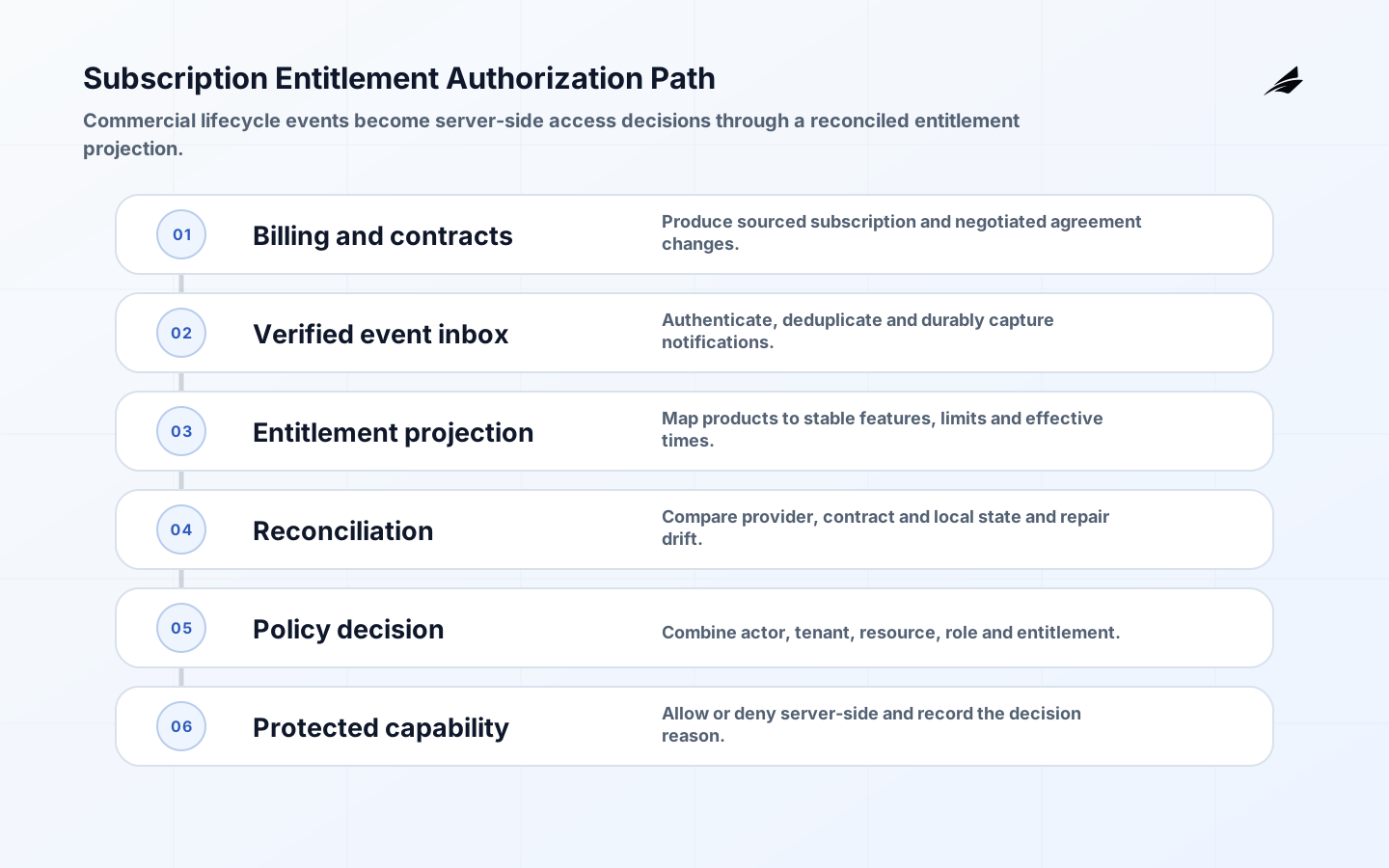
Subscription access control translates a commercial agreement into permission to use product capabilities. Billing state is an input, not the authorization decision itself: invoices, trials, grace periods, negotiated features, user roles and tenant relationships can change asynchronously. A sound architecture creates a stable entitlement model, processes verified provider events idempotently, evaluates access on the server, and reconciles local state when messages arrive late or out of order.
This guide treats subscription access control architecture: entitlements, events and safe provisioning as a set of decisions that can be reviewed and tested. The aim is not to prescribe one vendor or promise a universal result. It is to help business and technical owners define boundaries, preserve evidence, expose failure behavior and decide when the work is ready to expand.
Separate identity, subscription, entitlement and authorization
Identity establishes who or what is making a request. A subscription records a commercial lifecycle. An entitlement states that a customer organization may use a named capability, and authorization decides whether this actor may perform this action on this resource now.
Model these concepts separately so a paid customer does not automatically make every member an administrator. Preserve tenant membership, roles, resource relationships, feature grants and policy conditions as distinct inputs.
| Concept | Authoritative question | Example |
|---|---|---|
| Identity | Who is the actor? | Authenticated user or service principal |
| Tenant membership | Which customer context may the actor use? | User belongs to organization A |
| Subscription | What commercial lifecycle exists? | Active annual agreement |
| Entitlement | Which capability does the customer receive? | Advanced exports enabled |
| Authorization | May this actor do this action now? | Analyst can export organization A report |
Use decision examples for active, trialing, past-due, cancelled, scheduled downgrade and complimentary access. Review both customer-level grants and user-level restrictions.
Turn "Separate identity, subscription, entitlement and authorization" into a working control by naming one accountable owner, one maintained artifact and one review forum. The exit standard for this part of subscription access control architecture: entitlements, events and safe provisioning is concrete: Use decision examples for active, trialing, past-due, cancelled, scheduled downgrade and complimentary access. Review both customer-level grants and user-level restrictions. For this control, name the accountable owner, supporting evidence, exception route, and next measurable check.
Create a stable product entitlement vocabulary
Give each feature a durable internal key independent of display names and price IDs. Map products and negotiated agreements to features, limits or service levels, with effective times and provenance.
Store active entitlements locally for fast, resilient decisions, but preserve the provider or contract source and last synchronization state. Define precedence when billing, support grants and enterprise agreements disagree.
Version mapping changes and test upgrades, downgrades, add-ons, grandfathering and plan removal. A pricing redesign should not require authorization logic scattered across application code.
Turn "Create a stable product entitlement vocabulary" into a working control by naming one accountable owner, one maintained artifact and one review forum. The exit standard for this part of subscription access control architecture: entitlements, events and safe provisioning is concrete: Version mapping changes and test upgrades, downgrades, add-ons, grandfathering and plan removal. A pricing redesign should not require authorization logic scattered across application code. Within this part of the system, name the accountable owner, supporting evidence, exception route, and next measurable check.
Process subscription events as untrusted asynchronous input
Verify signatures using the provider’s documented method, retain event identity, and make handling idempotent. Events can be duplicated, delayed or delivered out of order, so compare object versions or retrieve current state where appropriate.
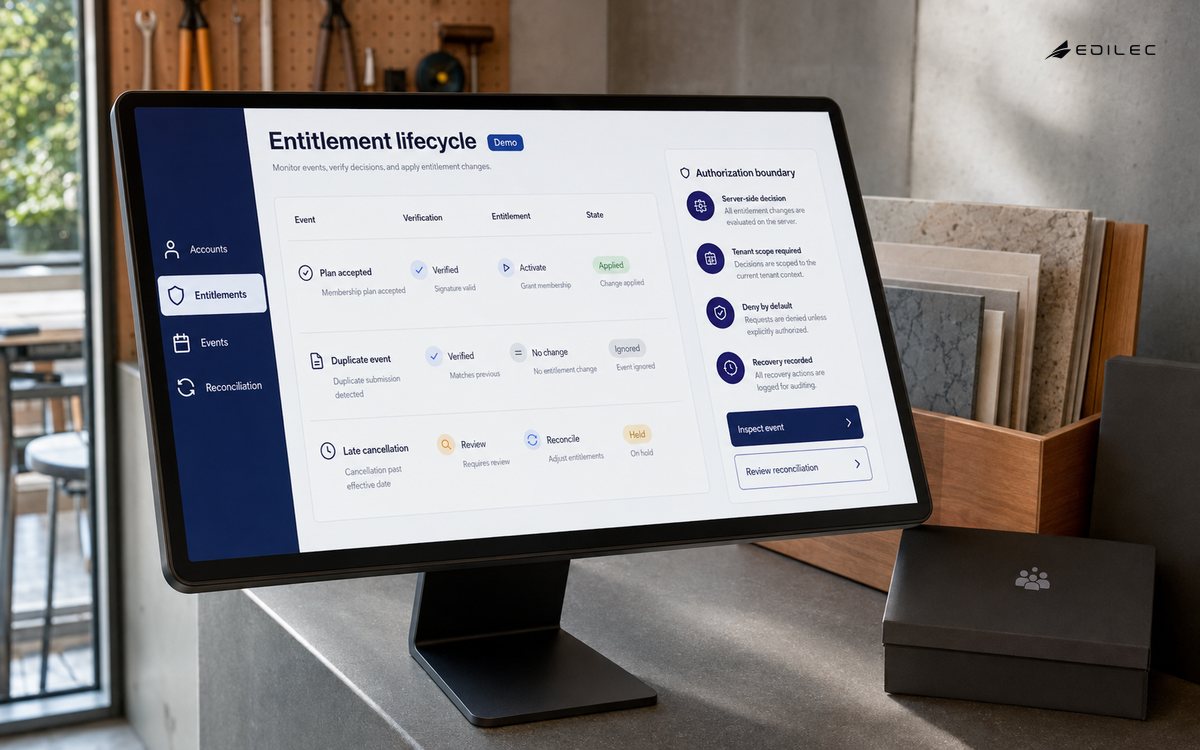
Acknowledge receipt only after durable capture, then update entitlement projections in a retryable worker. Keep a dead-letter or review path and avoid granting access from browser redirects or client assertions.
Turn "Process subscription events as untrusted asynchronous input" into a working control by naming one accountable owner, one maintained artifact and one review forum. The exit standard for this part of subscription access control architecture: entitlements, events and safe provisioning is concrete: Test duplicate events, old events after new ones, unavailable provider APIs, secret rotation and handler restart. The same event replay should produce the same final projection. When implementing this part of the system, name the accountable owner, supporting evidence, exception route, and next measurable check.
Enforce authorization on every protected request
Resolve trusted tenant context and authenticated actor, load current local entitlements, evaluate role and resource relationship, then apply feature limits. Deny by default when required inputs are absent or ambiguous.
Keep checks in shared server-side policy boundaries close to resource access. The UI may hide unavailable actions for clarity, but client behavior never substitutes for API authorization.
Create unit tests for policy combinations and integration tests that attempt cross-tenant IDs, direct API calls, stale tokens and guessed resources. Log decision reason without exposing sensitive policy internals.
Turn "Enforce authorization on every protected request" into a working control by naming one accountable owner, one maintained artifact and one review forum. The exit standard for this part of subscription access control architecture: entitlements, events and safe provisioning is concrete: Create unit tests for policy combinations and integration tests that attempt cross-tenant IDs, direct API calls, stale tokens and guessed resources. Log decision reason without exposing sensitive policy internals. Before releasing this part of the system, name the accountable owner, supporting evidence, exception route, and next measurable check.
Design upgrades, downgrades and payment failure behavior
Product policy must define when new features appear, how scheduled changes take effect, what happens to over-limit data, and whether a payment problem begins a grace period. Engineering should implement that policy, not invent it from event names.
Prefer reversible restriction over destructive deletion. Preserve customer data according to contract and retention policy, communicate impending changes, and keep administrative remediation distinct from ordinary user permissions.
Simulate every lifecycle transition with timestamps and existing data. Verify access, background jobs, exports, APIs and cached decisions, not only navigation elements.
Turn "Design upgrades, downgrades and payment failure behavior" into a working control by naming one accountable owner, one maintained artifact and one review forum. The exit standard for this part of subscription access control architecture: entitlements, events and safe provisioning is concrete: Simulate every lifecycle transition with timestamps and existing data. Verify access, background jobs, exports, APIs and cached decisions, not only navigation elements. While operating this design choice, name the accountable owner, supporting evidence, exception route, and next measurable check.
| Lifecycle event | Access policy decision | Data treatment |
|---|---|---|
| Trial begins | Grant trial feature set at effective time | Mark provenance and expiry |
| Upgrade | Add mapped entitlements after confirmed state | Preserve existing records |
| Scheduled downgrade | Communicate and apply at policy date | Keep over-limit data non-destructively |
| Payment failure | Apply documented grace or restriction | Retain according to contract |
| Cancellation | Revoke at agreed effective time | Offer governed export and retention path |
Reconcile local entitlements with the system of record
Webhooks provide timely change signals but should be backed by periodic or on-demand reconciliation. Compare provider state, internal agreements and the local projection; classify mismatches and repair them through idempotent commands.
Expose synchronization age and errors to support staff. Provide an audited resync action with bounded scope rather than allowing direct database toggles that bypass provenance.
Monitor event lag, handler failures, mismatch age, manual grants, authorization denials by reason and repeated access changes. Alert on patterns that indicate mapping or integration faults.
Turn "Reconcile local entitlements with the system of record" into a working control by naming one accountable owner, one maintained artifact and one review forum. The exit standard for this part of subscription access control architecture: entitlements, events and safe provisioning is concrete: Monitor event lag, handler failures, mismatch age, manual grants, authorization denials by reason and repeated access changes. Alert on patterns that indicate mapping or integration faults. When changing this data handoff, name the accountable owner, supporting evidence, exception route, and next measurable check.
Migrate access policy without surprising customers
Inventory existing plan checks, feature flags and manual exceptions. Define the target vocabulary, backfill entitlements, run shadow authorization and compare decisions before enforcing the new path.
Roll out by tenant cohort or capability with a kill switch that restores the previous policy path without losing events. Train support on decision reasons and approved remediation.
Acceptance requires zero unexplained high-consequence differences in the sampled cohort, successful replay and reconciliation, negative tenant tests and documented ownership.
Turn "Migrate access policy without surprising customers" into a working control by naming one accountable owner, one maintained artifact and one review forum. The exit standard for this part of subscription access control architecture: entitlements, events and safe provisioning is concrete: Acceptance requires zero unexplained high-consequence differences in the sampled cohort, successful replay and reconciliation, negative tenant tests and documented ownership. During support for this control, name the accountable owner, supporting evidence, exception route, and next measurable check.
Key takeaways
- Keep billing, entitlements, roles and request authorization as separate concepts.
- Use stable internal feature keys and versioned product mappings.
- Verify, durably capture and idempotently process asynchronous subscription events.
- Enforce deny-by-default policy on every protected server request.
- Reconcile local projections and make lifecycle restrictions reversible where possible.
Frequently asked questions
Can the application check the billing provider on every request?
It is usually better to evaluate a local, reconciled entitlement projection for latency and resilience. The provider remains a source of lifecycle facts, while verified events and scheduled reconciliation keep the projection current.
Should access be revoked immediately after a failed payment?
Follow an explicit commercial and legal policy. Some products use grace periods or restricted modes. The architecture should implement effective times consistently and avoid deleting customer data as an authorization shortcut.
Are feature flags the same as entitlements?
No. Feature flags control rollout or experimentation; entitlements express customer rights. They can interact, but a rollout flag should not silently grant a capability the customer did not purchase or receive.
How are enterprise exceptions handled?
Represent them as sourced, time-bounded grants with an owner and audit history. Avoid anonymous database overrides. Define precedence between contract grants, standard product mapping and temporary support remedies.
Conclusion
Subscription access control is dependable when commercial change becomes an explainable, repeatable policy decision. Stable entitlements, verified events, server-side authorization and reconciliation prevent billing mechanics from leaking unpredictably into product code. Design the uncomfortable transitions before launch and give support a governed way to diagnose them. Customers should experience deliberate access changes, not the timing accidents of distributed systems.