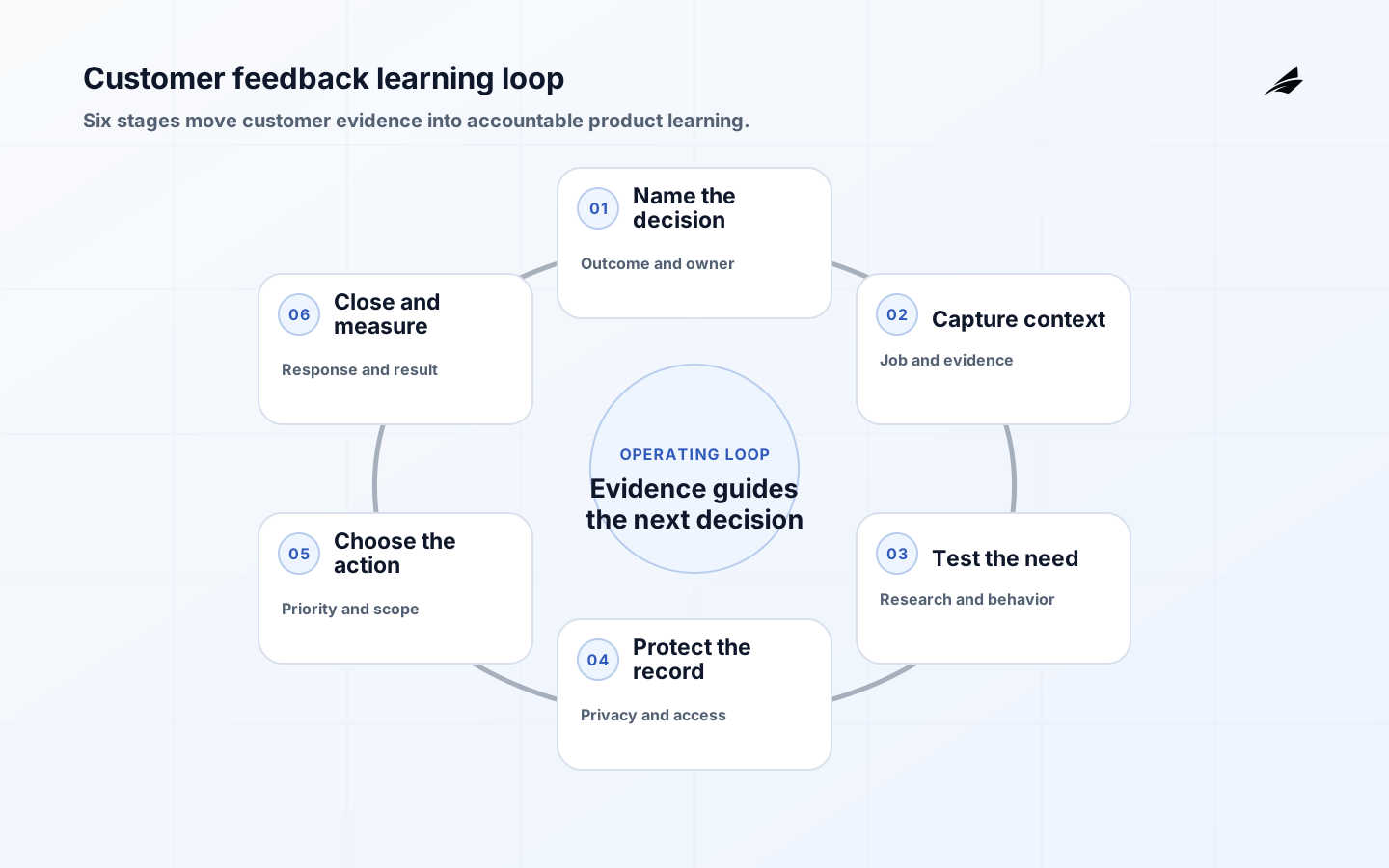
Customer feedback loops are a product operating system: they turn what people experience into evidence that a team can interpret, decide on, act on, and revisit. A request in a chat, ticket, interview, review, or usage trace is not automatically a requirement. It becomes useful when the team knows who experienced the problem, what they were trying to do, what happened, how costly the friction was, and what decision the evidence should influence. This customer feedback loops guide keeps that chain practical.
A good loop is neither a popularity contest nor a collection of quotes. GOV. UK’s user research guidance emphasizes understanding users, researching continuously, including different kinds of people, and sharing findings with the team. Edilec’s customer feedback implementation guide and trial conversion engineering notes can help connect feedback to a delivery decision.
Start with the decision the loop must improve
Choose a decision that currently relies on weak or delayed evidence: whether to fix an onboarding step, which support issue should become a product change, whether a pricing gate blocks a valuable workflow, or whether a release helped a target segment. Name the decision owner, the review cadence, the users affected, the evidence window, and the action that could follow. Without this boundary, every message competes equally and the loudest customer becomes the de facto product manager.
Separate discovery from prioritization. A conversation can reveal a need without proving its frequency; a usage metric can reveal friction without explaining its cause. Keep both pieces of evidence, but do not collapse them into one score prematurely. Write the hypothesis in a form that can change: “New administrators cannot find the invite control after creating a workspace” is more useful than “onboarding is confusing. ” The first statement points to a journey, a segment, and a test.
| Evidence type | What it can tell you | What it cannot prove alone |
|---|---|---|
| Interview or observation | Context, language, workarounds, unmet need | Frequency across the customer base |
| Support conversation | Observed failure and urgency in a real case | Whether the issue affects silent users |
| Product event | Where a journey stops or repeats | Why a user stopped or whether the event is correct |
| Survey response | Self-reported sentiment or stated preference | Behavioral impact or representativeness |
| Account request | Commercial importance and relationship context | A universal product requirement |
Capture context without creating a transcript warehouse
Capture the minimum fields that make a report actionable: source, date, customer or segment, job, trigger, observed behavior, consequence, workaround, evidence link, consent or access boundary, and suggested next step. Keep verbatim text only when it is necessary to preserve meaning and when the team can protect it. NIST’s definition of data processing includes collection, retention, logging, transformation, use, disclosure, sharing, and disposal; feedback tooling touches the whole lifecycle.
Use a stable feedback record with a short summary and a link to the source system. A support agent should not paste a full customer conversation into a public roadmap ticket. A researcher should distinguish participant number from identifiable contact information. A product analyst should record the event definition and query window. This separation lets the team work with the insight while limiting unnecessary exposure. It also makes deletion or correction requests possible without losing the decision history.
Turn requests into research questions
When a stakeholder says “customers want bulk export,” ask what work they are trying to complete, what they do today, which records must be included, when the task occurs, and what a correct result looks like. The GOV. UK planning guide recommends starting with research questions and testing assumptions rather than collecting a large volume of unfocused research. The question should be narrow enough that a team can learn something and change its next action.
Recruit for the experience, not only for account size. Include new and experienced users, successful and frustrated users, different roles, support-dependent users, and people who use assistive technology or constrained connectivity when those conditions affect the journey. Research continually: discovery finds the problem, prototype work tests the direction, and live research checks whether the service actually improved. A loop that listens only to existing power users will systematically miss quiet failure.
Build an intake that preserves signal
A structured intake form can ask for the customer job, affected journey, impact, frequency or recurrence, evidence, workaround, urgency, and request type. GitHub’s issue-form syntax is a concrete example of making descriptions, fields, labels, and assignees explicit. The exact tool matters less than the habit: the reporter should know what useful context looks like and the triager should be able to route the record.
Do not turn every field into a mandatory essay. Use controlled options for recurring classification and one concise free-text field for context. Keep “customer asked for” separate from “team believes the problem is. ” Mark duplicates, related records, and current status. If an issue is a security or privacy concern, route it to a restricted workflow rather than exposing it on a product board. Intake quality is a service design problem for the people who report feedback.
| Intake field | Example | Decision use |
|---|---|---|
| Customer job | Invite a finance reviewer before month end | Groups similar work across channels |
| Observed friction | Invite control is hidden after workspace creation | Describes behavior without prescribing solution |
| Impact | Two admins use a manual spreadsheet workaround | Supports severity and value assessment |
| Evidence | Session note, ticket, event query, or account record | Lets another person verify context |
| Boundary | Consent, retention, and restricted data flag | Controls who can view and reuse it |
Triage for impact, confidence, and action
A feedback triage meeting should produce one of a small number of states: investigate, merge, plan, respond, monitor, or decline with a reason. Use impact and confidence as separate dimensions. A highly credible issue affecting a small but safety-critical workflow may outrank a popular suggestion with weak evidence. Add effort and reversibility only after the problem and expected outcome are understood; otherwise the team will choose the easiest request instead of the most valuable one.
Make commercial context visible without letting it replace user evidence. An enterprise renewal request can deserve immediate attention, but the product decision should still state the underlying problem, the affected workflow, and whether the proposed change generalizes. Record the decision owner and the next evidence point. If the team declines a request, close the loop with a truthful explanation and a route for new evidence. Silence creates repeat contacts and teaches customers that feedback disappears.
Protect the people represented in the loop
Feedback often contains names, workplace details, support history, screenshots, and opinions about a person. Apply purpose limitation, access controls, retention, redaction, and deletion paths. NIST’s Privacy Framework treats privacy risk as an enterprise risk-management concern and provides a common language for communicating requirements across teams and suppliers. Treat research consent and product telemetry permission as separate decisions; observing behavior in a product does not automatically authorize publishing a quote.
Create roles for the feedback record: reporter, researcher or analyst, product decision owner, restricted-data reviewer, and system administrator. Limit exports and copied text. Keep a change history for classification and decision state, but avoid retaining raw personal details longer than needed. A privacy review should ask what new inference the loop enables, not only whether a field looks harmless. Strong privacy practice increases trust in the loop and makes participation more sustainable.
Close the loop with customers and the team
A closed loop has two audiences. The customer needs an accurate response: acknowledged, clarified, planned, shipped, declined, or still being investigated. The team needs a record of what changed, for whom, when, and how the outcome will be measured. Avoid promising a delivery date when the decision is not approved. When a change ships, tell the reporter what behavior changed and invite a new signal if the problem remains.
Share patterns with the whole team through a short weekly digest, an evidence board, or a decision review. Include what was learned, which assumptions changed, what work is now in scope, and which evidence was intentionally not used. GOV. UK guidance on analyzing research recommends involving observers in analysis and moving from observations to findings and actions. That practice reduces the chance that one person’s interpretation becomes the official truth.
Measure learning, not message volume
Track the age of untriaged feedback, duplicate rate, time to first response, time from signal to decision, percentage of decisions with a named owner, and the share of shipped changes with a post-release check. Pair these with product outcomes such as completion, support contacts, activation, task time, or correction rate. Avoid treating the number of tickets closed as proof that customers benefited. A team can close every ticket with a template and still learn nothing.
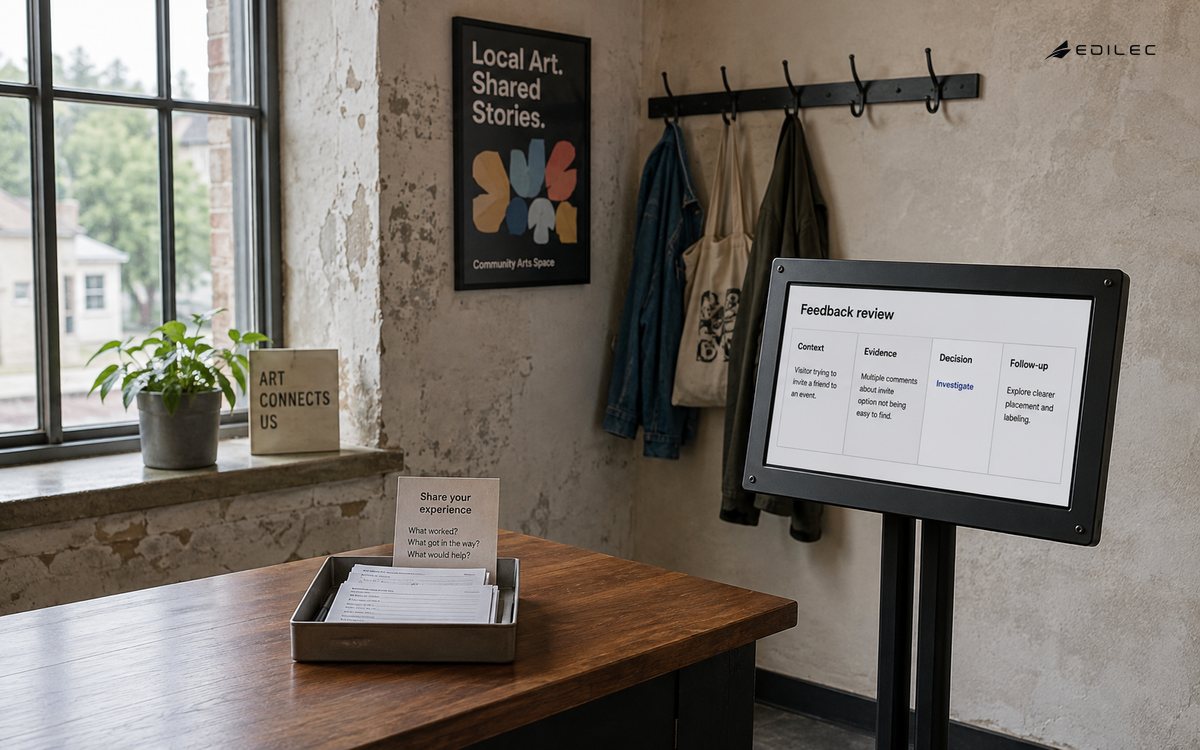
Review whether the loop changes behavior. Are support agents routing better context? Are product managers able to say why a request was prioritized? Can engineering find the original evidence without asking a researcher to repeat the work? Are customers seeing an honest response? If not, change the loop itself: simplify intake, improve the research question, change the review cadence, or stop collecting a field that no one uses.
Implement the loop in small steps
- Week 1: choose one decision, one journey, two customer segments, and one accountable owner.
- Week 2: define the feedback record, privacy boundary, intake fields, and states; test them with support and product.
- Weeks 3–4: run a focused research round and merge it with a small sample of support and usage evidence.
- Weeks 5–6: hold triage, make one explicit product decision, and send a truthful response to affected customers.
- Weeks 7–8: ship or test the smallest change, measure the outcome, and retire fields or steps that produced no value.
Key takeaways
- Feedback becomes useful when it is tied to a decision, a user job, and verifiable context.
- Combine qualitative context, behavioral evidence, and support signals without pretending they mean the same thing.
- Protect feedback across collection, sharing, retention, correction, and deletion.
- Triage for impact and confidence, then record owners, reasons, and next evidence.
- Close the loop with customers and measure whether the product behavior improved.
Frequently asked questions
How much customer feedback should a team collect?
Collect enough to answer the current decision, not an unlimited archive. A focused research round, representative support records, and a defined product-data window are often more useful than a large backlog with no owner or review path.
Should the loudest customer request win?
Not by itself. Consider the underlying job, impact, recurrence, affected segments, confidence, commercial context, and the cost of leaving the problem unresolved. Record the reasoning so the decision can be revisited when new evidence arrives.
How can feedback loops protect customer privacy?
Collect only what the decision needs, restrict raw records, separate identity from insight, define retention and deletion, obtain appropriate consent for research use, and keep a clear owner for privacy requests and access reviews.
For connected product planning, Compare customer feedback loops for SaaS product engineering with product analytics and roadmap systems so feedback decisions remain tied to evidence and prioritization.
For customer feedback loops that turn requests into product learning, test an unexpected load spike before treating the first release as complete. Test customer feedback loops that turn requests into product learning with normal, delayed, denied, and corrected workflow cases.
A practical example for customer feedback loops that turn requests into product learning is a customer-visible result remains pending. Keep customer language aligned with the recorded state for customer feedback loops that turn requests into product learning.
Evidence for “Customer Feedback Loops That Turn Requests into Product Learning” is grounded in User research for government services: an introduction, Plan user research for your service, NIST Glossary: Data Processing, Syntax for issue forms; each source informs a specific decision, test, or operating trade-off described in this guide.
Conclusion
Customer feedback loops work when they preserve the path from experience to learning to action. Start with a decision, capture enough context to understand the job, protect the people represented, triage with explicit reasoning, and close the loop with evidence. The result is a calmer product process and a more honest relationship with customers.