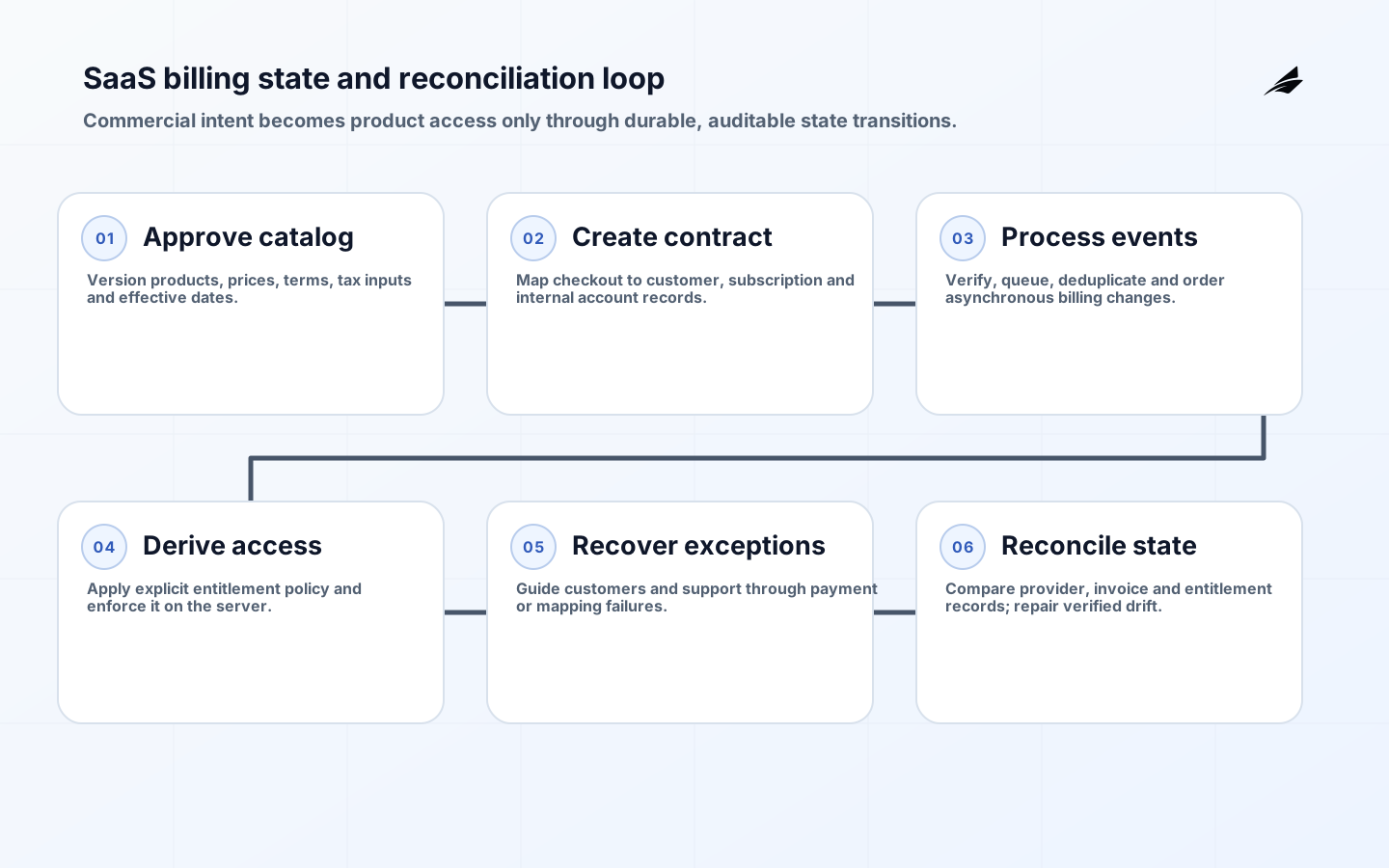
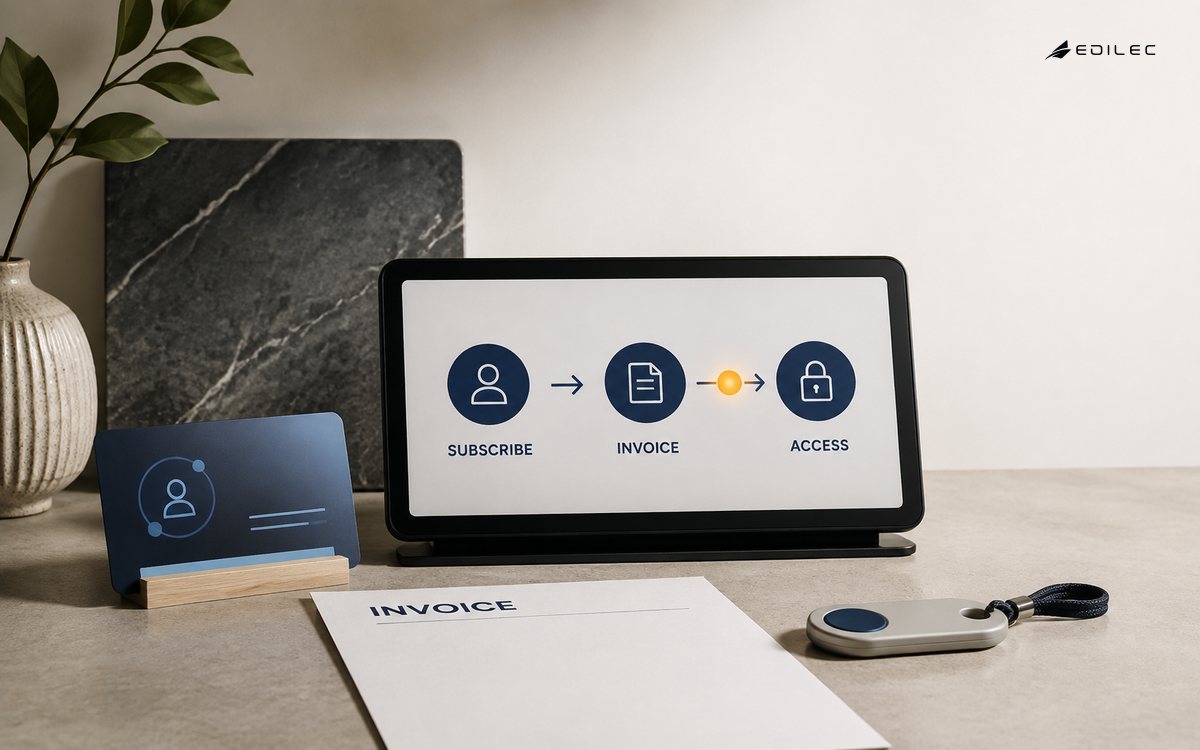
SaaS billing workflow design is the discipline of keeping commercial promises, payment records and product access consistent through every change. A pricing page may look simple, but the operating path includes checkout, tax information, authentication challenges, invoice finalization, asynchronous payment events, upgrades, credits, failed renewals, cancellation and data retention. If each screen changes access directly, customers eventually receive the wrong features or finance cannot explain an invoice. The safer design treats billing as a stateful business system with explicit owners and recoverable transitions.
This guide is for product, engineering, finance and support teams designing recurring billing or replacing fragile subscription code. It focuses on architecture and acceptance evidence, not provider-specific legal or tax advice. Pair it with the usage reporting architecture guide when charges depend on metering, and use the SaaS admin console guide to design bounded support actions.
Model billing as connected records, not one status
Separate the customer account, contract or subscription, price, invoice, payment attempt and entitlement. They answer different questions. A subscription describes an agreement and lifecycle; an invoice records an amount due; a payment attempt records collection; an entitlement states what the product should permit. One can change without the others. For example, an invoice may remain open while a grace policy keeps access active, or a paid invoice may include an implementation fee that grants no feature. Store provider identifiers and your internal identifiers together, but do not make a mutable provider object the only business record.
Write a state transition table before implementing handlers. Define which event can cause each transition, whether it is reversible, what customer communication is required and which record is authoritative. Include trial expiry, incomplete checkout, active service, scheduled cancellation, pause, delinquency and termination. Avoid a single boolean such as is_paid; it cannot represent future cancellation, multiple products, grace periods or a disputed payment. Preserve an append-only event and decision history so support can explain how current access was derived.
| Record | Authoritative question | Required evidence |
|---|---|---|
| Subscription | What commercial arrangement is active? | Plan, quantity, term, renewal and lifecycle state |
| Invoice | What amount was requested and why? | Immutable line items, currency, tax and adjustments |
| Payment | Was collection completed or does it need action? | Attempt identifier, outcome, failure class and timestamp |
| Entitlement | What may this account use now? | Feature key, scope, effective period and policy reason |
| Ledger event | How did the state change? | Source event, prior state, decision and actor |
Turn pricing and checkout into an explicit contract
Give every sellable price a stable internal key, currency, billing interval, unit definition and effective dates. Keep presentation labels separate from calculation rules. A pricing revision should create a new version rather than silently changing historical meaning. For usage pricing, define the meter, aggregation window, late-arriving event policy, rounding and correction process before launch. The customer should be able to see what will be charged, when, for which quantity and under what renewal or cancellation terms.
Prefer a provider-hosted checkout or properly isolated payment component when it meets the experience requirement. This can reduce the card-data surface, but it does not remove the merchant's responsibility to secure its own pages and integration. PCI SSC's current SAQ A script guidance specifically distinguishes redirects from embedded forms and asks merchants using embedded payment forms to address script attacks. Confirm the applicable assessment with the acquiring bank or qualified assessor rather than assuming a product choice establishes compliance.
Process provider events as untrusted, repeatable input
Subscription activity is asynchronous. Stripe's subscription webhook guidance documents events for creation, updates, invoices, payment failures and entitlement changes. Your endpoint should verify authenticity, persist the event identifier and raw relevant metadata, acknowledge quickly, then process through a queue. Assume duplicate delivery and do not assume arrival order. Fetch current provider state when a decision depends on facts that a delayed event may not contain.
Make every consumer idempotent. Record a unique event key and execute the state change in the same transaction as the processed marker where possible. For outbound creates or changes, use provider idempotency support; Stripe explains that an idempotency key allows a request to be retried without repeating its intended effect. Idempotency does not solve conflicting commands, so serialize changes per subscription or use version checks. Send poison events to a visible review queue instead of retrying indefinitely.
| Failure | Control | Acceptance test |
|---|---|---|
| Duplicate webhook | Unique event record and idempotent handler | Replay the same event and observe one transition |
| Events arrive out of order | Version or effective-time check plus state refresh | Deliver cancellation before an older update |
| Network timeout on create | Stable outbound idempotency key | Retry after an ambiguous timeout without duplication |
| Unknown product mapping | Quarantine queue with alert and owner | Send an unmapped price and preserve the event |
| Partial local write | Transactional state and processing marker | Interrupt processing and confirm a clean retry |
Derive access from policy, not payment callbacks
Create a product entitlement service or module that translates subscription facts into feature grants. Stripe's entitlements documentation illustrates mapping product features to active entitlements and recommends persisting them internally for fast resolution. Even when a provider offers this capability, keep your application-side policy explicit: which account, workspace or user receives the grant; when an upgrade begins; when a downgrade takes effect; and what remains available during delinquency or cancellation.
Do not delete customer data the moment payment fails. Separate access restriction, export availability, retention and final deletion. A short payment-recovery grace period may be commercially sensible, while a security-sensitive add-on may need immediate revocation. The rules should be approved by product, finance, support and counsel for the relevant markets. Test authorization on the server for each feature; hiding a navigation item is not enforcement. Cache entitlements only with a clear invalidation path and a safe behavior when billing dependencies are unavailable.
Design upgrades, credits and recovery before launch
Specify proration behavior for every plan change. Show a preview before confirmation, record the accepted terms and make the effective time visible. Decide whether quantity decreases apply immediately or at renewal, whether unused prepaid value becomes a credit and how tax adjustments are handled. Manual invoices and negotiated contracts need the same product mapping as self-service checkout. Otherwise enterprise customers become exceptions maintained in code and spreadsheets.
Payment recovery should distinguish a technical retry, authentication required, expired method, hard decline and disputed charge. Give customers a secure way to update payment details and see invoice history. Support operators need event history and bounded commands such as resend invoice, retry synchronization or schedule cancellation. They should not edit provider records and the application database independently. Each consequential command needs authorization, reason, actor, before-and-after state and a customer communication decision.
Implement the billing workflow in six controlled steps
- Approve the product catalog, price versions, tax inputs and subscription transition table.
- Integrate hosted checkout and persist stable account, customer, subscription and price mappings.
- Build authenticated event ingestion with a queue, deduplication and replay tooling.
- Derive entitlements through an explicit policy module and enforce them server-side.
- Add invoice history, recovery journeys and audited support commands.
- Reconcile provider and internal state, rehearse failures and release to a bounded cohort.
Measure correctness before revenue optimization
Start with integrity measures: unmatched provider objects, event processing lag, duplicate suppression, entitlement drift, invoice correction rate and support actions per account. Then monitor conversion, trial activation, voluntary cancellation and recovered revenue. A higher recovery rate is not healthy if it comes from confusing cancellation or repeated unwanted charges. Segment metrics by product and payment path so a small enterprise flow is not hidden by self-service volume.
Define service objectives for the customer-visible outcomes: time from successful checkout to usable access, time from plan change to correct entitlement and maximum age of an unprocessed billing event. Alert on symptoms requiring action, such as paid accounts lacking access, rather than every provider retry. Review a sample of invoices after every catalog or tax change. Billing accuracy is a product quality property, not only a finance reconciliation exercise.
Key takeaways
- Model subscriptions, invoices, payments and entitlements as distinct records.
- Version prices and define effective dates instead of mutating historical meaning.
- Verify, queue, deduplicate and reconcile asynchronous provider events.
- Apply access through a reviewed entitlement policy with server-side enforcement.
- Give customers and support staff transparent, auditable recovery paths.
Frequently asked questions
Should the payment provider be the system of record?
It should be authoritative for the payment objects it processes, but not for every product decision. Keep provider identifiers and current state synchronized while retaining your own contract, entitlement, support and audit records. This lets the application operate safely during an outage and preserves business context that payment objects do not contain.
When should access end after a failed payment?
There is no universal interval. Define a policy by product risk, customer contract and applicable law. The policy should distinguish temporary collection trouble from cancellation, communicate dates clearly, preserve appropriate export or support access, and be applied consistently by the entitlement service rather than scattered webhook handlers.
What billing scenarios belong in release testing?
Test new subscriptions, authentication-required payments, duplicate and delayed events, upgrades, downgrades, quantity changes, coupons, credits, tax changes, renewal failures, recovery, cancellation, refunds and provider outages. Verify both money and access, then inspect invoice presentation, customer messages, support history and reconciliation output.
Conclusion
A durable SaaS billing workflow is a controlled state machine wrapped in clear customer journeys. Version the commercial catalog, isolate payment data, process asynchronous events idempotently, derive entitlements from explicit policy and reconcile continuously. When invoices, access and support evidence tell the same story, the team can change pricing without turning every launch into a financial and operational incident.