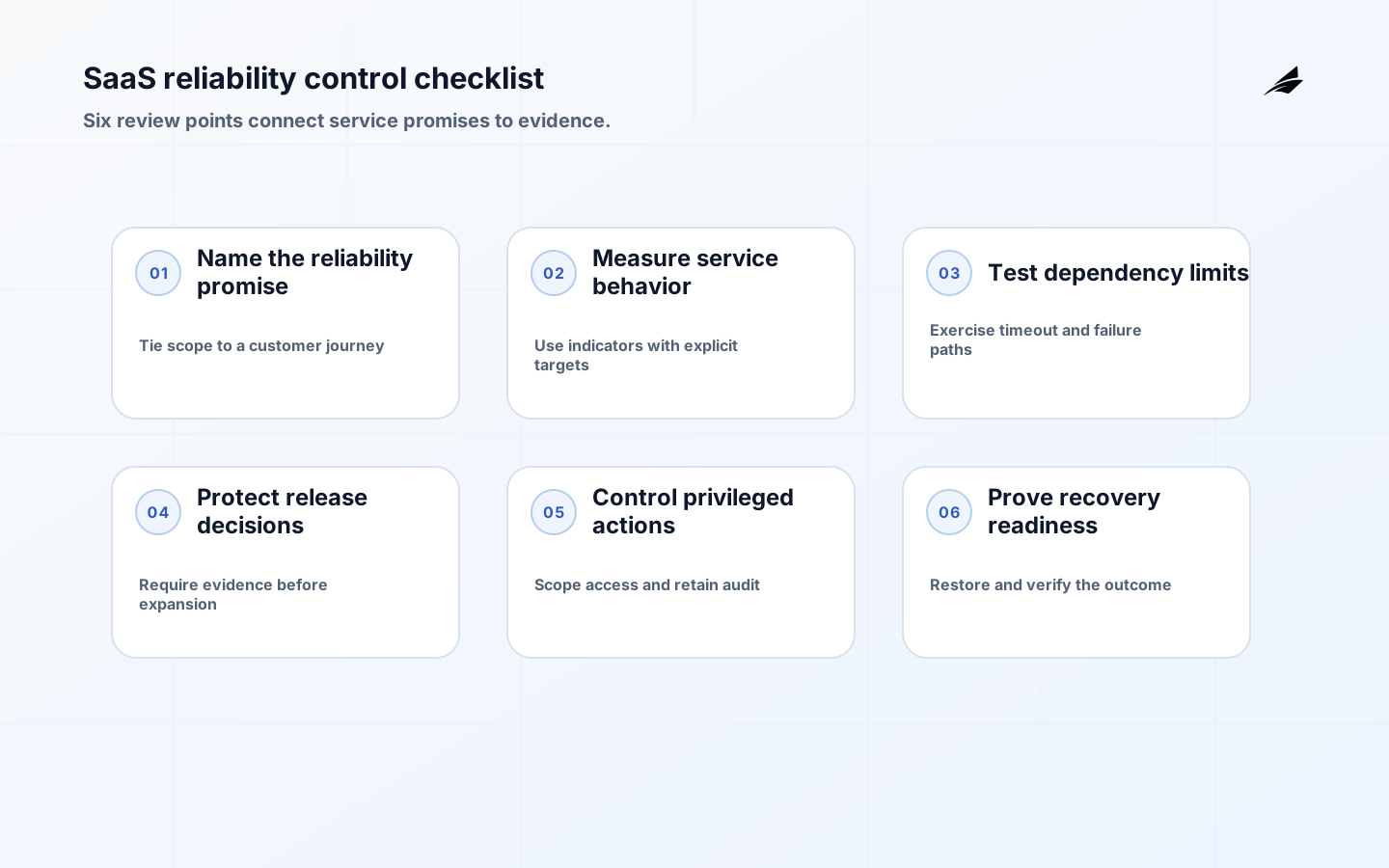
A SaaS reliability checklist is valuable only when each line leads to a decision, an owner, and evidence. “We have monitoring” does not tell a CTO whether a customer can finish a critical task, whether a noisy tenant can consume shared capacity, or whether the team can recover after a bad deployment. This guide turns the checklist into a review of the whole service: user outcomes, failure behavior, change, access, operations, and recovery.
Use the checklist before a launch, after a material architecture change, and at a regular operating review. Start with Edilec’s SaaS MVP delivery plan when scope is still forming, then connect the evidence to SaaS product development readiness and multi-tenant architecture planning.
1. Confirm the service outcome and owner
Write the service boundary in language a customer or internal user would recognize. List the journeys covered, supported plans, regions, operating hours, dependencies, data classes, and explicit exclusions. Assign a business owner who accepts the outcome and a technical owner who can change the service. Add a support and security owner; if one person holds several roles, document the combination and name a backup. Reliability work fails when every team can point to a dashboard but no one can authorize a tradeoff.
For each critical journey, define success and a degraded state. A successful document export might be a complete file with the expected records; a degraded result might be a queued job with an honest status and a support path. Google SRE’s SLO guidance emphasizes user-facing indicators and clear measurement conditions. Include correctness and freshness, not only uptime. A fast response with stale permissions or missing rows is not reliable service.
| Review item | Pass condition | Evidence |
|---|---|---|
| Service scope | Journeys, roles, plans, regions, and exclusions are explicit | Approved service brief |
| Accountability | Business, technical, support, and security owners are named | Responsibility record and backups |
| Success | Each journey has a measurable completion condition | Synthetic test and sample result |
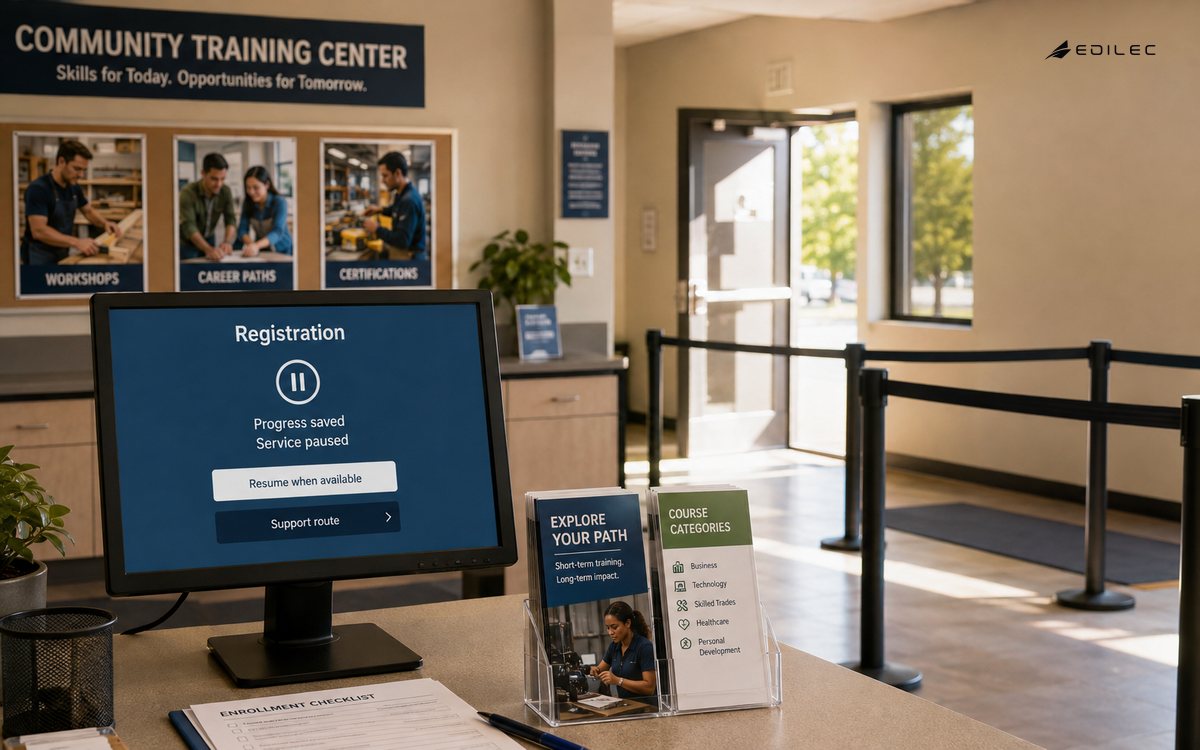
| Degraded state | Users see what is pending, stale, or unavailable | UX copy and support procedure |
| Review date | Targets and assumptions have a next review | Calendar entry and change log |
2. Choose indicators that trigger useful action
Select a compact set of indicators: successful journey completion, latency percentiles, error rate, queue age, dependency health, data freshness, and correctness samples. Record the measurement window, population, exclusions, and aggregation. OpenTelemetry can connect traces, metrics, and logs across a request, but correlation does not make a metric meaningful by itself. Tie every alert to a human decision or an automated safe action.
Use alert classes. A page should mean someone must act now; a ticket should mean planned work; a log should support diagnosis or later analysis. A growing SaaS team should inspect alert volume, duplicate pages, time to acknowledge, and the percentage of pages that resulted in a customer-impacting issue. Remove alerts no one can act on. A checklist that counts alerts instead of decision quality rewards noise.
3. Test dependencies, limits, and isolation
Inventory the providers and internal services that critical journeys depend on. For each one, state timeout, retry budget, fallback, rate limit, credential owner, failure message, and escalation path. Decide which work can leave the request path and become a durable job. A report generation task should not tie up a user request for several minutes if the user can safely receive progress and a notification.
Tenant-aware operations belong in this checklist. AWS’s SaaS Lens calls out tenant activity, tenant tiers, noisy neighbors, and tenant-aware health as architectural concerns. Measure resource use by tenant or tier where it affects the decision. Set quotas and fair scheduling before a large customer or a runaway integration tests the limits in production. A limit without a customer-visible state becomes a mysterious outage; a limit with a clear state becomes an operable contract.
| Dependency or limit | Control to review | Failure evidence |
|---|---|---|
| External API | Timeout, retry budget, circuit or fallback | Simulated slow and unavailable provider |
| Shared queue | Per-tenant quota, fair scheduling, durable status | Backlog test and tenant attribution |
| Database | Connection, query, storage, and migration limits | Load test with saturation signal |
| Identity provider | Session expiry, outage path, and break-glass access | Login and revocation drill |
| Object storage | Size, lifecycle, permission, and restore behavior | Large file and restore test |
4. Make change safe to reverse or repair
A release plan should name the risky behavior, the signal that will reveal harm, and the action that stops or repairs it. Use small cohorts, feature flags, backward-compatible schema steps, and a rollback or forward-fix path. A rollback is not always safe after data has been transformed; document the correct recovery direction. Test migrations against representative volume and permission states, not just a clean development database.
Review the deployment pipeline for identity and authorization. The person who can merge code should not automatically be the person who can approve a production data migration. Keep deployment records, configuration versions, feature-flag changes, and emergency exceptions. Add a post-release review when a change spends reliability budget. The goal is not bureaucracy; it is a short trail that explains why a service changed and what the team observed.
5. Protect data and operational authority
Separate authentication from authorization. A signed-in user may still lack access to a tenant, record, action, or export. Enforce checks on the server and carry tenant, role, resource, and action context through every request. Review service accounts, support impersonation, admin tools, exports, and background jobs. NIST’s Cybersecurity Framework 2.0 gives a useful structure for governing, protecting, detecting, responding, and recovering around the service.
Keep sensitive data out of diagnostic messages and define retention for logs, traces, tickets, exports, and backups. Test the revoke path, not only the grant path. A support engineer who can view a customer record for troubleshooting needs a time-bound reason, an audit event, and a way to prove what was accessed. Reliability and security meet at the point where an operator must act quickly without creating an untraceable privilege.
6. Prepare the team for incidents
Create a response path that starts with a symptom and ends with a customer-visible resolution. Define the incident commander, technical lead, communications owner, support liaison, severity levels, status cadence, and decision log. Include a route for declaring an incident when the service is technically up but a critical journey is failing. Test a dependency outage, elevated latency, bad configuration, cross-tenant access concern, and a queue that cannot catch up.
A useful incident record captures start time, affected journeys, scope, detection source, mitigation, customer communication, recovery evidence, and follow-up owners. Do not make the post-incident review a blame exercise. Ask which assumptions, controls, or incentives allowed the failure and which change will make the next response easier. If the same class of incident returns without a changed control, the review process is not closing the loop.
7. Prove recovery and continuity
Define recovery objectives for the service and for the data behind it. Then test restore, failover, replay, reconciliation, credentials, DNS or routing, and customer communication. Kubernetes Pod Disruption Budget guidance is a useful reminder that availability controls have scope and limits; they can protect against voluntary disruptions but cannot by themselves guarantee service continuity or handle every failure.
Use a recovery matrix with normal, degraded, and unrecoverable states. For a billing export, a restored database without the correct object storage files may still leave customers unable to download evidence. For an event-driven system, a restored database without replayed events may leave search, notifications, and entitlements out of sync. Reconciliation queries and an owner who can approve the result are as important as the backup command.
8. Run the review as a living control
Review the checklist at the cadence the service’s risk requires, not only before launch. Inspect SLO performance, change failures, unresolved risks, stale owners, backup test age, alert quality, dependency incidents, access-review age, and customer support patterns. Treat a missed review as an operational signal. A checklist item should move to done, accepted risk, or a dated corrective action; “noted” is not a state.
Bring product, engineering, support, security, and finance into the same decision when the tradeoff has commercial impact. A dedicated worker pool may protect a strategic tenant but raise cost; a longer retention period may help support but increase privacy exposure. Record the choice, the assumption, the owner, and when evidence will be revisited. Edilec’s SaaS reliability guide can extend this review into delivery planning.
A review sequence that fits a busy team
- Read the service brief and verify that a real user journey, owner, and degraded state are named.
- Trace one successful request and one failed request through logs, metrics, traces, queues, and dependencies.
- Run the highest-risk change and recovery test, including data correctness and access revocation.
- Review pages, tickets, and logs for actionability; remove signals with no owner or decision.
- Check tenant or plan dimensions for shared capacity, noisy neighbors, and support impact.
- Close with accepted risks, dated actions, and the next review trigger.
Key takeaways
- A checklist is useful when every item produces an owner, a decision, or evidence.
- Reliability reviews must include correctness, freshness, tenant impact, and recovery—not only uptime.
- Bound dependencies and shared capacity before traffic or a large customer exposes the limit.
- Treat deployment, access, incident response, and restore as one operating system.
- Keep the checklist current through recurring reviews and dated risk decisions.
Frequently asked questions
When should a SaaS reliability checklist be run?
Run it before a material launch, after a major change in dependencies or tenancy, and on a recurring cadence matched to service risk. A small team can review the highest-risk items monthly and rehearse recovery at a longer but explicit interval.
Do Kubernetes availability controls prove SaaS reliability?
No. They can reduce the effect of some voluntary disruptions, but customer reliability also depends on application correctness, dependencies, data recovery, access, queues, and operator response.
Who owns the checklist?
The service owner should keep the review active, while technical, support, security, and business owners sign off the parts they control. Ownership may be combined in a small team, but the decisions and backups must remain visible.
For saas reliability checklist, a good handoff ends with observable evidence rather than a verbal promise. Keep customer language aligned with the recorded state for saas reliability checklist.
The smallest useful improvement to saas reliability checklist is often a sharper boundary, not another feature.
During normal handling, keep scope, state, evidence, and recovery path visible for the SaaS reliability checklist.
A practical example for saas reliability checklist is a customer-visible result remains pending. Test saas reliability checklist with normal, delayed, denied, and corrected workflow cases.
For SaaS Reliability Checklist, Operate - SaaS Lens defines scope. Document the cited control, its scope, and the conditions for expansion.
During normal handling, verify the control and scope; during a denied request, confirm the recorded state and recovery path.
A practical example for saas reliability checklist is a delayed dependency. Test a delayed dependency and document the recovery decision.
For the SaaS reliability checklist, define the customer outcome, the mechanism that supports it, and the person who can change or accept each control. Keep that ownership visible through release, incident response, and recovery.
Evidence for “SaaS Reliability Checklist: From Happy Path to Recovery” is grounded in Operate - SaaS Lens, Service Level Objectives, Pod Disruption Budgets, Signals, The NIST Cybersecurity Framework 2.0; each source informs a specific decision, test, or operating trade-off described in this guide.
Conclusion
A SaaS reliability checklist should make the service’s promises, boundaries, failure behavior, and recovery evidence easy to inspect. Use it to move from a happy-path launch to a living operating model. The result is not a perfect system; it is a service whose risks are visible, bounded, and owned.