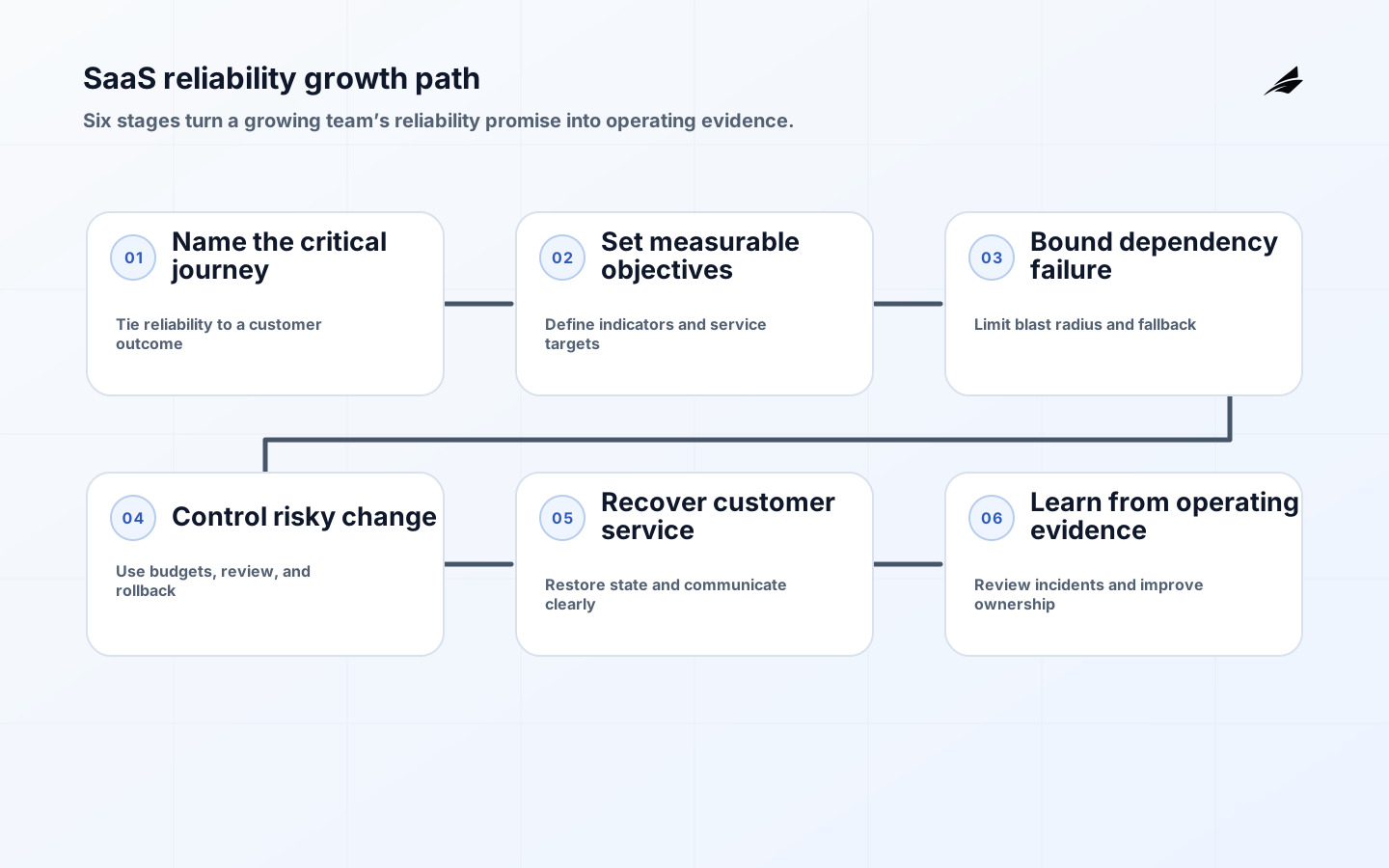
SaaS reliability is the discipline of keeping a software service useful when traffic rises, dependencies slow down, people deploy changes, and customers encounter the edges of the product. For a growing team, reliability is not a promise that nothing fails. It is the ability to define what customers need, detect when that experience is degrading, limit the blast radius, recover with evidence, and learn without turning every incident into a personal rescue mission. This SaaS reliability guide gives an IT manager a practical way to make those decisions.
Start with one customer journey rather than a platform inventory. A team may care about signing in, submitting an order, exporting a report, or receiving a webhook. Google’s guidance on service level objectives recommends measuring behavior that matters to users, not every metric a system can emit. Edilec’s SaaS reliability operations playbook and production reliability guide are useful companions when this first boundary is clear.
Define reliability as a customer outcome
Write a reliability statement with a user, action, time window, and acceptable result. “The reporting service is highly available” is too vague to guide an alert or a release. “A finance administrator can generate the monthly usage report within 30 seconds during business hours, or receives a clear retry state” is testable. Add the affected plan, region, authentication state, and dependencies when they change the promise. The statement becomes a contract between product, engineering, support, and the customer-facing team.
Separate a service-level indicator from its target. An SLI might be the percentage of report requests that return a valid file within 30 seconds; an SLO is the target over a stated window. Correctness belongs beside availability and latency: a fast response containing an incomplete report is a failure for the user. Google SRE’s SLO chapter also cautions against choosing targets from current performance alone. Begin with a defensible expectation, then tighten it when evidence shows the team can meet it without waste.
| Reliability question | Example decision | Evidence to keep |
|---|---|---|
| Who is affected? | Finance administrators exporting monthly reports | Named journey, role, and plan scope |
| What counts as success? | Complete file or explicit recoverable state | Synthetic test and request outcome |
| How fast? | 95% under 30 seconds in the agreed window | Latency distribution and percentile |
| What is excluded? | Unsupported legacy exports are labeled | Scope note and customer message |
| Who decides? | Service owner approves the target | Signed SLO record and review date |
Choose a small set of indicators
A growing team usually has too many dashboards and too few decisions. Keep the first reliability view to a handful of indicators: successful request rate, tail latency, correctness or freshness, dependency failure rate, queue age, and recovery-point freshness where data loss is possible. Instrument at the user boundary and at the server boundary so a browser regression is not hidden by a healthy API. OpenTelemetry signals provide a useful vocabulary for traces, metrics, and logs; the product team still has to define which signal represents a meaningful outcome.
Use percentiles for latency and segment results by journey, plan, region, and dependency when those dimensions change customer impact. An average can look acceptable while a small group waits minutes for a critical action. Do not page on every diagnostic fluctuation. Google’s production service guidance distinguishes pages, tickets, and logs: page when someone must act now, create a ticket when work can wait, and log information that is useful for later analysis. This classification protects attention as the team grows.
Design failure boundaries before adding capacity
Map the request path from browser or client through edge, application, queue, database, and external provider. For each hop, record timeout, retry rule, fallback, ownership, and the condition that prevents an overload from spreading. A payment provider should not be retried indefinitely from every web request; a report export may be moved to a durable job and shown as processing. Failure boundaries are product behavior, so write the user message and support action with the same care as the circuit breaker.
Use isolation deliberately. The AWS SaaS Lens treats tenant isolation, noisy neighbors, tenant activity, and tenant-aware operations as first-class concerns rather than afterthoughts. A shared queue may be economical but needs per-tenant limits, fair scheduling, and a way to identify the customer consuming capacity. A high-value enterprise plan may justify a separate worker pool, but that choice should be explicit in the commercial model and not a hidden exception. Reliability improves when the system can answer which tenant, feature, and dependency are creating pressure.
Connect error budgets to change
An error budget translates a reliability target into a decision about delivery pace. If a service has spent most of its budget, the next release should be smaller, delayed, or focused on reducing the cause of failure. This does not mean freezing every change forever. It means product and engineering use the same evidence when choosing between a new feature, a capacity fix, a migration, and a reliability improvement. Record who can override the policy, why, and what compensating control will run.
Make the release pipeline prove the risky behavior. A schema migration should test rollback or forward repair; a cache change should test cold-start latency; a dependency upgrade should replay representative failures. Attach the relevant SLO and rollback signal to the release. If the team cannot tell within the first review window whether the change harmed a customer journey, the observability contract is incomplete. The product analytics production guide offers a related reminder: evidence must support a decision, not merely fill a warehouse.
| Change event | Reliability control | Release evidence |
|---|---|---|
| Database migration | Expand, migrate, validate, then contract | Backfill health, correctness sample, rollback plan |
| New external provider | Timeout, bounded retry, fallback state | Dependency simulation and customer message |
| Large tenant onboarded | Capacity reservation and rate limits | Load test with tenant dimensions |
| Feature flag rollout | Small cohort and automatic stop rule | Cohort SLO comparison |
| Credential or policy change | Dual-run validation and fast revocation | Access test, audit event, recovery owner |
Make ownership visible in the operating model
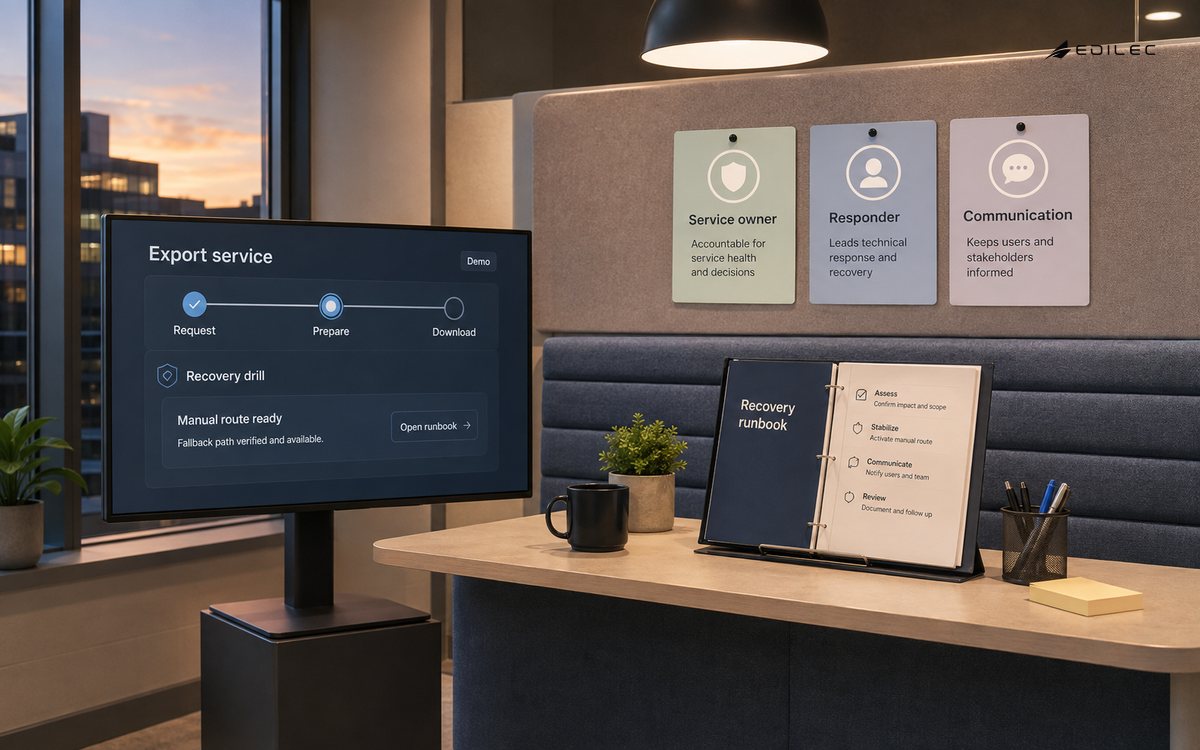
Every critical journey needs a service owner, an incident lead, a technical responder, and a customer-communication owner. These roles can be held by a small team, but they should not be inferred from a repository or a rota hidden in someone’s calendar. Keep a dependency map with the owning team, support channel, escalation boundary, data sensitivity, and last verification date. NIST’s Cybersecurity Framework 2.0 is helpful because Govern and Identify sit alongside Protect, Detect, Respond, and Recover; reliability work also needs governance and recovery, not just monitoring.
Write runbooks around symptoms and decisions. “Report export is slow” should lead to checks for queue age, worker saturation, database contention, dependency latency, and tenant concentration, followed by bounded actions. Include what not to do, such as raising concurrency when the database is already failing. Run the runbook with someone who did not write it. A runbook that depends on tribal memory is an untested dependency and will fail at the moment the team most needs it.
Test recovery as a user-visible capability
Backups, replicas, and failover settings are components, not proof of recovery. Choose a customer scenario, define the maximum tolerable data loss and service interruption, and rehearse the sequence. Include access to the recovery account, a dependency that is unavailable, a partial restore, and the customer update. For asynchronous jobs, verify whether work is replayed, discarded, or marked uncertain. The result should tell support what customers may see and tell engineering which records are authoritative.
Keep recovery evidence close to the service definition. Record the exercise date, dataset or tenant class, observed restore time, missing records, manual steps, and follow-up owners. Growing teams often discover that a restore works technically but leaves search indexes, caches, entitlements, or outbound events inconsistent. Treat reconciliation as part of recovery. AWS SaaS Lens guidance on tenant-aware operations reinforces the need to understand health through the lens of the affected tenant or tier.
Scale the routine before scaling the architecture
Before adding regions, queues, or microservices, reduce repeated ambiguity. A weekly reliability review can examine SLO compliance, top customer-impacting incidents, oldest unresolved action, change failures, alert quality, and the cost of manual recovery. Keep the meeting focused on decisions: which risk is accepted, which control changes, and who proves the change. If an incident has no follow-up that changes a system, test, policy, or training artifact, the organization may be recording events without learning.
Growth also changes the social system around the code. Support needs a status vocabulary, sales needs a truthful explanation of plan differences, and finance needs to understand the cost of a stronger isolation boundary. Use the same service names and journey names in dashboards, incident records, and customer updates. Reliability becomes easier to operate when a customer’s description of “reports are stuck” maps to the same queue, SLO, and runbook used by engineers.
A practical first 90 days
- Days 1–15: choose one customer journey, name the owner, map its dependencies, and write a draft SLO with a correctness condition.
- Days 16–30: instrument the user path, separate page-worthy alerts from tickets and logs, and record the first baseline.
- Days 31–45: introduce timeouts, bounded retries, queue or tenant limits, and explicit degraded states where the path needs them.
- Days 46–60: run one failure drill and one restore or reconciliation exercise with support observing.
- Days 61–75: connect the error budget to release review and test a rollback or forward-repair path.
- Days 76–90: review customer outcomes, retire noisy signals, and choose the next journey only if the first has an owner and recovery evidence.
Key takeaways
- Reliability starts with a named customer outcome, not a list of infrastructure components.
- Use a few user-centered indicators that include correctness, freshness, and tail behavior.
- Bound retries, queues, tenants, and dependencies so one failure does not become a service-wide event.
- Treat ownership, communication, recovery, and reconciliation as part of the product.
- Use error budgets and observed recovery evidence to decide when growth is safe.
Frequently asked questions
How many SLOs should a growing SaaS team start with?
Start with one or two critical journeys and a small indicator set for each. A target for every endpoint creates review work without clarifying which customer outcome deserves protection. Add another SLO when a distinct user group or failure mode needs a different decision.
Should a growing team split a monolith to improve SaaS reliability?
Not automatically. First identify the failure boundary, ownership gap, or scaling constraint. A well-instrumented monolith with durable jobs and clear limits can be easier to recover than many services with unclear contracts. Split only when the boundary improves isolation, delivery, or operating ownership.
What should happen when the error budget is nearly spent?
Pause or narrow risky changes, investigate the customer journey and contributing dependencies, and prioritize the work that restores headroom. Keep urgent security and corrective changes moving under an explicit exception rule with a named approver.
Ownership is clearer when saas reliability for growing teams separates the promise from the mechanism. Keep customer language aligned with the recorded state for saas reliability for growing teams.
Before widening saas reliability for growing teams, run a small rehearsal with normal, denied, delayed, and corrected cases.
The measurement plan for saas reliability for growing teams should pair an outcome with a reason to investigate it. Test saas reliability for growing teams with normal, delayed, denied, and corrected workflow cases.
For SaaS Reliability for Growing Teams, the SaaS Lens definitions establish the scope. Reconcile changes to SaaS reliability for growing teams against the original record.
Evidence for “SaaS Reliability for Growing Teams: Build a Service People Can Trust” is grounded in Service Level Objectives, Production Services Best Practices, Definitions - SaaS Lens, Signals, The NIST Cybersecurity Framework 2.0; each source informs a specific decision, test, or operating trade-off described in this guide.
Conclusion
SaaS reliability for a growing team is a way of making service behavior explainable and recoverable. Define the customer journey, measure the result at the user boundary, design failure states, make ownership explicit, and use recovery evidence to guide the next investment. This approach lets a small team grow the product without asking heroics to carry the operating model.