Release notes become a durable product surface as a team grows: customers, support, sales, operations, and engineers all use them to understand what changed and what to do next. Release notes are a product interface for change. Their job is to let a customer or internal operator decide whether an update matters, whether action is required, and where to look if a workflow behaves differently. A chronological list of pull requests cannot do that work, especially when deployment, feature exposure, and documentation are not simultaneous. For IT managers, release notes begins with one accountable decision: what changed, who is affected, and what an informed reader should do next. The design should make that decision understandable to a customer, enforceable by services, and explainable by the people who support it.
Define the release notes decision
Before choosing screens or vendors, write down the decision in ordinary language and name its actors: the release manager, engineer, security owner, support team, administrator, and end user. Then list the records that make the answer defensible: the release identifier, deployed build, change set, migration note, known issue, rollback record, and announcement. This exercise exposes disagreements that otherwise surface as inconsistent product behavior. A person operating the system should be able to answer who requested the action, what authority applies, which fact is current, and what changes when that fact is disputed.
| Question | Design choice | Evidence to retain |
|---|---|---|
| Scope | Which account, actor, and action does release notes cover? | Named boundary and current owner. |
| Authority | Which service or approved record decides the state? | Source identifier, timestamp, and change history. |
| Exception | When can a person override or reroute the normal path? | Reason, approver, expiry, and follow-up. |
| Completion | What proves the customer outcome was achieved? | Outcome event and visible confirmation. |
Name the audience and promised action
Use a release record that separates shipped code from enabled behavior. Feature flags, staged rollouts, and migrations can make a version visible without making a feature available to everyone. Give each note a scope, audience, effective date, and plain-language statement of impact. Keep the presentation layer honest about uncertainty: if a dependency is delayed or a policy cannot be evaluated, say so rather than showing a definitive outcome. In distributed products, a customer-facing state is often assembled from multiple services, so the system needs an explicit freshness rule and a safe response when it cannot meet that rule.
Authorization and isolation deserve particular attention whenever release notes touch account data or consequential actions. The OWASP Authorization Cheat Sheet recommends server-side, per-request authorization and least privilege. Its practical implication is simple: a role, tenant, plan, or UI state supplied by the browser is context to verify, not a verdict to trust.
Build a durable change queue
Begin with a release template for one product surface: summary, audience, change, action, known limitation, and support route. Require the author to link the deployed artifact or version and to name the owner for follow-up. A lightweight template prevents a hurried announcement from skipping a migration or compatibility consequence. Define the unhappy path at the same time as the normal one. Include a missing record, duplicated request, delayed dependency, reassigned owner, and a customer who needs an explanation. A narrow path with recovery tells a team more than a broad demonstration because it reveals whether the information model and accountability are actually usable.
| Release element | Minimum behavior | Failure signal |
|---|---|---|
| Intake | Validate the required context and state what is missing. | Repeated correction or abandoned work. |
| Decision | Apply an explicit rule and record the result. | Conflicting state or unexplained outcome. |
| Handoff | Assign a next owner with a due expectation. | Unowned queue or manual chase. |
| Recovery | Retry, compensate, or escalate without duplicating work. | Lost context, duplicate action, or stale state. |
Connect notes to verification evidence
Do not bury a breaking change in a celebratory summary. When a customer must reconfigure an integration, export data, or change a process, place the action near the change and keep the previous behavior, deadline, and recovery route explicit. Correcting a note later is fine; silently overwriting history is not. Treat support as part of the product boundary. A support person needs a constrained view of relevant account facts, a way to see what the customer saw, and a documented route to involve the right owner. They should not need broad production access or private knowledge to answer a routine question.
For release notes, observability closes the gap between a stated change and the behavior customers receive. The OpenTelemetry Metrics Data Model describes the signals that help teams interpret distributed behavior. Tag deployments and feature exposures so a support lead can connect a new customer report to a release, a rollout cohort, and a relevant trace. This is more useful than asserting causation from a timestamp, and it keeps a note’s correction grounded in evidence.
Measure whether explanations prevent support work
Review support contacts attributed to a release, completion of any required customer action, time to publish after deployment, and the number of corrections. Sample notes with administrators and support staff: can they explain who was affected and reproduce the promised behavior? Establish a short review cadence with the people who own the customer outcome, not only the system dashboards. Read complete and exceptional examples. Ask whether the assigned person had enough context, whether the record matches reality, and whether a policy or product choice is creating repeated manual work. A measure is valuable when it changes a decision, not when it merely decorates a report.
Review note quality with real readers
The implementation will vary, but the underlying checks are stable. Semantic Versioning 2.0.0, GitHub Docs: About Releases, NIST Secure Software Development Framework, OpenTelemetry Metrics Data Model provide practical reference points for access boundaries, tenant context, observable service behavior, communication, accessibility, and secure development. Use them to challenge the concrete workflow described here: what is the protected outcome, where is enforcement performed, how is failure detected, and how does the team recover without losing the customer’s context?
Test the note against deployed behavior
Before publishing, ask an administrator and a support teammate to answer three questions using only the note: what changed, does it affect me, and what should I do? If either reader must open a source-control history or ask an engineer for the answer, the note is incomplete. This small review also catches ambiguous dates, unnamed feature flags, and instructions that no longer match the shipped interface.
Keep corrections and deprecations visible
Keep a durable archive and label corrections with their date and reason. For deprecations, state the replacement, compatibility deadline, migration sequence, and escalation route. That history is useful when a customer reports an old integration behavior or when an incident review needs to distinguish an uncommunicated change from a misunderstood one.
Release notes takeaways
- Define release notes around a decision and a customer outcome, not a list of interface features.
- Make authority, current state, and exception ownership visible in the record.
- Release one narrow path with an honest failure and recovery route.
- Use telemetry and support evidence to inspect the real operating result.
- Change the workflow only after the review shows which assumption failed.
Growing-team release-note FAQ
What is the first question to ask about release notes? Ask which customer decision or job the growing-team release notes system must support, what record authorizes it, and who owns an exception. Those answers create a useful boundary for design and testing.
Can a small team do this without a large platform? Yes. A deployment log tells engineers what was promoted. Release notes explain the user-facing or operator-facing consequence. Keep both, because they answer different questions during an incident or a customer conversation. The first version needs explicit rules and a review habit more than it needs a complex stack.
For the final reader check, compare release notes before the first build, billing workflows in production, and billing workflows for growing teams. Use the comparison to test whether a note explains impact, customer action, and the correction route clearly.
Build a release-note system around reader action
For a growing release-note practice, compare GitHub Docs: Automatically generated release notes, Semantic Versioning 2.0.0, NIST Secure Software Development Framework (SSDF), and OWASP Logging Cheat Sheet when defining publication, version meaning, traceability, and review evidence. Use labels as an input rather than a final classification, retain provenance for the published artifact, and keep amendments attributable to a named editor and product owner.
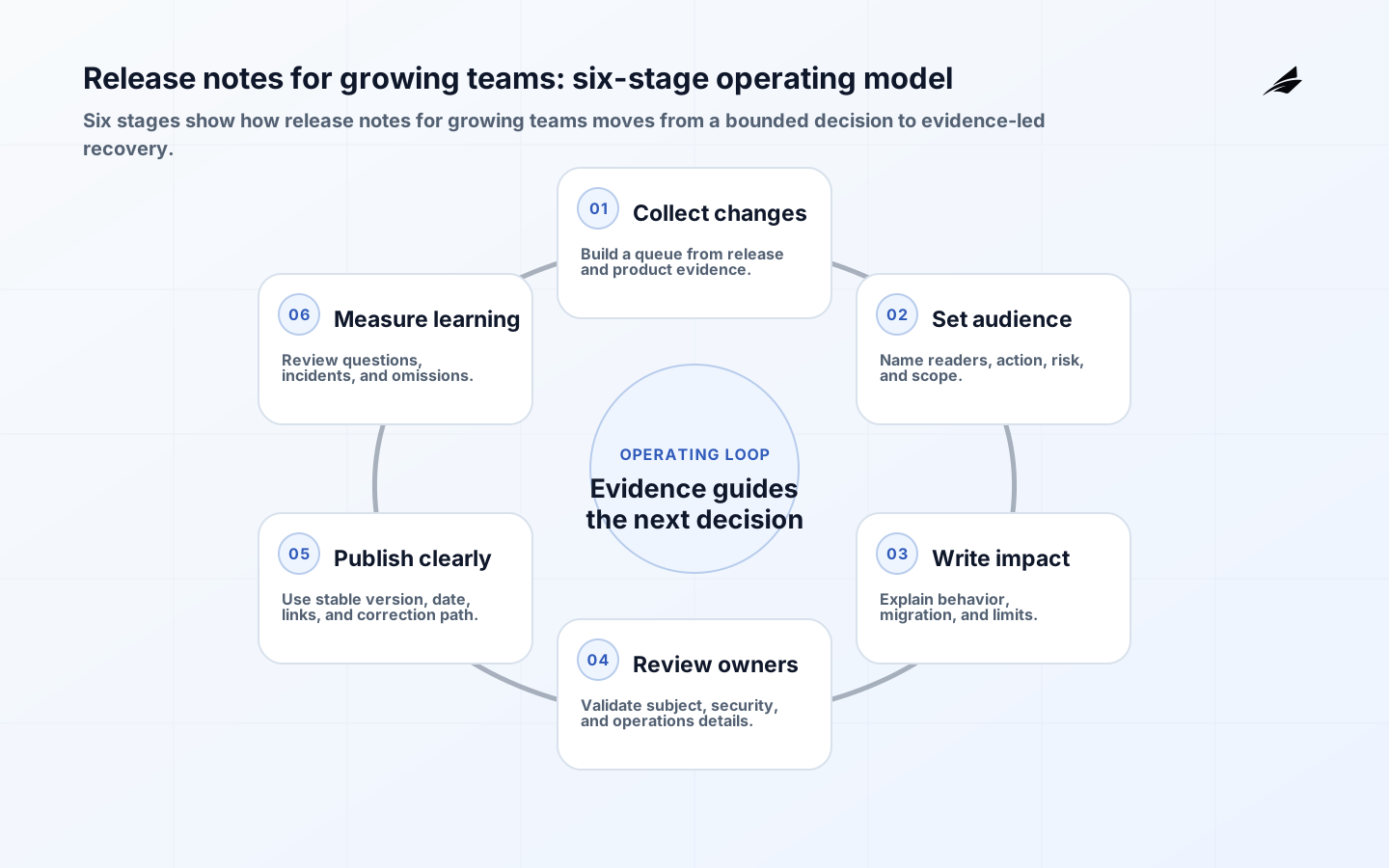
A growing team does not need longer release notes; it needs a reliable way to move from change evidence to useful explanation. Define the release boundary, collect source records, classify impact, write reader action, review risks, and publish with a stable version and date. The note should make it easy to answer whether a customer needs to migrate, whether an operator should change a runbook, and whether support should expect new questions. Keep internal detail available without letting it obscure the public decision.
Create a durable editorial change queue
Use release candidates, merged work, incident fixes, deprecations, and documentation changes as inputs to a queue. Track owner, audience, impact, evidence, draft status, and publication decision. A queue is valuable when it exposes omissions and stale drafts, not when it becomes another private spreadsheet. Set a clear handoff from engineer to product or support reviewer and preserve the reason an item was excluded.
Measure usefulness rather than publication volume
Count reader questions, support escalations, migration failures, corrections, and time from change to explanation. A short note that prevents a deployment mistake is more valuable than a long list of minor fixes. Review notes after incidents and link the missing explanation to a change in the template or review rule. Treat repeated confusion as evidence that the product behavior or documentation needs work, not merely that readers did not pay attention.
| Operating layer | What to keep | Owner |
|---|---|---|
| Input queue | Change, source, audience, impact, and evidence | Engineering or product coordinator |
| Editorial review | Action, risk, migration, and links | Product or documentation reviewer |
| Publication | Version, date, stable location, and correction route | Release owner |
| Feedback | Questions, incidents, omissions, and amendments | Support and product team |
Choose note depth from reader impact
Use impact to decide how much explanation is needed. Consistency matters more than forcing every release into the same length.
| Impact | Minimum content | Example |
|---|---|---|
| Low behavior impact | One clear sentence and link | Internal performance improvement with no user action |
| Visible behavior change | Before/after explanation | New workflow, default, or permission behavior |
| Migration required | Steps, boundary, deadline, and support route | API, schema, or configuration change |
| High-risk correction | Impact, affected versions, mitigation, and owner | Security or compatibility issue discovered after release |
Growing-team release-note practices to carry forward
- Turn change evidence into reader action, impact, migration, and ownership.
- Maintain a visible queue with source, audience, review, and exclusion reasons.
- Measure questions, corrections, and incidents to improve the system.
Review release notes with real readers
Sample a routine fix, customer-visible behavior change, migration, security notice, and post-publication correction with product, support, documentation, and engineering. Check what a reader can understand, what action is required, and whether the published evidence still matches the deployed behavior.

Growing-team release questions
How often should growing teams publish? Use a cadence that matches the product’s change rate and reader need. Publish when a meaningful change is ready, and consolidate minor internal changes when that improves comprehension.
Who owns final accuracy? Name one release owner for publication, while subject-matter owners validate behavior, migration, security, and operational details. Shared input still needs one accountable decision.
What should a release note include when there is no customer action? State what changed, who may notice it, what remains unchanged, and where to find technical or operational detail. “No action required” is useful only when the team has checked the impact.
Conclusion
Release notes for growing teams connects to release notes before the first build, billing workflows in production, and billing workflows for growing teams. These references help a growing team connect release-note quality to product change, billing effects, and the correction work readers experience.