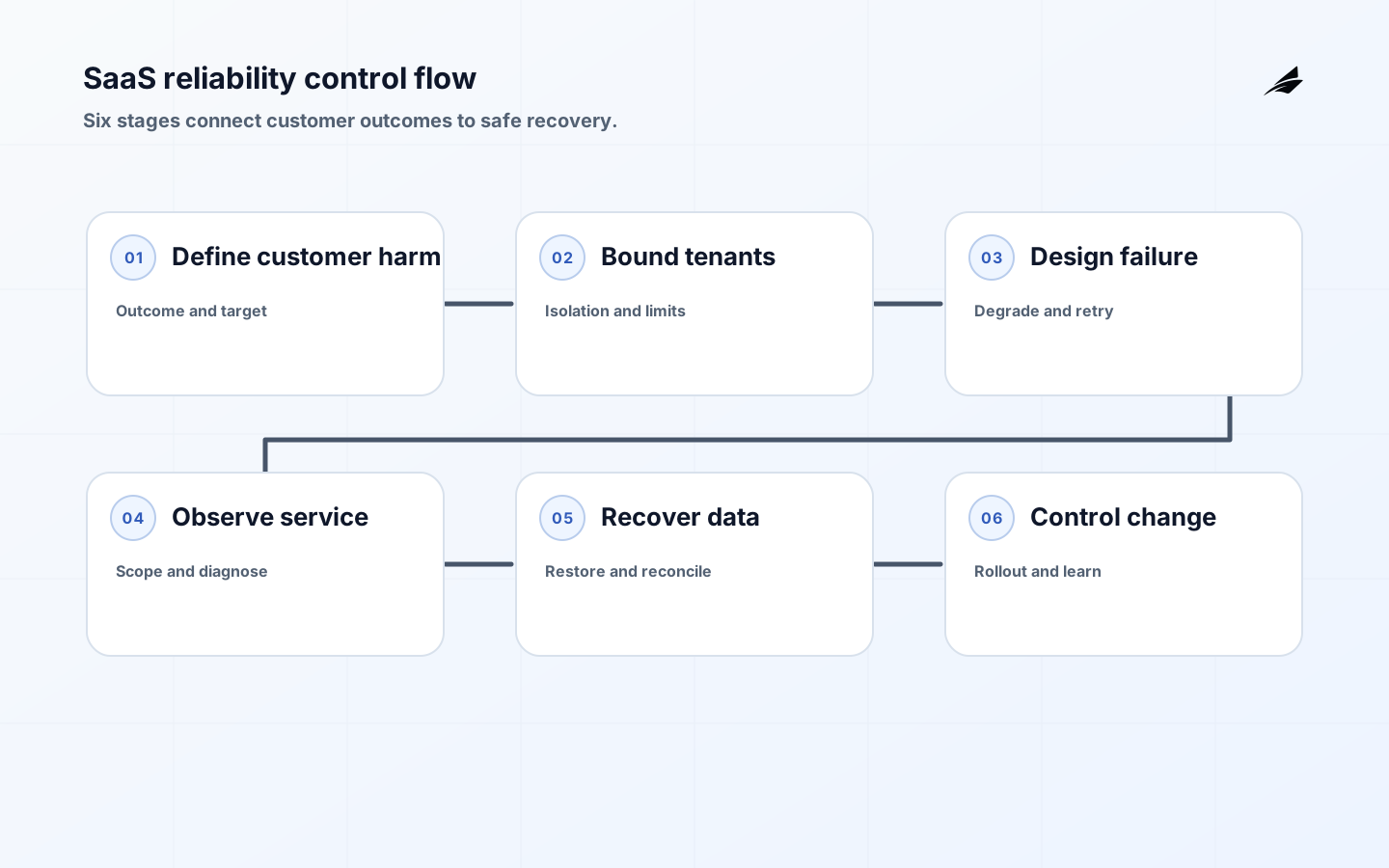
SaaS reliability decisions determine how a product keeps serving the customer’s important work, explains degraded behaviour, and recovers without losing trust. They do not promise that every request always succeeds. Before the first build, decide which customer outcomes matter, how tenants are isolated, what happens when dependencies fail, how data is recovered, and who owns the service at 02:00. The AWS SaaS Lens operational excellence guidance is a useful primary reference because it treats tenant-aware operations as part of the product model. Reliability decisions made early shape architecture, pricing, support, and customer communication.
Define the reliability promise
Start with customer journeys rather than infrastructure components. Name the workflow, acceptable latency, data-loss tolerance, recovery expectation, and communication obligation. A dashboard read, a billing action, and a long-running export do not need the same promise. Choose a small set of service objectives that map to customer harm: availability, freshness, completion time, error rate, or queue age. Define what counts as a valid measurement and which periods are excluded. Without a clear promise, teams optimise for whichever technical metric is easiest to collect and discover later that customers experienced a different failure.
| Customer outcome | Reliability decision | Evidence |
|---|---|---|
| Can sign in and work | Authentication dependency and fallback | Success, failure, and recovery rate |
| Can submit a business action | Idempotency and timeout | One outcome per request |
| Can retrieve current data | Freshness and stale state | Age and source health |
| Can recover from incident | Backup and restore target | Drill result and recovery time |
Model tenants and blast radius
Tenant isolation is both a security and reliability decision. Choose where tenant identity is enforced, how data is partitioned, how noisy neighbours are constrained, and what an operator may inspect during an incident. Decide whether a failure can affect one tenant, a region, or the whole service. Record tenant context in logs, metrics, traces, jobs, and support references without leaking customer data. The SaaS Lens helps frame shared services and tenant-aware operations; the product team still needs explicit limits for quotas, storage, queues, and expensive queries. A tenant boundary that exists only in a UI filter is not a dependable boundary.
Design failure behaviour
For every dependency, decide whether the product should fail closed, serve a cached result, queue the action, degrade a feature, or ask the user to retry. Show the state in plain language and preserve enough context to resume safely. A timeout is not proof that an external action failed. Stripe’s idempotent request guidance is a useful official reference for making retries safe, but idempotency needs a business scope, retention, and response policy. Include duplicate requests, late responses, partial completion, and a customer who closes the browser during the operation.
Make observability actionable
Collect the signals needed to answer who was affected, what changed, where the request stopped, and whether recovery worked. Use consistent names and attributes for request, tenant, user, feature, dependency, and release. OpenTelemetry trace semantic conventions provide a useful shared vocabulary for telemetry. Google SRE service-level objectives reinforce that visibility should support diagnosis against customer-relevant targets. Avoid collecting every payload by default. Choose logs, metrics, traces, and business events that support a decision, protect privacy, and can be retained at a sensible cost.
Connect the signals to a runbook. An alert should name the symptom, impact, owner, safe containment, evidence to preserve, escalation path, and recovery check. Link the design to what changes when customer feedback loops moves into production and customer feedback loop decisions before the first build because reliability is also a promise about how quickly the team learns from customer impact.
Plan data recovery
Backups are not a recovery plan until a team has restored them and verified the result. Define recovery point and recovery time targets per customer outcome, retention, encryption, access, and regional considerations. Decide how to handle deleted records, corrupt writes, schema changes, and a restore that creates duplicate downstream events. Reconcile business state after recovery rather than assuming infrastructure health means the product is correct. Capture restore evidence and update the runbook. A reliable SaaS product makes recovery a normal, permissioned operation that can be tested without inventing a crisis.
| Risk | Design control | Review signal |
|---|---|---|
| Noisy tenant | Quota, rate, and queue isolation | Per-tenant saturation |
| Retry creates duplicate effect | Idempotency and reconciliation | Duplicate outcome count |
| Alert lacks context | Tenant and dependency attributes | Time to scope impact |
| Restore leaves wrong state | Business reconciliation check | Post-restore discrepancy |
Control change and release
Reliability includes how the team changes the system. Define rollout scope, migration compatibility, feature-flag behaviour, rollback limits, and customer communication. Test a release with old clients, delayed jobs, partial migration, and a dependency at its limit. Do not call rollback safe when a schema or external side effect cannot be reversed. Record the release version on every operational signal and keep a clear owner for the decision to pause. The first build should include a change record, basic health gates, and a way to disable a risky path without taking the entire product offline.
Reliability review before the first tenant
Review reliability against the customer journeys that define the SaaS promise. Simulate a dependency timeout, duplicate write, noisy tenant, expired credential, partial migration, unavailable operator, and restore. For each case, explain the customer-visible state, the evidence the service records, the decision owner, and how recovery is verified. NIST incident-response recommendations provide a useful structure for rehearsing detection, response, and learning. Include support because a technically recovered service can still damage trust through unclear communication or unsafe manual work.
Keep the first service objective set small and review it after real traffic. A target that cannot be measured or linked to customer harm should not drive architecture. Use Customer Feedback Loops in Production: What Changes for Product Teams to capture the experience of degraded service and feed that evidence into reliability work. The objective is a service that can learn, not a dashboard that only reports green status.
- Trace one critical request across tenant, dependency, release, and outcome.
- Verify retries cannot create a second business effect.
- Restore a representative backup and reconcile business state.
- Test rollback limits and customer communication before launch.
Document the customer-facing meaning of each degraded state. “Delayed,” “read-only,” and “action pending” should lead to different support and recovery choices.
A service objective should have a consequence when it is missed: notify, degrade, pause a rollout, or review capacity. Without a response, the objective is descriptive rather than operational.
Keep the first reliability review grounded in a real customer story. Ask what the user was trying to finish, what evidence was lost, and what recovery would restore confidence. That story helps the team choose the right signal and the right investment.
The contract should name the person who can pause a risky change and the person who communicates impact to customers.
Have support rehearse the reliability contract before launch. If the team cannot explain the state or safe next step, the product still has an operational gap even when the service is technically healthy.
A reliability decision is useful only when its owner knows what action follows a missed target and how the customer impact will be explained.
Re-run the support rehearsal after a material change. If the team cannot explain the state or safe next step, infrastructure health has not yet become a dependable customer experience.
The reliability contract
Write the first service contract around one critical customer journey and include its degraded states. Define latency, freshness, error, recovery, and communication expectations in terms a support or product owner can use. Then trace the journey through tenant identity, dependencies, queues, storage, logs, and business outcome. If a technical signal cannot help someone choose a safe response, change the signal or the runbook.
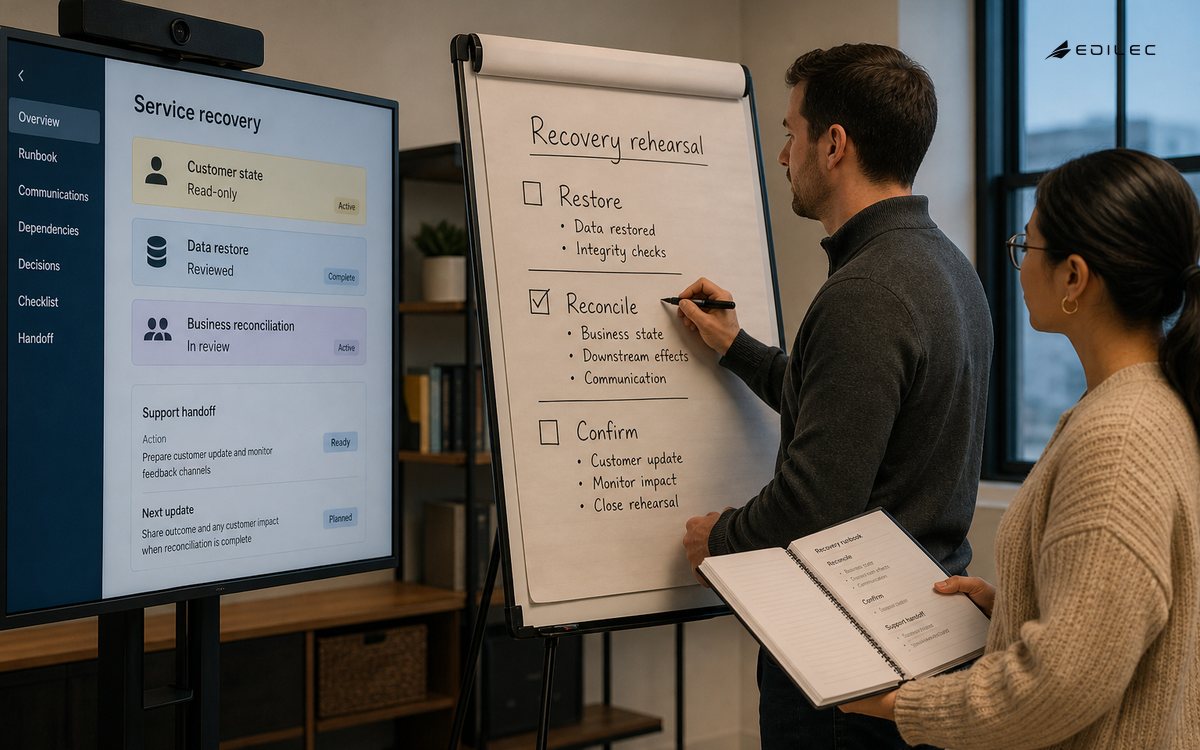
Test the contract with a dependency timeout, a duplicate request, a slow tenant, an old client, a partial migration, and a restore. Verify what the customer sees and what support can safely do. Link reliability learning to what changes when customer feedback loops moves into production and multi-tenant architecture decisions so degraded experiences become evidence for the next design decision.
- Set one owner and backup for each critical outcome.
- Record tenant and release context in operational signals.
- Make retries and recovery idempotent where effects matter.
- Reconcile business state after restoring data.
Operate with people and support
On-call ownership, support escalation, customer communication, and post-incident learning are product design. Name the service owner, backup, decision authority, and customer communicator. Define what support can safely retry or replay. Review incidents for both technical cause and confusing customer experience. Track time to detect, time to acknowledge, time to contain, time to restore, repeated incidents, unresolved follow-ups, and affected tenant count. A small service with an honest runbook is more reliable than a larger service whose operators need the original developer to explain every alert.
Key takeaways
- Define reliability around customer outcomes and harm.
- Make tenant isolation and blast radius explicit.
- Design timeouts, retries, queues, and degraded states before implementation.
- Instrument signals that help scope, diagnose, and verify recovery.
- Test restore and change paths with the people who will operate them.
Frequently asked questions
How many service objectives should a new SaaS product have?
Start with the few customer outcomes that would cause real harm if they failed: access, critical writes, data freshness, or recovery. A short set with owners is more useful than a catalogue nobody reviews.
Is tenant isolation only a security concern?
No. Isolation limits noisy-neighbour effects, clarifies incident scope, supports safer support access, and helps the team communicate impact accurately.
What proves backups are reliable?
A documented and repeated restore that meets the relevant recovery target, followed by business-level reconciliation. Backup existence alone is not proof of usable recovery.
Conclusion
SaaS reliability begins with explicit choices about customer harm, tenant boundaries, failure states, recovery, observability, and human ownership. Make those choices testable before the first build, then operate them as part of the product rather than as a separate promise.